
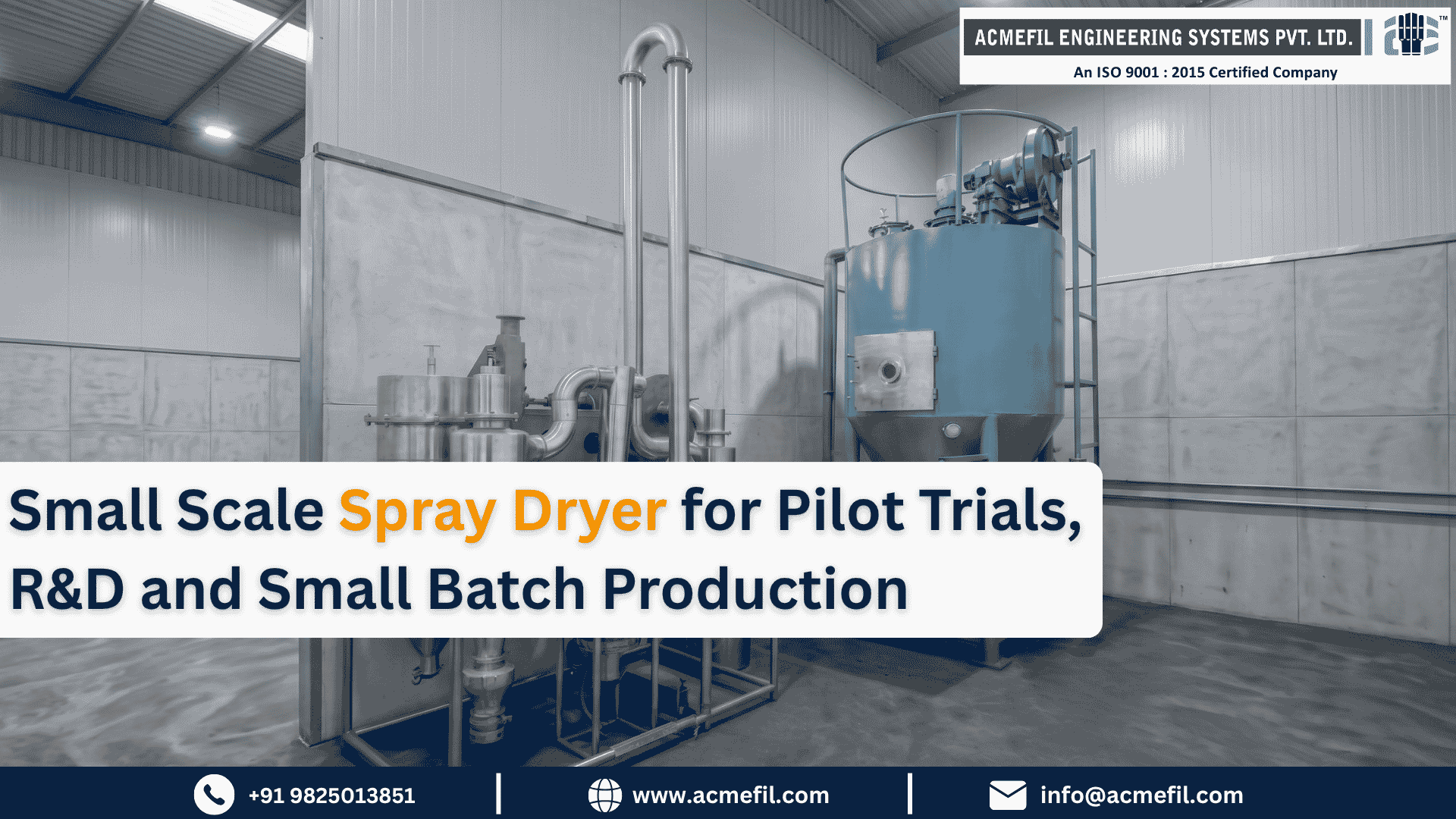
A small scale spray dryer is used when you need to convert a liquid feed, slurry, solution, suspension, or emulsion into dry powder without committing directly to a full-size industrial spray drying plant.
For manufacturers, R&D teams, and process development teams, the right small-scale spray dryer helps test product feasibility, optimize drying parameters, produce trial batches, and prepare for commercial scale-up. The best choice depends on your feed material, evaporation load, target powder quality, heat sensitivity, operating hours, available space, and future production plan.
Acmefil Engineering Systems Pvt. Ltd. supports spray drying requirements for laboratory, pilot, and industrial applications, including customized systems designed around capacity, temperature, particle size, material compatibility, and process needs. Acmefil’s spray dryer page already highlights laboratory spray dryers for R&D, pilot trials, product testing, and compact operation.
What Is a Small Scale Spray Dryer?
A small scale spray dryer is a compact spray drying system designed for lower-volume production, R&D, pilot plant trials, product testing, and small commercial batches.
The basic process is the same as industrial spray drying:
- The liquid feed is atomized into fine droplets.
- The droplets come into contact with hot drying air.
- Moisture evaporates rapidly.
- Dry powder is separated and collected through a cyclone, bag filter, or other recovery system.
Small-scale systems are especially useful when the manufacturer wants to test product behavior before investing in a larger plant.
When Should You Use a Small Scale Spray Dryer?
A small scale spray dryer is suitable when:
| Requirement | Why It Matters |
|---|---|
| R&D testing | Helps evaluate whether spray drying is suitable for the product. |
| Pilot trials | Allows process validation before full-scale investment. |
| Small batch production | Useful for limited-volume, high-value, or specialty products. |
| Product development | Helps test feed formulation, temperature range, atomization method, and powder quality. |
| Scale-up planning | Helps collect process data before moving to larger industrial spray dryers. |
| Heat-sensitive material drying | Allows controlled drying parameters for sensitive products. |
Small-scale spray dryers are commonly used in food, pharmaceutical, chemical, ceramic, pigment, dairy, nutraceutical, and specialty powder applications.
Best Spray Dryer Types for Small-Scale Production
1. Mini Spray Dryer
A mini spray dryer is usually selected for laboratory testing, early product development, and low-volume powder samples.
Best for:
R&D labs, academic testing, formulation trials, sample production.
Buyer advantage:
Compact size, lower feed requirement, easier testing, and faster trial cycles.
Limitation:
It may not represent commercial production behavior perfectly if the process needs larger-scale airflow, atomization, or residence time validation.
2. Laboratory Spray Dryer
A laboratory spray dryer is used when the buyer needs more control over drying conditions while still working at a compact scale.
Best for:
Product testing, feasibility studies, heat-sensitive products, and controlled R&D work.
Buyer advantage:
Useful for evaluating inlet temperature, outlet temperature, feed rate, atomization behavior, and powder characteristics.
Acmefil mentions laboratory spray dryers for precise control, compact design, pilot trials, and product testing.
3. Pilot Spray Dryer
A pilot spray dryer is the right choice when the buyer wants to move beyond lab testing and validate the process closer to real production.
Best for:
Pilot plants, product scale-up, trial batches, process optimization, and pre-commercial validation.
Buyer advantage:
It helps reduce scale-up risk by testing drying behavior, powder recovery, cleaning needs, energy requirements, and product consistency before investing in a full industrial system.
Acmefil’s spray dryer page describes pilot trial plants as a practical solution for testing and optimizing the drying process before full-scale production.
4. Custom Small-Scale Spray Dryer
A custom small-scale spray dryer is recommended when standard mini or lab systems are not suitable for the product, application, or future scale-up plan.
Best for:
Specialty chemicals, food ingredients, pharmaceutical intermediates, ceramics, pigments, heat-sensitive materials, and difficult feed formulations.
Buyer advantage:
The system can be designed around required capacity, atomization method, material of construction, temperature profile, powder recovery, cleaning needs, safety, and future expansion.
Acmefil states that its systems can be tailored around capacity, temperature, particle size requirements, flexible operating parameters, and feed material needs.
Mini vs Laboratory vs Pilot Spray Dryer: Which One Should You Choose?
| Spray Dryer Type | Best Use | Typical Buyer | Key Selection Factor |
|---|---|---|---|
| Mini spray dryer | Initial testing and small samples | R&D lab or university | Low sample volume and quick trials |
| Laboratory spray dryer | Controlled product development | R&D team or technical lab | Parameter control and repeatability |
| Pilot spray dryer | Scale-up and pre-commercial trials | Manufacturer or process team | Process validation and production confidence |
| Custom small-scale spray dryer | Specialized product or difficult application | Industrial buyer | Feed behavior, safety, recovery, cleaning, and future scale-up |
Best recommendation:
Do not choose only by machine size. Choose by the product’s drying behavior, required powder quality, feed characteristics, operating hours, and future production target.
Key Engineering Factors Before Buying a Small Scale Spray Dryer
1. Feed Material Characteristics
Check whether the feed is a solution, slurry, suspension, emulsion, or paste-like material. Viscosity, solids percentage, stickiness, heat sensitivity, and corrosiveness affect spray dryer design.
2. Required Evaporation Capacity
Capacity should be selected based on water evaporation load, not only feed volume. A small production requirement may still need a stronger system if the feed has high moisture content.
3. Atomization Method
Atomization affects droplet size, drying rate, particle size, and powder quality. Common options include:
- Rotary atomizer
- Two-fluid nozzle
- High-pressure nozzle
AVM’s pilot spray dryer page also highlights rotary disc atomizers, two-fluid nozzles, and high-pressure nozzles as feed liquid atomization options, showing that atomization is a major buyer consideration in this category.
4. Temperature Control
Temperature control is critical when drying heat-sensitive products. Buyers should check inlet temperature, outlet temperature, airflow control, and product degradation risk.
5. Material of Construction
Material selection depends on hygiene, corrosion resistance, product contact safety, and industry requirements. Stainless steel options are commonly used in industrial spray dryer systems.
6. Powder Recovery System
Powder collection may involve cyclone separators, bag filters, or other recovery systems. Recovery design affects yield, cleanliness, emission control, and product loss.
7. Cleaning and Maintenance
Small-scale production often involves frequent product changes. Easy cleaning, inspection access, and maintenance support are important for reducing downtime.
8. Scale-Up Path
The selected dryer should help generate useful process data for future industrial-scale production. This is especially important for buyers planning to move from R&D to commercial manufacturing.
Applications of Small Scale Spray Dryers
Small-scale spray dryers can support product development and production in:
- Food ingredients and flavors
- Dairy powders
- Herbal and nutraceutical powders
- Pharmaceutical intermediates
- Chemical powders
- Ceramic materials
- Pigments and dyes
- Specialty polymers
- Enzymes and heat-sensitive products
- Pilot plant and contract manufacturing trials
Acmefil’s spray dryer content mentions food processing, pharmaceuticals, and chemical industries as common spray dryer application areas.
Why Choose Acmefil for Small Scale Spray Dryer Requirements?
Acmefil is suitable for buyers who need more than a standard machine. The company’s spray dryer content highlights customized designs, adjustable operating parameters, consulting support, AMC, training, maintenance, installation support, and troubleshooting.
For small-scale and pilot spray drying, this matters because buyers usually need help with:
- selecting the right dryer type
- validating product feasibility
- choosing atomization method
- defining capacity and temperature range
- planning future scale-up
- reducing process risk before industrial investment
- maintaining consistent powder quality
- receiving support after installation
Questions to Ask Before Requesting a Spray Dryer Quote
Before requesting a quote, prepare these details:
- What material do you want to dry?
- Is the feed a solution, slurry, suspension, or emulsion?
- What is the feed solids percentage?
- What is the expected feed rate or evaporation load?
- Is the product heat-sensitive, sticky, corrosive, or hygroscopic?
- What powder moisture level is required?
- What particle size or bulk density is expected?
- Is the application for R&D, pilot trial, or small production?
- Will the system need future scale-up?
- Are there hygiene, safety, solvent, or industry-specific requirements?
FAQs
What is the best spray dryer for small-scale production?
The best spray dryer depends on your material, required capacity, target powder quality, and future scale-up plan. A mini or laboratory spray dryer is suitable for early testing, while a pilot spray dryer is better for process validation and small commercial batches.
Is a pilot spray dryer better than a mini spray dryer?
A pilot spray dryer is better when the goal is scale-up, production trials, or process validation. A mini spray dryer is better for low-volume R&D testing and initial formulation work.
Which industries use small-scale spray dryers?
Small-scale spray dryers are used in food, pharmaceuticals, chemicals, dairy, nutraceuticals, pigments, ceramics, polymers, and specialty powder manufacturing.
What information is needed to design a small-scale spray dryer?
Important inputs include feed type, solids percentage, viscosity, heat sensitivity, evaporation load, powder moisture target, atomization preference, material of construction, cleaning needs, and future production target.
Can a small-scale spray dryer help before investing in a large spray dryer?
Yes. A small-scale or pilot spray dryer can help test drying behavior, optimize process parameters, and reduce risk before investing in a full-scale industrial spray drying plant.
Need help selecting the right small-scale spray dryer?
Contact Acmefil Engineering Systems Pvt. Ltd. to discuss your product, pilot trial requirement, production capacity, and future scale-up plan. The team can help evaluate whether a laboratory, pilot, or customized spray dryer is suitable for your application.

Siddharth Nair is Technical Director at Acmefil Engineering Systems Pvt. Ltd. he leads solution design and applications engineering across the company’s full product range — spray dryers, multi-effect evaporators, agitated thin film dryers, spin flash dryers, fluid bed dryers, and complete ZLD systems.
His work spans process evaluation, equipment sizing, customer application consulting, and technical proposal development for industries including food and dairy, pharmaceuticals, chemicals, dyestuffs, ceramics, and industrial effluent treatment. He has hands-on commissioning experience across Acmefil’s 500+ installations in India and 15+ countries.
He holds a BTech in Mechanical Engineering from CHARUSAT University and also partners at A.S Engineers, working with blowers, sludge dryers, and industrial conveying systems.


