
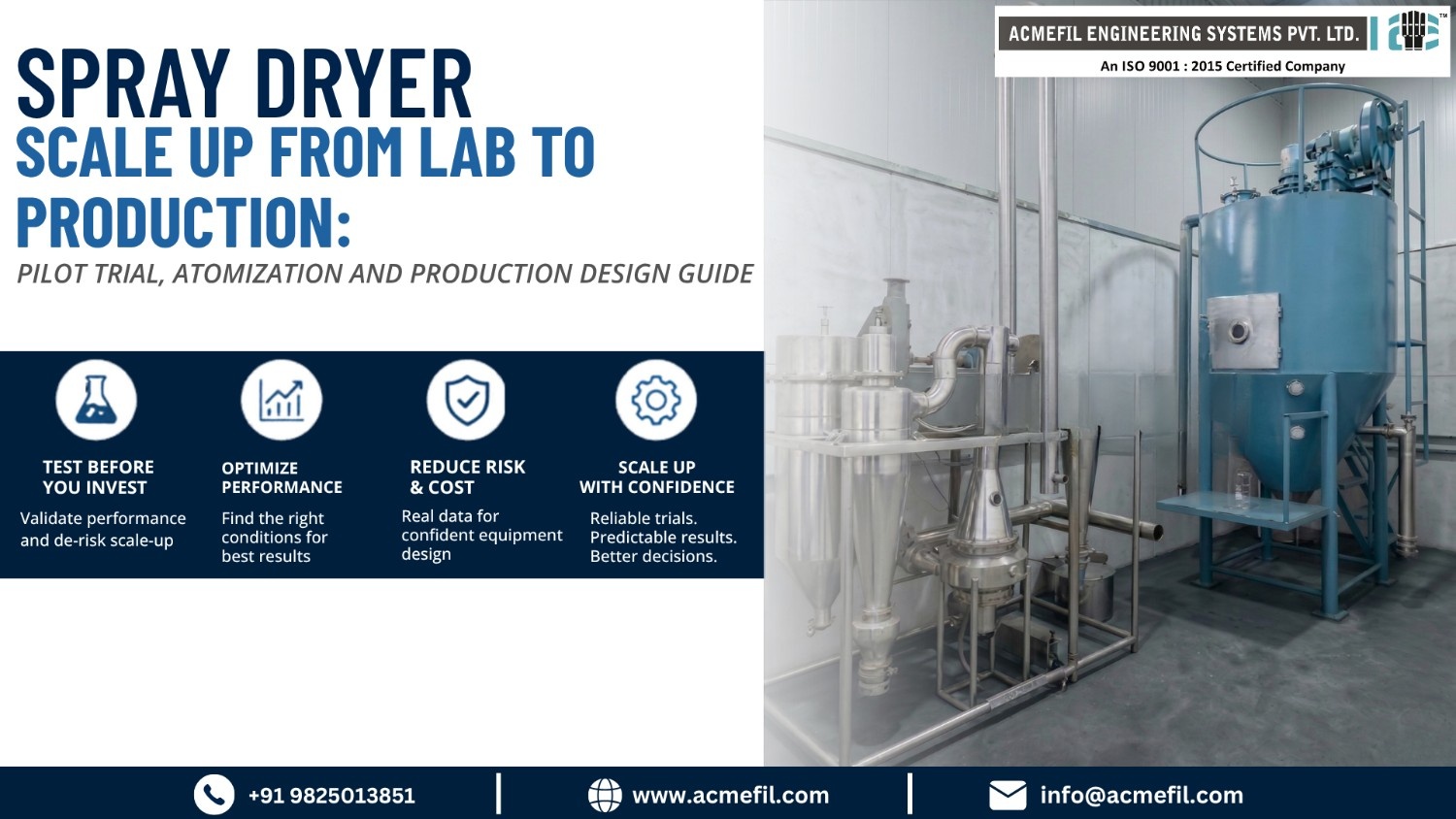
Spray dryer scale up from lab to production is not a simple capacity multiplication. A successful lab powder does not automatically become a reliable full-scale drying plant. The real job is to preserve the powder quality targets, such as final moisture, particle size distribution, bulk density, solubility, flowability and yield, while redesigning atomization, air flow, chamber size, residence time and powder recovery for production duty.
In my view, the safest scale-up route is pilot-trial-first. The feed tells you more than the catalogue. A product that behaves well in a small glass chamber may become sticky, dusty, coarse, heat-damaged or low-yielding when the same assumptions are taken directly to production.
For buyers evaluating a new plant, start with a controlled pilot scale spray dryer trial before finalizing the full-scale dryer design.
What Does Spray Dryer Scale Up Mean?
Spray dryer scale up means converting a lab or pilot spray drying result into a production dryer design that can run continuously at the required evaporation load and powder specification.
A lab dryer proves basic feasibility. It answers questions like:
- Can this liquid, slurry, emulsion or suspension be spray dried?
- Does the powder form without severe sticking?
- What inlet and outlet temperature range gives acceptable moisture?
- Does the product degrade under heat exposure?
- What particle size and flowability are possible?
A production spray dryer must answer a larger set of questions:
- How many kilograms of water must be evaporated per hour?
- Which atomizer can handle the feed viscosity, solids and target particle size?
- What chamber diameter and height are needed for droplet drying?
- What air flow and hot air generator capacity are required?
- How will powder be separated, cooled, discharged and collected?
- How will deposits, wall build-up, hygiene, safety and cleaning be managed?
- What controls are required for stable long-duration operation?
That is why lab-to-production scale up is an engineering exercise, not only a trial result.
Why Lab Spray Drying Results Often Fail at Production Scale
A lab spray dryer works with very small feed quantities, short trial duration and limited chamber volume. Production drying changes the physical environment.
The common failures I watch for are:
- Particle size changes after scale up
Matching only the lab atomizer setting rarely guarantees the same production powder. Droplet formation, chamber residence time, airflow pattern and solids loading all affect the final particle. - Powder sticks to the chamber wall
Sticky products may pass a short lab test but create wall deposits in longer production runs. This is common in sugar-rich food extracts, herbal extracts, polymers and some chemical slurries. - Moisture becomes inconsistent
Outlet temperature, feed rate, feed solids and air flow must remain stable. If any one of these shifts, powder moisture shifts. - Yield drops due to poor recovery
Powder collection depends on cyclone separator, bag filter and air flow design. A production plant must be designed for recovery, not only drying. - Feed behavior changes in a larger batch
Viscosity, sedimentation, pH, solids suspension and temperature can change during storage or continuous feeding. A good scale-up plan includes feed tank agitation and feed handling. - Atomizer selection becomes wrong
The atomizer that works in the lab may not be the best production choice. A rotary atomizer, pressure nozzle and two-fluid nozzle do not scale in the same way.
For a deeper background on dryer configuration, see this guide on spray dryer design and components.
Lab Scale vs Pilot Scale vs Production Scale Spray Dryer
| Stage | Main Purpose | What It Proves | What It Does Not Fully Prove |
|---|---|---|---|
| Lab scale spray dryer | Feasibility screening | Whether the product can form powder | Production yield, long-run stability, chamber build-up |
| Pilot scale spray dryer | Process development and scale-up data | Feed behavior, atomization, moisture trend, powder recovery, operating window | Final full-scale mechanical design |
| Production spray dryer | Commercial manufacturing | Continuous evaporation capacity, final powder specification, reliable recovery | It should not be the first place where process assumptions are tested |
A lab dryer is useful, but a pilot dryer is where the scale-up risk starts reducing. At Acmefil, the available pilot spray dryer capacity is 3 kg/hr water evaporation, which is suitable for process development, R&D trials and pre-production evaluation.
Key Parameters for Spray Dryer Scale Up from Lab to Production
A good scale-up study should not focus on one parameter. It should build a full operating window.
| Parameter | Why It Matters in Scale Up | What to Check Before Production |
|---|---|---|
| Feed solids | Higher solids reduce evaporation load but can increase viscosity and droplet size | Solids percentage, pumpability, settling, nozzle/atomizer limit |
| Feed viscosity | Affects atomization, droplet size and feed pumping | Viscosity at actual feed temperature and solids concentration |
| Feed temperature | Changes viscosity and drying behavior | Whether preheating helps or damages the product |
| Atomizer type | Controls droplet formation and particle size direction | Rotary atomizer vs pressure nozzle vs two-fluid nozzle |
| Atomizer speed or pressure | Changes droplet size and spray pattern | Target particle size, wall deposition, powder recovery |
| Inlet temperature | Provides drying energy | Product heat sensitivity and evaporation load |
| Outlet temperature | Strong indicator of final moisture and thermal exposure | Moisture target and product stability |
| Air flow | Carries heat and powder through the dryer | Residence time, chamber loading and cyclone/bag filter load |
| Residence time | Controls drying completion | Chamber height, diameter and airflow path |
| Powder separation | Determines yield and dust control | Cyclone, bag filter, discharge valve and fines handling |
| Cleaning requirement | Affects uptime and hygiene | CIP need, access doors, sanitary design, product changeover |
Atomizer Speed and Particle Size During Scale Up
Atomizer scale up is one of the most important parts of spray dryer scale up from lab to production.
In a rotary atomizer, the feed reaches a high-speed rotating disc. Centrifugal force spreads the liquid outward and breaks it into droplets. In general, higher disc speed tends to produce smaller droplets, but speed is not the only variable. Disc diameter, feed rate, feed solids, viscosity, surface tension and chamber airflow also affect the final powder.
For this reason, the production target should not be “copy the lab RPM.” The target should be:
- match the required powder particle size distribution
- maintain stable atomization at production feed rate
- avoid large droplets hitting the chamber wall
- prevent excessive fines if the powder becomes too small
- balance moisture, yield and flowability
ACMEFIL’s rotary disc type spray dryers use high-speed centrifugal disc atomization and are used where droplet size control is important, especially for slurries and applications such as dyes, ceramics, food, pharmaceuticals, detergents, pigments and inorganic chemicals.
If the powder needs a different particle structure, a nozzle atomizer type spray dryer may be considered. Pressure nozzles use feed pressure through an orifice. Two-fluid nozzles use compressed air for atomization and are often evaluated for finer particle requirements or smaller trial batches.
For comparison, read this supporting article on nozzle vs rotary atomizer spray dryers.
How to Build a Practical Spray Dryer Scale-Up Plan
Step 1: Define the Production Powder Specification
Do not begin with dryer size. Begin with the powder.
The production specification should include:
- final moisture percentage
- particle size distribution
- bulk density
- solubility or dispersibility
- powder flowability
- colour or active ingredient stability, where relevant
- residual solvent, if the feed is solvent-based
- microbial or hygiene requirements, where relevant
- expected production capacity
- acceptable yield and powder loss
For example, a milk powder, ceramic slurry, dyestuff, polymer resin and herbal extract cannot be scaled with the same logic. Their stickiness, solids, heat sensitivity and particle requirements are different.
Step 2: Characterize the Feed Properly
Many scale-up problems start before the feed enters the dryer.
A proper feed data sheet should include:
| Feed Data | Why It Matters |
|---|---|
| Total solids | Determines water evaporation load |
| Viscosity | Affects pumping and atomization |
| Density | Used for feed rate and process calculations |
| pH | Can affect stability and material compatibility |
| Particle suspension | Important for slurries and abrasive materials |
| Heat sensitivity | Controls inlet/outlet temperature selection |
| Stickiness tendency | Affects wall deposition risk |
| Solvent or water base | Decides open cycle vs closed loop system |
| Sedimentation behavior | Decides tank agitation and feed preparation |
| Required filtration | Prevents nozzle choking and atomizer issues |
A feed that is not characterized properly forces the production plant to solve problems that should have been solved during pilot work.
Step 3: Run Pilot Trials at Realistic Feed Conditions
A pilot trial should use feed that represents the real production material. If the lab sample is cleaner, thinner or more stable than the actual plant feed, the scale-up result becomes weak.
During pilot testing, record:
- feed solids and viscosity
- feed temperature
- feed rate
- atomizer type and setting
- inlet temperature
- outlet temperature
- drying air flow, where available
- powder moisture
- particle size
- chamber deposit tendency
- cyclone and bag filter recovery
- product colour, smell or degradation signs
- discharge behavior
- cleaning requirement after trial
This is where spray dryer operating principles and best practices become practical, because the same dryer can produce different results when feed rate, outlet temperature and atomization are changed.
Step 4: Convert Pilot Data into Evaporation Load
Production sizing should be based on water evaporation, not only feed litres per hour.
The basic logic is:
Water to evaporate = water entering with feed minus water allowed in final powder
A plant handling 1000 kg/hr feed at 30% solids does not have the same drying load as a plant handling 1000 kg/hr feed at 50% solids. The feed rate may look the same, but the evaporation duty is different.
This affects:
- hot air generator size
- air flow requirement
- drying chamber size
- atomizer loading
- cyclone and bag filter load
- fuel or utility consumption
- production cost per kg powder
For buyers comparing quotations, always ask whether the vendor has sized the plant on feed rate alone or on evaporation load plus product specification.
Step 5: Select the Right Spray Dryer Type
Not every product needs the same spray dryer configuration.
| Product Requirement | Dryer Direction to Evaluate |
|---|---|
| Fine powder from slurry | Rotary atomizer spray dryer |
| Very fine powder or small trial batches | Two-fluid nozzle spray dryer |
| Pressure-based atomization with defined spray pattern | Pressure nozzle spray dryer |
| Larger particles or agglomerated powder | Fluidized spray dryer |
| Solvent-based feed | Closed loop spray dryer |
| Sterile pharmaceutical powder | Sterile spray dryer with suitable filtration and hygienic design |
| R&D or product development | Lab scale or pilot scale spray dryer |
For larger particles, a fluidized spray dryer can be evaluated because it supports particle growth through integrated or external fluid bed arrangements.
For solvent-based or oxygen-sensitive products, the dryer selection must consider closed loop operation. A standard open-cycle dryer should not be assumed suitable without reviewing solvent, flammability, recovery and safety requirements.
Step 6: Scale Chamber Size and Residence Time
A larger chamber changes droplet movement.
The chamber must give droplets enough time to dry before they reach the wall or discharge point. If the chamber is undersized, the plant may face wet powder, wall deposits or unstable moisture. If it is oversized without proper airflow, cost rises and powder may still not behave correctly.
Production design should consider:
- droplet size range from the selected atomizer
- evaporation rate
- inlet and outlet temperature profile
- air distribution
- co-current or mixed flow pattern
- wall deposition risk
- expected powder residence time
- powder discharge system
- chamber cleaning access
This is why drying chamber sizing cannot be separated from atomization. Large droplets need more drying time. Fine droplets dry faster but may create dustier powder and higher load on powder recovery.
Step 7: Design Powder Recovery, Not Only Drying
A spray dryer is not only a chamber and atomizer. The production plant must recover powder consistently.
A typical production line may include:
- feed tank with agitation
- feed pump
- atomizer or nozzle system
- hot air generator
- drying chamber
- cyclone separator
- bag filter
- air lock rotary valve
- exhaust system
- control panel
- powder collection and packing arrangement
Poor powder recovery can make a technically successful drying process commercially weak. If fine powder escapes the cyclone or overloads the bag filter, yield, housekeeping and emissions become problems.
For supporting knowledge, see spray dryer troubleshooting common issues.
Step 8: Validate the Production Design Before Final Order
Before ordering a full-scale spray dryer, the buyer should ask for a technical review of:
| Review Point | Question to Ask |
|---|---|
| Feed basis | Is the design based on actual feed data or assumed data? |
| Evaporation basis | What kg/hr water evaporation is the dryer designed for? |
| Atomizer basis | Why is this atomizer selected for this feed and particle size? |
| Temperature basis | What inlet and outlet temperature range is expected? |
| Chamber basis | How is drying residence time considered? |
| Recovery basis | What cyclone and bag filter arrangement is selected? |
| Material of construction | Is it suitable for product, hygiene, corrosion or abrasion? |
| Cleaning basis | How will deposits and product changeover be handled? |
| Control basis | Which parameters are controlled during production? |
| Trial basis | What pilot data supports the design? |
This review is more useful than asking only for “spray dryer price.” A cheaper dryer that cannot maintain powder quality becomes expensive after installation.
Common Mistakes in Spray Dryer Scale Up
Mistake 1: Scaling Only by Feed Rate
Feed rate is incomplete. A 500 kg/hr feed with low solids may require more evaporation than a higher solids feed at the same flow rate. Always size by evaporation duty and powder target.
Mistake 2: Copying Lab Temperature Settings Blindly
Lab inlet and outlet temperatures are useful starting points. They are not final production guarantees. Airflow, chamber geometry and feed rate change at larger scale.
Mistake 3: Ignoring Feed Viscosity
Viscosity can increase with solids concentration, temperature change or holding time. This affects pump selection, atomization and droplet size.
Mistake 4: Treating Particle Size as Only an Atomizer Issue
Atomization is central, but final particle size also depends on feed solids, droplet drying, agglomeration, fines recycling and powder recovery.
Mistake 5: Not Checking Wall Deposition
Wall build-up may not appear in a short lab trial. It often appears during longer pilot or production operation. A proper pilot trial should record chamber deposits after the run.
Mistake 6: Selecting the Vendor Before the Process Is Understood
A vendor should not only sell a dryer model. They should help evaluate feed behavior, operating window, atomizer selection and scale-up risk.
What Data Should You Share for a Production Spray Dryer RFQ?
For a serious technical quote, share this information:
- product name and industry
- liquid, slurry, emulsion or suspension type
- feed solids percentage
- feed viscosity at operating temperature
- feed pH and density
- required dry powder moisture
- target particle size
- required bulk density, if important
- heat sensitivity
- stickiness or hygroscopic behavior
- solvent or water-based feed
- required feed rate or powder output
- batch or continuous operation
- available utilities and fuel
- space and layout limits
- hygiene, GMP or cleanability requirements, if applicable
- pilot trial requirement
- country of installation and project timeline
When this data is missing, the quotation becomes assumption-heavy. That is where scale-up problems begin.
When Should You Run a Pilot Trial Before Production?
A pilot trial is strongly recommended when:
- the product is new or not previously spray dried
- the feed is sticky, viscous or slurry-based
- the powder moisture target is tight
- particle size is commercially important
- the product is heat-sensitive
- the feed contains suspended solids
- the product is expensive and yield loss matters
- the buyer is comparing rotary atomizer and nozzle options
- production investment is high
- the plant must run continuously, not only batch trials
For early-stage work, this guide on spray dryer for small-scale production can support the trial planning stage.
Practical Scale-Up Checklist
Before moving from lab to production, confirm these points:
| Checklist Item | Status |
|---|---|
| Powder specification is defined | Required |
| Feed solids and viscosity are measured | Required |
| Lab trial result is documented | Required |
| Pilot trial is completed with representative feed | Strongly recommended |
| Atomizer type is justified | Required |
| Evaporation load is calculated | Required |
| Inlet and outlet temperature window is defined | Required |
| Chamber deposit behavior is reviewed | Required |
| Cyclone and bag filter recovery are considered | Required |
| Cleaning and maintenance access are planned | Required |
| Utilities and hot air generator duty are reviewed | Required |
| Production control philosophy is discussed | Required |
| Vendor has reviewed full process data | Required |
Final Takeaway
Spray dryer scale up from lab to production should be treated as a controlled engineering path: lab feasibility, pilot validation, process window development and then production design. The biggest mistake is assuming that a powder made once in the lab will behave the same inside a full-scale drying chamber.
If your powder quality matters, define the product target first. Then validate feed behavior, atomization, evaporation load, chamber design and powder recovery. That is how you reduce scale-up risk before investing in the production plant.
FAQs
Can I directly scale a lab spray dryer result to production?
No, not safely. A lab result proves feasibility, but production scale changes airflow, residence time, chamber geometry, atomizer loading and powder recovery. Use lab data as a starting point, then validate the process through pilot trials and engineering calculations.
Which parameter is most important in spray dryer scale up?
There is no single parameter. Feed solids, viscosity, atomizer type, droplet size, inlet temperature, outlet temperature, air flow, residence time and powder recovery all interact. If one is ignored, the production plant may fail to meet moisture, particle size or yield targets.
Does atomizer speed control particle size?
In a rotary atomizer, atomizer speed strongly influences droplet size, and droplet size influences final particle size. But speed alone is not enough. Feed rate, viscosity, solids, disc design and chamber airflow also affect the final powder.
What is the role of a pilot spray dryer in scale up?
A pilot spray dryer helps validate feed behavior, atomization, drying temperature window, powder moisture, particle size, wall deposition and recovery before committing to a full-scale plant. It reduces the risk of designing production equipment from lab data alone.
What should I share with a spray dryer manufacturer for scale up?
Share feed solids, viscosity, density, pH, heat sensitivity, target moisture, particle size requirement, powder output, feed rate, solvent or water base, stickiness behavior, utilities, installation location and trial requirement. The more complete the data, the more reliable the design.
Planning to move from lab spray drying to production? Share your feed details, target powder specification and required capacity with Acmefil’s technical team. We can review the process data, recommend the right atomization route and guide whether a pilot spray dryer trial is required before full-scale plant design.

Siddharth Nair is Technical Director at Acmefil Engineering Systems Pvt. Ltd. he leads solution design and applications engineering across the company’s full product range — spray dryers, multi-effect evaporators, agitated thin film dryers, spin flash dryers, fluid bed dryers, and complete ZLD systems.
His work spans process evaluation, equipment sizing, customer application consulting, and technical proposal development for industries including food and dairy, pharmaceuticals, chemicals, dyestuffs, ceramics, and industrial effluent treatment. He has hands-on commissioning experience across Acmefil’s 500+ installations in India and 15+ countries.
He holds a BTech in Mechanical Engineering from CHARUSAT University and also partners at A.S Engineers, working with blowers, sludge dryers, and industrial conveying systems.


