
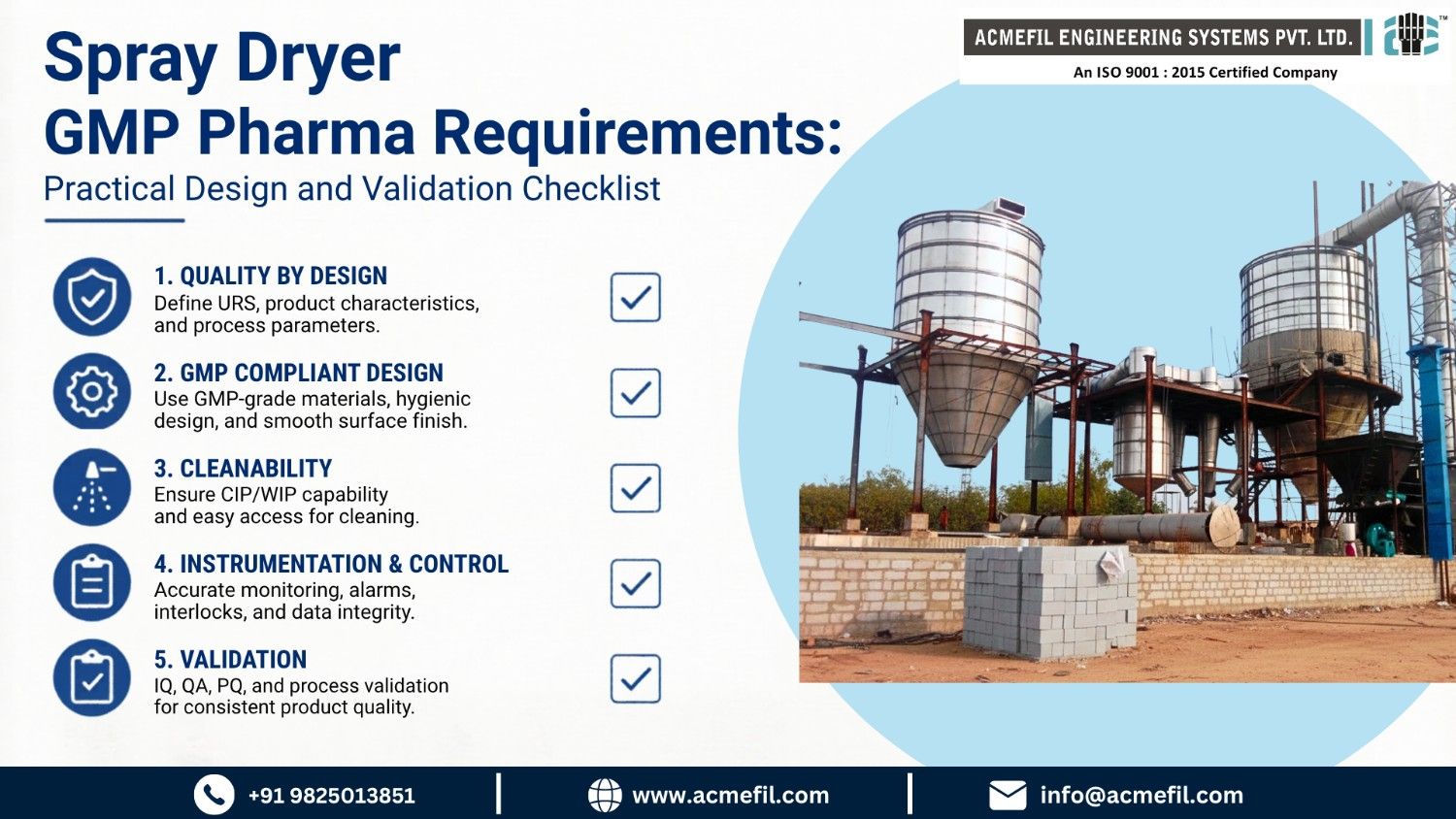
A pharma spray dryer is not GMP-compliant only because it is made from stainless steel. The real GMP requirement is that the dryer must support cleanability, contamination control, validated operation, controlled air handling, proper documentation, and repeatable batch quality. For pharmaceutical applications, the buyer must evaluate the spray dryer as part of the full manufacturing system, not as a standalone drying chamber.
This is where many projects go wrong. The purchase team asks for a “GMP spray dryer”, but the technical discussion stops at SS 316, polishing, and PLC control. That is not enough.
GMP is a quality-system requirement. WHO describes GMP as part of a quality management system that ensures products are consistently produced and controlled according to intended-use quality standards, mainly to reduce risks such as cross-contamination, mix-ups, and false labelling.
What does GMP mean for a pharmaceutical spray dryer?
For a spray dryer, GMP means the equipment must be designed, installed, cleaned, operated, maintained, and documented in a way that protects product quality.
In practical terms, the dryer should help the pharma manufacturer answer these questions:
Can the product-contact path be cleaned and inspected?
Can the drying air be filtered and controlled?
Can the atomizer, chamber, cyclone, bag filter, ducts, and discharge points avoid contamination traps?
Can the equipment be qualified through DQ, IQ, OQ, and PQ?
Can operating parameters be monitored, recorded, and repeated?
Can cleaning, maintenance, calibration, and batch usage records be maintained?
If the answer is weak at any of these points, the dryer may become a GMP bottleneck even if the fabrication looks good.
For pharma buyers who are still comparing dryer types, first review the basic equipment selection logic in choosing the right spray dryer and the pharma-specific application context in spray dryer applications in pharmaceuticals.
Why pharma spray drying has stricter requirements than normal chemical drying
A chemical spray dryer can often be judged mainly on evaporation rate, outlet moisture, particle size, powder recovery, and thermal efficiency.
A pharmaceutical spray dryer needs all of that, plus quality-system control.
The product may be an API intermediate, excipient, herbal extract, enzyme, protein, sterile powder, or heat-sensitive formulation. Each one brings different risks. Some products are non-sterile. Some need low bioburden. Some need solvent recovery. Some need closed handling. Some need sterile or aseptic-area integration.
That is why I do not recommend buying a pharma spray dryer with a generic checklist. The correct requirement sheet must start with the product, process route, cleaning expectation, regulatory market, and validation strategy.
India’s Schedule M frames GMP around a pharmaceutical quality system incorporating GMP and Quality Risk Management, with suitable premises, equipment, and facilities maintained through the product life cycle.
Core spray dryer GMP pharma requirements
| GMP requirement | What to check in a pharma spray dryer | Why it matters |
|---|---|---|
| Product-contact material | Confirm SS grade, gasket compatibility, surface finish, weld quality, and non-reactive contact path | Avoid product contamination, corrosion, extractables, and cleaning failure |
| Cleanable design | Check chamber geometry, ducting, cyclone, bag filter, atomizer, feed line, discharge valve, and access points | Residue retention creates cross-contamination and validation failure |
| Air handling | Confirm pre-filtration, HEPA filtration where required, temperature control, humidity control, and pressure logic | Drying air becomes a direct quality input in spray drying |
| Atomization control | Define rotary atomizer or nozzle type, droplet size target, feed pressure, speed, and repeatability | Atomization affects particle size, drying profile, yield, and batch consistency |
| Containment | Check closed transfer, enclosed powder collection, safe discharge, dust handling, and operator exposure risk | Pharma powders can create exposure, mix-up, and contamination risk |
| Cleaning validation readiness | Check CIP provisions, dismantling logic, drainability, inspection access, and sampling points | Cleaning must be demonstrable, not assumed |
| Instrumentation | Confirm sensors for inlet temperature, outlet temperature, feed rate, atomizer speed, pressure, airflow, and alarms | Critical parameters must be monitored and controlled |
| Data and records | Check PLC/HMI, batch records, alarm logs, calibration records, and audit trail expectations | GMP requires traceability and controlled records |
| Qualification support | Ask for DQ, IQ, OQ, FAT, SAT, manuals, MOC certificates, P&ID, GA drawing, and instrument list | The dryer must be ready for validation, not just installation |
| Maintenance and calibration | Define preventive maintenance, critical spares, calibration schedule, and access for inspection | Poor maintenance control can directly affect product quality |
The US cGMP rule in 21 CFR Part 211 requires equipment to be of appropriate design, adequate size, and suitably located for intended use, cleaning, and maintenance. It also requires product-contact surfaces not to be reactive, additive, or absorptive in a way that alters product quality.
Product-contact material and surface finish are not decorative details
For pharmaceutical spray drying, stainless steel selection is not only a purchase specification. It is a product-quality decision.
The feed solution, solvent, pH, chloride content, cleaning agent, operating temperature, and powder abrasiveness all influence material selection. SS 316 or SS 316L is commonly considered for product-contact areas, but the correct grade must be matched to the product and cleaning chemistry.
The buyer should ask for:
Material of Construction certificate for product-contact parts
Surface finish specification for product-contact areas
Weld quality and internal finishing details
Gasket, seal, and elastomer compatibility
Food/pharma-grade lubricant separation where applicable
Confirmation that product-contact parts are not reactive, additive, or absorptive
Do not accept “GMP model” as a substitute for written material specifications.
Cleanability is the main GMP risk in spray dryers
A spray dryer has many areas where powder can accumulate if the design is weak: atomizer housing, chamber cone, cyclone inlet, duct bends, bag filter housing, rotary valve, powder discharge, and inspection ports.
In non-pharma drying, a small amount of retained powder may look like a yield issue. In pharma, retained powder can become a contamination issue.
Good GMP-oriented spray dryer design should support:
Smooth product-contact surfaces
Minimum dead zones
Accessible inspection doors
Cleanable atomizer assembly
Cleanable ducting and powder transfer path
Defined cleaning method
Drainability where wet cleaning is used
Proper sealing after cleaning
Protection of cleaned equipment before use
FDA cGMP requires written procedures for equipment cleaning and maintenance, including cleaning schedules, methods, disassembly and reassembly methods where needed, protection of cleaned equipment, and inspection before use.
Air handling requirements for pharma spray dryers
In spray drying, air is not just a utility. It contacts the atomized feed and carries the dried particles through the system.
That means air handling must be discussed early in the design stage.
Key points include:
Inlet air filtration level
HEPA filtration requirement
Air pressure control
Temperature and humidity control
Protection from dust recirculation
Exhaust handling
Differential pressure monitoring
Filter integrity and maintenance access
For sterile or aseptic-related products, the air classification and clean area integration must be defined by the pharma manufacturer’s QA, validation, and facility teams. WHO sterile GMP guidance states that sterile preparation should be carried out in clean areas entered through airlocks, supplied with filtered air of required efficiency, and monitored for environmental cleanliness.
For non-sterile pharma products, the requirement may be different, but uncontrolled inlet air is still a risk.
HEPA filtration and sterile spray dryer design
A sterile spray dryer is not the same as a normal spray dryer placed inside a clean room.
For sterile or aseptic-related applications, the design discussion should include:
Clean-area classification
Airlock and material movement
HEPA-filtered process air
Sterile micro-filtration where applicable
Closed feed preparation and transfer
Aseptic connection strategy
Validated sterilization or sanitization approach
Environmental monitoring
Cleaning and disinfection programme
Operator gowning and intervention control
ACMEFIL’s verified product data includes sterile spray dryers for pharmaceutical applications with HEPA filters and sterile micro filters, and closed-loop spray dryers for solvent recovery in nitrogen atmosphere. This makes the equipment discussion more specific for pharma, but the final GMP status still depends on the user’s complete facility, process, validation, and QA approval.
For related pharma drying context, review spray drying in pharmaceuticals and spray dryer manufacturer details from Acmefil.
Closed loop spray dryer requirements for solvent-based pharma products
If the feed contains an organic solvent, the dryer cannot be evaluated like a normal open-cycle hot air dryer.
Closed-loop spray drying usually becomes necessary when the process requires:
Solvent recovery
Nitrogen atmosphere
Oxygen control
Explosion-risk reduction
Vapour containment
Product protection from oxidation
Safe exhaust and condensate handling
Fire detection and suppression logic
This is not only a drying decision. It is a process-safety and GMP decision.
For solvent-based pharmaceutical products, the buyer should involve process engineering, QA, EHS, validation, and the equipment manufacturer before freezing the layout. The drying chamber, condenser, nitrogen circulation, solvent recovery system, oxygen analyser, interlocks, and powder discharge arrangement must be reviewed as one system.
Validation requirements: DQ, IQ, OQ and PQ
A pharma spray dryer should be purchased with validation in mind. If the equipment supplier cannot support the qualification package, the validation burden shifts heavily to the buyer after installation.
The practical validation path is usually:
| Stage | What it proves | Spray dryer examples |
|---|---|---|
| DQ, Design Qualification | The proposed design meets process and GMP requirements | MOC, capacity, air handling, cleanability, controls, safety logic, documentation |
| IQ, Installation Qualification | The supplied dryer is installed as approved | Equipment ID, utility connections, instruments, filter installation, drawings, calibration records |
| OQ, Operational Qualification | The dryer operates correctly across defined ranges | Inlet/outlet temperature, atomizer speed, feed pump control, airflow, alarms, interlocks |
| PQ, Performance Qualification | The process consistently produces acceptable product | Moisture, particle size, bulk density, assay, impurity profile, yield, cleaning results |
ICH Q9(R1) positions quality risk management as relevant to facility and equipment design, product-contact material selection, utilities, preventive maintenance, qualification, cleaning validation limits, calibration, and computer-controlled equipment.
That is exactly how a pharma spray dryer should be approached.
Cleaning validation requirements for spray dryers
Cleaning validation is often the hardest part of pharma spray dryer approval because spray dryers have large internal surface areas and powder-handling sections.
The buyer should not wait until installation to ask: “How will we clean this?”
Ask these questions before purchase:
Which parts are cleaned in place?
Which parts need manual cleaning?
How will the atomizer be cleaned?
How will cyclone and duct residues be inspected?
How will bag filter or cartridge filter changeover be controlled?
Where will swab or rinse samples be taken?
How will detergent residue be controlled?
How will dry powder retention be prevented?
How will clean equipment be protected before next use?
In India’s Schedule M, major and critical equipment records must include validations, calibrations, maintenance, cleaning, or repair operations, and written procedures must define cleaning and sanitation responsibilities, schedules, methods, equipment, and materials.
This is why cleanability must be designed into the spray dryer, not added later as an SOP.
Documentation package pharma buyers should ask for
For a pharmaceutical spray dryer, the technical documentation package is as important as the machine.
Ask the manufacturer for:
General Arrangement drawing
P&ID
User Requirement Specification support
Design Qualification support documents
Material of Construction certificates
Surface finish details
Welding and fabrication records where applicable
Instrument list
Calibration certificates for supplied instruments
PLC and control logic description
Alarm and interlock list
FAT protocol and report
SAT protocol support
Operation and maintenance manual
Cleaning procedure support
Recommended preventive maintenance schedule
Spares list
Electrical panel documentation
Filter specifications
Utility requirement sheet
Batch and equipment log support format
FDA cGMP also requires written records of major equipment cleaning, maintenance, and use, including product and lot number details where applicable.
Control system and data integrity expectations
Modern pharma spray dryers commonly use PLC and HMI controls, but automation alone does not make the system GMP-ready.
The control system should support repeatable operation, controlled access, parameter monitoring, alarm visibility, and record review.
At minimum, review:
User access levels
Recipe control
Critical parameter display
Alarm history
Batch report requirement
Sensor calibration traceability
Manual override control
Change control approach
Data backup expectation
Integration with plant-level systems if required
21 CFR 211.68 allows automatic, mechanical, and electronic equipment where it performs satisfactorily, but requires routine calibration, inspection, or checking according to a written programme, with records maintained.
GMP requirements for atomizer selection
Atomizer selection affects both product quality and cleanability.
A rotary atomizer may be preferred where fine droplet generation and particle-size control are critical. ACMEFIL’s verified spray dryer data describes rotary disc atomizers producing fine droplets in the 20 to 75 micron range, with droplet size control through disc selection and speed.
Nozzle atomizers may be preferred for certain heat-sensitive pharmaceutical and food applications, using pressure nozzle or two-fluid nozzle atomization.
For pharma, do not select the atomizer only on particle size. Also check:
Cleanability of atomizer parts
Ease of dismantling and inspection
Seal design
Feed path hold-up volume
Repeatability of droplet formation
Wear resistance
Compatibility with solvent or aqueous feed
Risk of blockage
Maintenance access
For more fundamentals, see spray dryer atomization techniques and spray dryer design and components.
Non-sterile vs sterile pharma spray dryer requirements
Not every pharmaceutical spray dryer needs sterile design. This distinction matters because over-specifying the dryer increases cost, complexity, validation burden, and maintenance difficulty.
| Application type | Typical requirement focus | Spray dryer implication |
|---|---|---|
| Non-sterile herbal extracts | Moisture control, cleaning, microbial control, material compatibility | Hygienic design, validated cleaning, controlled inlet air |
| API intermediate drying | Solvent control, impurity control, residue control, containment | Closed loop may be required depending solvent and product risk |
| Excipients | Consistency, bulk density, particle size, contamination control | Repeatable atomization and validated cleaning |
| Enzymes and proteins | Heat sensitivity, activity retention, gentle drying | Tight inlet/outlet temperature control and feed characterization |
| Sterile powder production | Aseptic handling, sterile filtration, cleanroom integration | Sterile spray dryer design, HEPA filtration, validated aseptic process |
| Potent or hazardous APIs | Containment, operator exposure, cross-contamination | Dedicated or segregated equipment may be required after risk assessment |
The mistake is asking only, “Is this dryer GMP?” The better question is, “Which GMP risks does this product create, and how does the dryer design control them?”
Pharma spray dryer buyer checklist before RFQ
Before asking for a quote, prepare these details:
Product name or product category
Feed type, aqueous or solvent-based
Feed solids percentage
Feed viscosity
Heat sensitivity
Target powder moisture
Target particle size
Bulk density requirement
Batch size or evaporation load
Solvent details, if any
Sterile or non-sterile requirement
Cleanroom grade or installation area
Required MOC
Cleaning method expectation
CIP requirement, if any
Containment requirement
Dust explosion or solvent risk
Required documentation package
Validation support expectation
Preferred automation level
Utility availability
This information helps the supplier size the dryer properly and avoids vague proposals that cannot survive validation review.
Common mistakes when buying a GMP pharma spray dryer
The first mistake is treating GMP as a brochure word. GMP is demonstrated through design, qualification, procedures, records, and actual validated use.
The second mistake is underestimating powder collection. The cyclone, bag filter, rotary valve, and discharge system are part of the product-contact path. If the chamber is polished but the powder collection area is difficult to clean, the system is not pharma-ready.
The third mistake is ignoring the atomizer. The atomizer is not only a droplet generator. It is also a product-contact assembly with seals, crevices, wear parts, and cleaning requirements.
The fourth mistake is discussing validation after fabrication. Validation support must be built into the design and documentation stage.
The fifth mistake is selecting an open-cycle dryer for solvent-based products without evaluating closed-loop requirements. That can become a safety, environmental, and validation issue.
How ACMEFIL supports pharma spray drying projects
At ACMEFIL, we treat pharma spray drying as a process-engineering discussion first. The product, feed behavior, solvent system, particle-size target, cleaning expectation, and validation requirement must be understood before the dryer design is finalized.
ACMEFIL’s verified product range includes rotary disc spray dryers, nozzle type spray dryers, fluidized spray dryers, closed loop spray dryers, sterile spray dryers, and lab-scale pilot spray dryers. Pharmaceutical applications listed in ACMEFIL’s source data include herbal extracts, dextrose, lactose, protein, hemoglobin, enzymes, and sterile powder production.
For early-stage validation, ACMEFIL has an in-house spray dryer pilot facility with 3 kg/hr water evaporation capacity. Pilot trials are useful when the product team needs to study drying behavior, powder formation, moisture target, and scale-up risk before committing to a production-scale dryer.
You can also explore lab scale spray dryers and ACMEFIL’s manufacturing quality control information before starting the RFQ discussion.
Final selection advice
A GMP pharma spray dryer should be selected by combining process performance with GMP readiness. Do not approve the dryer only because it reaches evaporation capacity. Approve it only when the design supports cleanability, contamination control, validation, documentation, air handling, controlled operation, and maintenance over the full product life cycle.
The best pharma spray dryer proposal is not the one with the longest feature list. It is the one that clearly answers: how the product will dry, how the system will be cleaned, how the process will be validated, how records will be maintained, and how contamination risk will be controlled.
FAQs
Is a stainless steel spray dryer automatically GMP-compliant?
No. Stainless steel is only one part of the requirement. A GMP-ready spray dryer must also support cleanability, contamination control, written procedures, validated operation, documentation, calibration, maintenance, and batch traceability.
Which stainless steel is used for pharma spray dryers?
Pharma spray dryers often use SS 316 or SS 316L for product-contact parts, depending on product chemistry, cleaning agents, solvent exposure, and corrosion risk. The exact grade should be confirmed through the User Requirement Specification and Material of Construction certificates.
Does every pharma spray dryer need HEPA filtration?
Not every application has the same requirement. Sterile and cleanroom-integrated applications usually need stricter air filtration and environmental control. Non-sterile pharmaceutical drying may still require filtered and controlled inlet air, but the filtration level should be defined by QA, validation, and process risk assessment.
What is the difference between GMP-ready and sterile spray dryer design?
GMP-ready design supports cleaning, validation, documentation, and controlled production. Sterile spray dryer design goes further and may require cleanroom integration, HEPA filtration, sterile micro-filtration, aseptic connections, sterilization or sanitization strategy, and environmental monitoring.
What documents should I ask from a pharma spray dryer manufacturer?
Ask for GA drawing, P&ID, MOC certificates, surface finish details, instrument list, calibration records, FAT/SAT support, operation manual, cleaning support documents, preventive maintenance schedule, electrical documentation, alarm list, control logic, and validation support documents.
If you are planning a pharmaceutical spray drying project, do not start with machine capacity alone. Share your feed composition, solvent system, solids percentage, target moisture, particle-size requirement, cleaning expectation, sterile or non-sterile requirement, and validation needs. ACMEFIL can help evaluate the correct spray dryer configuration and pilot-trial route before full-scale procurement.

Siddharth Nair is Technical Director at Acmefil Engineering Systems Pvt. Ltd. he leads solution design and applications engineering across the company’s full product range — spray dryers, multi-effect evaporators, agitated thin film dryers, spin flash dryers, fluid bed dryers, and complete ZLD systems.
His work spans process evaluation, equipment sizing, customer application consulting, and technical proposal development for industries including food and dairy, pharmaceuticals, chemicals, dyestuffs, ceramics, and industrial effluent treatment. He has hands-on commissioning experience across Acmefil’s 500+ installations in India and 15+ countries.
He holds a BTech in Mechanical Engineering from CHARUSAT University and also partners at A.S Engineers, working with blowers, sludge dryers, and industrial conveying systems.


