
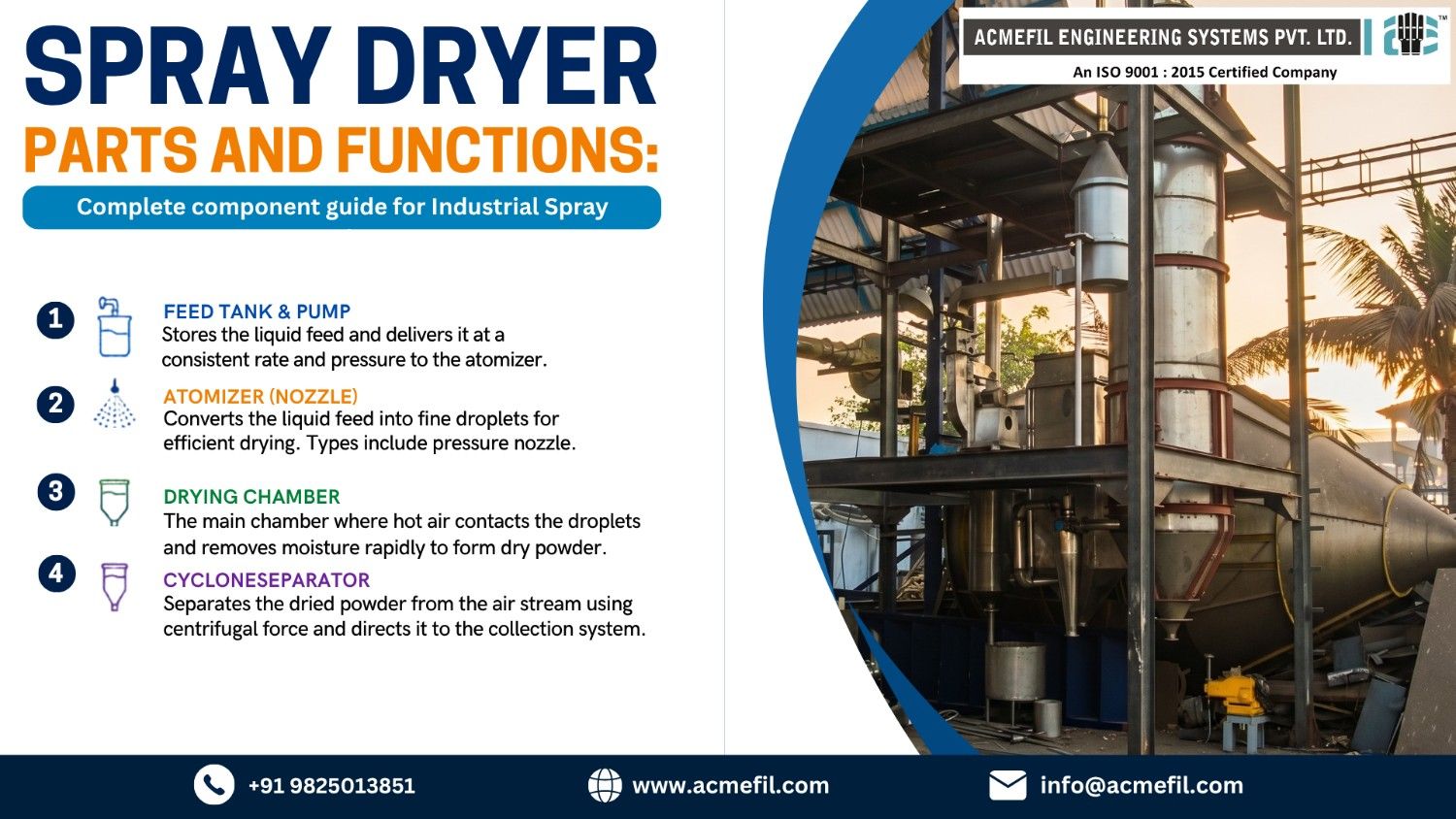
A spray dryer has one job: convert liquid feed, slurry, emulsion, or solution into dry powder by atomizing it into hot drying air and separating the dried particles from the exhaust air. The main spray dryer parts are the feed system, atomizer, hot air system, air distributor, drying chamber, cyclone separator, bag filter, powder discharge system, exhaust system, and control panel.
In my experience, most spray dryer problems start when buyers look at the main chamber and ignore the supporting parts. A spray dryer is not only a tall vessel. It is a complete process system.
For a broader process view, you can also read our guide on how a spray dryer works and the detailed article on spray dryer design and components.
Quick Answer: What Are the Main Parts of a Spray Dryer?
A standard industrial spray dryer includes these main parts:
| Spray Dryer Part | Main Function | Why It Matters |
|---|---|---|
| Feed tank | Holds and conditions the liquid feed | Prevents feed inconsistency before drying |
| Feed pump | Transfers feed to atomizer at controlled flow | Controls feed rate and drying load |
| Atomizer | Converts liquid into fine droplets | Controls droplet size, powder size, and drying behavior |
| Hot air generator or heater | Produces heated drying air | Supplies thermal energy for moisture evaporation |
| Air blower | Moves air through the system | Maintains airflow and pressure balance |
| Air distributor | Spreads hot air inside the chamber | Improves contact between droplets and hot air |
| Drying chamber | Main space where moisture evaporates | Controls residence time and powder formation |
| Cyclone separator | Separates powder from exhaust air | Recovers product and reduces product loss |
| Bag filter | Captures fine powder and dust | Improves collection efficiency and emission control |
| Air lock rotary valve | Discharges powder while limiting air leakage | Maintains pressure balance and steady discharge |
| Exhaust blower | Pulls process air through the system | Maintains system draft and airflow stability |
| Control panel | Controls temperature, feed rate, atomizer, and safety logic | Supports consistent operation and troubleshooting |
The exact design changes depending on the product. A milk powder spray dryer, dyestuff spray dryer, coffee extract spray dryer, ceramic slurry spray dryer, and solvent-based closed loop spray dryer do not need identical parts.
Why Spray Dryer Parts Must Be Selected as a System
Spray drying has four core stages:
- Atomization of feed into droplets
- Contact between spray and hot drying air
- Drying of droplets into powder particles
- Separation of dried product from air
Each stage depends on the previous one.
If the feed pump gives unstable flow, the atomizer cannot produce consistent droplets. If the atomizer creates droplets that are too large, the drying chamber may not provide enough residence time. If the chamber performs well but the cyclone or bag filter is undersized, powder recovery suffers.
That is why I do not recommend buying a spray dryer by chamber size alone. The better question is: does each part match the feed properties, target moisture, particle size, heat sensitivity, and powder recovery requirement?
Feed Tank and Feed Preparation System
The feed tank stores the liquid, slurry, emulsion, or suspension before atomization. In many plants, this part looks simple, but it has a direct effect on powder quality.
The feed system may include:
- Feed tank
- Agitator
- Feed filter or strainer
- Homogenizer, when required
- Feed pump
- Feed line and valves
- Flow control instrumentation
The function of the feed tank is not only storage. It keeps the feed condition stable before drying. For slurries, pigments, dyestuff, ceramic material, and food formulations, settling can create major variation between the first and last batch of powder.
A good feed preparation system controls:
- Total solids
- Viscosity
- Feed temperature
- Suspension stability
- Lump or foreign particle removal
- Continuous feed availability
One common mistake is sending poorly filtered feed to a fine atomization system. A small blockage at the nozzle or feed line can disturb the spray pattern, increase chamber wall deposition, and create uneven powder moisture.
Feed Pump
The feed pump transfers material from the feed tank to the atomizer at a controlled rate. Its function is simple to state but critical in operation.
A spray dryer is designed around a specific evaporation load. If feed flow suddenly increases, the chamber receives more moisture than the hot air can evaporate. Outlet temperature drops. Powder may become wet, sticky, or deposit on the chamber wall.
If feed flow drops suddenly, the outlet temperature can rise. This can affect heat-sensitive materials like food ingredients, enzymes, flavors, herbal extracts, and pharmaceutical intermediates.
Feed pump selection depends on:
| Feed Type | Typical Pump Consideration |
|---|---|
| Low-viscosity solution | Smooth metering and accurate flow control |
| High-solids slurry | Abrasion resistance and stable pumping |
| Viscous feed | Positive displacement behavior may be needed |
| Heat-sensitive feed | Gentle handling and controlled feed temperature |
| Feed with suspended particles | Avoid clogging and excessive shear |
For pressure nozzle systems, the pump also contributes to atomization because the feed must pass through the nozzle orifice under pressure. For two-fluid nozzle systems, compressed air assists atomization. For rotary atomizer systems, the pump mainly supplies steady feed to the rotating disc.
Atomizer
The atomizer is the part that converts liquid feed into fine droplets. This is one of the most important spray dryer parts because droplet size directly affects drying time, particle size, flowability, wall deposition, and final powder quality.
Common atomizer types include:
- Rotary atomizer
- Pressure nozzle
- Two-fluid nozzle
You can read the detailed technical comparison here: nozzle vs rotary atomizer spray dryer and spray dryer atomization techniques.
Rotary Atomizer
A rotary atomizer uses a high-speed rotating disc or wheel. Feed enters the rotating disc and is thrown outward by centrifugal force, forming droplets.
Its function is to create controlled droplets from feeds such as slurries, suspensions, pigments, dyestuff, ceramic material, food ingredients, and chemical products.
Rotary atomizers are useful where:
- Droplet size control is important
- Feed contains suspended solids
- Feed viscosity is higher than a simple solution
- Production flow may need operating flexibility
- A wider range of products must be handled in one plant
At Acmefil, rotary disc type spray dryers are used for applications such as dyes, ceramics, food products, pharmaceuticals, detergents, pigments, and inorganic chemicals.
Pressure Nozzle
A pressure nozzle atomizes feed by forcing it through a small orifice under pressure. The energy for atomization comes mainly from the feed pressure.
Its function is to produce a spray pattern suitable for controlled particle formation. It can be useful when the process needs defined particle characteristics or when the dryer geometry supports nozzle-based spraying.
Pressure nozzle selection depends on:
- Feed pressure
- Orifice size
- Feed viscosity
- Solids loading
- Required droplet size
- Spray angle
- Wear resistance
The buyer mistake I see here is selecting the nozzle before understanding the feed. A nozzle that performs well on a clean solution may not work on an abrasive slurry or a feed with suspended solids.
Two-Fluid Nozzle
A two-fluid nozzle uses compressed air or gas to atomize the liquid feed. It is often selected for finer particles, smaller capacity systems, and process development work.
Its function is to use compressed air energy to break the feed into droplets. This is useful when the feed flow is low or when pressure nozzle atomization is not suitable.
Two-fluid nozzles are commonly considered for:
- Lab scale spray dryers
- Pilot scale trials
- Fine powder development
- Heat-sensitive products
- Low feed quantity R&D work
However, compressed air consumption and nozzle wear must be considered. The spray pattern also needs to be matched with the drying chamber to avoid wall wetting.
Hot Air Generator or Air Heater
The hot air generator supplies heated air for moisture evaporation. Without properly controlled hot air, atomization alone cannot produce powder.
A spray dryer may use direct-fired or indirect-fired heating depending on the product and process requirement. In direct-fired systems, combustion gases contact the process air. In indirect-fired systems, a heat exchanger separates combustion gases from process air.
The hot air system usually includes:
- Hot air generator or heater
- Combustion system or heating medium
- Air blower
- Air filter
- Temperature sensors
- Ducting
- Dampers
For products sensitive to contamination, indirect heating may be preferred. For many chemical and industrial applications, direct-fired hot air may be acceptable if the product and process permit it.
The function of the hot air generator is not simply to reach a high temperature. It must deliver stable, controlled drying energy. Inlet temperature, outlet temperature, airflow, feed rate, and chamber residence time must work together.
For process optimization, read how to optimize spray drying parameters.
Air Blower and Air Handling System
The blower moves drying air through the spray dryer system. Depending on the plant design, the system may use forced draft, induced draft, or a balanced arrangement.
The blower function includes:
- Supplying required air volume
- Maintaining pressure balance
- Supporting steady drying conditions
- Moving exhaust air through separation equipment
- Preventing uncontrolled leakage or backflow
In a spray dryer, airflow affects heat transfer, drying time, powder transport, and separation efficiency. Poor airflow distribution can create wet zones, wall deposits, powder carryover, and unstable outlet temperature.
The air handling system must be designed with the chamber, cyclone, bag filter, ducting, and exhaust path in mind.
Air Distributor
The air distributor introduces hot air into the drying chamber in a controlled pattern. This part is often overlooked, but it has a major influence on drying uniformity.
Its function is to distribute air so the spray and hot air meet correctly. Depending on design, the dryer may use co-current, counter-current, or mixed-flow air contact.
For many heat-sensitive products, co-current drying is preferred because the hottest air contacts the wettest droplets first. The evaporating moisture keeps the particle surface temperature lower during the early drying stage.
A poor air distributor can create:
- Uneven drying
- Chamber wall wetting
- Powder sticking
- Hot spots
- Low product recovery
- Unstable outlet temperature
When I review spray dryer performance complaints, I pay close attention to air distribution, not only atomizer speed or inlet temperature.
Drying Chamber
The drying chamber is the main vessel where droplets meet hot air and moisture evaporates. It is the most visible spray dryer part, but it cannot work correctly without the right upstream and downstream equipment.
The chamber function is to provide:
- Sufficient residence time
- Correct spray-air contact
- Safe droplet drying distance
- Controlled powder movement
- Proper cone discharge
- Minimum wall deposition
Chamber design depends on:
| Design Factor | Why It Matters |
|---|---|
| Droplet size | Larger droplets need more drying time |
| Feed solids | Higher solids affect viscosity and particle formation |
| Product heat sensitivity | Affects inlet and outlet temperature selection |
| Powder stickiness | Influences wall deposition risk |
| Desired particle size | Affects atomizer and chamber geometry |
| Bulk density target | Influences drying and agglomeration approach |
| Airflow pattern | Controls droplet path and drying behavior |
A common misconception is that a taller chamber automatically solves drying problems. Height helps only when it matches atomization, airflow, feed rate, and thermal load. A bad spray pattern in a tall chamber still creates poor product.
Chamber Cone and Powder Discharge Zone
The lower cone of the drying chamber guides powder toward the discharge system. Its function is to collect dried powder without allowing buildup, bridging, or excessive air leakage.
The discharge zone may include:
- Chamber cone
- Product outlet
- Air lock rotary valve
- Collection bin
- Pneumatic conveying connection
- Vibrator or knocking arrangement, when required
If powder is sticky, hygroscopic, or very fine, discharge design becomes critical. A well-sized atomizer and chamber can still fail if powder does not discharge smoothly.
This is especially important in food powders, dyestuff, pigments, ceramic slurries, detergents, and pharmaceutical powders.
Cyclone Separator
The cyclone separator separates dried powder from exhaust air using centrifugal action. Exhaust air enters the cyclone tangentially, creating a spinning flow. Heavier particles move outward and downward, while air exits from the top.
The cyclone function is to recover powder and reduce load on the final filtration system.
Cyclones are commonly used because they are simple, robust, and suitable for many powder recovery duties. However, very fine particles may still escape with exhaust air. That is why many spray dryer plants also use bag filters after the cyclone.
Cyclone performance depends on:
- Particle size
- Air velocity
- Inlet design
- Cyclone diameter and height
- Pressure drop
- Powder density
- Air leakage at discharge
- Rotary valve sealing
If the air lock below the cyclone leaks too much air, cyclone efficiency can drop. This is why the discharge valve is not just an accessory. It is part of the separation system.
Bag Filter
The bag filter captures fine powder and dust from exhaust air after the cyclone or as a final product recovery stage.
Its function is to improve powder collection and control dust emissions. In fine powder applications, a bag filter can be essential for product recovery.
A bag filter system may include:
- Filter housing
- Filter bags
- Pulse jet cleaning system
- Compressed air header
- Dust hopper
- Rotary valve
- Differential pressure sensor
- Exhaust outlet
Differential pressure across the bag filter is an important operating indicator. If it rises too high, airflow drops and drying performance changes. If filter bags are damaged, fine powder escapes.
For maintenance-related problems, read our guide on spray dryer troubleshooting and spray dryer maintenance tips.
Air Lock Rotary Valve
The air lock rotary valve discharges powder while limiting air leakage between different pressure zones.
It is usually installed below:
- Drying chamber cone
- Cyclone separator
- Bag filter hopper
- Powder collection system
Its function is to maintain pressure balance and allow continuous powder discharge. If the valve clearance, speed, or sealing is wrong, powder recovery and airflow stability can suffer.
In spray dryer plants, the air lock rotary valve is small compared to the chamber, but it can create large process issues if ignored.
Exhaust Blower and Exhaust Ducting
The exhaust blower pulls moisture-laden air through the separation system and discharges it safely through the exhaust path.
Its function is to maintain required airflow and system draft. If exhaust airflow is too low, wet air remains in the chamber and powder may become sticky. If airflow is too high, powder carryover can increase and separation equipment may be overloaded.
Exhaust ducting must be designed to avoid dead zones, powder buildup, and unnecessary pressure drop.
Control Panel and Instrumentation
The control panel manages the operating logic of the spray dryer. It does not replace process understanding, but it helps maintain repeatability.
Important control points include:
- Inlet air temperature
- Outlet air temperature
- Feed flow rate
- Atomizer speed or nozzle pressure
- Airflow or blower load
- Bag filter differential pressure
- Chamber pressure
- Exhaust temperature
- Rotary valve operation
- Safety interlocks
In many spray dryers, outlet temperature is one of the most useful control indicators. If outlet temperature changes without operator adjustment, something has changed in feed rate, feed solids, airflow, atomization, or heat input.
Good instrumentation helps the operator identify the real cause instead of adjusting the wrong parameter.
Optional Parts in Advanced Spray Dryer Systems
Not every spray dryer uses the same parts. Certain applications need additional systems.
Fluid Bed Section
A fluidized spray dryer may include an integrated or external fluid bed. Its function is to complete drying, cool powder, improve agglomeration, or produce larger particles.
Acmefil’s fluidized spray dryer designs are used where larger particle formation is required, such as detergents and agglomerated food ingredients.
Fines Recycle System
A fines recycle system returns fine particles back into the drying chamber or fluid bed zone. Its function is to increase particle size and improve powder properties.
This is important when the target powder should not be too dusty or too fine.
Closed Loop System
A closed loop spray dryer uses nitrogen atmosphere instead of open air for solvent-based or oxidation-sensitive products.
Its function is to recover solvent, reduce oxygen exposure, and support safer drying of certain materials. These systems require additional parts such as condenser, solvent recovery system, nitrogen circulation, oxygen monitoring, and safety interlocks.
HEPA Filtration and Sterile Air System
For sterile or pharmaceutical applications, HEPA filters and sterile micro filters may be used. Their function is to control inlet air quality and support hygienic or aseptic drying requirements.
CIP System
A Clean-in-Place system supports cleaning of internal surfaces in hygienic applications. Its function is to reduce manual cleaning effort and improve repeatability where product changeover or hygiene is important.
Spray Dryer Parts by Application
Different products need different spray dryer configurations.
| Application | Parts That Need Special Attention | Practical Reason |
|---|---|---|
| Milk powder | Atomizer, chamber, fines recycle, fluid bed, hygiene system | Powder solubility, moisture, and bulk density matter |
| Coffee extract | Feed concentration, atomizer, chamber temperature, powder recovery | Aroma and powder properties are sensitive |
| Dyestuff and pigments | Atomizer, feed pump, chamber lining, cyclone, bag filter | Abrasion, solids loading, and recovery matter |
| Ceramic slurry | Rotary atomizer, feed agitation, chamber, powder discharge | Slurry stability and particle control matter |
| Pharmaceutical powder | Sterile filtration, closed loop option, controls, material contact parts | Hygiene, repeatability, and controlled conditions matter |
| Detergent powder | Fluidized spray dryer, fines recycle, powder discharge | Larger particles and flowability matter |
| Solvent-based feed | Closed loop, nitrogen circulation, condenser, safety system | Solvent recovery and oxygen control matter |
For equipment selection, the better starting point is not “which dryer is cheapest?” It is “which parts must be designed around my feed behavior and powder target?”
The guide on choosing the right spray dryer explains this decision in more detail.
Common Buyer Mistakes When Comparing Spray Dryer Parts
Mistake 1: Comparing only chamber size
A bigger chamber does not automatically produce better powder. If atomization, airflow, feed rate, and separation are wrong, the chamber size will not fix the process.
Mistake 2: Ignoring feed properties
Feed viscosity, solids percentage, abrasiveness, stickiness, and heat sensitivity decide the real design. Buyers should share proper feed data before asking for a quote.
Mistake 3: Choosing atomizer type too early
Rotary atomizer, pressure nozzle, and two-fluid nozzle systems each have their place. The right choice depends on feed behavior, particle target, capacity, and chamber design.
Mistake 4: Underestimating powder separation
Cyclone and bag filter selection affects product recovery. A good dryer with poor separation is still a poor plant.
Mistake 5: Treating controls as an afterthought
Without stable control of feed rate, temperature, airflow, and atomization, operators have to guess. Guesswork is expensive in continuous drying.
What Data Should You Share Before Selecting Spray Dryer Parts?
Before finalizing a spray dryer system, share these details with the equipment manufacturer:
- Product name and application
- Feed type, solution, slurry, emulsion, or suspension
- Total solids percentage
- Feed viscosity
- Feed temperature
- Required evaporation load
- Desired final moisture
- Bulk density target
- Particle size requirement
- Heat sensitivity
- Stickiness or hygroscopic behavior
- Solvent or water-based feed
- Required material of construction
- Hygiene or GMP requirement, if applicable
- Existing process flow, if it is a replacement or upgrade
At Acmefil, we use this process data to decide whether the plant needs a rotary atomizer, nozzle atomizer, fluidized spray dryer, closed loop system, lab scale trial, or a custom configuration.
How Acmefil Approaches Spray Dryer Component Selection
Acmefil Engineering Systems manufactures spray dryers and related drying systems from Ahmedabad, India. The company has worked across food, pharmaceutical, chemical, dyestuff, ceramic, detergent, inorganic chemical, and effluent-related applications.
For spray drying, the important point is not to push one fixed model for every product. The plant must be designed around the feed.
Acmefil’s spray dryer range includes rotary disc type spray dryers, nozzle type spray dryers, fluidized spray dryers, closed loop or sterile spray dryers, and lab scale pilot spray dryers. The in-house pilot spray dryer facility is available for process development and trials before full-scale procurement.
That trial step matters. A lab or pilot test can reveal whether the feed atomizes cleanly, whether the powder sticks, whether the target moisture is realistic, and whether the final powder behaves as expected.
For supporting equipment references, see Acmefil’s pages on rotary atomizer type spray dryers, nozzle atomizer type spray dryers, fluidized spray dryers, closed loop spray dryers, and pilot spray dryer trials.
Final Takeaway
Spray dryer parts and functions must be understood as one connected system. The feed tank, feed pump, atomizer, hot air generator, drying chamber, cyclone separator, bag filter, rotary valve, exhaust blower, and control panel all affect final powder quality.
If you are planning a spray dryer plant, do not start with only capacity and price. Start with feed data, powder target, heat sensitivity, separation requirement, and validation trials. That is the safer way to select the correct spray dryer configuration.
FAQs
What are the main parts of a spray dryer?
The main parts of a spray dryer are the feed tank, feed pump, atomizer, hot air generator, air blower, air distributor, drying chamber, cyclone separator, bag filter, air lock rotary valve, exhaust system, and control panel. Some systems also include fluid beds, fines recycle, closed loop nitrogen circulation, HEPA filtration, or CIP systems.
Which part of a spray dryer controls particle size?
The atomizer has the strongest influence on droplet size and final particle size. Rotary atomizers, pressure nozzles, and two-fluid nozzles produce different droplet patterns. Feed solids, viscosity, chamber design, airflow, and drying conditions also affect the final powder size and shape.
What is the function of the drying chamber in a spray dryer?
The drying chamber provides the space where atomized droplets contact hot air and lose moisture. Its function is to provide enough residence time, correct air contact, and proper powder movement before product separation. Chamber design must match droplet size, feed rate, heat sensitivity, and target moisture.
Why is a cyclone separator used in a spray dryer?
A cyclone separator recovers dried powder from exhaust air using centrifugal separation. It reduces powder loss and lowers dust load before the final filtration stage. Very fine particles may still require a bag filter after the cyclone for better recovery and emission control.
What is the difference between a cyclone and a bag filter in a spray dryer?
A cyclone separates powder by centrifugal force, while a bag filter captures fine particles through filter bags. Cyclones are robust and useful for primary powder recovery. Bag filters are useful for finer powder capture, dust control, and improving total collection efficiency.
If you are selecting a spray dryer and want to avoid wrong atomizer, chamber, or powder separation decisions, share your feed details with the engineering team. Include feed solids, viscosity, required moisture, particle size target, heat sensitivity, and capacity requirement.
You can start with the spray dryer enquiry page or review more technical articles in the SprayDryer.com article library.

Siddharth Nair is Technical Director at Acmefil Engineering Systems Pvt. Ltd. he leads solution design and applications engineering across the company’s full product range — spray dryers, multi-effect evaporators, agitated thin film dryers, spin flash dryers, fluid bed dryers, and complete ZLD systems.
His work spans process evaluation, equipment sizing, customer application consulting, and technical proposal development for industries including food and dairy, pharmaceuticals, chemicals, dyestuffs, ceramics, and industrial effluent treatment. He has hands-on commissioning experience across Acmefil’s 500+ installations in India and 15+ countries.
He holds a BTech in Mechanical Engineering from CHARUSAT University and also partners at A.S Engineers, working with blowers, sludge dryers, and industrial conveying systems.


