
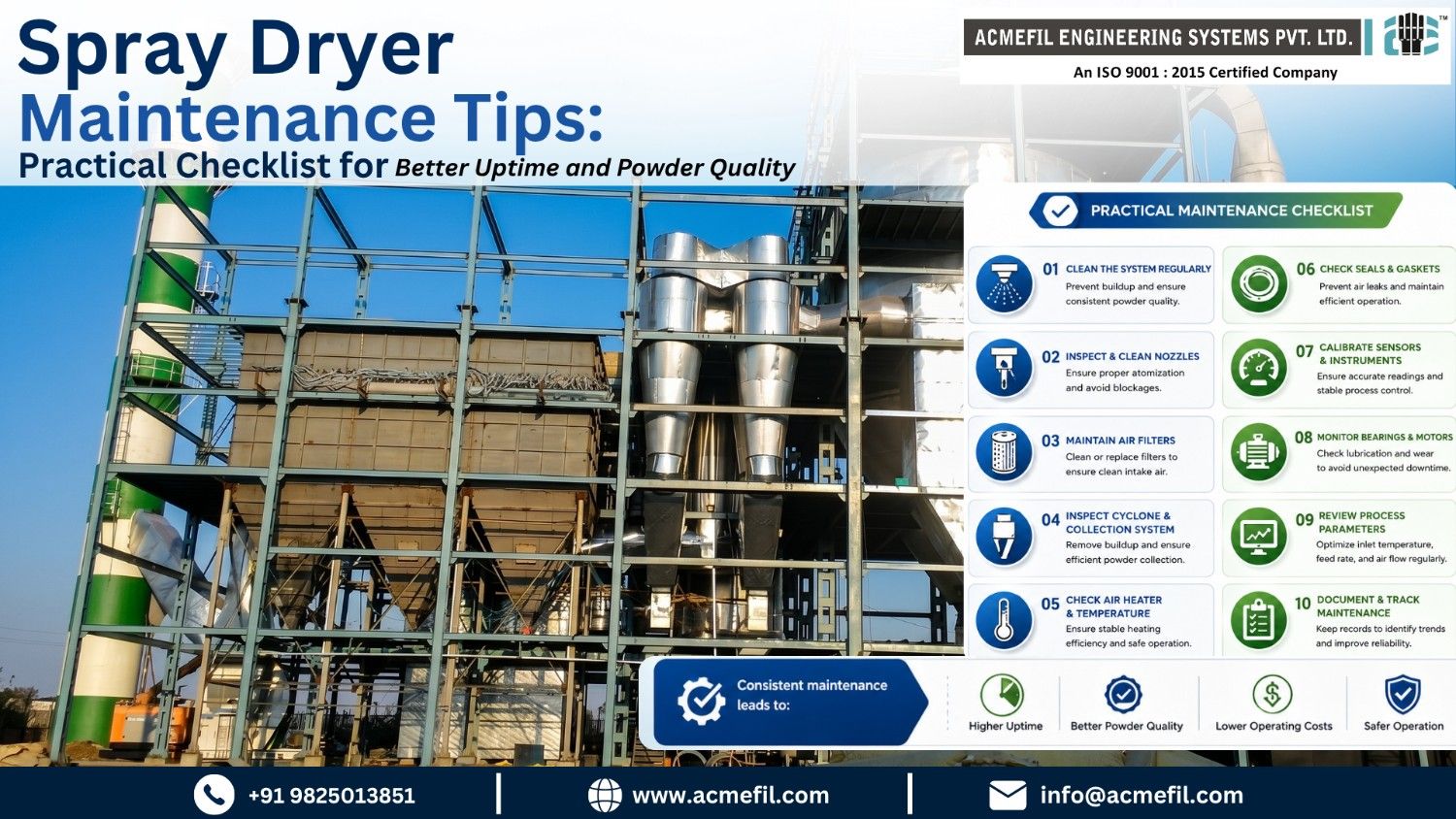
Spray dryer maintenance is not only about cleaning the chamber after production. The four areas I check first are atomization, airflow, temperature control, and powder separation. If any one of these drifts, the plant starts showing symptoms: wet powder, wall deposits, unstable outlet temperature, higher utility consumption, poor particle size control, or unplanned stoppage.
This guide gives practical spray dryer maintenance tips for plant teams handling rotary atomizer, nozzle atomizer, fluidized, closed loop, sterile, and pilot spray dryers.
Why Spray Dryer Maintenance Fails in Many Plants
In my experience, spray dryer maintenance fails for one simple reason: teams look at the dryer as one machine.
It is not one machine.
A spray dryer is a system made of feed preparation, feed pumping, atomization, hot air generation, air distribution, drying chamber, powder separation, air filtration, discharge, controls, and safety interlocks. A small issue in one section quickly appears as a product-quality problem somewhere else.
For example:
- A partially choked nozzle may look like a temperature problem.
- A worn rotary atomizer disc may look like a powder-size problem.
- A leaking duct or gasket may look like reduced drying efficiency.
- A blocked rotary valve may look like a cyclone or bag filter problem.
- A dirty inlet air filter may disturb airflow and outlet moisture.
This is why maintenance should be based on process symptoms, not only on a calendar.
For readers new to the process, it is worth first reviewing the basic working principle of spray dryers and the main spray dryer design components before building a maintenance plan.
Spray Dryer Maintenance Tips That Matter Most
A good maintenance plan should protect three outcomes:
- Stable powder quality
- Safe and predictable operation
- Lower unplanned downtime
The most important maintenance points are the atomizer or nozzle, drying chamber, air filters, blower, heater, cyclone, bag filter, discharge rotary valve, sensors, and control system.
Here is the practical sequence I recommend.
Start With the Atomization System
Atomization is where spray drying really begins. If droplet formation is poor, the rest of the dryer cannot fully correct the problem.
In a rotary atomizer type spray dryer, check the disc condition, feed distribution, drive mechanism, bearing sound, vibration, and buildup around the atomizer zone. A rotary disc depends on high-speed centrifugal force. Any imbalance, buildup, or wear can disturb droplet size and spray pattern.
In a nozzle atomizer type spray dryer, inspect the orifice, nozzle tip, swirl chamber, feed strainer, feed pressure, pump condition, and compressed-air line if it is a two-fluid nozzle system. Even slight wear or partial blockage can change the spray cone.
Atomizer Maintenance Checklist
| Maintenance Area | What to Check | Why It Matters |
|---|---|---|
| Rotary disc | Buildup, erosion, imbalance, cleanliness | Affects droplet size and spray distribution |
| Atomizer drive | Bearing sound, vibration, lubrication, alignment | Prevents mechanical failure and unstable atomization |
| Pressure nozzle | Orifice wear, clogging, cone angle, feed pressure | Protects particle size and moisture consistency |
| Two-fluid nozzle | Air pressure, feed pressure, tip condition | Prevents inconsistent droplet formation |
| Feed strainer | Choking, foreign particles, solids buildup | Reduces nozzle blockage and feed pulsation |
| Feed pump | Flow stability, seal leakage, pressure fluctuation | Keeps drying load stable |
A common mistake is cleaning the chamber repeatedly while ignoring the cause of deposition. In many cases, the deposition begins with poor atomization, wrong feed concentration, unstable feed rate, or a disturbed air pattern.
For deeper selection context, see spray dryer atomization techniques and nozzle vs rotary atomizer spray dryers.
Keep the Drying Chamber Clean, but Do Not Treat Cleaning as the Full Solution
Wall deposits inside the drying chamber are one of the most visible maintenance issues. But they are usually a symptom.
Deposits can come from:
- Oversized droplets
- Low outlet temperature
- Sticky product behavior
- Wrong feed solids
- Poor air distribution
- Slow powder discharge
- Incorrect atomizer setting
- Inadequate chamber cleaning frequency
The chamber should be inspected after production campaigns, especially when processing sticky products, heat-sensitive materials, dyes, pigments, food ingredients, or pharmaceutical intermediates.
Do not allow powder deposits to remain on hot surfaces. The maintenance team should follow the plant’s safety SOP and the equipment manual before entering or cleaning any chamber.
Maintain Airflow Before You Adjust Temperature
Many operators quickly change inlet temperature when powder moisture changes. I prefer checking airflow first.
The dryer depends on controlled contact between droplets and hot air. If the airflow is restricted, leaking, or uneven, temperature adjustment becomes a temporary patch.
Check these areas:
- Inlet air filter condition
- Blower vibration and bearing condition
- Duct leakage
- Expansion joints and gaskets
- Air distributor cleanliness
- Air heater performance
- Pressure drop trends
- Exhaust airflow
- Bag filter differential pressure
A spray dryer with poor airflow may show unstable outlet temperature, powder buildup, low evaporation rate, or inconsistent final moisture. Before changing the process recipe, confirm that air movement is healthy.
For process-side optimization, refer to spray dryer operating principles and best practices and how to optimize spray drying parameters.
Do Not Ignore Cyclone, Bag Filter, and Powder Discharge Maintenance
Many spray dryer stoppages happen after the drying chamber, not inside it.
The powder separation and discharge system needs regular attention because fine powder, sticky powder, and high dust loads can quickly create blockages.
Separation and Discharge Checklist
| Component | Maintenance Focus | Early Warning Sign |
|---|---|---|
| Cyclone separator | Wear, internal buildup, leakage, cone blockage | Product loss, poor separation, dust carryover |
| Bag filter | Differential pressure, bag condition, pulse jet function | Reduced airflow, dust leakage, frequent cleaning |
| Rotary valve | Blade wear, jamming, air leakage, motor load | Powder backup, inconsistent discharge |
| Ducting | Buildup, leakage, insulation damage | Pressure drop change, dust leakage |
| Powder collection | Hygroscopic buildup, bridging, contamination risk | Poor flow or inconsistent packing |
Acmefil also manufactures and supports related equipment such as bag filters, air lock rotary valves, and spray dryer systems, so these parts should not be treated as secondary accessories. They directly affect dryer performance.
Build a Maintenance Schedule by Frequency
Every plant should adapt the schedule to product type, operating hours, cleaning requirements, and safety category. A plant drying ceramic slurry does not need the same maintenance rhythm as a sterile pharmaceutical dryer or a solvent-based closed loop dryer.
Still, this maintenance structure works as a practical starting point.
| Frequency | Maintenance Tasks | Responsible Team |
|---|---|---|
| Every shift | Check inlet and outlet temperature stability, feed pressure, atomizer sound, blower sound, vibration, powder discharge, abnormal smell, visible leakage | Operator |
| Daily | Clean visible powder buildup, check feed strainer, inspect nozzle or atomizer zone, verify rotary valve discharge, note pressure drop | Operator + maintenance |
| Weekly | Inspect chamber deposits, ducting, air filters, cyclone, bag filter pulse system, gaskets, seals, drain points | Maintenance |
| Monthly | Check atomizer wear, nozzle wear, blower bearings, motor load, sensor readings, control panel alarms, lubrication points | Maintenance + instrumentation |
| Quarterly | Review trend logs, calibrate key sensors, inspect structural supports, expansion joints, insulation, heater performance | Maintenance head |
| Annual shutdown | Detailed chamber inspection, duct inspection, cyclone wear check, bag filter review, atomizer overhaul, control-system review, spare-parts audit | Engineering + OEM/service team |
The interval should be shortened for sticky products, abrasive slurries, solvent-based products, high-temperature operation, or continuous-duty plants.
Watch the Outlet Temperature Trend
The outlet temperature is one of the best early indicators of spray dryer health. It reflects the balance between feed rate, feed solids, inlet temperature, airflow, and evaporation load.
If outlet temperature starts drifting without an intentional process change, do not immediately blame the heater. Check:
- Feed rate stability
- Feed solids variation
- Feed viscosity
- Atomizer performance
- Airflow restriction
- Chamber deposits
- Cyclone or bag filter restriction
- Sensor calibration
A spray dryer can still run while slowly moving away from its best operating window. That is when product rejection starts.
Troubleshooting Table: Maintenance Symptoms and First Checks
| Symptom | Likely Maintenance Cause | First Area to Check |
|---|---|---|
| Wet powder | Low outlet temperature, high feed rate, poor atomization, airflow restriction | Feed pump, atomizer/nozzle, air filter, blower |
| Wall deposits | Oversized droplets, sticky product, wrong air pattern, poor chamber cleaning | Atomizer, feed solids, chamber, air distributor |
| Powder carryover | Cyclone leakage, bag filter issue, high airflow, fine particle overload | Cyclone, bag filter, ducting |
| Abnormal vibration | Atomizer imbalance, blower bearing issue, motor alignment problem | Atomizer drive, blower, motor base |
| Sudden pressure drop change | Filter choking, duct buildup, leakage, bag filter issue | Air filters, bag filter, ducting |
| Inconsistent particle size | Nozzle wear, disc wear, unstable feed pressure, viscosity variation | Nozzle, rotary disc, feed system |
| Product contamination risk | Poor cleaning, damaged filter, worn seals, wrong maintenance practice | Chamber, filters, seals, CIP protocol |
| Rotary valve blockage | Sticky powder, high moisture, bridging, worn blades | Rotary valve, discharge cone, powder moisture |
For related fault diagnosis, connect this guide with spray dryer troubleshooting common issues.
Maintain the Feed System, Not Only the Dryer Body
The feed system is often the hidden source of unstable dryer performance.
Check these points:
- Feed tank agitation
- Feed solids consistency
- Feed viscosity
- Pump pulsation
- Strainer condition
- Feed-line blockage
- Air ingress in the feed line
- Valve leakage
- Pressure gauge accuracy
If feed properties change from batch to batch, the dryer will behave differently even when all machine settings look unchanged.
For new products, I recommend trials before full-scale assumptions. Acmefil’s pilot spray dryer supports process development and helps evaluate drying behavior before committing to a full production design.
Calibrate Sensors and Do Not Run Blind
A spray dryer depends on instrumentation. If sensors drift, operators make wrong decisions from wrong numbers.
The key instruments to check include:
- Inlet temperature sensor
- Outlet temperature sensor
- Feed pressure gauge
- Air pressure or airflow indicator
- Differential pressure across filters
- Motor load indicators
- Control panel alarms
- Safety interlocks
Calibration should be recorded. Do not rely only on visual inspection if the plant is producing powder for food, pharmaceutical, chemical, or export-sensitive applications.
Maintain Cleaning Discipline for Food and Pharmaceutical Products
For food and pharmaceutical applications, cleaning is part of quality control, not only maintenance.
The team should define:
- Cleaning frequency by product
- Cleaning method and chemical compatibility
- Inspection points after cleaning
- Filter replacement rules
- Gasket and seal inspection rules
- Cross-contamination control
- Drying and reassembly checks after cleaning
For sterile or solvent-sensitive applications, closed loop and sterile spray dryer systems require stricter review. Do not copy a general open-cycle dryer maintenance checklist and apply it blindly to closed loop or sterile operation.
Acmefil’s spray dryer range includes closed loop spray dryers and application-specific configurations for different process needs.
Keep Critical Spares Ready
A maintenance plan without spare-parts planning is incomplete. The lowest-cost spare part can become the highest-cost downtime if it is not available when the plant stops.
Common critical spares include:
- Nozzle tips
- Nozzle gaskets
- Atomizer wear parts
- Bearings
- Seals
- Rotary valve parts
- Bag filter bags
- Filter pads
- Temperature sensors
- Pressure gauges
- Belts and couplings
- Electrical contactors and control components
The exact list depends on dryer design, product behavior, operating hours, and site location. Export plants and remote installations should maintain a stronger spare strategy because emergency procurement can take longer.
Acmefil supports genuine spare parts and AMC services for maintenance planning.
When Maintenance Is Not Enough
Sometimes maintenance does not solve the problem because the issue is design-related or process-related.
You may need engineering review if:
- Wall deposition continues after cleaning and atomizer maintenance
- Outlet moisture is unstable even with stable feed
- Product quality has changed after a capacity increase
- Bag filter pressure drop rises too quickly
- The dryer cannot handle a new feed formulation
- Energy use has increased without a production reason
- The plant has repeated nozzle choking or atomizer wear
- The dryer was modified without airflow validation
In such cases, the solution may involve airflow correction, atomizer change, feed-system modification, control upgrade, insulation review, bag filter correction, or a capacity study.
Acmefil provides system retrofits, rebuilds, and upgrades when the issue is beyond routine maintenance.
Spray Dryer Maintenance Record Template
A basic spray dryer maintenance log should capture more than “checked and cleaned.”
Include these fields:
| Record Field | Why It Matters |
|---|---|
| Date and shift | Connects issue to production batch |
| Product handled | Sticky, abrasive, or hygroscopic products affect maintenance frequency |
| Feed solids and viscosity | Helps link feed changes to dryer behavior |
| Inlet and outlet temperature | Shows drying trend stability |
| Feed pressure and feed rate | Helps identify pump or nozzle issues |
| Atomizer/nozzle condition | Tracks wear and cleaning history |
| Filter differential pressure | Shows airflow restriction trend |
| Rotary valve status | Protects discharge continuity |
| Cleaning completed | Confirms hygiene and buildup control |
| Abnormal sound or vibration | Early warning for mechanical failure |
| Corrective action | Prevents repeat troubleshooting from zero |
A good logbook reduces guesswork. It also helps the OEM or service team diagnose the plant faster.
My Practical Rule for Spray Dryer Maintenance
Do not wait for the spray dryer to stop before you inspect it.
A spray dryer usually gives warning signs before failure. The powder changes. The outlet temperature drifts. The chamber starts collecting more deposits. The atomizer sound changes. The bag filter pressure drop rises. The rotary valve becomes less smooth.
When your operators learn to read these signals, maintenance becomes preventive instead of reactive.
For ACMEFIL plants or existing spray dryers that need maintenance review, performance correction, spares, or upgrade assessment, share your product, feed condition, dryer type, capacity, operating temperature range, and current problem. That information is more useful than a generic complaint such as “dryer not working properly.”
FAQs
How often should a spray dryer be cleaned?
A spray dryer should be cleaned based on product behavior, production cycle, hygiene requirement, and deposit formation. Sticky, hygroscopic, food, and pharmaceutical products usually need stricter cleaning schedules than non-sticky mineral or ceramic products. The drying chamber, atomizer zone, cyclone, bag filter, and discharge points should be included in the cleaning plan.
What is the most important part to maintain in a spray dryer?
The atomization system is one of the most important maintenance areas because it controls droplet formation. In rotary atomizer dryers, check the disc, drive, vibration, and bearings. In nozzle dryers, check the nozzle tip, orifice, feed strainer, pressure, and pump stability.
Why does powder stick to the spray dryer chamber wall?
Powder can stick to the chamber wall due to poor atomization, oversized droplets, low outlet temperature, sticky feed behavior, high feed moisture, disturbed airflow, or delayed powder discharge. Cleaning removes the deposit, but the root cause must be traced through atomization, airflow, temperature, and feed properties.
What should be checked daily in a spray dryer?
Daily checks should include inlet and outlet temperature stability, atomizer or nozzle condition, feed pressure, feed pump behavior, blower sound, visible powder buildup, air leaks, bag filter pressure drop, rotary valve discharge, and abnormal vibration. Any drift should be recorded in the maintenance log.
When should a spray dryer be upgraded instead of repaired?
A spray dryer may need upgrade or engineering review when repeated maintenance does not solve wall deposition, poor moisture control, high pressure drop, airflow imbalance, atomizer wear, or capacity limitation. If the process has changed from the original design basis, repair alone may not restore performance.
Need help maintaining or troubleshooting a spray dryer?
Share your dryer type, atomizer type, feed material, feed solids, current moisture issue, operating temperature range, and photos of the chamber, atomizer/nozzle, cyclone, bag filter, and rotary valve area. Acmefil can review the problem and recommend whether you need routine maintenance, spare parts, process correction, or a system upgrade.
For technical support, visit Acmefil’s contact page or explore spray dryer systems by Acmefil.

Siddharth Nair is Technical Director at Acmefil Engineering Systems Pvt. Ltd. he leads solution design and applications engineering across the company’s full product range — spray dryers, multi-effect evaporators, agitated thin film dryers, spin flash dryers, fluid bed dryers, and complete ZLD systems.
His work spans process evaluation, equipment sizing, customer application consulting, and technical proposal development for industries including food and dairy, pharmaceuticals, chemicals, dyestuffs, ceramics, and industrial effluent treatment. He has hands-on commissioning experience across Acmefil’s 500+ installations in India and 15+ countries.
He holds a BTech in Mechanical Engineering from CHARUSAT University and also partners at A.S Engineers, working with blowers, sludge dryers, and industrial conveying systems.


