
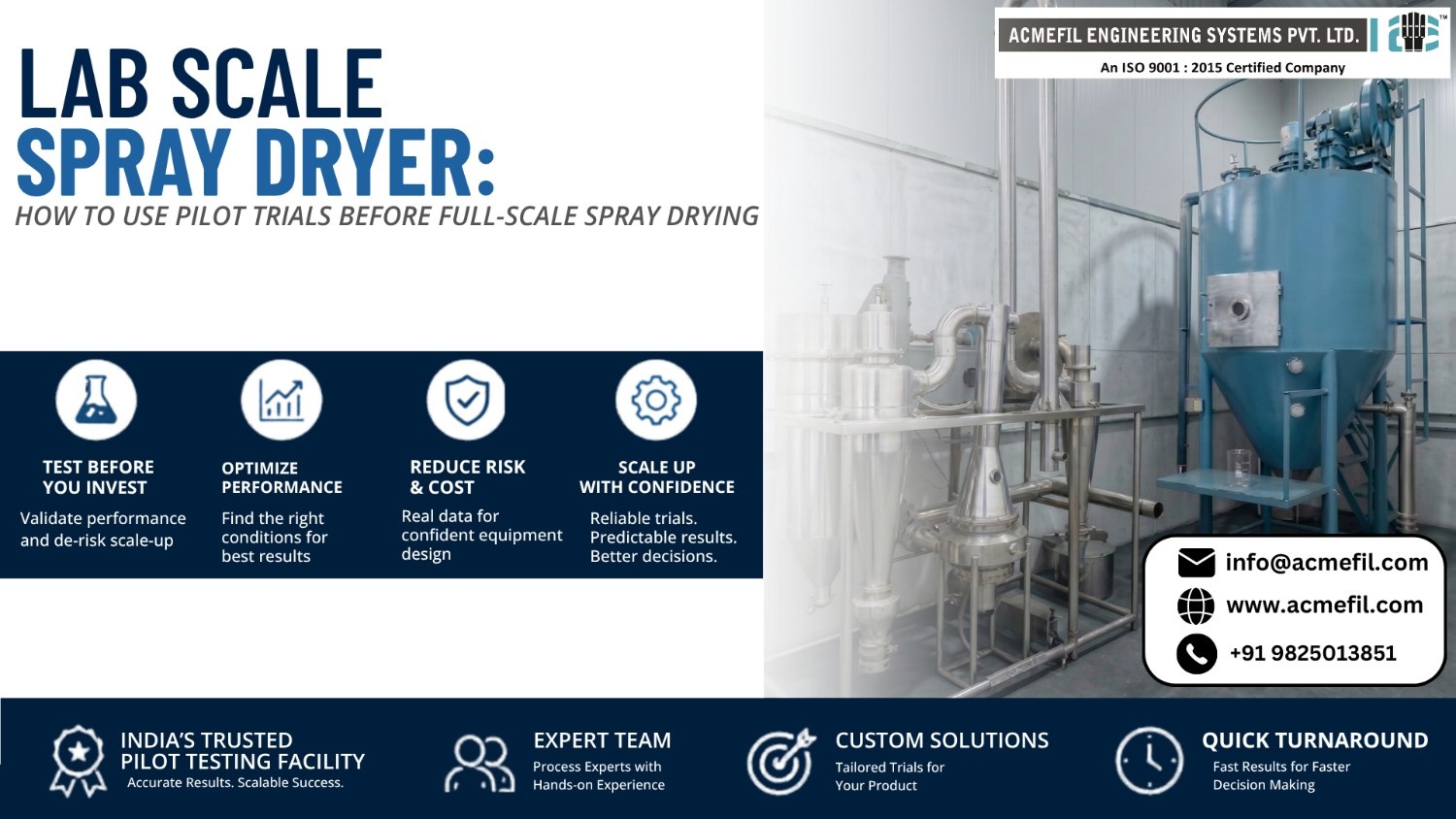
A lab scale spray dryer is used to test whether a liquid feed can be converted into a stable powder before investing in a production spray dryer. It helps validate atomization, drying temperature, powder recovery, moisture content, particle behavior, and scale-up risk using a small trial quantity instead of risking a full industrial plant.
In my view, this is where many spray drying projects should begin. A brochure specification can tell you the dryer size. A lab trial tells you whether your material will actually behave inside the dryer.
At Acmefil, our pilot spray dryer facility is built for this exact stage of decision-making. The verified pilot capacity is 3 kg/hr water evaporation, which is suitable for R&D trials, process development, new product development, universities, and research institutes.
Before you compare equipment prices, you should first answer one question: has your feed been tested under realistic spray drying conditions?
What Is a Lab Scale Spray Dryer?
A lab scale spray dryer is a small spray drying system used for laboratory testing, formulation trials, process development, and early scale-up studies. It works on the same basic principle as an industrial spray dryer, but at a smaller water evaporation capacity.
The process has four main steps:
- Atomization of the liquid feed into droplets
- Contact between droplets and hot drying air
- Rapid evaporation of moisture from each droplet
- Separation of dry powder from air through cyclone, bag filter, or collection system
The purpose is not just to “make powder.” The purpose is to understand whether the feed can be spray dried consistently and what operating window is required.
A good lab scale spray dryer trial should answer questions like:
- Does the feed atomize cleanly?
- Does it stick to the chamber wall?
- What inlet and outlet temperature range gives acceptable powder?
- Is the product heat-sensitive?
- Is the powder free-flowing, sticky, fluffy, dense, or agglomerated?
- What is the likely moisture target?
- Which atomizer type is more suitable?
- Can the process be scaled to pilot or production size?
For a general process foundation, you can also read our guide on how a spray dryer works.
Why Lab Scale Spray Drying Matters Before Commercial Production
A full-scale spray dryer is a capital equipment decision. The wrong selection affects plant layout, utility load, powder quality, maintenance, and production economics.
The lab scale stage reduces uncertainty before that investment.
I do not treat a lab spray dryer only as an R&D machine. I treat it as a risk filter. It helps identify problems that are much cheaper to solve before the production plant is designed.
Common risks caught during lab or pilot trials include:
- Feed viscosity too high for stable atomization
- Suspended solids settling before atomization
- Sticky powder depositing on chamber walls
- Outlet moisture not reaching target
- Low powder recovery
- Product discoloration due to temperature sensitivity
- Poor particle size distribution
- Foam formation in the feed tank
- Nozzle choking or unstable spray pattern
- Need for pre-concentration, filtration, or formulation adjustment
A buyer who skips this stage may still get a dryer. But the dryer may not deliver the powder quality expected by R&D, quality control, or the customer.
That is why pilot testing is especially important for pharmaceuticals, food ingredients, herbal extracts, enzymes, dyestuffs, pigments, ceramics, specialty chemicals, and new formulations.
Lab Scale Spray Dryer vs Pilot Spray Dryer vs Production Spray Dryer
The terms “lab scale” and “pilot scale” are sometimes used loosely. In practical project discussions, the difference is not just size. It is the purpose of the trial.
| Dryer Type | Main Purpose | Typical User | What It Helps Decide |
|---|---|---|---|
| Lab scale spray dryer | Small sample preparation and early feasibility testing | R&D lab, university, formulation team | Can this material be spray dried at all? |
| Pilot spray dryer | Process development and scale-up validation | R&D head, process engineer, equipment buyer | What operating window and dryer configuration are suitable? |
| Production spray dryer | Commercial powder manufacturing | Plant team, production unit, manufacturer | How to produce powder continuously at required capacity? |
A lab scale spray dryer is useful when you are still proving feasibility. A pilot spray dryer is more useful when you are closer to equipment selection and want scale-up confidence.
For buyers evaluating smaller production needs, this article also connects with our guide on spray dryer for small scale production.
The Most Common Mistake: Confusing Feed Rate With Water Evaporation Rate
This is one of the first points I clarify with buyers.
A lab scale spray dryer capacity of 3 kg/hr water evaporation does not automatically mean 3 kg/hr feed rate. Feed rate depends on how much water or solvent must be removed from the feed.
For example, a feed with low solids will require more evaporation per kg of powder produced. A feed with higher solids may produce more powder at the same water evaporation load. Viscosity, pumpability, atomization quality, inlet temperature, outlet temperature, and powder recovery also affect the practical trial output.
So when you compare lab scale spray dryer options, do not ask only, “What is the capacity?”
Ask:
- Is this water evaporation capacity or feed throughput?
- What feed solids percentage is assumed?
- What outlet moisture target is expected?
- Is the feed aqueous or solvent-based?
- Is the feed heat-sensitive?
- What atomizer is being used?
- How much trial material is needed to produce useful data?
This distinction prevents wrong scale-up assumptions.
When Should You Use a Lab Scale Spray Dryer?
A lab scale spray dryer is useful when the product, formulation, or drying behavior is not yet fully proven.
It is especially useful in these cases:
| Application Situation | Why Lab Trial Helps |
|---|---|
| New product development | Confirms whether the liquid feed can become stable powder |
| Food ingredient development | Tests flavor, color, moisture, and powder recovery under controlled drying |
| Herbal extract drying | Checks stickiness, hygroscopic behavior, and thermal sensitivity |
| Pharmaceutical intermediate drying | Helps evaluate heat sensitivity, powder consistency, and process feasibility |
| Dye and pigment slurry drying | Tests atomization, solids behavior, wall deposition, and final powder quality |
| Ceramic slurry drying | Helps understand particle behavior and powder handling |
| Enzyme or biochemical drying | Checks whether lower outlet temperature and controlled drying are needed |
| University or institute research | Generates sample powder and process data for development work |
| Pre-commercial validation | Reduces uncertainty before a full-size spray dryer order |
A trial is not always required for standard materials where process data already exists. But when the material is new, expensive, heat-sensitive, sticky, abrasive, or commercially important, a lab scale spray dryer trial is usually worth the time.
What Data Should a Lab Scale Spray Dryer Trial Produce?
A useful trial should produce more than a powder sample. It should produce engineering data.
At minimum, I would want the following information from a serious trial:
| Trial Data | Why It Matters |
|---|---|
| Feed solids percentage | Determines evaporation load and expected powder yield |
| Feed viscosity | Affects pump selection, atomization, and droplet formation |
| Feed temperature | Influences viscosity and spray stability |
| Inlet air temperature | Controls drying energy entering the chamber |
| Outlet air temperature | Better indicator of product thermal exposure |
| Feed rate | Helps estimate scale-up basis |
| Atomizer type | Impacts droplet size, particle size, and powder morphology |
| Powder moisture | Confirms whether target dryness is achievable |
| Powder recovery | Shows product loss and collection behavior |
| Wall deposition | Indicates stickiness or drying chamber design concerns |
| Particle behavior | Helps judge flowability, density, and packaging suitability |
| Cleaning observations | Important for food, pharma, and frequent product changeover |
If the trial only tells you “powder formed,” it is incomplete.
For deeper operating parameter control, read how to optimize spray drying parameters.
Atomizer Selection in Lab Scale Spray Drying
Atomization is the heart of spray drying. The droplet size produced at the atomizer strongly affects drying behavior, particle size, moisture removal, and powder recovery.
For lab scale and pilot trials, the common atomization options are:
| Atomizer Type | Best Fit | Buyer Watch Point |
|---|---|---|
| Two-fluid nozzle | Small batches, fine droplets, R&D work, low feed rate trials | Requires compressed air and careful nozzle control |
| Pressure nozzle | Higher-pressure feed atomization and defined droplet formation | Feed must be pumpable and stable under pressure |
| Rotary atomizer | Slurries, suspended solids, and applications needing broader process flexibility | Disc speed and feed behavior must be evaluated carefully |
There is no universal “best” atomizer. The right choice depends on feed rheology, solids content, target particle size, heat sensitivity, and commercial powder requirement.
If you are comparing atomization options, our article on spray dryer atomization techniques will help you understand the selection logic.
What Materials Can Be Tested in a Lab Scale Spray Dryer?
A lab scale spray dryer can be used for many liquid feeds that are pumpable and capable of atomization. The feed may be a solution, suspension, slurry, emulsion, extract, or concentrate, depending on the equipment configuration and trial objective.
Common application categories include:
- Milk products and food ingredients
- Herbal extracts and plant-based extracts
- Enzymes and biochemical products
- Pharmaceutical intermediates
- Dyes and pigments
- Ceramic slurry
- Detergent-related ingredients
- Inorganic chemicals
- Flavors and food colors
- Research formulations for universities and institutes
The important word is “testable,” not “guaranteed.”
Some feeds look simple in a beaker but become difficult inside the dryer. High sugar content, stickiness, high viscosity, poor filtration, foam, abrasive solids, heat sensitivity, and solvent behavior can all change the result.
That is why a trial should include realistic feed preparation and honest observation, not just a clean demonstration.
How Lab Trials Support Spray Dryer Scale-Up
Scale-up is not a straight multiplication of lab results.
A production spray dryer has different chamber geometry, air flow, residence time, atomizer energy, powder separation arrangement, cleaning requirements, and control philosophy. Still, a lab scale spray dryer trial gives useful direction.
It helps establish:
- Whether spray drying is technically feasible
- Approximate inlet and outlet temperature range
- Powder moisture behavior
- Atomizer suitability
- Stickiness or wall deposition risk
- Need for pre-treatment or feed concentration
- Powder collection and recovery tendency
- Whether a nozzle, rotary atomizer, fluidized, or other design direction should be considered
For production equipment selection, the lab result must be interpreted by a process engineer. A trial does not replace design. It informs design.
That is why the trial report should be connected to the next step, such as dryer type selection, chamber sizing, hot air system selection, separation system selection, and layout discussion.
For a broader design perspective, read spray dryer design and components.
What Makes ACMEFIL’s Pilot Spray Dryer Facility Useful?
Acmefil operates an in-house R&D and pilot plant facility for process development and trials. The pilot spray dryer capacity is 3 kg/hr water evaporation.
This matters because the trial is not separated from equipment design. The same engineering thinking used for full-scale spray dryer selection is applied during pilot evaluation.
For buyers, this creates three advantages:
- Trial results can be interpreted for scale-up
A powder sample is useful. But scale-up guidance is more useful. The trial can show whether the material needs nozzle atomization, rotary atomization, different feed preparation, temperature adjustment, or design caution. - The buyer can reduce full-scale procurement risk
Before committing to a production spray dryer, the buyer gets evidence about material behavior. This is especially valuable for new formulations, export-oriented products, and high-value specialty powders. - R&D and commercial teams can align early
Many projects fail because the lab team wants one powder property, while the production team selects equipment on capacity and price. A pilot trial helps both sides discuss the same data.
You can also review Acmefil’s dedicated pilot spray dryer facility and lab scale spray dryer page for commercial enquiry context.
Lab Scale Spray Dryer Selection Checklist
Before selecting a lab scale spray dryer or booking a pilot trial, collect the right process information.
| Information Needed | Why It Is Required |
|---|---|
| Product name and application | Helps understand industry requirements and quality expectations |
| Feed type | Solution, slurry, suspension, emulsion, extract, or concentrate |
| Feed solids percentage | Required to estimate evaporation load |
| Feed viscosity | Helps judge pumpability and atomization |
| Solvent system | Aqueous or solvent-based feed changes dryer safety and configuration needs |
| Heat sensitivity | Helps define inlet and outlet temperature limits |
| Target final moisture | Determines drying requirement |
| Required powder quantity | Decides whether lab, pilot, or small production trial is suitable |
| Target particle size | Helps select atomizer type |
| Bulk density requirement | Important for packaging and downstream use |
| Hygroscopic or sticky behavior | Helps identify deposition and recovery risks |
| Cleaning requirement | Important for food, pharma, and multi-product use |
| Scale-up objective | Sample generation, formulation screening, pilot validation, or production planning |
If you cannot provide every detail, start with what you have. But do not hide known problems like stickiness, foaming, settling, or heat sensitivity. Those details are exactly what a trial is meant to test.
Lab Scale Spray Dryer for Food, Pharma, Chemical, and R&D Applications
The value of a lab scale spray dryer changes by industry.
In food applications, the trial usually focuses on flavor retention, color, moisture, powder flow, and heat exposure. Milk-based products, beverage ingredients, food colors, herbal extracts, and enzymes all need careful drying conditions.
In pharmaceutical and biochemical applications, the trial may focus on heat sensitivity, powder consistency, process repeatability, and hygienic handling requirements. Some applications may need special configurations such as closed loop or sterile drying systems. These should be discussed case by case, not assumed from a general lab dryer.
In chemical, dye, pigment, and ceramic applications, the trial often focuses on slurry handling, solids behavior, abrasive content, wall deposition, particle size, and recovery. A material that atomizes poorly at lab scale will not become easier at production scale unless the feed or equipment design changes.
For broader application mapping, read applications of spray dryers.
How to Judge a Successful Lab Scale Spray Dryer Trial
A successful trial is not simply one where powder comes out.
A successful trial should create a practical decision.
The result should help you decide one of these paths:
- Move forward to pilot scale or production design
- Modify feed solids or formulation
- Change atomizer type
- Adjust drying temperature range
- Add pre-filtration or pre-concentration
- Reconsider whether spray drying is the right technology
- Compare spray drying with another drying method
- Produce more sample quantity for customer validation
In some projects, the best result of a trial is learning that spray drying is not suitable in the current feed condition. That may sound negative, but it can save a large wrong investment.
If the trial exposes a problem early, it has done its job.
Lab Scale Spray Dryer vs Other Drying Methods
A lab scale spray dryer is not the answer for every material. It is best when the feed can be pumped, atomized, and dried rapidly into powder.
For pastes, filter cakes, or very viscous materials, other equipment such as spin flash dryer, flash dryer, fluid bed dryer, or agitated thin film dryer may be more suitable.
| Feed Condition | Spray Dryer Fit | Better Alternative to Consider |
|---|---|---|
| Pumpable liquid solution | Strong fit | Spray dryer |
| Low-viscosity slurry | Possible, depends on solids and atomization | Spray dryer or rotary atomizer spray dryer |
| Sticky high-sugar extract | Needs trial | Spray dryer with careful formulation or process adjustment |
| Filter cake | Poor fit | Spin flash dryer or flash dryer |
| Wet granules | Not ideal | Fluid bed dryer |
| Concentrated viscous slurry | Case-specific | ATFD, spin flash dryer, or special drying route |
| Solvent-based feed | Needs special design | Closed loop spray dryer |
This is why the first discussion should not be “Which dryer is cheapest?” It should be “What is the material behavior?”
For technology comparison, see spray dryer vs freeze dryer and comparing spray drying with other technologies.
What to Ask Before Booking a Lab Scale Spray Dryer Trial
Before sending material for a trial, ask these questions:
- What is the actual water evaporation capacity of the trial dryer?
- Which atomizer will be used?
- Can the dryer test my feed viscosity and solids level?
- What quantity of feed sample is required?
- What trial data will be recorded?
- Will I receive powder samples and operating observations?
- Can the trial result be used for production scale discussion?
- Are there limitations for solvent-based, sticky, abrasive, or heat-sensitive products?
- Is the facility suitable for my industry requirement?
- What process information should I share before the trial?
A good supplier should welcome these questions. If the answer is only “send material and we will run it,” the trial may not give enough engineering value.
What Process Details Should You Share With ACMEFIL?
When you approach Acmefil for a lab scale spray dryer or pilot spray dryer trial, share the following details:
- Product name and industry
- Feed composition, if shareable
- Feed solids percentage
- Feed viscosity or flow behavior
- Current moisture content
- Target final moisture
- Heat sensitivity
- Solvent or aqueous base
- pH, if relevant
- Suspended solids or abrasive content
- Required powder quantity
- Target particle size or bulk density
- Current drying method, if any
- Commercial production target, if known
- Trial objective: feasibility, sample powder, process development, or scale-up
This helps the technical team decide whether the trial should be run directly or whether feed preparation changes are required first.
Final View: Use the Lab Dryer to De-Risk the Full Plant
A lab scale spray dryer is not just a small machine. Used correctly, it is a decision tool.
It helps you move from assumption to process evidence. It shows whether your feed atomizes, dries, separates, and recovers as a usable powder. It also tells the engineering team what must be considered before selecting a full-scale spray dryer.
If you are developing a food ingredient, herbal extract, pharmaceutical intermediate, dyestuff, pigment, ceramic slurry, biochemical product, or specialty chemical powder, do not begin with a production dryer quotation alone.
Begin with the material.
Then run the trial.
Then design the dryer.
FAQs
What is a lab scale spray dryer used for?
A lab scale spray dryer is used for R&D trials, formulation development, sample powder generation, and process feasibility testing. It helps check whether a liquid feed can be atomized, dried, and recovered as powder before moving to pilot or production spray drying.
What is the capacity of ACMEFIL’s pilot spray dryer?
ACMEFIL’s pilot spray dryer has a verified capacity of 3 kg/hr water evaporation. This is water evaporation capacity, not fixed feed throughput. Actual feed rate depends on feed solids, moisture removal requirement, viscosity, temperature range, and powder recovery behavior.
Can lab scale spray dryer results be scaled to production?
Lab scale spray dryer results can guide scale-up, but they should not be multiplied directly into production capacity. The trial helps define atomizer selection, temperature range, drying behavior, powder recovery, and design risk. Production scale still requires engineering evaluation.
Which industries use lab scale spray dryers?
Lab scale spray dryers are used in food, pharmaceutical, biochemical, chemical, dyestuff, pigment, ceramic, detergent, and research applications. They are especially useful for new products, heat-sensitive materials, sticky feeds, and formulations where powder quality must be validated before commercial production.
What sample details are needed for a spray drying trial?
The most useful details are feed solids percentage, viscosity, solvent or water base, target final moisture, heat sensitivity, required powder quantity, particle size target, bulk density requirement, and commercial production goal. These details help plan a meaningful trial instead of a simple demonstration.
Need to Test Your Product Before Buying a Spray Dryer?
If you are unsure whether your feed can be spray dried, start with a lab scale or pilot spray dryer trial. Share your feed details, target powder quality, moisture requirement, and scale-up objective with Acmefil’s technical team.
You can begin with the pilot spray dryer enquiry page or speak with the team through Acmefil contact.

Siddharth Nair is Technical Director at Acmefil Engineering Systems Pvt. Ltd. he leads solution design and applications engineering across the company’s full product range — spray dryers, multi-effect evaporators, agitated thin film dryers, spin flash dryers, fluid bed dryers, and complete ZLD systems.
His work spans process evaluation, equipment sizing, customer application consulting, and technical proposal development for industries including food and dairy, pharmaceuticals, chemicals, dyestuffs, ceramics, and industrial effluent treatment. He has hands-on commissioning experience across Acmefil’s 500+ installations in India and 15+ countries.
He holds a BTech in Mechanical Engineering from CHARUSAT University and also partners at A.S Engineers, working with blowers, sludge dryers, and industrial conveying systems.


