
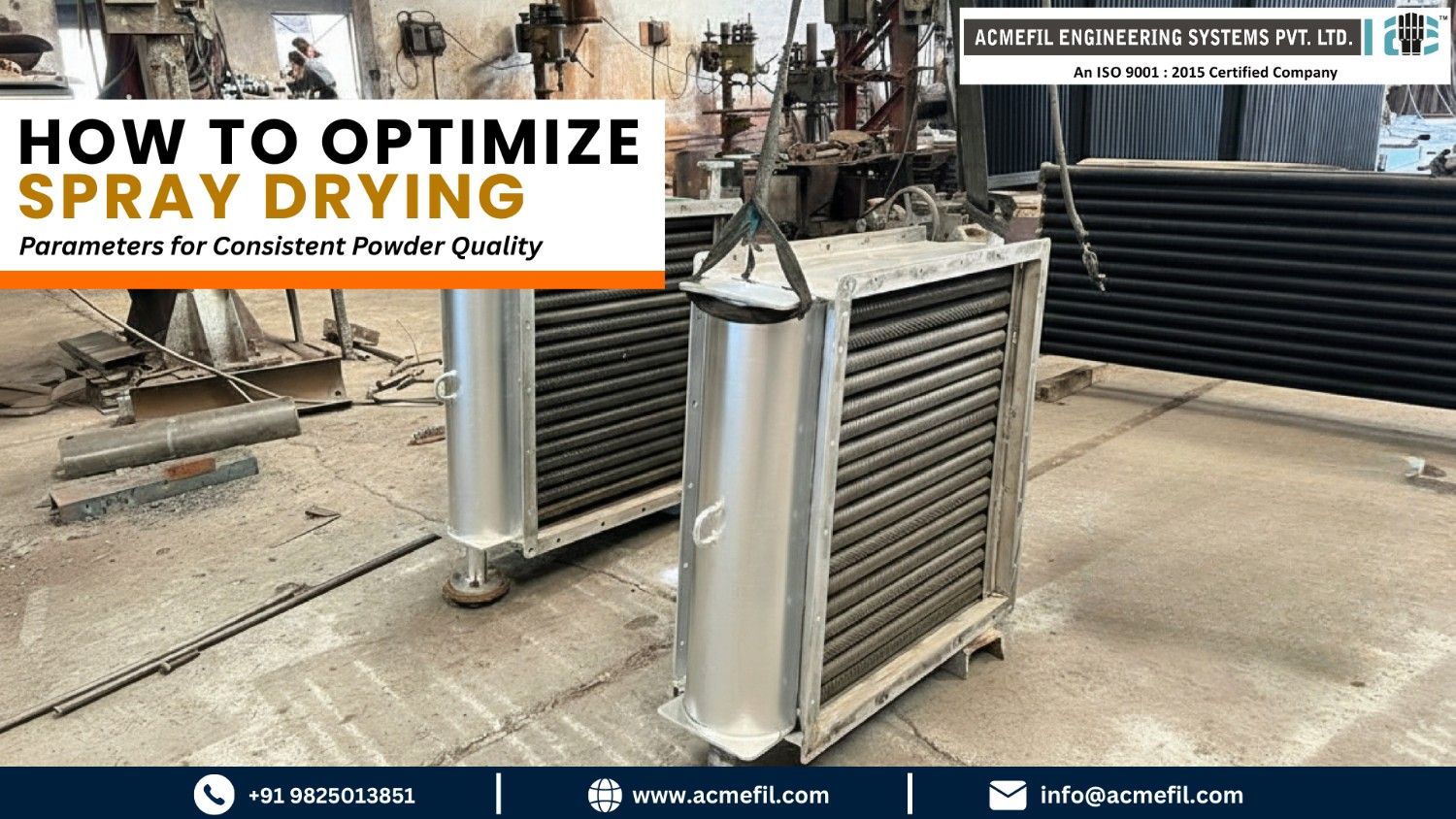
How to Optimize Spray Drying Parameters for Consistent Powder Quality
Spray drying does not improve because one parameter is increased or decreased blindly. The correct way to optimize spray drying parameters is to control the relationship between feed solids, feed rate, inlet temperature, outlet temperature, atomization, airflow, and powder collection. In my experience, most drying problems start when these parameters are treated separately instead of as one connected system.
If the powder is too wet, sticky, thermally damaged, dusty, or inconsistent in particle size, the answer is usually not “increase temperature.” The answer is to understand which part of the drying curve is failing.
For a basic understanding of the process, you can first read our guide on how a spray dryer works. This article goes deeper into the practical parameter decisions that affect final powder quality.
What Are Spray Drying Parameters?
Spray drying parameters are the operating conditions that control how a liquid feed becomes a dry powder. The most important parameters are:
- Feed solids concentration
- Feed viscosity and temperature
- Feed rate
- Inlet air temperature
- Outlet air temperature
- Atomizer type and atomization energy
- Droplet size distribution
- Airflow rate and air distribution
- Residence time inside the drying chamber
- Powder separation and collection efficiency
A spray dryer works in four broad stages: atomization, spray-air contact, droplet drying, and powder separation. If any one stage is unstable, the final powder quality changes.
At Acmefil, this is why we do not look only at the machine size. We first look at the product behavior. A dye slurry, a ceramic slurry, a milk-based feed, an enzyme solution, and a pharmaceutical extract do not respond to drying air in the same way.
Start With Feed Characterization, Not Temperature
Many operators start optimization from inlet temperature. I prefer to start from the feed.
Before changing the dryer settings, collect these details:
| Feed Property | Why It Matters in Spray Drying |
|---|---|
| Total solids | Higher solids reduce water evaporation load, but can increase viscosity |
| Viscosity | High viscosity affects atomization and may create larger droplets |
| Feed temperature | Warmer feed may atomize better, but heat-sensitive products need caution |
| Suspended solids | Important for nozzle wear, blockage risk, and rotary atomizer selection |
| Sugar, protein, or resin content | Can increase stickiness and wall deposition |
| Solvent or water base | Solvent-based feeds may need closed loop or inert drying design |
| Target moisture | Decides outlet temperature and residence time requirements |
| Target particle size | Decides atomizer type, pressure, speed, and droplet formation |
A common mistake is increasing inlet temperature to solve high moisture without checking feed solids and droplet size. If the droplets are too large, the outside may dry while the inside remains wet. The powder then becomes sticky, hollow, or inconsistent.
For product trials before full-scale selection, Acmefil’s pilot spray dryer can be used to validate drying behavior at small scale before committing to plant-level design.
Inlet Temperature: Control Drying Rate, Not Just Heat
Inlet temperature is the temperature of hot air entering the drying chamber. It controls the initial evaporation rate.
A higher inlet temperature can increase drying capacity, but it can also damage heat-sensitive products if the product remains exposed for too long or if the outlet temperature rises beyond the safe limit. For products like enzymes, herbal extracts, food ingredients, and pharmaceutical intermediates, the product’s thermal sensitivity must decide the safe operating window.
For ceramic slurry, inorganic chemicals, and some dyestuff applications, higher thermal loads may be acceptable. But even then, inlet temperature should be matched with atomization and airflow. A hot chamber with poor droplet dispersion still creates wall deposition and uneven drying.
The practical question is not “What is the highest inlet temperature we can run?” The better question is:
Can we achieve the required moisture and powder properties at the lowest stable thermal stress?
That is the starting point of serious spray dryer optimization.
Outlet Temperature: The Parameter Most Operators Underestimate
Outlet temperature is one of the strongest indicators of final powder moisture. It is not controlled independently. It is affected by:
- Inlet air temperature
- Feed rate
- Feed solids
- Airflow
- Evaporation load
- Chamber heat loss
- Product drying behavior
If outlet temperature drops below the process window, powder moisture usually increases. If it rises too high, the powder may overdry, lose volatiles, degrade, or become more brittle.
For heat-sensitive products, outlet temperature often matters more than inlet temperature because it is closer to the thermal condition experienced near the end of drying.
A useful operating discipline is to track outlet temperature together with final moisture and bulk density. If outlet temperature is stable but moisture still fluctuates, the problem may be feed solids variation, atomization instability, cyclone leakage, or uneven air distribution.
Feed Rate: Match Evaporation Load With Dryer Capacity
Feed rate controls how much liquid enters the drying chamber per hour. If feed rate is increased without enough evaporation capacity, the dryer becomes overloaded.
Typical symptoms of excessive feed rate include:
- High final moisture
- Sticky powder
- Wall deposits
- Wet chamber bottom
- Poor cyclone recovery
- Unstable outlet temperature
Reducing feed rate can improve drying, but it is not always the best long-term answer. A very low feed rate may reduce plant productivity and increase energy cost per kilogram of powder.
The correct feed rate is the rate at which the dryer can maintain:
- Stable outlet temperature
- Target final moisture
- Acceptable powder temperature
- Proper particle size
- Clean chamber operation
- Consistent powder recovery
For commercial operation, the aim is not only to make one good batch. The aim is to hold that window continuously.
Atomization: Where Particle Size Control Begins
Atomization is the process of breaking liquid feed into droplets. Droplet size strongly affects drying time, particle size, bulk density, flowability, and powder recovery.
If droplets are too large, drying may remain incomplete. If droplets are too fine, powder may become dusty and harder to recover. Fine particles can also increase losses through the exhaust if the separation system is not designed properly.
Acmefil manufactures different spray dryer configurations, including rotary atomizer type spray dryers and nozzle atomizer type spray dryers. The right choice depends on feed behavior and target powder properties.
You can also compare the selection logic in our guide on nozzle vs rotary atomizer spray dryers.
| Atomization Option | Best Fit | Parameter to Watch |
|---|---|---|
| Rotary atomizer | Slurries, feeds needing controlled droplet distribution, variable feed rates | Disc speed, disc type, feed distribution |
| Pressure nozzle | Finer or controlled particles where feed can be pumped at pressure | Nozzle pressure, orifice wear, blockage |
| Two-fluid nozzle | Small-scale trials, fine atomization, low feed rate applications | Compressed air flow, feed stability, nozzle cleaning |
| Fluidized spray dryer design | Agglomerated or larger particles | Fines recycle, bottom fluid bed drying, product residence time |
For more detail on this stage, read our guide on spray dryer atomization techniques.
Feed Solids: Reduce Water Load, But Respect Viscosity
Increasing feed solids is often useful because it reduces the amount of water that must be evaporated. But there is a limit.
If solids are increased too much, viscosity rises. High viscosity can disturb atomization, increase droplet size, overload the atomizer, and create unstable particle formation.
For example, in food and dairy applications such as milk products, maltodextrin-based powders, soup mixes, and herbal extracts, feed concentration affects stickiness and final powder flow. In dyestuff and pigment applications, suspended solids and abrasive particles also affect atomizer and nozzle selection.
A good trial plan should test more than one feed solids level. Do not optimize only temperature and feed rate while keeping feed formulation uncontrolled.
Airflow and Air Distribution: The Hidden Cause of Uneven Drying
Airflow decides how effectively heat reaches the droplets and how long particles remain suspended in the chamber.
Poor airflow distribution can create:
- Hot spots
- Wet zones
- Chamber wall deposits
- Powder scorching
- Uneven moisture
- Product carryover
- Inconsistent particle residence time
Air distribution is especially important when scaling from pilot to commercial spray dryer. A setting that works in a small dryer cannot be copied directly to a large chamber unless residence time, droplet trajectory, evaporation load, and air pattern are considered.
This is why spray dryer design and operation must be connected. For the equipment-side fundamentals, read our guide on spray dryer design and components.
Parameter Interaction Table
The table below is useful during troubleshooting and process trials.
| Problem Seen in Powder | Likely Parameter Area | What to Check First |
|---|---|---|
| High final moisture | Outlet temperature, feed rate, droplet size | Reduce feed load, check atomization, verify inlet and outlet temperature stability |
| Sticky powder | Product composition, outlet temperature, wall temperature | Check sugars, proteins, resin behavior, outlet temperature, airflow pattern |
| Powder too fine | Atomization energy too high, low solids | Reduce atomizer speed or atomizing pressure, review feed concentration |
| Powder too coarse | Droplets too large, high viscosity | Check feed viscosity, nozzle condition, rotary disc speed, feed solids |
| Wall deposition | Droplet trajectory, airflow, stickiness | Check atomizer alignment, chamber airflow, feed formulation, outlet temperature |
| Low yield | Cyclone/bag filter loss, fines, wall deposits | Inspect separation system, seals, airflow, particle size distribution |
| Nozzle blockage | Suspended solids, viscosity, filtration | Pre-filter feed where suitable, inspect nozzle wear and feed preparation |
| Thermal degradation | High outlet temperature or residence time | Lower thermal exposure, review feed rate, airflow, and product heat sensitivity |
This is also why troubleshooting should not be random. Change one variable at a time, record the result, and build a stable operating window.
How I Would Optimize a Spray Dryer in Practice
I would not begin with a full production run. I would begin with a controlled trial.
1. Define the Powder Target
Before adjusting parameters, define the target quality:
- Final moisture
- Bulk density
- Particle size distribution
- Flowability
- Solubility or dispersibility
- Color, aroma, or active retention where relevant
- Yield and collection efficiency
- Storage stability
Without a quality target, optimization becomes guesswork.
2. Fix the Feed Preparation Method
Keep feed preparation consistent:
- Same solids level
- Same filtration method
- Same feed tank agitation
- Same feed temperature
- Same holding time
- Same viscosity range
If feed changes every hour, the spray dryer cannot produce consistent powder even if the machine settings look correct.
3. Establish a Safe Thermal Window
Set inlet and outlet temperature based on product sensitivity, target moisture, and dryer capacity.
For heat-sensitive material, avoid chasing high inlet temperature unless the residence time and outlet temperature remain safe. For more stable inorganic or ceramic products, the allowable thermal window may be wider, but product morphology still needs control.
4. Optimize Atomization Before Increasing Heat
If drying is incomplete, check droplet formation before raising temperature.
Ask:
- Are the droplets too large?
- Is the nozzle worn?
- Is atomizer speed stable?
- Is feed viscosity higher than expected?
- Is spray pattern hitting the chamber wall?
- Is the droplet distribution suitable for target powder size?
Better atomization often solves problems that operators wrongly blame on temperature.
5. Adjust Feed Rate Gradually
Once atomization and thermal window are stable, increase feed rate gradually while monitoring outlet temperature and powder moisture.
The maximum feed rate is not the pump’s maximum capacity. It is the highest feed rate at which the dryer can maintain target quality continuously.
6. Verify Powder Collection
Do not ignore the cyclone, bag filter, airlock rotary valve, and discharge arrangement. A dryer can produce acceptable powder but still lose product because fines are not separated properly.
Powder recovery is part of spray dryer optimization, not a separate maintenance issue.
For maintenance-related causes of performance loss, see our guide on spray dryer maintenance tips.
Pilot Trials Reduce Full-Scale Risk
Spray drying is product-specific. A parameter window that works for milk powder may not work for herbal extract. A setting that works for ceramic slurry may not suit dye intermediates. A nozzle setup that gives fine powder may be unsuitable for a high-solids slurry.
This is why pilot trials are valuable.
Acmefil’s in-house R&D facility includes a lab scale pilot spray dryer with 3 kg/hr water evaporation capacity. For customers developing new products or shifting from batch drying to spray drying, this trial helps answer three practical questions:
- Can the feed be atomized properly?
- Can the product reach target moisture without quality loss?
- Which atomizer and operating window should be considered for scale-up?
A pilot trial will not remove every scale-up calculation, but it reduces uncertainty before full-scale procurement.
Common Mistakes While Optimizing Spray Drying Parameters
Optimizing Temperature Without Checking Feed Solids
If feed solids vary, outlet temperature and moisture will fluctuate. Stabilize the feed first.
Ignoring Atomizer Wear
A worn nozzle or unbalanced rotary atomizer changes droplet size. The temperature may look correct, but the powder will still drift out of specification.
Treating Outlet Temperature as a Result Only
Outlet temperature is not just a number on the panel. It is a live indicator of evaporation balance.
Copying Parameters From Another Product
Spray drying parameters are not universal. Even two products in the same industry can behave differently because of solids content, viscosity, sugar content, particle morphology, or heat sensitivity.
Running Full-Scale Trials Too Early
If product behavior is not understood at pilot scale, full-scale trials become expensive and difficult to troubleshoot.
Spray Drying Parameters for Different Applications
| Application | Parameter Sensitivity | Practical Focus |
|---|---|---|
| Milk and dairy powders | Heat sensitivity, solubility, bulk density | Outlet temperature, feed solids, airflow, agglomeration behavior |
| Herbal extracts | Stickiness, active retention, color | Lower thermal stress, drying aids if approved, controlled outlet temperature |
| Enzymes and biochemical products | Activity retention | Short exposure, controlled outlet temperature, gentle drying window |
| Dyestuff and pigments | Slurry handling, particle size, abrasiveness | Atomizer selection, feed agitation, nozzle wear, collection efficiency |
| Ceramic slurry | Particle size distribution, flowability | Atomization control, solids loading, chamber airflow |
| Detergent powders | Agglomeration and particle size | Fluidized drying stage, fines recycle, controlled particle build-up |
| Pharmaceutical powders | Moisture, morphology, contamination control | Atomization, outlet temperature, sterile or closed loop design where required |
For pharma-specific applications, you can also read our article on spray dryer applications in pharmaceuticals.
When Parameter Optimization Is Not Enough
Sometimes the problem is not the operating parameter. It is the dryer configuration.
For example:
- A pressure nozzle may not be suitable for a highly abrasive slurry.
- A standard open-cycle dryer may not be suitable for solvent-based feed.
- A basic single-stage dryer may not produce the required agglomerated particle size.
- A small cyclone may not recover very fine powder effectively.
- A chamber with poor airflow geometry may keep creating wall deposition.
In these cases, changing temperature or feed rate will only give temporary improvement. The correct answer may be atomizer change, airflow correction, chamber modification, fines recycle, fluid bed integration, or closed loop design.
If you are still selecting the equipment, read our guide on choosing the right spray dryer.
Final Practical Checklist
Before finalizing spray drying parameters, confirm these points:
- Feed solids and viscosity are measured and stable.
- Inlet temperature is selected based on product sensitivity and evaporation load.
- Outlet temperature is linked to target final moisture.
- Atomizer type matches feed behavior and target particle size.
- Droplet size is not causing wet cores or excessive fines.
- Airflow and air distribution are stable.
- Chamber wall deposits are monitored during trial.
- Cyclone or bag filter recovery is checked.
- Powder is tested for moisture, bulk density, flowability, and particle size.
- Trial data is recorded before scale-up.
A good spray drying process is not the one that runs hot. It is the one that holds product quality, powder recovery, and energy use within a stable operating window.
FAQs
Which spray drying parameter affects final moisture the most?
Outlet temperature is one of the strongest operating indicators for final moisture, but it depends on inlet temperature, feed rate, feed solids, airflow, and evaporation load. If moisture is high, do not adjust outlet temperature alone. Check feed load, droplet size, and air distribution together.
How does atomization affect spray dryer product quality?
Atomization controls droplet size. Droplet size affects drying time, particle size, bulk density, flowability, and powder recovery. Poor atomization can create wet particles, excessive fines, wall deposits, or inconsistent powder even when temperature settings appear correct.
Should I increase inlet temperature to reduce powder moisture?
Not immediately. Higher inlet temperature may improve evaporation, but it can also degrade heat-sensitive products or create poor particle morphology. First check feed rate, feed solids, atomization, and airflow. Then adjust temperature inside a controlled trial window.
Why does spray dried powder become sticky?
Stickiness can come from high outlet moisture, low glass transition behavior, sugars, proteins, resins, organic acids, poor airflow, wall deposition, or incorrect feed formulation. Reducing feed rate or changing temperature may help temporarily, but the root cause must be confirmed through product and process data.
Can pilot trials help optimize spray drying parameters?
Yes. Pilot trials help test feed atomization, drying behavior, target moisture, powder recovery, and particle quality before full-scale procurement. Acmefil’s pilot spray dryer facility supports small-scale trials so buyers can validate process parameters before committing to full-scale equipment.
Need Help Optimizing Your Spray Drying Parameters?
If your spray dryer is producing wet powder, sticky powder, poor yield, inconsistent particle size, or frequent deposits, do not change parameters randomly.
Share your feed details, current operating conditions, target moisture, and powder quality issue with Acmefil’s technical team. We can review your process and recommend whether the issue is related to feed preparation, temperature profile, atomization, airflow, dryer design, or powder collection.
Request a spray drying parameter review or explore Acmefil’s spray dryer manufacturing capabilities.

Siddharth Nair is Technical Director at Acmefil Engineering Systems Pvt. Ltd. he leads solution design and applications engineering across the company’s full product range — spray dryers, multi-effect evaporators, agitated thin film dryers, spin flash dryers, fluid bed dryers, and complete ZLD systems.
His work spans process evaluation, equipment sizing, customer application consulting, and technical proposal development for industries including food and dairy, pharmaceuticals, chemicals, dyestuffs, ceramics, and industrial effluent treatment. He has hands-on commissioning experience across Acmefil’s 500+ installations in India and 15+ countries.
He holds a BTech in Mechanical Engineering from CHARUSAT University and also partners at A.S Engineers, working with blowers, sludge dryers, and industrial conveying systems.


