
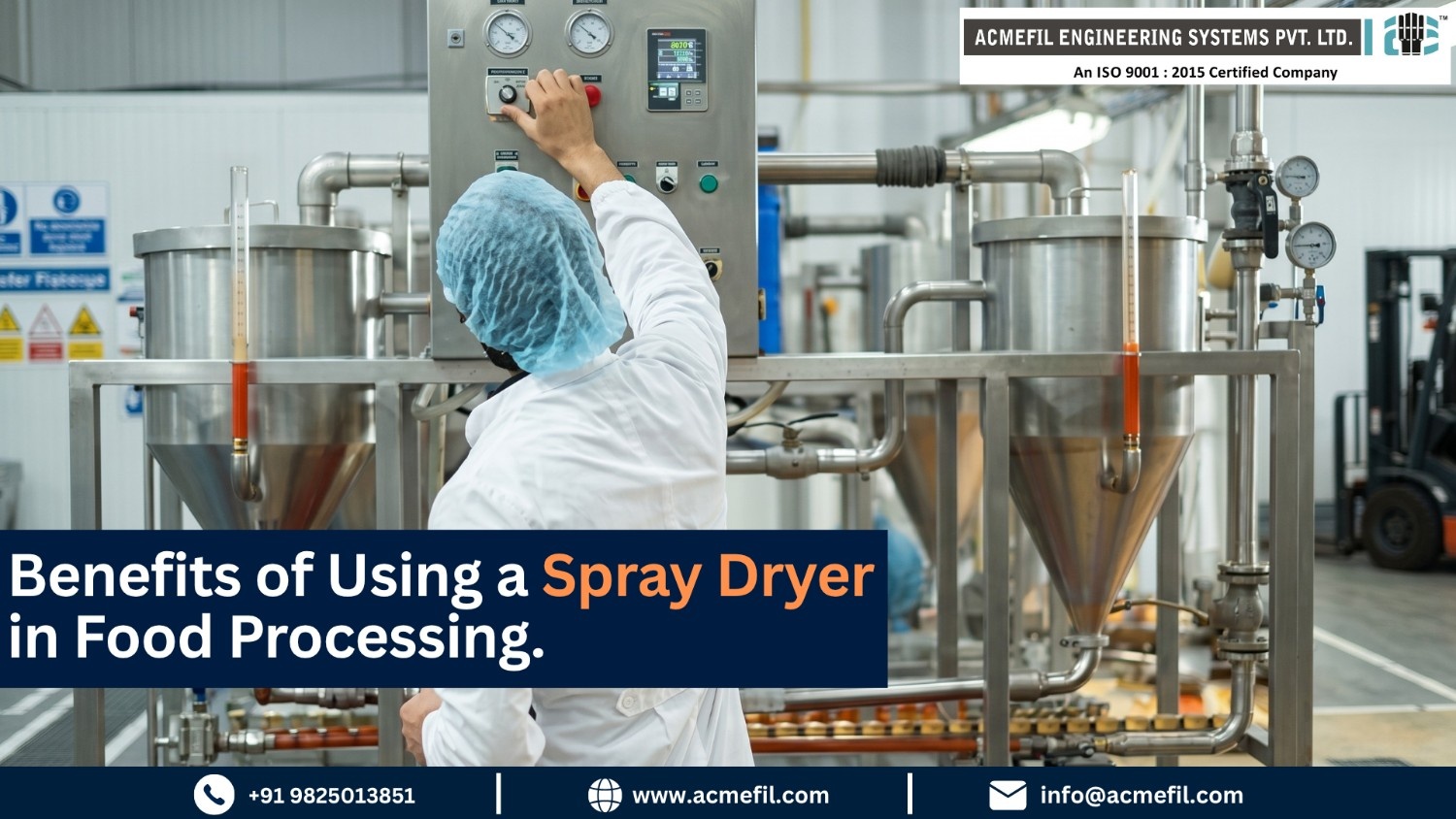
The biggest benefit of using a spray dryer in food processing is that it converts liquid or concentrated feed into a stable, free-flowing powder in one continuous drying operation. For food manufacturers, this can improve moisture control, shelf stability, solubility, particle size consistency, storage, transport, and product handling. But the real result depends on feed behaviour, atomizer selection, drying temperature, residence time, and powder collection design.
I do not look at a food spray dryer only as a drying machine. I look at it as a powder quality system.
A plant can evaporate water and still fail commercially if the final powder is sticky, slow to dissolve, uneven in particle size, or difficult to pack. That is why the correct question is not only, “What is the spray dryer capacity?” The better question is, “Can this system produce the powder behaviour my market needs?”
What Spray Drying Does in Food Processing
Spray drying converts a liquid, slurry, emulsion, or concentrated food feed into dry powder by atomizing the feed into fine droplets and contacting those droplets with hot drying air.
In practical terms, the process has four stages:
- Atomization of liquid feed into droplets
- Contact between droplets and hot drying air
- Rapid moisture evaporation from the droplets
- Separation and collection of dry powder from exhaust air
This is why spray drying is widely used for food products such as milk powder, whey powder, coffee extract, fruit juice powder, food colours, flavours, maltodextrin, soup mixes, vegetable proteins, enzymes, and other food ingredients.
For a broader equipment-level understanding, you can also read ACMEFIL’s guide on applications of spray dryers.
Key Benefits of Using a Spray Dryer in Food Processing
| Benefit | What it means in a food plant | Why it matters |
|---|---|---|
| Moisture reduction | Converts liquid or concentrated feed into dry powder | Improves shelf stability and handling |
| Controlled particle size | Atomizer and drying design influence droplet and powder size | Affects solubility, bulk density, mouthfeel, and packaging |
| Better powder handling | Produces powders that are easier to pack, blend, transport, and dose | Reduces handling problems compared with liquid feed |
| Faster drying | Droplets dry quickly because of high surface area | Useful for many heat-sensitive food ingredients |
| Continuous production | Suitable for industrial-scale powder production | Helps plants move beyond small batch drying |
| Product consistency | Process parameters can be controlled batch after batch | Supports consistent customer experience |
| Versatile food applications | Works for dairy, beverages, food additives, colours, flavours, proteins, and enzymes | Allows one technology family to serve many powder products |
| Scale-up support | Pilot trials help validate feed behaviour before full-scale design | Reduces equipment selection risk |
Why Spray Drying Helps Preserve Food Quality
Food drying is not just about removing water. It is about removing water without damaging the product.
In spray drying, liquid feed is broken into small droplets. Because each droplet has a high surface area, moisture evaporates quickly. The particle does not remain in the hot air stream for a long time. This is one reason spray drying is used for products where flavour, colour, solubility, nutrient sensitivity, or aroma retention matters.
This does not mean every heat-sensitive product will automatically perform well in a spray dryer. Enzymes, flavours, colours, proteins, and fruit-based products still need careful control of inlet temperature, outlet temperature, feed concentration, residence time, and powder recovery.
A common buyer mistake is assuming that a spray dryer is “safe for food products” simply because the drying time is short. In reality, the feed chemistry decides the risk.
For example:
- A milk-based feed behaves differently from a fruit juice concentrate.
- A protein feed behaves differently from a flavour emulsion.
- A sugar-rich fruit powder may stick to the chamber wall if glass transition behaviour is ignored.
- An enzyme product may lose activity if the drying profile is not controlled properly.
This is why feed testing matters before final equipment sizing.
Spray Dryer Benefits for Food Powder Stability
One of the main benefits of spray drying in food processing is improved powder stability.
When moisture is reduced to the required level, the food product becomes easier to store and transport than liquid feed. This is especially important for dairy powders, beverage powders, flavour systems, soup mixes, food colours, and nutritional ingredients.
A stable powder can help manufacturers:
- reduce dependence on liquid storage,
- improve bulk handling,
- simplify packing,
- reduce transport weight,
- improve blending with other dry ingredients,
- support longer distribution cycles.
The exact shelf life still depends on the product formulation, final moisture, water activity, packaging, storage temperature, and hygiene controls. I would not publish a shelf-life claim without product-specific test data.
Particle Size Control and Solubility
A spray dryer does not only dry. It shapes the powder.
Particle size affects:
- solubility,
- dispersibility,
- bulk density,
- flowability,
- appearance,
- dusting tendency,
- reconstitution behaviour,
- packaging performance.
For instant beverage powders, solubility and dispersibility matter. For milk powder and whey powder, moisture, bulk density, and reconstitution are important. For flavours and colours, protection of volatile compounds and controlled release may matter. For soup mixes and additives, blending consistency becomes important.
This is where atomizer selection becomes a major engineering decision.
If you want a deeper explanation of atomizer options, read spray dryer atomization techniques and nozzle vs rotary atomizer spray dryers.
Which Spray Dryer Type Is Better for Food Processing?
There is no single best spray dryer for every food product. The correct dryer depends on the feed and powder target.
| Spray dryer option | Food processing fit | Practical selection note |
|---|---|---|
| Rotary atomizer type spray dryer | Milk products, egg products, soup mixes, general food powders | Useful where droplet control, operating flexibility, and consistent powder quality are required |
| Nozzle atomizer type spray dryer | Flavours, enzymes, heat-sensitive food ingredients, fine powders | Useful where specific particle morphology or finer atomization is required |
| Fluidized spray dryer | Agglomerated food powders and larger particle requirements | Useful when better instant properties, particle enlargement, or staged drying is needed |
| Pilot spray dryer | R&D, formulation trials, scale-up validation | Useful before investing in a full-scale food spray drying plant |
At ACMEFIL, the lab-scale pilot spray dryer is available for trials with 3 kg/hr water evaporation capacity. For a food manufacturer developing a new powder, that trial can answer questions that a proposal alone cannot answer.
You can review ACMEFIL’s pilot spray dryer and spray dryer manufacturer pages for the equipment range.
Benefit 1: Better Moisture Control
Moisture control is the first reason food processors choose spray drying.
If final moisture is too high, the powder may cake, spoil, or fail storage requirements. If the drying is too aggressive, the product may lose colour, aroma, flavour, or functional performance.
A well-designed spray dryer controls moisture through:
- feed concentration,
- atomizer selection,
- inlet air temperature,
- outlet air temperature,
- air flow,
- residence time,
- chamber geometry,
- powder separation system.
For food plants, the outlet temperature is often more important than the inlet temperature because it reflects the final drying condition seen by the powder. This is one of the first parameters I review when a customer says the powder is either too wet or heat affected.
Benefit 2: Better Powder Consistency
Food brands need powder consistency because the customer does not judge the dryer. The customer judges the powder.
A spray dryer can help maintain consistent powder characteristics when the feed and process parameters are controlled properly.
Important powder quality parameters include:
- particle size distribution,
- final moisture,
- bulk density,
- solubility,
- colour,
- flavour retention,
- flowability,
- dust level,
- reconstitution behaviour.
For large food processors, consistency also reduces packing and blending problems. A powder that flows well through one packaging line but bridges in another can create production interruptions.
This is why process data should be collected before equipment finalization, not after installation.
Benefit 3: Faster Conversion from Liquid to Powder
Spray drying is suitable for continuous conversion of liquid or concentrated food feed into powder.
Compared with slow surface drying methods, spray drying creates fine droplets and exposes them to drying air. This allows moisture to evaporate quickly. For industrial food production, that makes spray drying suitable for high-volume powder manufacturing where batch drying would become slow or inconsistent.
Food applications where this matters include:
- milk powder,
- whey powder,
- coffee extract powder,
- tea extract powder,
- fruit juice powder,
- vegetable protein powder,
- food colours,
- flavours,
- soup mixes,
- maltodextrin,
- egg powder.
For milk-specific equipment guidance, see spray dryer for milk powder production.
Benefit 4: Easier Storage, Transport, and Handling
Liquid food products require tanks, pumps, refrigeration in some cases, and careful transport. Powders are generally easier to pack, move, dose, and blend.
Spray drying can help convert a difficult liquid feed into a dry product that is more practical for:
- bulk bags,
- cartons,
- drums,
- sachets,
- ingredient blending,
- export logistics,
- long-distance distribution.
The transport benefit comes from removing water. A powder usually carries less water weight than the original liquid feed, and this can reduce storage and logistics pressure. I would not claim exact savings without project-specific data, but the operational logic is clear.
Benefit 5: Better Ingredient Functionality
In food processing, a powder is rarely just a dried product. It must behave correctly in the next process or in the final consumer application.
For example:
- Milk powder must dissolve or disperse properly.
- Coffee powder must preserve aroma and reconstitute quickly.
- Flavour powders must protect volatile compounds.
- Food colour powders must disperse evenly.
- Protein powders must retain functional properties as far as the process allows.
- Soup mixes must blend consistently with other dry ingredients.
Spray drying supports these requirements because the dryer design can be matched to particle size, moisture, bulk density, and powder recovery targets.
This is where a technical discussion with the manufacturer matters. A generic spray dryer proposal may mention capacity, but it may not address how the powder must behave after drying.
Benefit 6: Supports Product Development and Scale-Up
Many food manufacturers make the mistake of moving too quickly from lab formulation to full-scale plant selection.
That is risky.
A food feed can look easy in a lab beaker and still create problems in a production dryer. Common issues include wall sticking, poor atomization, nozzle blockage, colour change, uneven drying, poor solubility, and powder loss in the exhaust stream.
Pilot trials help identify these problems early.
ACMEFIL’s in-house R&D pilot plant allows food processors and research teams to test spray drying behaviour before committing to full-scale equipment. This is especially useful for new food powders, herbal extracts, enzyme-based ingredients, beverage powders, and sugar-rich formulations.
For equipment selection guidance, read choosing the right spray dryer.
What Food Feed Data Should Be Shared Before Spray Dryer Selection?
Before sizing a spray dryer for food processing, share the following data with the equipment manufacturer:
| Data required | Why it matters |
|---|---|
| Feed type | Milk, coffee, juice, protein, enzyme, flavour, colour, additive, or other product |
| Initial solids percentage | Affects water evaporation load and dryer sizing |
| Target final moisture | Defines drying duty and powder stability target |
| Feed viscosity | Affects pumping, atomization, and droplet formation |
| Heat sensitivity | Helps set drying profile and residence time |
| Stickiness or hygroscopic behaviour | Helps predict wall deposition and cleaning frequency |
| Required particle size | Guides atomizer and chamber design |
| Solubility target | Important for instant beverage and dairy powders |
| Bulk density target | Affects packaging and customer use |
| Cleaning expectations | Important for food-grade operation and changeover planning |
| Utilities available | Fuel, steam, power, compressed air, and site constraints |
Without this data, the proposal becomes a capacity estimate. With this data, the proposal becomes a process recommendation.
Common Food Spray Drying Problems
Spray drying is powerful, but it is not automatic. These problems are common when feed data or dryer selection is weak.
Wall Sticking
Sugar-rich and hygroscopic products can stick to the chamber wall. Fruit powders and some extracts are common examples. Wall sticking reduces yield and increases cleaning time.
Heat Damage
Heat-sensitive ingredients such as flavours, colours, proteins, enzymes, and nutritional compounds may degrade if the drying profile is not balanced.
Poor Solubility
A powder can meet moisture specification and still fail in the market if it does not dissolve properly. Particle structure, agglomeration, and drying profile affect reconstitution.
Uneven Particle Size
Poor atomization can create a wide particle size distribution. Fine powder may be lost in exhaust handling, while larger particles may retain excess moisture.
Collection Loss
Incorrect cyclone, bag filter, or powder separation design can lead to product loss. This matters more when the food ingredient is high value.
For operating issue diagnosis, see spray dryer troubleshooting common issues and optimize spray drying parameters.
Spray Drying vs Other Food Drying Methods
Spray drying is not always the correct choice. It is strongest when the product starts as a liquid, slurry, emulsion, or concentrate and must become a powder with controlled quality.
| Method | Better suited for | Limitation compared with spray drying |
|---|---|---|
| Spray drying | Liquid food feeds, powders, flavours, dairy, beverage powders, additives | Needs careful control for sticky or heat-sensitive products |
| Drum drying | Thick pastes, some starches, mashed products, heat-tolerant materials | More surface contact, different powder texture, less suitable for many instant powders |
| Freeze drying | Very heat-sensitive premium products | Higher cost and longer drying cycle |
| Tray drying | Small batches and simple products | Slower and less consistent for fine food powder production |
| Fluid bed drying | Granules or already formed particles | Not normally used as the first conversion step from liquid feed to powder |
For a broader comparison, read spray drying vs drum drying in the food industry and comparing spray drying with other technologies.
When Is a Spray Dryer Worth Considering for Food Processing?
A spray dryer is worth considering when your food product meets one or more of these conditions:
- The feed is liquid, slurry, emulsion, or concentrated solution.
- The final product must be a powder.
- Moisture control is commercially important.
- Powder solubility or dispersibility matters.
- Batch drying is too slow or inconsistent.
- Shelf stability and logistics matter.
- The product needs controlled particle size or bulk density.
- You need to scale from R&D to industrial production.
- The powder must be used in blending, instant beverages, nutrition, dairy, flavours, or additives.
A spray dryer is not worth finalizing until feed behaviour is understood. The correct process starts with product data, trial results where needed, and a clear powder quality target.
My Practical Advice Before Buying a Food Spray Dryer
Before you ask for a quotation, define the powder first.
Do not start with only capacity. Capacity is important, but powder performance decides whether the project succeeds.
Share the feed composition, solids percentage, viscosity, heat sensitivity, moisture target, solubility target, particle size requirement, and production hours. If the product is new, run a pilot trial before committing to a full-scale plant.
This approach saves time during procurement and reduces the chance of selecting a dryer that evaporates water but does not produce the powder your market expects.
FAQs
What is the main benefit of using a spray dryer in food processing?
The main benefit is the conversion of liquid or concentrated food feed into a stable, free-flowing powder with controlled moisture and particle characteristics. This helps with storage, transport, blending, shelf stability, and product consistency when the dryer is correctly matched to the feed.
Which food products are commonly made using spray drying?
Common food applications include milk powder, whey powder, coffee extract powder, tea extract powder, fruit juice powder, food colours, flavours, soup mixes, maltodextrin, vegetable proteins, enzymes, and egg products. Each product needs different control over moisture, particle size, solubility, and heat exposure.
Is spray drying suitable for heat-sensitive food ingredients?
Spray drying can be suitable for many heat-sensitive ingredients because droplets dry quickly during short exposure to hot air. However, suitability depends on the ingredient, outlet temperature, residence time, feed concentration, and formulation. Heat-sensitive products should be tested before full-scale selection.
What data is needed before selecting a food spray dryer?
The key data includes feed type, initial solids, target final moisture, viscosity, heat sensitivity, stickiness, required particle size, solubility target, bulk density, production capacity, utilities, and cleaning requirements. Without this data, equipment sizing becomes too general.
Why should food manufacturers run pilot trials before buying a spray dryer?
Pilot trials reveal how the feed actually behaves during atomization and drying. They help identify wall sticking, heat damage, powder recovery, solubility, moisture control, and particle size issues before full-scale investment. This is especially important for new food powders and sticky or heat-sensitive feeds.
For food spray drying projects, share your feed details, target final moisture, particle size requirement, solubility expectation, and daily production target with ACMEFIL’s technical team. If the product is new or sensitive, start with a pilot trial before full-scale equipment selection.
Request a technical discussion through the ACMEFIL contact page or review ACMEFIL’s spray dryer solutions for food powder applications.

Siddharth Nair is Technical Director at Acmefil Engineering Systems Pvt. Ltd. he leads solution design and applications engineering across the company’s full product range — spray dryers, multi-effect evaporators, agitated thin film dryers, spin flash dryers, fluid bed dryers, and complete ZLD systems.
His work spans process evaluation, equipment sizing, customer application consulting, and technical proposal development for industries including food and dairy, pharmaceuticals, chemicals, dyestuffs, ceramics, and industrial effluent treatment. He has hands-on commissioning experience across Acmefil’s 500+ installations in India and 15+ countries.
He holds a BTech in Mechanical Engineering from CHARUSAT University and also partners at A.S Engineers, working with blowers, sludge dryers, and industrial conveying systems.


