
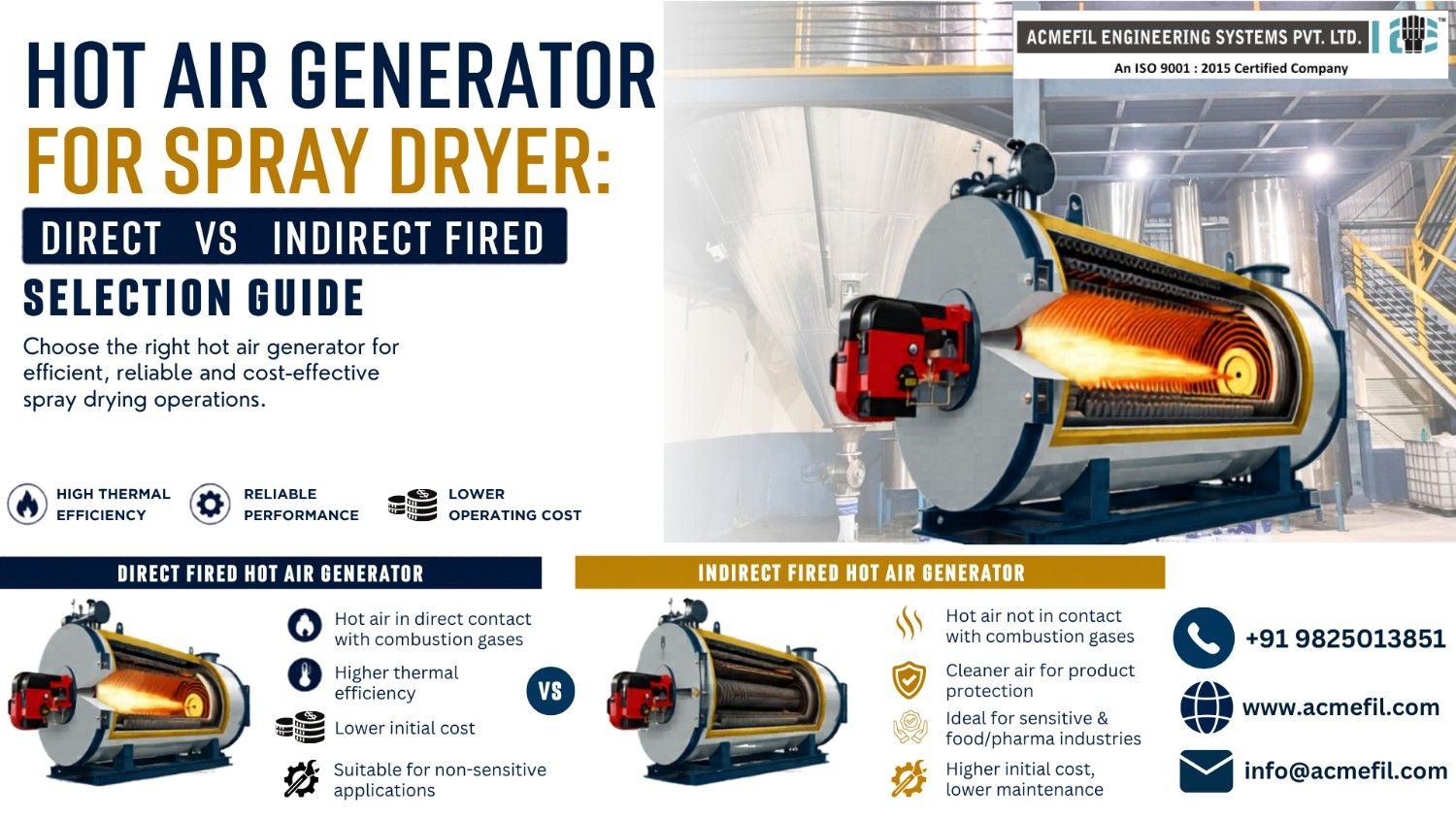
A hot air generator for spray dryer systems supplies the controlled heated air required to evaporate moisture after atomization. The correct selection is not only about fuel or burner capacity. It depends on the product being dried, contamination risk, inlet air temperature, air volume, evaporation load, fuel availability, and whether combustion gases can safely contact the drying air. In spray drying, a wrong hot air generator can create unstable outlet temperature, product discoloration, poor moisture control, or unacceptable powder quality.
For a deeper view of how the dryer body, atomizer, heating system, cyclone, and bag filter work together, read our guide on spray dryer design and components.
What Does a Hot Air Generator Do in a Spray Dryer?
A hot air generator heats the process air before it enters the spray dryer chamber. Once the liquid feed is atomized into fine droplets, this hot air comes into contact with the droplets and evaporates moisture within a short residence time.
In a spray dryer, the hot air generator affects four important results:
- Evaporation capacity, because heat input decides how much moisture can be removed.
- Outlet moisture, because unstable heat input changes the final powder condition.
- Powder colour and quality, especially for food, pharma, dyes, pigments, and heat-sensitive products.
- Fuel and operating cost, because heating is one of the largest energy loads in a spray drying plant.
I usually tell buyers not to treat the hot air generator as an accessory. It is part of the process design. A good atomizer cannot compensate for unstable air temperature or the wrong firing method.
How Hot Air Enters the Spray Drying Process
Spray drying works by converting liquid feed into droplets, contacting those droplets with hot air, drying them, and separating the powder from the air stream. The hot air generator sits before the drying chamber and supplies the heat source for the drying air.
The typical flow is:
Feed preparation → Atomization → Hot air contact → Moisture evaporation → Powder separation → Exhaust treatment
The heating system must be matched with the spray dryer chamber, atomizer type, air distributor, cyclone separator, bag filter, and exhaust system. For process basics, see our article on spray dryer operating principles and best practices.
Direct Fired Hot Air Generator for Spray Dryer
A direct fired hot air generator allows combustion gases to mix with the process air. This gives fast heat transfer and can be a practical choice when the product and process can tolerate direct contact with combustion products.
Direct fired systems are commonly considered for industrial drying duties where contamination sensitivity is lower and fuel efficiency is a major decision factor.
Typical fuel options include:
- Coal
- Lignite
- Wood
- LDO
- Gas
The main advantage is direct heat availability. The main question is product suitability. If the product is sensitive to combustion contact, smell, colour change, oxidation, ash carryover, or contamination, direct firing may create quality risk.
Indirect Fired Hot Air Generator for Spray Dryer
An indirect fired hot air generator separates combustion from the process air using a heat exchanger. The combustion side and the process air side do not mix.
This makes indirect fired heating more suitable when the powder must be protected from combustion gases. Food ingredients, pharmaceutical intermediates, herbal extracts, certain chemicals, and contamination-sensitive products often need this type of separation.
The trade-off is that indirect systems usually require more attention to heat exchanger design, pressure drop, thermal efficiency, cleaning access, and metallurgy. But when powder purity is critical, the extra design complexity is justified.
For equipment-level reference, see Acmefil’s indirect fired hot air generator page.
Direct Fired vs Indirect Fired Hot Air Generator
| Selection Point | Direct Fired Hot Air Generator | Indirect Fired Hot Air Generator |
|---|---|---|
| Heating method | Combustion gases mix with process air | Combustion heat transfers through a heat exchanger |
| Product contact | Product contacts air mixed with combustion products | Product contacts clean heated air |
| Best suited for | Non-sensitive industrial powders where direct firing is acceptable | Food, pharma, herbal, specialty chemical, and contamination-sensitive powders |
| Energy transfer | Direct heat transfer | Indirect heat transfer |
| Main advantage | Simpler heat transfer path and fast heating | Cleaner process air |
| Main risk | Contamination, smell, colour change, or ash carryover if wrongly selected | Higher design attention needed for heat exchanger and pressure drop |
| Buyer mistake | Selecting only by fuel cost | Ignoring thermal duty and heat exchanger sizing |
For direct-fired equipment reference, see Acmefil’s direct fired hot air generator page.
How to Select a Hot Air Generator for Spray Dryer Applications
The correct hot air generator for a spray dryer is selected from process data, not from a catalogue photo.
Before sizing or finalizing the heating system, collect these inputs:
| Input Required | Why It Matters |
|---|---|
| Feed material | Decides contamination sensitivity, heat sensitivity, stickiness, and corrosion risk |
| Feed concentration | Affects water evaporation load |
| Water evaporation rate | Determines heat duty |
| Inlet air temperature | Sets drying intensity |
| Outlet air temperature | Controls final powder moisture and thermal exposure |
| Product application | Food, pharma, chemical, ceramic, dyestuff, detergent, or effluent duty changes selection |
| Fuel available | Coal, lignite, wood, LDO, gas, or site-specific fuel |
| Direct or indirect contact suitability | Decides firing type |
| Air volume and duct layout | Affects pressure drop and air distribution |
| Emission and dust handling requirement | Decides cyclone, bag filter, scrubber, or other pollution control needs |
| Material of construction | Depends on temperature, corrosion, hygiene, and product contact requirements |
This is also why hot air generator design must be discussed along with the complete spray dryer selection process, not after the dryer is already finalized.
Why Inlet and Outlet Temperature Control Matters
In spray drying, inlet temperature is not the same as product temperature. The droplets evaporate moisture rapidly, and the outlet temperature becomes one of the key indicators of final powder condition.
If the hot air generator cannot maintain stable heat input, the spray dryer may show:
- High outlet moisture
- Powder sticking inside the chamber
- Overheated or discoloured powder
- Variable bulk density
- Higher fines or poor recovery
- Bag filter load fluctuation
- Unstable product quality between batches
The heating system must respond consistently to feed rate, inlet air flow, and moisture load. Poor control at the hot air generator side often appears later as a “spray dryer problem,” even when the atomizer and chamber are not the root cause.
For related operational symptoms, refer to our guide on spray dryer troubleshooting and common issues.
Product Type Decides the Heating Method
A hot air generator for spray dryer duty must be matched to the material being dried.
For dyestuff and pigments, the focus is often on moisture control, shade consistency, powder recovery, and resistance to build-up inside the chamber.
For food powders, the concerns are product colour, flavour, contamination risk, hygiene, and thermal degradation.
For pharmaceutical or herbal extracts, the concerns become stricter: clean heated air, controlled exposure, solvent or oxidation risk where applicable, and validated process conditions.
For ceramic or inorganic chemical powders, higher process robustness may be needed, but corrosion, abrasion, and dust load must still be considered.
For detergent powders, air volume, temperature control, powder particle size, and downstream recovery system design become important.
This is why a single hot air generator design cannot be called ideal for every spray dryer. The right answer depends on material behaviour and process objective.
Common Mistakes Buyers Make
Choosing Fuel Before Checking Product Suitability
Fuel cost matters, but it should not be the first decision. If a product cannot tolerate direct combustion contact, a low-cost direct fired option may create a higher cost through rejection, contamination, or powder quality failure.
Asking Only for Burner Capacity
A hot air generator is not just a burner. Air flow, combustion chamber design, heat transfer method, temperature control, insulation, pressure drop, and integration with the spray dryer all matter.
Ignoring Outlet Moisture Control
Many buyers focus only on inlet temperature. In practice, outlet temperature and exhaust air condition often tell you more about final powder moisture.
Not Checking Dust and Emission Handling
Spray drying produces powder-laden air. The heating system, dryer chamber, cyclone, bag filter, and exhaust treatment should be reviewed as one line. A strong heating system with weak powder separation still creates plant problems.
Selecting a Standard Unit for a Custom Feed
Feed properties change everything. Viscosity, solids percentage, stickiness, thermal sensitivity, and corrosive tendency can all change the dryer and hot air generator selection.
When Should You Use an FBC Type Hot Air Generator?
An FBC type hot air generator uses fluidized bed combustion and is generally considered for solid fuels. It can be relevant when the site has access to suitable solid fuel and the process economics justify that firing system.
However, this selection needs careful engineering review. Fuel quality, ash handling, combustion control, air pollution control, maintenance access, and process air cleanliness must be checked before finalizing FBC heating for spray dryer duty.
I would not recommend selecting FBC type only because solid fuel is cheaper. The plant has to handle the complete fuel and emission system reliably.
What Should Be Included in an RFQ?
When sending an inquiry for a hot air generator for spray dryer systems, include:
- Product or material to be dried
- Feed concentration and viscosity
- Required evaporation rate
- Required powder moisture
- Expected inlet and outlet temperature
- Fuel available at site
- Direct or indirect firing preference
- Existing spray dryer details, if it is a retrofit
- Required material of construction
- Dust collection and emission control requirement
- Plant location and utility constraints
- Whether pilot trial data is available
A better RFQ gives a better technical proposal. Without these inputs, most vendors can only give a budgetary offer, not a properly engineered solution.
Hot Air Generator in New Spray Dryer vs Retrofit Projects
For a new spray dryer, the hot air generator should be sized together with the chamber, atomizer, air distributor, cyclone, bag filter, and exhaust fan.
For a retrofit, the first question is different: what is limiting the existing plant?
It may be:
- Low heat input
- Unstable burner control
- Poor air distribution
- High duct losses
- Fouled or undersized heat exchanger
- Incorrect air volume
- Product sticking due to outlet temperature fluctuation
- Bag filter or cyclone bottleneck
Replacing only the hot air generator may not solve the problem if the chamber, fan, duct, or powder separation system is the real bottleneck.
How Acmefil Approaches Hot Air Generator Selection
At Acmefil, hot air generators are treated as part of the complete drying plant. The equipment range includes direct fired, indirect fired, and FBC type hot air generators, with fuel options such as coal, lignite, wood, LDO, and gas.
The selection starts with the product and process requirement. If the product is contamination-sensitive, indirect firing becomes a serious consideration. If the product can tolerate direct combustion contact and the application is industrial, direct firing may be evaluated. If the fuel strategy depends on solid fuels, FBC type may be reviewed with the complete combustion and emission control system.
Acmefil’s wider drying system experience also matters here because the hot air generator must work with the spray dryer, flash dryer, fluid bed dryer, cyclone, bag filter, fan, and ducting. You can review Acmefil’s broader hot air generators manufacturer page for product-level details.
Quick Selection Summary
| Application Situation | Recommended Direction |
|---|---|
| Product can tolerate combustion contact | Evaluate direct fired hot air generator |
| Product must avoid combustion gas contact | Evaluate indirect fired hot air generator |
| Solid fuel is required | Evaluate FBC type with emission and ash handling review |
| Food, pharma, herbal, or sensitive powder | Start with indirect heating discussion |
| Existing dryer has unstable moisture | Check temperature control, air flow, and heat duty before replacing equipment |
| New spray dryer plant | Size heating system with full dryer line, not separately |
Final Takeaway
A hot air generator for spray dryer operation must be selected from the product backward. The best design is not always the cheapest fuel option or the highest temperature unit. It is the system that gives stable drying air, protects product quality, fits the fuel available at site, and integrates correctly with the spray dryer chamber and powder recovery system.
If you are comparing direct fired and indirect fired options, start with one question: can your product safely contact combustion gases? If the answer is no, the firing method is already decided.
FAQs
What is a hot air generator in a spray dryer?
A hot air generator is the heating system that supplies controlled hot air to the spray dryer chamber. This hot air contacts atomized feed droplets and evaporates moisture to form powder. It must be matched with the evaporation load, inlet temperature, outlet temperature, air volume, fuel type, and product sensitivity.
Which is better for a spray dryer, direct fired or indirect fired hot air generator?
Neither is universally better. Direct fired hot air generators are practical when the product can tolerate combustion gas contact. Indirect fired hot air generators are better when clean heated air is required, especially for food, pharma, herbal, and contamination-sensitive powders.
Can a direct fired hot air generator be used for food powder spray drying?
It depends on the product, fuel, combustion quality, process requirement, and acceptance criteria. For sensitive food powders where clean air and flavour protection matter, indirect fired heating is often reviewed first. The final decision should be made after product and process evaluation.
What fuel can be used in a hot air generator for spray dryer systems?
Common fuel options include coal, lignite, wood, LDO, and gas. Fuel selection should consider availability, operating cost, combustion control, emission handling, product contamination risk, and maintenance requirements.
Why does a spray dryer show unstable powder moisture even when the atomizer is working?
Unstable powder moisture may come from unstable hot air temperature, incorrect air volume, changing feed rate, poor outlet temperature control, duct losses, or downstream separation issues. The hot air generator should be checked along with the complete spray dryer system.
For a correct hot air generator recommendation, share your product, feed concentration, water evaporation requirement, inlet and outlet temperature target, fuel availability, and whether direct contact with combustion gases is acceptable. For project discussion, use the SprayDryer.com contact page or review related engineering guides before finalizing the dryer line.

Siddharth Nair is Technical Director at Acmefil Engineering Systems Pvt. Ltd. he leads solution design and applications engineering across the company’s full product range — spray dryers, multi-effect evaporators, agitated thin film dryers, spin flash dryers, fluid bed dryers, and complete ZLD systems.
His work spans process evaluation, equipment sizing, customer application consulting, and technical proposal development for industries including food and dairy, pharmaceuticals, chemicals, dyestuffs, ceramics, and industrial effluent treatment. He has hands-on commissioning experience across Acmefil’s 500+ installations in India and 15+ countries.
He holds a BTech in Mechanical Engineering from CHARUSAT University and also partners at A.S Engineers, working with blowers, sludge dryers, and industrial conveying systems.


