
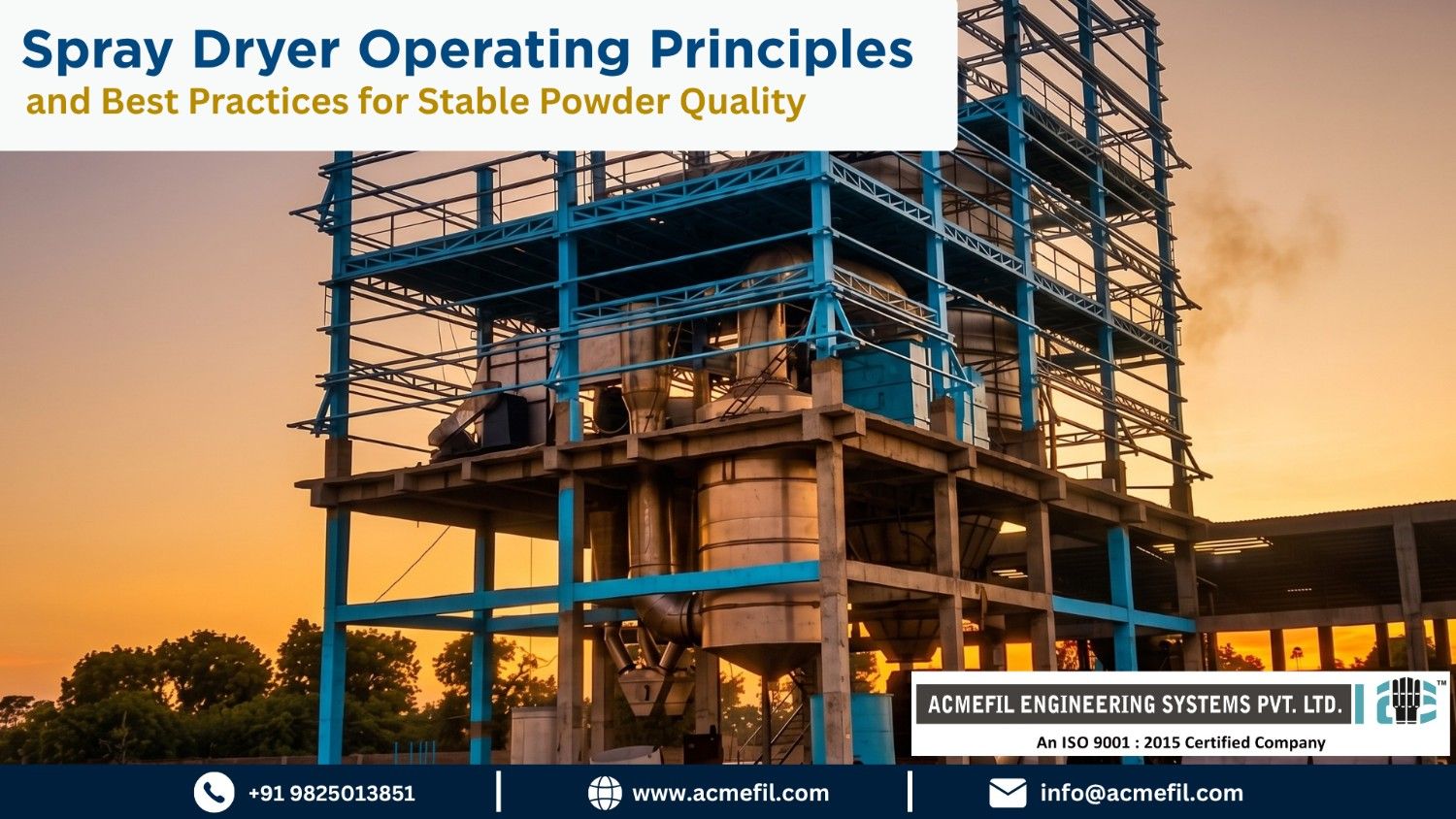
Spray dryer operating principles are built around four actions: atomizing liquid feed into droplets, contacting those droplets with hot drying air, evaporating moisture quickly, and separating the dried powder from exhaust air. In real plant operation, stable powder quality depends less on one temperature setting and more on the balance between feed solids, viscosity, atomization, airflow, inlet temperature, outlet temperature, and collection efficiency.
I have seen many spray dryer problems start before the feed even reaches the chamber. If the feed is not characterized properly, the operator keeps adjusting temperature, while the real issue may be viscosity, poor filtration, atomizer wear, unstable feed rate, or a powder that becomes sticky at the selected outlet condition.
For a deeper equipment-level view, read our guide on spray dryer design and components. This article focuses on how the system should be operated once the plant is running.
How Does a Spray Dryer Work?
A spray dryer converts a liquid feed into a dry powder in a continuous process. The feed may be a solution, slurry, suspension, emulsion, or paste-like liquid, depending on the product and atomizer design.
The working sequence is:
- Feed preparation
The feed is mixed, filtered, concentrated, standardized, and sometimes heated or cooled before atomization. - Atomization
The feed is broken into small droplets using a rotary atomizer, pressure nozzle, or two-fluid nozzle. - Hot air contact
The droplets meet hot air inside the drying chamber. The airflow pattern may be co-current, counter-current, or mixed-flow depending on the product and dryer design. - Moisture evaporation
Water or solvent evaporates from the droplet surface. As moisture leaves, each droplet becomes a particle. - Powder separation
The dried powder is separated from the exhaust air through chamber collection, cyclone separation, bag filtration, or a combination of recovery systems. - Final powder handling
The powder may be cooled, sieved, blended, packed, or sent to downstream processing.
The principle looks simple on paper. The difficulty is that every variable affects another variable. A higher feed rate changes outlet temperature. Higher solids can reduce evaporation load but may disturb atomization. Finer droplets dry faster but may increase fines loss if the collection system is not designed correctly.
The Main Spray Drying Parameters Operators Must Control
| Operating parameter | What it controls | What can go wrong if ignored |
|---|---|---|
| Feed solids | Evaporation load, powder density, dryer capacity | High energy use if solids are too low, poor atomization if solids are too high |
| Feed viscosity | Pumping, droplet formation, atomizer load | Oversized droplets, nozzle blockage, wall deposition |
| Feed rate | Outlet temperature and final moisture | Wet powder, chamber deposits, unstable drying |
| Inlet temperature | Heat available for evaporation | Product degradation, poor evaporation, excessive fuel use |
| Outlet temperature | Final moisture trend and product exposure | Over-drying, under-drying, stickiness, powder quality variation |
| Atomizer speed or nozzle pressure | Droplet size and particle size | Broad particle distribution, dusting, poor solubility |
| Airflow rate | Residence time, drying capacity, powder movement | Carryover, insufficient drying, low thermal efficiency |
| Chamber pressure | Air movement and leakage control | Air ingress, powder escape, unstable combustion or heating |
| Cyclone and bag filter performance | Powder recovery and emission control | Product loss, pressure drop increase, poor recovery |
| Cleaning frequency | Hygiene, heat transfer, airflow path | Contamination risk, wall buildup, reduced capacity |
A good operator does not treat these as isolated settings. The process window should be built from product behavior, not copied from another product.
Why Outlet Temperature Matters More Than Many Operators Realize
Inlet temperature tells you how much heat is entering the dryer. Outlet temperature tells you more about what happened after that heat met the feed.
If the feed rate increases and all other conditions remain constant, the outlet temperature generally drops because more moisture is absorbing heat. If the feed rate drops, outlet temperature may rise, which can over-dry or thermally stress the product.
That is why outlet temperature is often the most practical operating indicator for final moisture trend. It does not replace moisture testing, but it gives the operator a live signal.
I prefer to treat inlet temperature as a heat supply variable and outlet temperature as a product condition signal. Both matter. But if your powder moisture is unstable, outlet temperature behavior usually deserves the first check.
Atomization Is Where Many Spray Dryer Problems Begin
Atomization decides droplet size. Droplet size decides drying time. Drying time influences particle size, bulk density, solubility, moisture, wall deposition, and powder recovery.
The wrong atomizer selection can make a good dryer perform badly.
| Atomizer type | Best suited for | Operating watch points |
|---|---|---|
| Rotary atomizer | Slurries, feeds with suspended solids, larger capacity plants, applications needing flexible feed handling | Disc condition, speed stability, vibration, feed distribution, buildup on atomizer assembly |
| Pressure nozzle | Feeds that can be pumped at pressure and need defined particle characteristics | Orifice wear, pressure fluctuation, clogging, feed filtration |
| Two-fluid nozzle | Low-flow trials, fine atomization, some heat-sensitive or specialty products | Compressed air consumption, air-to-liquid ratio, nozzle fouling, very fine powder carryover |
For a focused comparison, use our guide on nozzle vs rotary atomizer spray dryers and the detailed article on spray dryer atomization techniques.
ACMEFIL manufactures both rotary atomizer type spray dryers and nozzle atomizer type spray dryers, so the selection can be matched to feed behavior rather than forced into one standard design.
Feed Preparation Comes Before Dryer Optimization
When a spray dryer is giving inconsistent powder, operators often start by changing temperature. Sometimes that works. Often, it only hides the real cause.
Before changing the dryer settings, check the feed.
A proper feed review should include:
- Solids percentage
- Viscosity at operating temperature
- Density
- pH where relevant
- Suspended solids behavior
- Filtration level
- Thermal sensitivity
- Foaming tendency
- Stickiness or glass transition behavior
- Target moisture
- Target particle size
- Bulk density and solubility requirement
For products such as milk powder, coffee extract, fruit juice concentrate, herbal extracts, dyestuff, pigments, ceramic slurry, and detergent base, feed behavior can change the full operating window.
This is also where pilot testing becomes useful. ACMEFIL’s pilot spray dryer facility is used to study feed behavior at small scale before full-scale plant decisions are made.
Best Practices for Stable Spray Dryer Operation
Set the Process Window by Product, Not by Guesswork
A spray dryer should not be started with a random temperature pair. The operating window should be developed from product data.
The minimum useful trial data includes:
- Feed solids
- Feed viscosity
- Feed temperature
- Atomizer type
- Feed rate
- Inlet temperature
- Outlet temperature
- Powder moisture
- Bulk density
- Particle size
- Solubility or dispersibility
- Wall deposition tendency
- Powder recovery rate
Once the acceptable window is known, operators can control the dryer with confidence.
Keep Feed Rate Stable
Unstable feed rate causes unstable outlet temperature. That creates moisture variation.
Check the feed pump, feed tank agitation, line pressure, strainer condition, and nozzle or atomizer feed path. If the feed tank settles or thickens during the run, the dryer will not behave consistently.
Control Outlet Temperature Gradually
Do not make aggressive adjustments unless there is a clear risk. Sudden changes in feed rate, inlet temperature, or airflow can create temporary instability inside the chamber.
For moisture control, make one adjustment at a time and wait for the system to stabilize before changing the next variable.
Inspect the Atomizer or Nozzle Before Blaming the Dryer
A worn pressure nozzle can increase droplet size and widen particle distribution. A blocked nozzle can create poor spray pattern and wall wetting. A rotary atomizer with imbalance or buildup can produce inconsistent atomization.
Daily visual checks are not enough for critical products. The operator should also track pressure, flow, vibration, unusual sound, and powder behavior.
Watch Wall Deposition Early
Wall buildup is not only a cleaning issue. It is an operating signal.
Common causes include:
- Feed too sticky for the selected outlet condition
- Droplets too large
- Poor atomization
- Incorrect airflow pattern
- Low drying capacity
- Poor chamber air distribution
- Product not suitable for single-stage spray drying
For sticky products, read our article on optimizing spray drying parameters and review whether formulation, carrier addition, outlet condition, or dryer configuration needs adjustment.
Maintain Air Filters, Cyclones, and Bag Filters
Spray drying is not only a chamber operation. The air path and powder recovery system affect performance.
A blocked air filter changes airflow. A poorly performing cyclone reduces recovery. A bag filter with rising pressure drop can reduce stable operation and increase product loss risk.
If powder recovery is poor, do not only check the chamber. Check the full air and powder path.
ACMEFIL’s support equipment includes bag filters, rotary atomizers, and spray nozzles for complete drying plant design.
Keep a Real Operating Log
A spray dryer log should capture more than temperature.
At minimum, record:
- Product name and batch or run reference
- Feed solids
- Feed viscosity
- Feed temperature
- Feed rate
- Atomizer speed or nozzle pressure
- Inlet temperature
- Outlet temperature
- Airflow or fan setting
- Chamber pressure
- Cyclone and bag filter pressure drop
- Powder moisture
- Bulk density
- Particle size if measured
- Cleaning time
- Wall deposition observation
- Operator comments
This log becomes valuable when the same product creates a problem after weeks of stable operation.
Spray Dryer Troubleshooting Matrix
| Problem observed | Likely operating cause | Corrective direction |
|---|---|---|
| Powder moisture is high | Feed rate too high, inlet heat too low, atomization too coarse, airflow imbalance | Review feed rate, outlet temperature trend, atomizer condition, and airflow |
| Powder is over-dried | Outlet temperature too high, feed rate too low, excessive residence time | Reduce heat input or increase feed rate within the validated process window |
| Wall deposition | Sticky feed, coarse droplets, poor air distribution, low outlet control | Check atomization, feed formulation, temperature profile, and chamber airflow |
| Particle size is inconsistent | Feed variation, atomizer wear, nozzle pressure fluctuation | Stabilize feed, inspect atomizer or nozzle, check pump and pressure control |
| Powder recovery is low | Excess fines, cyclone inefficiency, bag filter issue, high exhaust velocity | Check particle size, cyclone condition, bag filter pressure drop, and airflow |
| Energy use is high | Low feed solids, air leakage, poor insulation, poor heat transfer | Review feed concentration, seals, insulation, air heating system, and exhaust losses |
| Nozzle blockage | Poor filtration, feed crystallization, high viscosity, solids settling | Improve filtration, agitation, feed temperature control, and nozzle cleaning schedule |
| Rotary atomizer vibration | Disc imbalance, buildup, bearing issue, incorrect assembly | Stop and inspect according to plant safety procedure and manufacturer guidance |
| Product quality varies during run | Feed tank change, solids settling, temperature drift, airflow fluctuation | Track feed behavior, outlet temperature trend, and air system stability |
This table is for diagnostic direction. Final corrective action should follow the plant’s operating manual and equipment-specific procedure.
Industry-Specific Spray Dryer Best Practices
Food and Dairy Products
For milk powder, coffee extract, whey, soup mixes, maltodextrin, egg products, and beverage powders, the main concerns are solubility, bulk density, flavor retention, heat exposure, and stickiness.
Best practice is to define the product target first. A powder designed for instant solubility may need a different particle structure than a powder designed only for moisture removal.
Read more on spray dryer for milk powder and spray dryers in the food industry.
Pharmaceuticals and Herbal Extracts
Pharmaceutical and herbal products require closer attention to contamination control, thermal sensitivity, and powder consistency. For some products, closed-loop or sterile spray drying may be required.
ACMEFIL’s closed loop spray dryer is designed for solvent-based or oxygen-sensitive drying applications where product recovery and controlled atmosphere operation are important.
Dyestuff, Pigments, and Chemicals
Chemical and pigment applications often create challenges with slurry behavior, abrasive solids, variable particle size, and wall deposition.
For these products, atomizer selection, feed filtration, chamber material, and powder recovery design matter as much as temperature. The dryer should be selected after studying the feed, not only after checking evaporation capacity.
Ceramics and Inorganic Materials
Ceramic slurry and inorganic chemical drying often require careful particle size and flow property control. Powder behavior after drying can affect pressing, granulation, handling, and downstream product quality.
In these cases, atomization and final powder morphology become key operating targets.
Detergent and Agglomerated Powders
Detergent and agglomerated powders may require larger particle size and better flowability. A fluidized spray dryer or multi-stage drying arrangement can be more suitable where larger granules or agglomerated powder properties are required.
ACMEFIL’s fluidized spray dryer supports applications where particle enlargement and controlled final drying are part of the process requirement.
When Should You Run a Pilot Trial?
A pilot trial is useful when the feed is new, sticky, heat-sensitive, abrasive, solvent-based, expensive, or difficult to characterize from lab data alone.
Run a pilot spray dryer trial before full-scale purchase when:
- The feed has not been spray dried before
- Target moisture is strict
- Particle size or bulk density is commercially important
- The product is sticky or hygroscopic
- The feed contains suspended solids
- The product is heat-sensitive
- The buyer is comparing rotary and nozzle atomization
- The full-scale plant cost is high enough that trial data reduces decision risk
At ACMEFIL, pilot trials help answer practical questions before equipment sizing. The target is not only “Can we dry it?” The better question is, “Can we dry it repeatedly at the required powder quality?”
For small-scale evaluation, see pilot-scale spray dryers and lab scale spray dryers.
What Data Should You Share Before Asking for a Spray Dryer Recommendation?
Before requesting a spray dryer quote, prepare this information:
| Required data | Why it matters |
|---|---|
| Feed type | Defines whether the feed is solution, slurry, emulsion, suspension, or extract |
| Feed solids | Decides evaporation load and capacity |
| Viscosity | Affects atomization and pumping |
| Feed temperature | Affects flow behavior and evaporation |
| Target moisture | Sets the drying endpoint |
| Target particle size | Influences atomizer selection |
| Bulk density requirement | Affects powder handling and packaging |
| Heat sensitivity | Decides safe temperature window |
| Stickiness tendency | Affects chamber deposition risk |
| Required metallurgy | Important for food, pharma, chemical, or corrosive feeds |
| Required capacity | Drives chamber size, air system, heating load, and recovery system |
| Solvent or water-based feed | Decides open-cycle or closed-loop design |
This is why a generic spray dryer price is rarely useful. Two products with the same evaporation load can require different atomizers, different chamber geometry, different air handling, and different powder recovery systems.
Final Operating View
A spray dryer is stable when the feed, atomization, heat input, airflow, residence time, and powder recovery system are working as one process.
The best operators do not chase every fluctuation. They understand which variable moved first. They know whether the problem started in the feed tank, the atomizer, the air system, the chamber, or the collection system.
That is the real value of understanding spray dryer operating principles. You stop treating the dryer like a black box and start controlling it like a process system.
FAQs
What is the basic operating principle of a spray dryer?
A spray dryer works by atomizing liquid feed into small droplets, contacting those droplets with hot air, evaporating moisture, and separating the dried powder from exhaust air. The final powder quality depends on feed properties, atomization, inlet temperature, outlet temperature, airflow, residence time, and collection efficiency.
Which parameter is most important in spray dryer operation?
There is no single universal parameter, but outlet temperature is one of the most useful live indicators because it reflects the balance between heat input and moisture evaporation. Atomization is equally important because droplet size directly affects drying behavior, particle size, wall deposition, and powder recovery.
Why does powder stick to the spray dryer chamber wall?
Powder sticks to the chamber wall when droplets remain wet or sticky for too long, when atomization creates oversized droplets, when outlet conditions are unsuitable, or when airflow distribution is poor. Sticky feeds such as fruit extracts, sugars, and some chemical products may need formulation changes, carrier addition, or a different drying configuration.
How do I improve spray dryer efficiency without damaging product quality?
Start with feed solids, stable feed rate, correct atomization, clean air filters, proper insulation, and controlled outlet temperature. Do not increase inlet temperature blindly. Higher heat can improve evaporation, but it can also damage heat-sensitive products or increase wall deposits if the feed is not suitable.
When should I choose rotary atomizer instead of nozzle atomizer?
A rotary atomizer is often preferred for slurries, suspended solids, variable feed rates, and applications needing flexible operation. A nozzle atomizer may be better when specific particle morphology, density, or fine powder control is required. The safest selection comes from feed data and pilot trials, not from a general rule.
If your spray dryer is producing unstable moisture, wall deposits, low recovery, or inconsistent powder size, share your feed details before changing major operating conditions. ACMEFIL can evaluate feed solids, viscosity, atomization requirement, capacity, target moisture, and powder quality expectations to recommend the right operating direction.
Use the ACMEFIL contact page or submit your process details through the product inquiry page for a technical review.

Siddharth Nair is Technical Director at Acmefil Engineering Systems Pvt. Ltd. he leads solution design and applications engineering across the company’s full product range — spray dryers, multi-effect evaporators, agitated thin film dryers, spin flash dryers, fluid bed dryers, and complete ZLD systems.
His work spans process evaluation, equipment sizing, customer application consulting, and technical proposal development for industries including food and dairy, pharmaceuticals, chemicals, dyestuffs, ceramics, and industrial effluent treatment. He has hands-on commissioning experience across Acmefil’s 500+ installations in India and 15+ countries.
He holds a BTech in Mechanical Engineering from CHARUSAT University and also partners at A.S Engineers, working with blowers, sludge dryers, and industrial conveying systems.


