
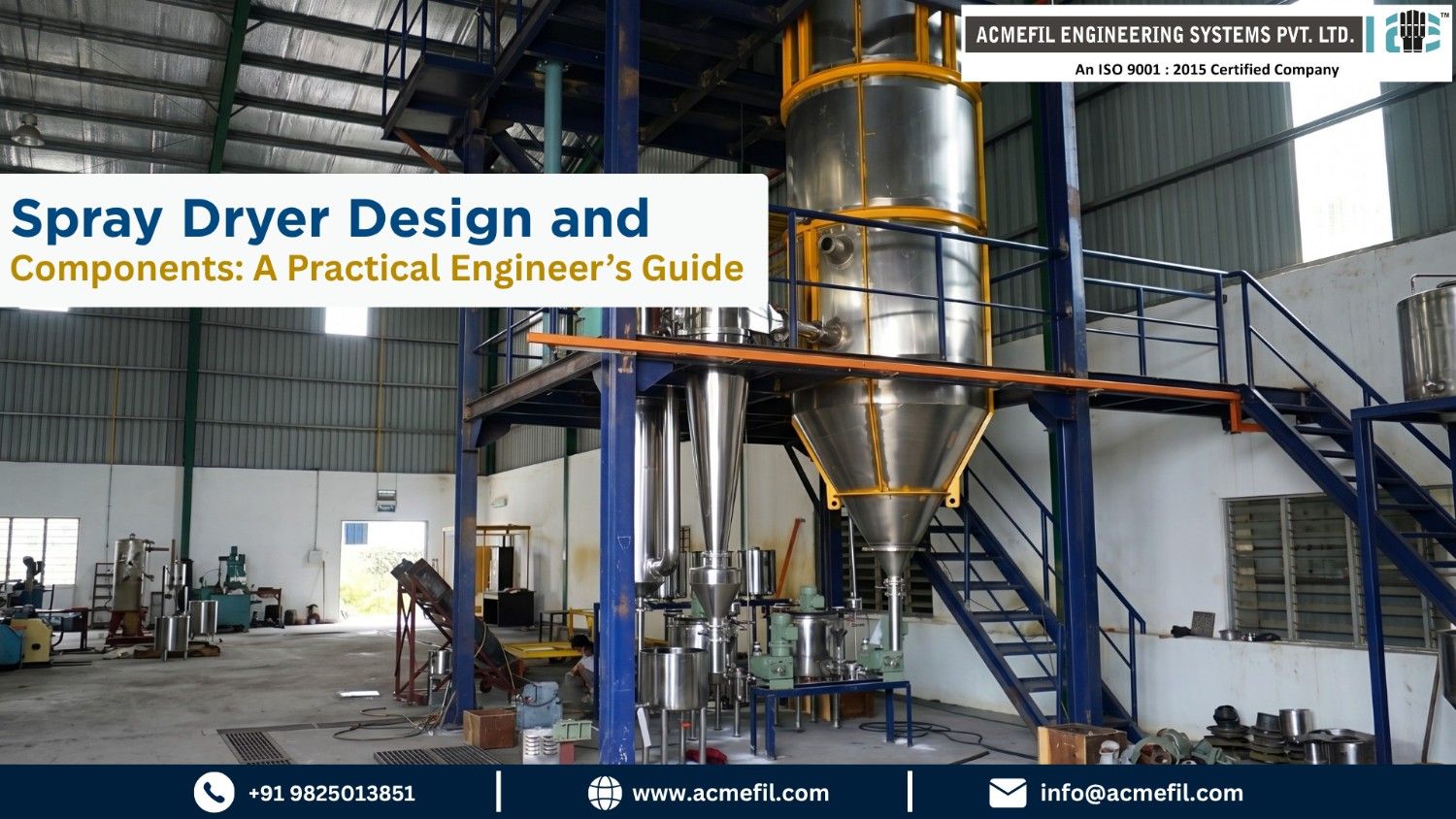
Spray dryer design and components decide whether a liquid feed becomes a stable, free-flowing powder or a plant headache. The atomizer, drying chamber, hot air system, powder recovery section, and controls must be designed around the feed properties, required moisture, particle size, thermal sensitivity, and recovery expectations. A spray dryer is not one machine. It is a process system.
I see many spray dryer discussions start with capacity. That is useful, but it is not the first design question.
The first question is simpler: what exactly are you trying to dry, and what powder behavior do you need after drying?
For a basic process explanation before this design guide, read the spray dryer working principle guide. This article goes deeper into the mechanical and process design of a complete spray dryer system.
What is included in spray dryer design?
A complete spray dryer design normally includes the feed preparation system, feed pump, atomizer, hot air generator, air distribution system, drying chamber, powder separation system, discharge equipment, exhaust system, instrumentation, controls, and safety provisions where required.
The usual process sequence is:
- Prepare and condition the liquid feed.
- Atomize the feed into droplets.
- Contact the droplets with hot drying air.
- Evaporate moisture inside the drying chamber.
- Separate dry powder from exhaust air.
- Discharge, cool, collect, or convey the powder.
In practice, weak design in any one section can disturb the whole system. A good atomizer cannot compensate for unstable feed. A large chamber cannot solve poor air distribution. A cyclone cannot recover powder well if the particle size distribution is not understood.
That is why spray dryer design should be treated as process engineering, not only equipment fabrication.
Main spray dryer components and what each one controls
| Component | What it does | What it affects in the final powder |
|---|---|---|
| Feed tank and agitator | Holds and keeps feed uniform before drying | Feed consistency, solids distribution, process stability |
| Feed pump | Delivers controlled feed flow to the atomizer | Moisture control, throughput, atomizer stability |
| Atomizer | Converts liquid feed into droplets | Particle size, drying rate, bulk density, wall deposition risk |
| Hot air generator | Supplies thermal energy for evaporation | Drying capacity, contamination risk, fuel economy |
| Air disperser | Distributes hot air into the chamber | Residence time, droplet path, powder sticking |
| Drying chamber | Provides drying volume and droplet-air contact | Final moisture, wall deposits, product degradation risk |
| Cyclone separator | Recovers larger powder particles from exhaust air | Product yield, powder split, dust loading |
| Bag filter or scrubber | Captures finer powder or controls emissions | Fine recovery, air cleanliness, environmental control |
| Rotary air lock valve | Discharges powder while limiting air leakage | Continuous discharge, pressure balance, powder flow |
| Control panel and instrumentation | Monitors and controls operating variables | Repeatability, safety interlocks, process stability |
The important point is this: components should not be selected independently. The atomizer, chamber, hot air flow, and powder recovery system must be matched to one another.
Feed system: the design starts before atomization
A spray dryer can only perform consistently when the feed going into the atomizer is consistent.
The feed system normally includes a feed tank, agitator, filtration arrangement, feed pump, flow control, and sometimes feed pre-heating or homogenization. The purpose is not simply to move liquid from one point to another. The purpose is to present a stable, pumpable, uniform feed to the atomizer.
Before designing this section, the following data matters:
- Feed type: solution, slurry, suspension, emulsion, or extract
- Total solids percentage
- Viscosity at operating temperature
- Density
- pH and corrosive nature
- Suspended solids or abrasive particles
- Thermal sensitivity
- Stickiness or hygroscopic behavior
- Required final moisture
- Required particle size and bulk density
- Required evaporation load per hour
A common buyer mistake is assuming that any pumpable liquid can be spray dried with the same design. That is not true. A milk concentrate, ceramic slurry, dyestuff solution, detergent slurry, herbal extract, and pharmaceutical intermediate do not behave the same inside a spray dryer.
For industry-specific application context, see the guide on applications of spray dryers.
Atomizer: the component that decides droplet behavior
The atomizer is the heart of spray dryer design because it decides droplet size and distribution. Droplet size affects drying rate, residence time, powder size, bulk density, wall deposition, and separation efficiency.
The main spray dryer atomization options are:
Rotary atomizer
A rotary atomizer uses a high-speed rotating disc to throw the feed outward by centrifugal force. In ACMEFIL rotary disc type spray dryers, fine droplets in the range of 20 to 75 microns are used for applications where droplet size control is important.
Rotary atomizers are often considered when the feed is a slurry, when suspended solids are present, or when the buyer needs flexible operation over a wider feed range.
Typical applications include dyes, ceramics, food products, pharmaceuticals, detergents, pigments, and inorganic chemicals.
For a deeper comparison, read rotary atomizer vs nozzle atomizer spray dryers and ACMEFIL’s rotary atomizer type spray dryer page.
Pressure nozzle atomizer
A pressure nozzle atomizer pumps feed through an orifice under pressure. It can produce fine or coarse particles depending on nozzle design, pressure, feed properties, and dryer configuration.
Pressure nozzle systems are often selected when the required particle morphology, powder density, or flow behavior makes nozzle atomization more suitable than rotary atomization.
Two-fluid nozzle atomizer
A two-fluid nozzle uses compressed air for atomization. It is useful where finer atomization is needed or where a specific product development requirement makes pneumatic atomization practical.
Two-fluid systems are common in laboratory, pilot, and some lower-capacity process applications.
For more detail on atomizer selection, read spray dryer atomization techniques and ACMEFIL’s nozzle atomizer type spray dryer page.
Atomizer selection table
| Feed or product requirement | Better starting point | Reason |
|---|---|---|
| Slurry with suspended solids | Rotary atomizer | Better flexibility for slurry-type feeds |
| Requirement for controlled fine droplets | Rotary atomizer or nozzle, depending on feed | Final choice depends on powder target and feed behavior |
| Fine powder development at small scale | Two-fluid nozzle or pilot trial | Flexible for trials and development work |
| Dense or coarser granular powder | Pressure nozzle | Often useful where powder density and morphology matter |
| Abrasive feed | Requires special review | Atomizer wear and material selection become important |
| Solvent-based feed | Closed loop design review | Nitrogen atmosphere, solvent recovery, and safety systems may be required |
| Uncertain feed behavior | Pilot spray dryer trial | Trial reduces scale-up risk before full investment |
No table can replace product testing. The final atomizer decision should be made after reviewing feed data and, wherever possible, running a trial.
Drying chamber design: where droplet path becomes powder quality
The drying chamber is not just a tall vessel. It is the space where atomized droplets meet hot air, lose moisture, and become dry particles.
The chamber design must allow enough residence time for drying without overheating the product or allowing powder to stick to the wall. The chamber diameter, height, cone angle, air entry pattern, atomizer location, and discharge design all affect the result.
Key design questions include:
- How much water must be evaporated per hour?
- What is the inlet and outlet temperature window?
- Is the product heat-sensitive?
- Does the material become sticky during drying?
- What particle size and bulk density are required?
- How much residence time is needed?
- Will the powder flow freely after drying?
- Is the feed corrosive, abrasive, or hygienic in nature?
- Is CIP required for cleaning?
A wrong chamber design normally shows up as one of four symptoms: wet powder, scorched powder, powder sticking on the wall, or poor recovery at the cyclone and bag filter.
For operating-side causes of these issues, see spray dryer troubleshooting common issues.
Hot air generator and air handling system
The hot air system provides the thermal energy for drying. In a complete spray dryer plant, it usually includes the hot air generator, blower, filters, ducting, dampers, air disperser, temperature sensors, and exhaust arrangement.
ACMEFIL’s hot air generator options include direct fired and indirect fired systems using fuels such as coal, lignite, wood, LDO, and gas. The choice depends on fuel availability, product sensitivity, contamination risk, efficiency expectations, and process conditions.
Direct fired hot air generator
In a direct fired hot air generator, combustion gases come in contact with process air. It can be practical for certain industrial applications where this contact is acceptable.
Indirect fired hot air generator
In an indirect fired hot air generator, a heat exchanger separates combustion from process air. This becomes important for products where contamination risk must be reduced.
For related equipment, see ACMEFIL’s direct fired hot air generator and indirect fired hot air generator pages.
Air disperser: a small-looking part with a large effect
The air disperser controls how hot air enters the drying chamber.
This matters because droplets do not dry only because air is hot. They dry because air contacts them in the right pattern for the right time. Uneven air distribution can create dead zones, wall deposits, uneven moisture, and unstable powder quality.
A good air disperser design supports:
- Uniform contact between droplets and drying air
- Stable residence time
- Reduced wall deposition
- Better control of outlet temperature
- Predictable powder separation downstream
This is one reason why copying a generic chamber shape is risky. The same chamber diameter can behave differently with a different atomizer, air inlet design, feed rate, and powder property.
Powder recovery system: cyclone, bag filter, and discharge
After drying, powder must be separated from the exhaust air. This is handled by the powder recovery system.
The most common arrangement includes a cyclone separator followed by a bag filter. In some applications, scrubbers or other air pollution control equipment may be used depending on product, emission requirement, and process design.
Cyclone separator
The cyclone separates powder using centrifugal action. Larger particles are normally easier to recover at the cyclone stage.
Cyclone performance depends on air velocity, particle size, powder density, pressure drop, and loading pattern.
Bag filter
The bag filter captures finer particles that pass beyond the cyclone. Pulse jet bag filters are commonly used for dust control and powder recovery in industrial drying systems.
For related recovery components, see ACMEFIL’s bag filter page.
Rotary air lock valve
The rotary air lock valve discharges powder while helping maintain pressure balance in the system. If the valve leaks too much air or the powder bridges at discharge, the dryer can become unstable.
This component is easy to ignore during purchase discussions, but it matters in day-to-day operation.
Controls and instrumentation: what should be monitored?
Spray drying needs stable control because small changes in feed rate, atomizer behavior, or air temperature can change powder quality.
A practical control system monitors:
- Feed flow rate
- Feed pressure where applicable
- Inlet air temperature
- Outlet air temperature
- Atomizer speed or nozzle pressure
- Chamber pressure
- Exhaust air temperature
- Bag filter differential pressure
- Blower operation
- Rotary valve operation
- Interlocks and alarms
The most important control variable in many spray dryer discussions is outlet temperature. It is closely connected with residual moisture, but it should not be treated as a magic number. Outlet temperature must be interpreted along with feed rate, inlet temperature, atomization, air flow, and product behavior.
For process-side tuning, read spray drying parameters optimization.
How spray dryer design changes by application
Spray dryer design changes sharply by industry.
| Application | Main design concern | Component focus |
|---|---|---|
| Milk powder and food ingredients | Heat sensitivity, hygiene, powder solubility | Atomizer, chamber, filtration, CIP-ready design |
| Dyestuff and pigments | Slurry behavior, color consistency, recovery | Feed handling, rotary atomizer, chamber, cyclone, bag filter |
| Ceramics | Abrasive slurry, particle size control | Atomizer wear, chamber design, powder recovery |
| Detergents | Particle size and agglomeration behavior | Fluidized spray dryer, fines return, air flow |
| Pharmaceuticals | Hygiene, controlled drying, contamination control | Nozzle selection, sterile filtration, closed design where required |
| Solvent-based products | Solvent recovery and safety | Closed loop nitrogen system, condenser, safety review |
| R&D trials | Scale-up data, feasibility testing | Pilot spray dryer, flexible atomization, sample recovery |
ACMEFIL manufactures multiple spray dryer variants, including rotary disc type, nozzle type, fluidized spray dryer, closed loop or sterile spray dryer, and lab scale pilot spray dryer. The right selection depends on feed behavior and powder target, not only on industry name.
For the commercial selection process, read choosing the right spray dryer.
Fluidized spray dryer design
A fluidized spray dryer is used when the final product requires larger particles or staged drying. ACMEFIL’s fluidized spray dryer design is used for particles in the 50 to 150 micron range, with moist powder dried in an integrated fluid bed at the bottom of the drying chamber. Fines can be recycled back into the chamber, and tertiary drying can be used when larger particle development is required.
This design is especially relevant for detergents, food ingredients, and agglomerated powders.
See ACMEFIL’s fluidized spray dryer page for related equipment context.
Closed loop and sterile spray dryer design
Closed loop spray dryer design is used for solvent-based products, oxidation-sensitive materials, and applications where solvent recovery is required. Instead of using open atmospheric air, the process operates in a nitrogen atmosphere and recovers both product and solvent.
Sterile spray dryers may include HEPA filters and sterile micro filters for pharmaceutical applications.
This area must be handled carefully. Closed loop and sterile systems involve safety, solvent handling, filtration, and process validation questions. A blog article can explain the concept, but final design should be reviewed by the equipment manufacturer and the client’s process and safety team.
See ACMEFIL’s closed loop spray dryer page for the equipment category.
Pilot testing before full-scale spray dryer design
Pilot testing is one of the strongest ways to reduce spray dryer selection risk.
At ACMEFIL’s R&D centre, the spray dryer pilot facility is available at 3 kg/hr water evaporation capacity. This matters when the buyer is unsure about:
- Atomizer selection
- Feed pumpability
- Drying temperature window
- Powder stickiness
- Final moisture behavior
- Particle size
- Bulk density
- Recovery at cyclone or bag filter
- Scale-up feasibility
A pilot trial does not remove all engineering judgment, but it gives the design team practical data before committing to full-scale plant design.
For smaller trial and development contexts, see spray dryer for small-scale production and ACMEFIL’s pilot spray dryer page.
Data required before designing a spray dryer
Before asking for a technical quote, prepare the following information.
| Data required | Why it matters |
|---|---|
| Feed name and composition | Confirms suitability and material compatibility |
| Feed type | Solution, slurry, emulsion, suspension, extract, or concentrate |
| Feed solids percentage | Decides evaporation load and energy requirement |
| Viscosity | Affects pump selection and atomization |
| Feed temperature | Affects flow, viscosity, and thermal load |
| pH and corrosive nature | Affects material of construction |
| Abrasive or suspended solids | Affects atomizer and wear design |
| Thermal sensitivity | Affects inlet and outlet temperature window |
| Required final moisture | Controls drying target |
| Required particle size | Influences atomizer and chamber design |
| Bulk density target | Important for packaging and downstream handling |
| Required production capacity | Decides evaporation capacity and plant size |
| Utility availability | Fuel, steam, power, compressed air, cooling water |
| Cleaning requirement | Important for food, pharma, and hygienic applications |
| Existing plant layout | Affects installation, ducting, access, and maintenance |
Without this data, spray dryer design becomes guesswork. A low-cost quote based on incomplete feed information can become expensive during operation.
Spray dryer design mistakes to avoid
Selecting atomizer type only from capacity
Capacity matters, but atomizer selection also depends on viscosity, solids, particle size, powder density, abrasive behavior, and required morphology.
Ignoring feed variability
If feed solids or viscosity change during the day, the dryer must be designed and controlled for that reality. Otherwise, moisture and particle size will fluctuate.
Treating inlet temperature as the only drying factor
Inlet temperature is important, but drying depends on air flow, outlet temperature, droplet size, residence time, feed rate, and product behavior.
Under-designing powder recovery
Cyclone and bag filter selection directly affect yield and emission control. Fine powders need careful recovery design.
Forgetting maintenance access
Atomizers, filters, rotary valves, ducting, chamber access doors, and inspection points must be reachable. A plant that is hard to clean or maintain will not run well for long.
Skipping pilot trials for uncertain feeds
If the feed is sticky, heat-sensitive, abrasive, solvent-based, or new to production, pilot testing is often a better decision than assuming full-scale behavior.
For long-term operation, see maintenance tips for spray dryers.
How ACMEFIL approaches spray dryer design
At ACMEFIL, spray dryer design starts with the product and process requirement. The equipment is then selected around that requirement.
The company’s verified spray dryer range includes:
- Rotary disc type spray dryers
- Nozzle type spray dryers
- Fluidized spray dryers
- Closed loop and sterile spray dryers
- Lab scale pilot spray dryers
- Rotary atomizers
- Spray nozzles
- Hot air generators
- Bag filters
- Air lock rotary valves
- Controls and automation support
ACMEFIL is an ISO 9001:2015 certified manufacturer of drying and concentrating equipment, incorporated in 2000, with 500+ installations across India and international markets. More importantly for this topic, the company has in-house pilot plant facilities for process development before full-scale equipment selection.
For a full equipment overview, visit ACMEFIL’s spray dryer manufacturer page.
Practical conclusion
Good spray dryer design is not about adding more components. It is about matching the right components to the feed, powder target, temperature window, recovery requirement, and operating reality.
The key design chain is:
Feed properties → atomizer selection → droplet size → drying chamber behavior → outlet moisture → powder recovery → final product quality.
When this chain is understood, the spray dryer becomes predictable. When it is ignored, the plant may still run, but the powder may not meet specification consistently.
FAQs
What are the main components of a spray dryer?
The main components of a spray dryer are the feed tank, feed pump, atomizer, hot air generator, air disperser, drying chamber, cyclone separator, bag filter or scrubber, rotary air lock valve, exhaust blower, ducting, instrumentation, and control panel. Each component affects powder quality, moisture control, recovery, or operating stability.
Which atomizer is best for spray dryer design?
There is no universal best atomizer. Rotary atomizers are often suitable for slurries, suspended solids, and flexible operation. Pressure nozzles are useful when particle morphology or denser powder is required. Two-fluid nozzles are useful in pilot and fine atomization applications. The final choice should be based on feed properties and powder targets.
Why is drying chamber design important in a spray dryer?
The drying chamber controls droplet-air contact, residence time, wall deposition risk, moisture removal, and thermal exposure. If the chamber is poorly matched to the atomizer and air flow, the plant may face wet powder, sticky deposits, product overheating, or poor powder recovery.
What data is needed before designing a spray dryer?
Important data includes feed composition, solids percentage, viscosity, density, pH, thermal sensitivity, abrasive content, target final moisture, particle size, bulk density, required capacity, utility availability, and cleaning requirements. For new or difficult products, pilot testing gives better design confidence.
When should a pilot spray dryer trial be done?
A pilot spray dryer trial should be considered when the feed is new, sticky, heat-sensitive, abrasive, solvent-based, or commercially important. It helps evaluate atomizer selection, temperature window, powder behavior, moisture control, and scale-up risk before investing in full-scale equipment.
Planning a new spray dryer or evaluating an existing design?
Share your feed properties, required capacity, final moisture target, particle size expectation, and utility details with ACMEFIL’s technical team. For uncertain feeds, ask for a pilot spray dryer trial before finalizing the full-scale design.
Request a spray dryer design discussion

Siddharth Nair is Technical Director at Acmefil Engineering Systems Pvt. Ltd. he leads solution design and applications engineering across the company’s full product range — spray dryers, multi-effect evaporators, agitated thin film dryers, spin flash dryers, fluid bed dryers, and complete ZLD systems.
His work spans process evaluation, equipment sizing, customer application consulting, and technical proposal development for industries including food and dairy, pharmaceuticals, chemicals, dyestuffs, ceramics, and industrial effluent treatment. He has hands-on commissioning experience across Acmefil’s 500+ installations in India and 15+ countries.
He holds a BTech in Mechanical Engineering from CHARUSAT University and also partners at A.S Engineers, working with blowers, sludge dryers, and industrial conveying systems.


