
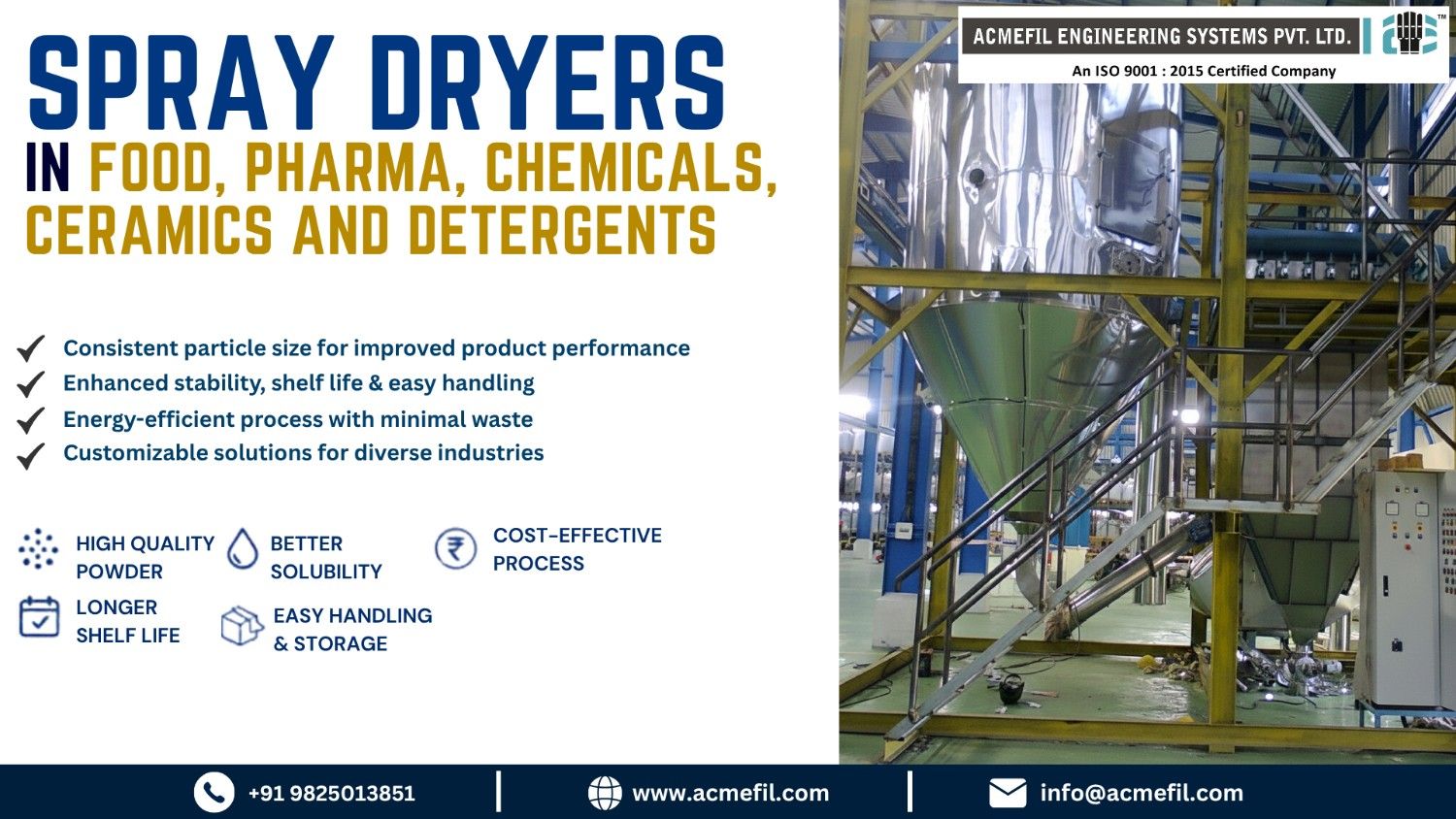
A spray dryer is used when a liquid, slurry, emulsion, paste, or solution needs to become a dry powder in one continuous operation. The main applications of spray dryers are in food and dairy, pharmaceuticals, dyestuffs, pigments, ceramics, detergents, polymers, inorganic chemicals, biochemical products, and selected effluent treatment processes. The correct spray dryer is not selected by industry name alone. It is selected by feed behavior, heat sensitivity, particle size requirement, solvent system, final moisture target, and powder handling requirement.
I see one common mistake in spray dryer selection: buyers first ask for capacity, but they do not describe the feed properly. Capacity matters, but viscosity, solids percentage, stickiness, abrasiveness, thermal sensitivity, and required powder form decide whether the plant will run smoothly.
For a technical foundation before reading this application guide, see the introduction to spray dryers guide and the explanation of how a spray dryer works.
What are the main applications of spray dryers?
Spray dryers are used to convert pumpable liquid feeds into powders with controlled moisture, bulk density, flowability, solubility, and particle size. The technology is widely used because atomization creates fine droplets with high surface area, so drying happens quickly when the droplets contact hot drying air.
In industrial plants, spray drying is not only about removing water. It is often about controlling the final powder quality.
Common product goals include:
- Making a liquid ingredient easier to store and transport
- Improving powder solubility or dispersibility
- Achieving controlled particle size
- Reducing moisture to a stable level
- Handling heat-sensitive materials with short residence time
- Converting slurry or solution into a saleable powder
- Preparing powders for blending, dosing, packaging, or downstream processing
The equipment design can change significantly from one application to another. A dairy powder plant, a dyestuff spray dryer, a ceramic slurry dryer, and a closed-loop pharmaceutical dryer should not be treated as the same machine.
Spray dryer application matrix by industry
| Industry | Typical products dried | Main purpose of spray drying | Key selection checks |
|---|---|---|---|
| Food and dairy | Milk products, egg products, beverages, food colours, food additives, vegetable proteins, herbal extracts, maltodextrin, soup mixes, enzymes | Convert liquid food ingredients into stable powders with controlled moisture and solubility | Heat sensitivity, flavour retention, hygiene requirement, powder solubility, bulk density |
| Pharmaceuticals and biochemicals | Herbal extracts, mineral extracts, dextrose, lactose, protein, hemoglobin, enzymes, selected API-related powders | Produce fine powders with controlled moisture, particle size, and stability | Product sensitivity, contamination control, solvent system, sterile or closed-loop need |
| Dyestuffs and pigments | Reactive dyes, disperse dyes, acid dyes, direct dyes, vat dyes, dye intermediates, pigments | Convert colour solutions or slurries into dry powder for packaging and downstream use | Abrasion, wall deposition, colour stability, atomizer wear, exhaust dust handling |
| Ceramics | Alumina, aluminium silicate, china clay, ferrites, silicon carbides, zirconia, steatites, titanates, glass slurry | Produce ceramic powders with controlled particle size and flow | Slurry solids, particle distribution, abrasion, bulk density, spray pattern |
| Detergents | Zeolite, alkyl benzene sulphonate, detergents, bleach activator, SLS | Create detergent powders and agglomerated particles | Particle size, moisture, density, agglomeration, powder flow |
| Polymers and resins | ABS, acrylic polymer, melamine-formaldehyde, PVA, urea-formaldehyde | Convert polymer or resin-based feed into powder form | Stickiness, glass transition behavior, feed viscosity, drying temperature |
| Inorganic chemicals | Aluminium chloride, barium sulphate, calcium chloride, manganese sulphate, silica, sodium silicate, catalysts | Dry chemical solutions or suspensions into solid powder | Corrosion, crystallization, particle size, moisture, exhaust treatment |
| Effluent and ZLD-related drying | Effluent concentrate and selected high-TDS streams | Reduce liquid discharge by drying concentrated waste streams | Salt loading, stickiness, fouling, air pollution control, disposal requirement |
Spray dryer applications in the food and dairy industry
Food and dairy applications are among the most familiar uses of spray drying. The goal is usually to convert liquid or semi-liquid feed into a powder that is easier to store, transport, blend, and dose.
Common food and dairy applications include:
- Milk products
- Egg products
- Food colours
- Beverages
- Food additives
- Vegetable proteins
- Herbal extracts
- Maltodextrin
- Soup mixes
- Enzymes
In food spray drying, the important question is not only “Can this product be dried?” The better question is “What powder behavior do we need after drying?”
Milk powder needs good solubility. Soup mixes need consistent blending behavior. Enzyme products may need careful temperature control. Herbal extracts may become sticky if the drying profile is not selected properly.
For buyers evaluating this area, the existing guide on spray dryer for milk powder and spray drying in the food industry are useful supporting references.
Spray dryer applications in pharmaceuticals and biochemicals
In pharmaceutical and biochemical applications, spray drying is used when the final powder needs controlled moisture, particle size, solubility, or stability. Applications may include herbal extracts, dextrose, lactose, proteins, hemoglobin, enzymes, and other sensitive materials.
This is where dryer selection becomes more serious.
For a heat-sensitive feed, a general-purpose dryer may not be enough. The design must consider inlet temperature, outlet temperature, residence time, feed concentration, atomization method, and powder collection system.
For solvent-based or oxygen-sensitive products, a closed-loop or sterile spray dryer may be needed. A closed-loop system uses a controlled atmosphere, commonly nitrogen, and allows solvent recovery where the process requires it. A sterile spray dryer may include filtration and hygienic design features for pharmaceutical use.
For deeper application context, see spray dryer applications in pharmaceuticals and Acmefil’s page on spray drying pharmaceuticals.
Spray dryer applications in dyestuffs, pigments and chemicals
Chemical and dyestuff spray drying is very different from food spray drying. The feed may be abrasive, corrosive, sticky, colour-sensitive, or difficult to atomize. This is why chemical spray dryer design must consider the feed in detail before capacity is finalized.
Typical dyestuff and pigment applications include:
- Reactive dyes
- Disperse dyes
- Acid dyes
- Direct dyes
- Vat dyes
- Dye intermediates
- Pigments
In inorganic chemicals, spray dryers may be used for products such as aluminium chloride, barium sulphate, calcium chloride, manganese sulphate, silica, sodium silicate, and catalysts.
For these products, the selection risk is usually in the details. A slurry with high solids may need a rotary atomizer. A feed that crystallizes quickly may behave differently inside the chamber. A product that deposits on the wall may require changes in temperature profile, atomization, chamber sizing, or air flow pattern.
If your product is chemical or dyestuff-based, do not finalize a dryer only from a capacity chart. Share the feed analysis, solids percentage, viscosity, required moisture, and powder handling requirement before design. Acmefil’s support article on spray drying chemical products is a useful starting point.
Spray dryer applications in ceramics
Ceramic spray drying is used when slurry must be converted into a powder with controlled particle size and flowability. Common ceramic applications include alumina, aluminium silicate, ceramics, china clay, ferrites, silicon carbides, zirconia, steatites, titanates, and glass slurry.
In ceramic applications, the feed is often abrasive. That affects atomizer selection, wear parts, chamber design, and powder collection. The buyer should check more than evaporation capacity.
Important checks include:
- Slurry solids percentage
- Particle size distribution
- Abrasiveness
- Sedimentation tendency
- Required powder flow
- Final moisture target
- Bulk density requirement
A rotary atomizer is often considered where slurry handling and droplet size control are important. For more focused support, see Acmefil’s page on spray dryers in the ceramic industry.
Spray dryer applications in detergents
Detergent powder production often needs controlled particle size, density, and moisture. Spray dryers are used for products such as zeolite, alkyl benzene sulphonate, detergents, bleach activator, and SLS.
In this application, powder structure matters. A powder that is too fine may create dusting and handling problems. A powder that is too wet may affect packaging and storage. A powder that is not properly agglomerated may not behave as required in downstream blending.
A fluidized spray dryer may be considered when larger particles or agglomerated powders are required. In this design, fines can be recycled back into the drying chamber, and further drying can happen through an integrated or external fluid bed stage.
For related design understanding, see the guide on spray dryer design and components and Acmefil’s fluidized spray dryer page.
Spray dryer applications in polymers and resins
Spray drying is also used for polymer and resin materials such as ABS, acrylic polymer, melamine-formaldehyde, PVA, and urea-formaldehyde.
These feeds can be more difficult than they appear on paper. Some polymer feeds become sticky at specific temperature ranges. Some form deposits inside the chamber. Some require careful control of inlet and outlet temperature to avoid poor powder recovery.
Before selecting a dryer for polymer or resin applications, check:
- Feed solids
- Feed viscosity
- Stickiness behavior
- Glass transition behavior where relevant
- Required particle size
- Final moisture
- Cleaning requirement
- Powder collection method
This is also where pilot testing can prevent expensive mistakes. A small feed sample can reveal wall deposition, powder recovery, and moisture behavior before committing to a full-scale plant.
Spray dryer applications in effluent and ZLD systems
Spray dryers can also be used in selected effluent treatment and zero liquid discharge applications, especially where concentrated effluent needs to be converted into dry residue.
This application requires careful review. Effluent concentrate can be sticky, corrosive, high in salts, and variable from batch to batch. A dryer designed from only one sample may fail if the actual plant feed changes during operation.
In ZLD-related projects, the spray dryer is usually not the first treatment step. The feed often comes after upstream treatment and evaporation. For broader process context, review Acmefil’s zero liquid discharge system and multi-effect evaporator resources.
Which spray dryer type fits which application?
| Application condition | Dryer type commonly evaluated | Why it matters |
|---|---|---|
| Slurry, pigment, dye, ceramic, or inorganic chemical feed | Rotary atomizer spray dryer | Rotary atomization can help with droplet formation where slurry behavior and particle size control are critical |
| Heat-sensitive food, enzyme, flavour, or pharmaceutical feed | Nozzle atomizer spray dryer or carefully designed low-residence-time system | The design must control drying temperature, residence time, and final powder moisture |
| Solvent-based or oxygen-sensitive product | Closed-loop spray dryer | Controlled atmosphere and solvent recovery may be required |
| Pharmaceutical sterile or contamination-sensitive product | Sterile spray dryer | Filtration, hygienic design, and contamination control become central |
| Detergent or food ingredient requiring larger/agglomerated particles | Fluidized spray dryer | Integrated or external fluid bed drying can support larger particle formation |
| Product development or uncertain feed behavior | Lab scale pilot spray dryer | Trial drying helps validate process behavior before full-scale design |
For a detailed comparison of atomization methods, see comparing spray dryers: nozzle vs rotary atomizer and Acmefil’s pages on rotary atomizer type spray dryer and nozzle atomizer type spray dryer.
What data should you share before selecting a spray dryer?
A serious spray dryer recommendation needs process data. Without that, the discussion becomes guesswork.
Share these details before asking for a quote:
| Data point | Why it matters |
|---|---|
| Product name and industry | Gives the first indication of hygiene, corrosion, and powder handling needs |
| Feed type | Solution, slurry, emulsion, paste, or suspension behave differently during atomization |
| Feed solids percentage | Directly affects water evaporation load and drying profile |
| Viscosity | Decides pumpability and atomization suitability |
| Required final moisture | Controls outlet temperature and residence time decisions |
| Heat sensitivity | Helps define safe drying temperature limits |
| Desired particle size | Influences atomizer type and operating parameters |
| Solvent or water-based feed | Decides whether open-cycle or closed-loop design is needed |
| Bulk density and flow requirement | Affects powder discharge, collection, and downstream handling |
| Trial sample availability | Enables pilot validation before full-scale design |
Acmefil has an in-house pilot spray dryer facility with 3 kg/hr water evaporation capacity for development applications. If the feed is new, sticky, heat-sensitive, or commercially important, I would strongly prefer a pilot trial before freezing the full-scale design. You can review the pilot spray dryer and lab scale spray dryer support pages for this route.
Buyer mistakes in spray dryer application selection
The wrong spray dryer is usually not wrong because the equipment is bad. It is wrong because the application was not defined correctly.
The most common mistakes are:
- Treating all powders in the same industry as identical
Milk powder, herbal extract powder, and enzyme powder may all fall under food, but their drying behavior can be very different. - Ignoring viscosity and solids percentage
A feed that looks pumpable at room temperature may behave differently during atomization. - Selecting only by evaporation capacity
Water evaporation capacity is important, but it does not tell you whether the product will stick, degrade, clog, or form the desired powder. - Not checking atomizer suitability
Rotary atomizers, pressure nozzles, and two-fluid nozzles do not give the same particle behavior. - Skipping pilot trials for difficult products
For sticky, heat-sensitive, abrasive, or high-value products, pilot testing is often cheaper than correcting a wrong full-scale design.
For operating guidance after selection, read spray dryer operating principles and best practices and optimize spray drying parameters.
When should you choose spray drying over other drying methods?
Spray drying is usually suitable when the feed is pumpable and the target product is a powder. It is especially useful when rapid drying, controlled particle size, and continuous operation are important.
It may not be the best first choice when the feed is not atomizable, when the product is extremely sticky without formulation adjustment, when a wet cake is better suited to spin flash drying, or when the product requires a drying mechanism that spray drying cannot provide.
That is why a comparison with other drying technologies should come before equipment purchase. The guide on comparing spray drying with other technologies can help in early-stage evaluation.
Practical conclusion
The applications of spray dryers are broad, but the correct design is always application-specific. Food powders need solubility and hygiene. Pharmaceutical products may need controlled drying, sterile design, or closed-loop operation. Chemicals and pigments need attention to corrosion, abrasion, and dust handling. Ceramics need powder consistency. Detergents may need agglomerated particles. Effluent streams need careful upstream and downstream process integration.
If you are evaluating a spray dryer, do not start with the machine model. Start with the feed. Once the feed behavior is clear, the correct atomizer, chamber, air flow, heating system, powder recovery system, and trial route can be selected with much less risk.
FAQs
Which industries use spray dryers the most?
Spray dryers are widely used in food and dairy, pharmaceutical, biochemical, chemical, ceramic, detergent, polymer, resin, dyestuff, pigment, inorganic chemical, and selected effluent treatment applications. The final goal may be moisture reduction, powder stability, solubility, flowability, particle size control, or easier storage and transport.
Which spray dryer is best for food industry applications?
There is no single best spray dryer for all food products. Milk powder, herbal extracts, enzymes, maltodextrin, soup mixes, and food colours can need different drying profiles. The right design depends on heat sensitivity, solids percentage, powder solubility, flavour retention, hygiene requirement, and desired particle size.
Can spray dryers handle slurry?
Yes, spray dryers can handle suitable slurries if the feed is pumpable and atomizable. Slurry solids, viscosity, sedimentation tendency, abrasion, and nozzle blockage risk must be checked. Ceramic, pigment, dye, and inorganic chemical slurries often need careful atomizer selection and pilot testing.
Are spray dryers suitable for heat-sensitive products?
Spray dryers can be suitable for many heat-sensitive products because drying happens quickly, but the design must be correct. Outlet temperature, residence time, atomization, chamber size, and product recovery system all matter. Heat-sensitive products should be evaluated through process data and, when possible, pilot trials.
When should a pilot spray dryer trial be done?
A pilot spray dryer trial is useful when the feed is new, sticky, heat-sensitive, abrasive, solvent-based, or commercially important. A trial can show powder recovery, wall deposition, moisture behavior, and atomization suitability before the buyer commits to a full-scale spray drying plant.
Need to check whether your product is suitable for spray drying?
Share your feed details, target moisture, desired particle size, heat sensitivity, and current process challenge with Acmefil’s technical team. For uncertain or high-value products, ask about pilot spray dryer trials before finalizing a full-scale plant.
Recommended next step: send your product data sheet, current feed sample details, and required powder specification through the Acmefil contact page or review Acmefil’s spray dryer manufacturer page for equipment options.

Siddharth Nair is Technical Director at Acmefil Engineering Systems Pvt. Ltd. he leads solution design and applications engineering across the company’s full product range — spray dryers, multi-effect evaporators, agitated thin film dryers, spin flash dryers, fluid bed dryers, and complete ZLD systems.
His work spans process evaluation, equipment sizing, customer application consulting, and technical proposal development for industries including food and dairy, pharmaceuticals, chemicals, dyestuffs, ceramics, and industrial effluent treatment. He has hands-on commissioning experience across Acmefil’s 500+ installations in India and 15+ countries.
He holds a BTech in Mechanical Engineering from CHARUSAT University and also partners at A.S Engineers, working with blowers, sludge dryers, and industrial conveying systems.


