
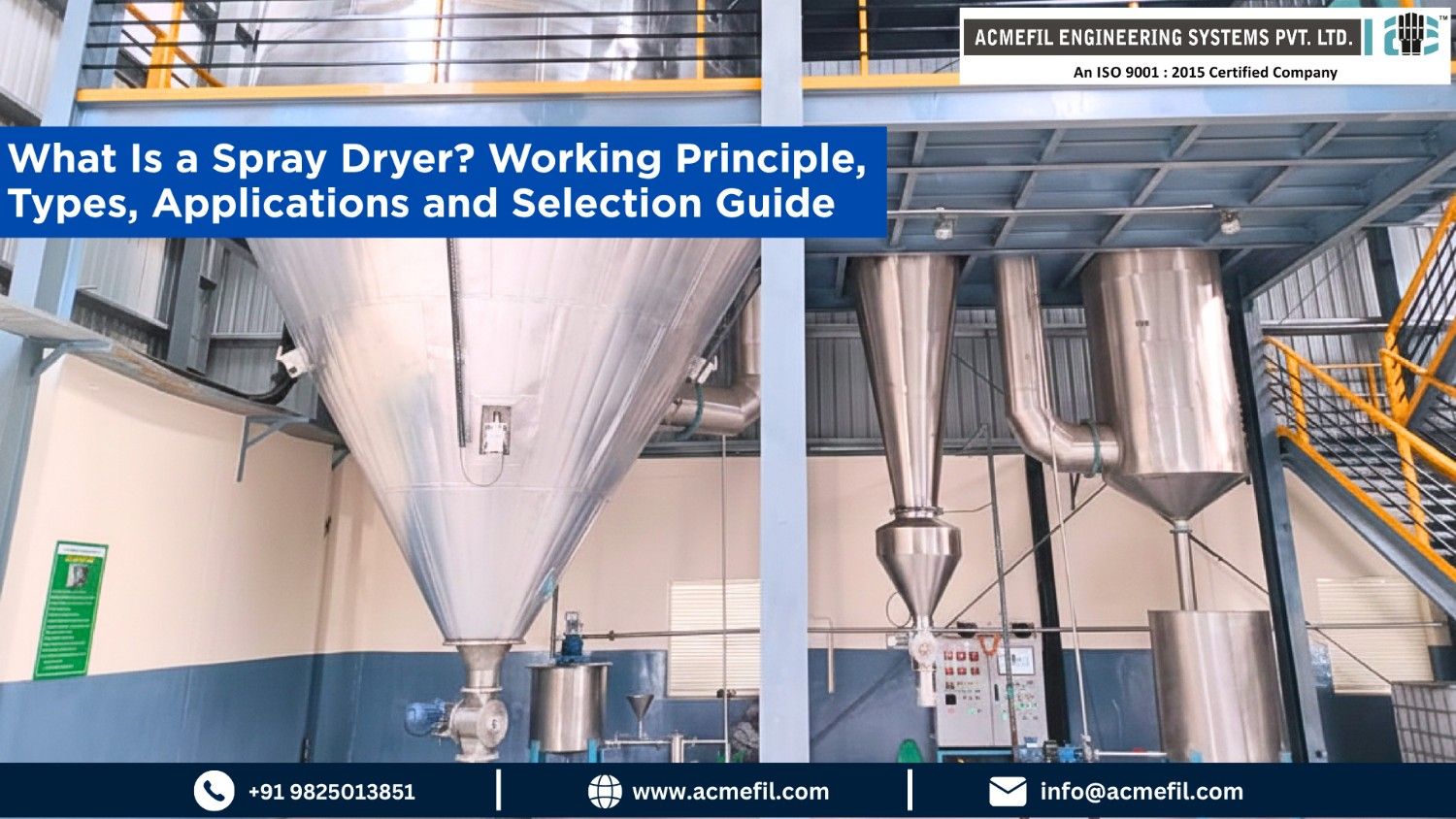
A spray dryer is an industrial drying system that converts a liquid feed into dry powder by atomizing the feed into fine droplets, drying those droplets with hot air, and separating the dried particles from the exhaust air. In simple terms, it turns pumpable liquid into powder in one continuous process.
That is the textbook answer. In real plant selection, I do not start with the textbook.
When a buyer asks us for a spray dryer, the first question is not only capacity. I want to know the feed solids, viscosity, stickiness, thermal sensitivity, required final moisture, target particle size, and whether the product must be free-flowing, agglomerated, sterile, or solvent-safe.
A spray dryer is not just a drying chamber. It is a complete process system. If atomization is wrong, chamber size will not save the product. If the outlet temperature is wrong, the powder may come out wet, sticky, scorched, or inconsistent. If powder recovery is weak, the plant may dry the product but lose value in the exhaust line.
The Direct Answer: How Does a Spray Dryer Work?
A spray dryer works in four stages:
| Stage | What Happens | Why It Matters |
|---|---|---|
| Atomization | Liquid feed is converted into fine droplets | Droplet size controls drying speed and particle size |
| Spray-air contact | Droplets meet hot drying air inside the chamber | Airflow pattern controls heat transfer and residence time |
| Drying | Moisture evaporates from each droplet | Poor control causes wet powder, wall deposits, or thermal damage |
| Powder separation | Dried particles are separated from exhaust air | Recovery design affects yield, dust load, and plant cleanliness |
Most spray drying problems begin in the first two stages. If the feed is not prepared properly or the atomizer does not match the product, the dryer may never produce stable powder, even if the heating and collection systems are correctly sized.
For a deeper process explanation, read how a spray dryer works.
Why Spray Drying Is Used
Spray drying is used when a liquid feed must be converted into a stable powder with controlled moisture, particle size, and handling properties.
It is common in:
- Food and dairy powders
- Pharmaceutical and biochemical powders
- Dyestuff and pigment powders
- Ceramic slurry processing
- Detergent powder production
- Inorganic chemical drying
- Effluent and process-concentrate drying in specific applications
The main advantage is that evaporation and particle formation happen in a single continuous operation. This makes spray drying useful when product quality depends on fast drying, controlled powder form, and consistent moisture.
Main Components of a Spray Dryer
A spray dryer plant normally includes these sections:
| Component | Function | Selection Impact |
|---|---|---|
| Feed tank | Holds the prepared liquid feed | Feed stability affects atomization |
| Feed pump | Delivers feed at controlled flow | Unstable pumping creates unstable droplets |
| Atomizer | Breaks feed into droplets | Controls particle size and drying rate |
| Hot air generator or heater | Supplies heated air | Defines available drying energy |
| Air disperser | Distributes hot air inside chamber | Reduces uneven drying and wall buildup |
| Drying chamber | Main evaporation zone | Controls residence time and drying path |
| Cyclone separator | Recovers powder from air | Important for product yield |
| Bag filter | Captures fine particles | Reduces powder loss and dust load |
| Rotary valve | Discharges powder while limiting air leakage | Helps maintain system pressure balance |
| Exhaust fan and ducting | Moves process air through the system | Controls airflow and pressure |
| Control panel | Monitors temperature, feed rate, airflow and safety functions | Improves repeatability and operating discipline |
A weak component can affect the full plant. For example, if the feed pump pulsates, droplet size changes. If droplet size changes, final moisture changes. If final moisture changes, the operator starts adjusting temperature, and the plant becomes difficult to control.
For component-level details, use spray dryer design and components.
Spray Dryer Working Principle
The spray dryer working principle is based on heat transfer and mass transfer.
First, the liquid feed is atomized into droplets. These droplets have a large surface area compared with the same liquid volume in bulk form. Hot air then transfers heat to the droplet surface. Moisture evaporates from the surface and moves into the drying air. As moisture leaves, the dissolved or suspended solids form a dry particle.
Two things must be controlled together:
| Principle | What It Means in Practice |
|---|---|
| Heat transfer | Hot air provides the energy needed to evaporate water or solvent |
| Mass transfer | Moisture moves from the droplet into the surrounding air |
| Residence time | Droplets must remain in the chamber long enough to dry |
| Particle formation | Solids must form the required powder structure without sticking or degrading |
Many buyers focus only on inlet temperature. I pay close attention to outlet temperature because it is usually more closely linked with final powder moisture and product exposure. A very high inlet temperature does not automatically mean product damage, because evaporative cooling protects the droplet during early drying. But once the particle becomes dry, excessive thermal exposure can still become a problem.
This is why feed behavior, outlet temperature, droplet size, and residence time must be reviewed together.
Types of Spray Dryers
Spray dryers are not all the same. The right type depends on feed characteristics, particle size target, thermal sensitivity, solvent condition, and powder behavior.
| Type of Spray Dryer | Best Suited For | Practical Selection Note |
|---|---|---|
| Rotary disc type spray dryer | Slurries, dyes, ceramics, food powders, pharmaceutical powders, detergents, pigments, inorganic chemicals | Good when droplet size control through disc speed and disc selection is important |
| Nozzle type spray dryer | Heat-sensitive products, enzymes, flavours, pharmaceutical products, food processing applications | Useful where pressure nozzle or two-fluid nozzle atomization fits the feed |
| Fluidized spray dryer | Detergents, food ingredients, agglomerated powders | Helps produce larger particles and supports additional drying in fluid bed section |
| Closed loop spray dryer | Solvent-based or oxidation-sensitive products | Uses nitrogen atmosphere and solvent recovery logic |
| Sterile spray dryer | Pharmaceutical and aseptic powder applications | Uses sterile filtration and hygienic process design |
| Lab scale pilot spray dryer | R&D, trials, process development | Used to test drying behavior before full-scale investment |
At Acmefil, spray dryer selection is connected with the product, not just the equipment name. A ceramic slurry, a herbal extract, a dye intermediate, and a detergent formulation may all need spray drying, but they do not behave the same inside the chamber.
Rotary Atomizer vs Nozzle Atomizer
Atomizer selection is one of the most important decisions in a spray dryer project.
A rotary atomizer uses a high-speed rotating disc. Feed spreads across the disc and forms droplets by centrifugal force. Acmefil’s rotary disc type spray dryer reference range includes fine droplets generally in the 20 to 75 micron range, depending on disc selection, speed, and feed properties.
A nozzle atomizer uses either pressure or compressed air. In a pressure nozzle system, feed is pumped through an orifice under pressure. In a two-fluid nozzle system, compressed air helps atomize the liquid into finer droplets.
| Selection Factor | Rotary Atomizer | Pressure Nozzle | Two-Fluid Nozzle |
|---|---|---|---|
| Atomization method | High-speed centrifugal disc | Feed pressure through nozzle orifice | Liquid feed plus compressed air |
| Droplet control | Disc design and speed | Pressure and nozzle geometry | Air-liquid ratio and nozzle design |
| Common fit | Slurries, dyes, ceramics, food, detergents, pigments | Pumpable liquids needing nozzle atomization | Fine particle and smaller-scale or special applications |
| Watch point | Disc condition, speed, mechanical balance | Nozzle blockage, pressure stability | Compressed air consumption and consistency |
| Buyer mistake | Choosing only by capacity | Ignoring filtration and nozzle wear | Ignoring compressed air demand |
The right answer is not “rotary is better” or “nozzle is better.” The right answer depends on feed behavior and powder target.
For a detailed comparison, read nozzle vs rotary atomizer spray dryers and spray dryer atomization techniques.
Where Spray Dryers Are Used
Spray dryers are used across industries where powders must be produced from liquid feed.
| Industry | Example Products | Why Spray Drying Is Used |
|---|---|---|
| Food industry | Milk products, egg products, food colours, beverages, food additives, vegetable proteins, maltodextrin, soup mixes, enzymes | Shelf-stable powder, easier handling, controlled moisture |
| Pharmaceutical and biochemical | Herbal extracts, dextrose, lactose, protein, hemoglobin, mineral extracts | Controlled drying of sensitive materials |
| Dyestuff and pigments | Reactive dyes, disperse dyes, acid dyes, direct dyes, vat dyes, dye intermediates, pigments | Powder consistency and easier downstream processing |
| Ceramic industry | Alumina, aluminium silicate, china clay, ferrites, silicon carbides, zirconia, steatites, titanates, glass slurry | Uniform powder preparation before forming or firing |
| Detergents | Zeolite, alkyl benzene sulphonate, detergents, bleach activator, SLS | Large-volume powder production |
| Inorganic chemicals | Aluminium chloride, barium sulphate, calcium chloride, manganese sulphate, silica, sodium silicate, catalysts | Dry chemical powder production |
The same machine category serves all these industries, but the engineering changes from product to product. A food-grade dryer may require hygienic design and cleanability. A ceramic slurry may require abrasion-aware material handling. A solvent-based product may require a closed loop system and detailed safety review.
For more industry examples, read applications of spray dryers.
What Makes a Good Spray Dryer Design?
A good spray dryer design is not the biggest chamber or the highest temperature. A good design is one that gives stable powder quality at the required capacity, with practical operating cost and maintainable equipment.
The design must answer these questions:
| Design Question | Why It Matters |
|---|---|
| Can the feed be pumped consistently? | Poor feed flow creates unstable droplet size |
| Can the feed be atomized properly? | Atomization controls drying rate and particle size |
| Is the drying chamber sized for required residence time? | Short residence time causes wet powder |
| Is the product sticky during drying? | Sticky phases create wall deposits |
| What final moisture is required? | Moisture target defines drying duty |
| What particle size is required? | Particle size affects atomizer and collection system |
| Is the product heat-sensitive? | Temperature profile must be controlled |
| Are solvents present? | Closed loop and safety design may be required |
| What recovery efficiency is needed? | Fine powders need suitable cyclone and bag filter design |
| How will the dryer be cleaned? | Critical for food, pharma, and multi-product plants |
The strongest proposals usually come after feed characterization or pilot trials. Without feed data, a spray dryer quotation is only an assumption.
Advantages of Spray Drying
Spray drying has several practical advantages:
- It converts liquid feed into powder in one continuous process.
- It can be suitable for heat-sensitive products when outlet temperature and residence time are controlled.
- It allows control over particle size, moisture, bulk density, and powder handling.
- It supports industrial-scale continuous production.
- It can be configured for food, pharmaceutical, chemical, ceramic, detergent, dyestuff, and inorganic chemical applications.
- It can be integrated with cyclones, bag filters, fluid beds, sterile filtration, or solvent recovery systems.
- It can be tested at pilot scale before full-scale procurement.
The real advantage is not only speed. The real advantage is controlled powder formation. That is why spray drying is selected when powder quality matters, not only when water must be removed.
Limitations of Spray Drying
Spray drying is powerful, but it is not suitable for every product.
| Limitation | Practical Meaning |
|---|---|
| Feed must be pumpable | Highly viscous or paste-like material may not atomize properly |
| Sticky products can deposit on chamber walls | Product behavior during drying must be understood |
| Energy demand can be high | Heating large air volumes requires proper utility planning |
| Fine powder recovery needs good separation | Cyclone and bag filter design affect yield |
| Plant footprint and height matter | Spray dryers need suitable installation space |
| Wrong atomizer causes quality problems | The atomizer must match feed and powder target |
| Solvent-based products need special design | Closed loop and safety systems may be required |
This is where many selection mistakes happen. A buyer may compare two spray dryer quotations only on price, without checking atomizer type, chamber sizing logic, material of construction, collection system, cleaning design, and utility assumptions.
That comparison is risky.
When Should You Choose a Spray Dryer?
You should consider a spray dryer when:
- Your feed is a solution, slurry, emulsion, suspension, extract, or concentrate that can be pumped and atomized.
- You need powder instead of liquid or wet cake.
- Final moisture and particle size matter.
- Continuous production is required.
- The product must dry quickly with controlled exposure.
- The application is in food, pharma, dyestuff, pigment, ceramic, detergent, inorganic chemical, or similar powder-processing industries.
You should be cautious when:
- The feed is too viscous for proper atomization.
- The product becomes sticky during drying.
- The product is highly heat-sensitive and has a narrow temperature window.
- The feed contains solvent or creates explosion/dust risk.
- You do not have enough feed data to size the plant.
- You are trying to compare suppliers without pilot trial results or clear design assumptions.
For selection guidance, read choosing the right spray dryer.
Data Required Before Selecting a Spray Dryer
Before I recommend a spray dryer configuration, I want the buyer to share process data.
| Required Data | Why It Is Needed |
|---|---|
| Feed type | Solution, slurry, suspension, emulsion, extract, or concentrate |
| Feed solids percentage | Defines evaporation load and powder yield |
| Feed viscosity | Decides pumpability and atomizer suitability |
| Feed temperature | Affects flow and energy balance |
| Initial moisture | Defines starting condition |
| Final moisture target | Defines required drying duty |
| Thermal sensitivity | Controls temperature window |
| Target particle size | Guides atomizer and chamber design |
| Bulk density requirement | Affects powder handling and packaging |
| Stickiness behavior | Helps predict wall deposition risk |
| Solvent presence | May require closed loop design |
| Required capacity | Defines scale and utility load |
| Cleaning requirement | Important for food, pharma, and multi-product plants |
| Material compatibility | Helps select contact-part material |
| Available utilities | Affects heating system, air, power, and layout |
If a supplier gives a confident final design without asking these questions, the buyer should slow down.
Why Pilot Plant Trials Matter
Pilot testing is the practical bridge between theory and full-scale investment.
At Acmefil, the in-house R&D centre includes a lab scale pilot spray dryer with 3 kg/hr water evaporation capacity. This is used for trials, process development, and checking whether a product can be dried as expected before committing to full-scale equipment.
A pilot trial can help confirm:
- Whether the feed atomizes properly
- Whether the powder reaches the required moisture
- Whether wall deposition occurs
- Whether rotary or nozzle atomization is better
- Whether the product changes colour, texture, or performance
- Whether downstream powder recovery is practical
- Whether the full-scale design needs changes before manufacturing
For a standard product, prior experience may be enough. For a new formulation, difficult slurry, heat-sensitive product, or export project, pilot testing can prevent an expensive mistake.
For trial-related information, visit Acmefil’s pilot spray dryer page.
Common Spray Dryer Problems and What They Usually Mean
| Problem | Likely Cause | First Checks |
|---|---|---|
| Final powder moisture is high | Feed rate too high, inlet temperature too low, large droplets, short residence time | Check feed rate, outlet temperature, atomizer condition |
| Powder sticks to chamber wall | Sticky phase, poor air distribution, wrong temperature profile | Check product behavior, air disperser, outlet temperature |
| Particle size is inconsistent | Atomizer wear, pressure fluctuation, viscosity change | Inspect atomizer and stabilize feed preparation |
| Nozzle blockage occurs | Feed impurities, poor filtration, precipitation | Improve filtration and cleaning routine |
| Powder carryover is high | Too many fines, weak separation, high airflow imbalance | Review cyclone, bag filter, and airflow |
| Product changes colour | Excessive thermal exposure or oxidation | Review outlet temperature and drying atmosphere |
| Powder does not flow well | Moisture too high, particle morphology issue, fines overload | Check moisture, atomization, and collection |
For troubleshooting, use spray dryer troubleshooting common issues.
Maintenance Areas That Affect Spray Dryer Performance
Spray dryer maintenance should focus on the parts that affect droplet formation, airflow, powder recovery, and hygiene.
Key areas include:
- Rotary disc, pressure nozzle, or two-fluid nozzle condition
- Feed pump and feed-line cleanliness
- Feed filtration
- Hot air generator or air heater condition
- Air disperser inspection
- Drying chamber cleaning
- Cyclone and bag filter condition
- Rotary valve and powder discharge performance
- Temperature sensor calibration
- Exhaust fan and ducting condition
- Control panel and safety interlocks
A spray dryer does not usually fail only on the day something breaks. Many problems develop slowly through atomizer wear, airflow imbalance, sensor drift, filter loading, or poor cleaning discipline.
For practical maintenance guidance, read maintenance tips for spray dryers.
Spray Dryer Cost: What Actually Drives the Investment?
The cost of a spray dryer depends on the complete process requirement, not only evaporation capacity.
Important cost drivers include:
| Cost Driver | Why It Changes Price |
|---|---|
| Evaporation load | Higher moisture removal needs larger thermal duty |
| Material of construction | Food, pharma, chemical, and abrasive products need different contact materials |
| Atomizer type | Rotary, pressure nozzle, and two-fluid systems have different design requirements |
| Drying chamber size | Residence time and airflow influence size |
| Heating system | Direct fired, indirect fired, steam, or other utility choices affect cost |
| Powder recovery system | Cyclone, bag filter, and fines recovery affect layout and price |
| Automation level | Controls, instrumentation, and PLC systems change investment |
| Cleaning requirement | Hygienic or multi-product operation needs better cleanability |
| Solvent or sterile requirement | Closed loop or sterile systems need additional engineering |
| Pilot testing requirement | Trials may add time, but reduce design risk |
The cheapest spray dryer is not always the lowest-cost plant. If it produces wet powder, creates deposits, loses fines, consumes excess energy, or needs frequent shutdowns, the lifecycle cost becomes higher.
For investment thinking, read cost-benefit analysis of investing in a spray dryer.
How Acmefil Approaches Spray Dryer Selection
Acmefil Engineering Systems Pvt. Ltd. is an ISO 9001:2015 certified manufacturer, supplier, and exporter of drying and concentrating equipment, incorporated in 2000 and headquartered in GIDC Vatva, Ahmedabad.
For spray drying, Acmefil’s portfolio includes:
- Rotary disc type spray dryers
- Nozzle type spray dryers
- Fluidized spray dryers
- Closed loop spray dryers
- Sterile spray dryers
- Lab scale pilot spray dryers
- Rotary atomizers
- Spray nozzles
- Hot air generators
- Powder recovery and supporting drying plant equipment
Acmefil has 500+ installations across India and international markets. The company also supports equipment selection, design, engineering, supply, installation, commissioning, training, automation, troubleshooting, spares, maintenance, and after-sales service.
My practical recommendation is simple: do not select a spray dryer only from a brochure or a capacity number. Share the feed data first. If the product is new or difficult, run a pilot trial. Then finalize atomizer type, chamber design, heating system, powder recovery, and automation scope.
For product details, visit Acmefil’s spray dryer manufacturer page and spray dryer types guide.
Final Takeaway
A spray dryer converts liquid feed into dry powder through atomization, hot air drying, and powder separation. The principle is easy to explain, but correct selection depends on the product.
The most important questions are:
- Can the feed be atomized?
- What final moisture is required?
- What particle size and powder behavior are expected?
- Is the product heat-sensitive or sticky?
- Is the right atomizer being selected?
- Is pilot testing needed before full-scale design?
When these questions are answered properly, spray drying becomes a controlled powder production process. When they are ignored, the same technology can become a source of wet powder, wall deposits, poor recovery, and repeated shutdowns.
FAQs
What is a spray dryer?
A spray dryer is an industrial machine that converts liquid feed into dry powder. It atomizes the liquid into fine droplets, dries those droplets with hot air inside a chamber, and separates the dried powder from exhaust air using a cyclone, bag filter, or similar recovery system.
What is the working principle of a spray dryer?
The working principle of a spray dryer is atomization followed by rapid moisture evaporation. Liquid feed is converted into droplets, exposed to hot drying air, dried in suspension, and recovered as powder. Droplet size, air temperature, residence time, and feed properties control the final result.
Which products can be dried in a spray dryer?
Spray dryers are used for food products, dairy powders, herbal extracts, pharmaceutical powders, dyes, pigments, ceramic slurries, detergents, inorganic chemicals, catalysts, and similar pumpable feeds. Suitability depends on feed viscosity, thermal sensitivity, solids content, stickiness, and final powder specification.
What is the difference between rotary atomizer and nozzle spray dryer?
A rotary atomizer uses a high-speed rotating disc to form droplets by centrifugal force. A nozzle spray dryer uses pressure or compressed air to atomize the feed. Rotary atomizers are often used for slurries and variable feeds, while nozzle systems are useful where nozzle-based particle control fits the product.
Why is pilot testing important before buying a spray dryer?
Pilot testing confirms how the actual feed behaves during atomization and drying. It helps evaluate moisture reduction, wall deposition, particle size, product sensitivity, and powder recovery before full-scale investment. For new or difficult products, pilot testing reduces the risk of wrong equipment selection.
Need Help Selecting the Right Spray Dryer?
Share your feed properties, solids percentage, viscosity, moisture target, thermal sensitivity, capacity, particle size requirement, and application details with Acmefil’s technical team.
If the product is new, sticky, heat-sensitive, solvent-based, or difficult to atomize, start with a pilot trial before finalizing the full-scale spray dryer.
Use Acmefil’s spray dryer manufacturer page for equipment details, or contact the team through SprayDryer.com contact.

Siddharth Nair is Technical Director at Acmefil Engineering Systems Pvt. Ltd. he leads solution design and applications engineering across the company’s full product range — spray dryers, multi-effect evaporators, agitated thin film dryers, spin flash dryers, fluid bed dryers, and complete ZLD systems.
His work spans process evaluation, equipment sizing, customer application consulting, and technical proposal development for industries including food and dairy, pharmaceuticals, chemicals, dyestuffs, ceramics, and industrial effluent treatment. He has hands-on commissioning experience across Acmefil’s 500+ installations in India and 15+ countries.
He holds a BTech in Mechanical Engineering from CHARUSAT University and also partners at A.S Engineers, working with blowers, sludge dryers, and industrial conveying systems.


