
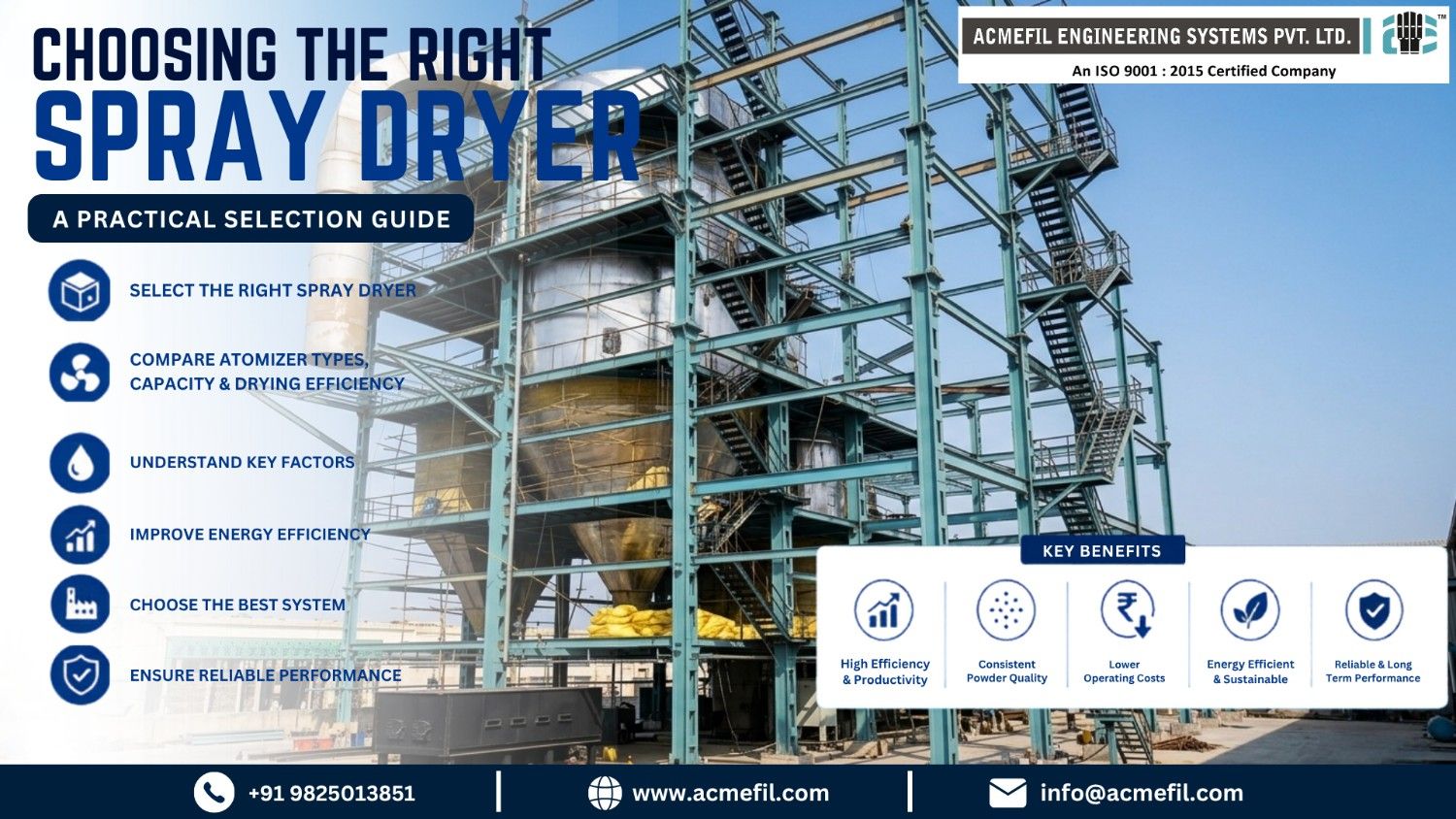
Choosing the right spray dryer starts with your feed, not with the machine catalogue. Before selecting rotary atomizer, nozzle atomizer, fluidized, closed loop, sterile, or pilot-scale spray drying equipment, you need to define feed viscosity, solids content, heat sensitivity, target particle size, final moisture, capacity, solvent presence, cleaning requirement, and scale-up risk.
I have seen buyers compare spray dryers only by capacity and price. That is where problems begin. A spray dryer that looks economical on paper can become expensive if the feed blocks the atomizer, sticks to the chamber wall, fails to reach target moisture, or produces powder with the wrong bulk density.
For a deeper process background, first understand how a spray dryer works and then use this guide as your selection checklist.
The Main Question Is Not “Which Spray Dryer Is Best?”
The correct question is:
Which spray dryer matches this product, this feed behavior, this powder specification, and this plant condition?
A spray dryer converts liquid feed into dry powder by atomizing the feed into fine droplets, contacting those droplets with hot drying air, evaporating the moisture, and separating the dried powder from the exhaust air.
That process sounds simple. In practice, the final powder depends on many connected variables:
| Selection Variable | Why It Matters |
|---|---|
| Feed viscosity | Affects pumpability, atomization quality, droplet size, and nozzle choking risk |
| Solids content | Affects water evaporation load, chamber size, drying time, and energy demand |
| Heat sensitivity | Decides inlet and outlet temperature window, residence time, and dryer configuration |
| Target particle size | Drives atomizer selection, chamber design, fines return, and powder flow behavior |
| Final moisture | Determines drying duty, outlet temperature control, and second-stage drying need |
| Bulk density and flowability | Important for packaging, dosing, handling, and downstream processing |
| Solvent or water-based feed | Decides whether open-cycle or closed-loop spray drying is required |
| Cleaning requirement | Critical in food, dairy, pharma, and multi-product plants |
| Production scale | Decides lab, pilot, or industrial spray dryer sizing |
| Plant utilities | Affects hot air generator, steam, power, compressed air, and exhaust treatment planning |
This is why a serious spray dryer selection process should begin with a product data sheet and, where possible, a pilot trial.
What Data Should You Collect Before Selecting a Spray Dryer?
Before discussing machine size, collect the following details. This saves time for both the buyer and the manufacturer.
| Data Required | What to Provide | Selection Impact |
|---|---|---|
| Product name and application | Milk powder, dye slurry, ceramic slurry, enzyme, herbal extract, pigment, detergent, pharma intermediate | Helps identify proven dryer configuration and material-contact requirements |
| Feed form | Solution, suspension, slurry, emulsion, paste-like liquid | Determines whether rotary atomizer, pressure nozzle, or two-fluid nozzle is practical |
| Feed solids | Percentage of solids in feed | Affects evaporation load and dryer capacity |
| Feed viscosity | At operating temperature if possible | High viscosity can make nozzle selection difficult |
| Heat sensitivity | Maximum product temperature or degradation limit | Drives co-current flow, outlet temperature, and residence time selection |
| Required powder moisture | Final moisture target | Affects drying duty and outlet temperature control |
| Particle size target | Fine powder, coarse powder, agglomerated powder, free-flowing granules | Drives atomizer and fluidized drying decisions |
| Bulk density requirement | Low, medium, or high density | Important for food, detergent, ceramic, and pharma powders |
| Solvent presence | Water-based or solvent-based feed | Solvent-based feed may require closed-loop drying |
| Production capacity | Kg/hr feed, kg/hr powder, or kg/hr water evaporation | Required for chamber sizing and heat load calculation |
| Available utilities | Fuel, steam, power, compressed air, nitrogen, space | Affects heating method, atomizer choice, and plant layout |
| Cleaning requirement | CIP, manual cleaning, product changeover frequency | Important for hygienic and multi-product operation |
If this data is missing, the supplier can only give a rough commercial estimate. They cannot correctly size the spray dryer.
Choosing the Right Spray Dryer by Type
Spray dryers are not interchangeable. Each type solves a different process problem.
| Spray Dryer Type | Best Fit | Key Selection Check | Avoid When |
|---|---|---|---|
| Rotary Atomizer Spray Dryer | Slurries, suspended solids, dyes, ceramics, detergents, food powders | Feed solids, viscosity, droplet size, disc speed, chamber diameter | You need very specific nozzle-driven particle morphology |
| Nozzle Atomizer Spray Dryer | Food, pharma, flavours, enzymes, heat-sensitive products, selected chemicals | Feed filtration, pressure, nozzle type, particle requirement | Feed has coarse solids or frequent choking risk |
| Fluidized Spray Dryer | Large particles, agglomerated powders, detergents, food ingredients | Powder residence time, fines recycle, integrated or external fluid bed | You need only a simple fine powder without agglomeration |
| Closed Loop Spray Dryer | Solvent-based, oxidation-sensitive, or solvent recovery applications | Nitrogen loop, oxygen control, condenser, solvent recovery, safety system | Feed is simple water-based and does not require oxygen exclusion |
| Sterile Spray Dryer | Pharmaceutical and aseptic powder applications | HEPA filtration, sterile micro filters, containment, validation needs | Non-sterile industrial powder where sanitary design is not required |
| Lab Scale / Pilot Spray Dryer | R&D, new product development, process validation before scale-up | Trial result, powder recovery, moisture, wall sticking, particle size | Buyer expects direct commercial scale-up without trial interpretation |
Acmefil manufactures multiple spray dryer types, including rotary atomizer spray dryers, nozzle atomizer spray dryers, fluidized spray dryers, and closed loop spray dryers. The correct choice depends on process behavior, not preference.
How to Select Spray Dryer Atomizer Type
Atomizer selection is one of the most important decisions in spray dryer design. The atomizer controls droplet formation. Droplet size affects drying rate, final particle size, moisture, wall deposition, and powder recovery.
Rotary Atomizer
A rotary atomizer uses a high-speed rotating disc to convert liquid feed into droplets by centrifugal force. At Acmefil, rotary disc type spray dryers are used where droplet size control is important and where slurries or suspended solids need practical handling.
Rotary atomizers are often suitable for:
- Dye and pigment slurries
- Ceramic slurry
- Detergent powders
- Food powders such as milk, egg, and soup mixes
- Pharmaceutical and inorganic chemical applications
- Feeds where nozzle choking risk is high
The main advantage is operating flexibility. Disc selection and speed help control droplet size. The trade-off is that chamber design and fines handling must be planned correctly.
Pressure Nozzle Atomizer
A pressure nozzle atomizer pumps feed through an orifice under high pressure. It can produce fine or coarse particles depending on nozzle design and operating pressure.
Pressure nozzle systems are often considered when:
- Feed is well-filtered
- Particle size distribution needs tighter control
- Product morphology or bulk density is important
- The dryer configuration supports nozzle spray pattern
The weak point is blockage. If the feed contains suspended particles, undissolved solids, or unstable viscosity, nozzle choking can become a recurring operating problem.
Two-Fluid Nozzle Atomizer
A two-fluid nozzle uses compressed air or gas to atomize the liquid feed. This can be useful for small capacities, pilot dryers, difficult feeds, and fine particle requirements.
Two-fluid nozzles are often used when:
- Feed rate is low
- Fine droplets are required
- The product is high value
- Pilot-scale testing is needed
- Compressed air or gas consumption is acceptable
The trade-off is operating cost. Compressed air is not free. For full-scale production, this must be evaluated carefully.
For a focused comparison, read nozzle vs rotary atomizer spray dryers and spray dryer atomization techniques.
Match the Dryer to the Product, Not the Other Way Around
A spray dryer should be selected from the product requirement backward.
For Food and Dairy Powders
Food and dairy applications often care about solubility, flavour retention, bulk density, hygiene, and consistent powder flow. Milk powder, coffee extract, fruit juice concentrate, whey, starch, glucose, egg products, soup mixes, and food colours all behave differently inside the chamber.
Key checks:
- Is the product heat-sensitive?
- Is agglomeration required?
- Is CIP required?
- Does the powder need instant solubility?
- Is the product sticky at outlet temperature?
- Is an integrated or external fluid bed needed?
For food applications, the final answer is rarely just “spray dryer capacity.” Powder quality matters as much as evaporation capacity.
For Pharmaceutical and Herbal Extract Applications
Pharmaceutical and herbal extract spray drying needs tighter control over product contact surfaces, contamination risk, cleaning, heat exposure, powder recovery, and documentation.
Key checks:
- Is sterile or aseptic processing required?
- Is the product oxygen-sensitive?
- Is solvent present?
- Is product containment required?
- Are HEPA filters or sterile micro filters needed?
- Is batch traceability required?
Where aseptic or solvent-based conditions are involved, closed loop or sterile spray drying may be more appropriate than a conventional open-cycle system.
For Chemical, Dyestuff, and Pigment Applications
Chemical and dyestuff feeds often create practical problems that look small on paper but become serious in production. Viscosity shift, abrasive particles, wall sticking, colour contamination, exhaust dust load, and nozzle choking must be checked early.
Key checks:
- Is the feed a solution, slurry, or suspension?
- Does it contain abrasive particles?
- Does viscosity change with temperature?
- Is the powder dusty?
- Is exhaust air treatment required?
- Is the material corrosive?
For many dye, pigment, ceramic, and inorganic chemical applications, rotary atomizer selection is common because it handles many slurry-type feeds better than nozzle systems. But trial data is still the safer route.
For Solvent-Based or Oxidation-Sensitive Products
A water-based feed and solvent-based feed cannot be treated the same way. If the feed contains solvent, the selection discussion moves beyond powder quality. It includes oxygen control, solvent recovery, fire detection, explosion protection, condenser sizing, nitrogen loop design, and emissions control.
This is where a closed loop spray dryer may be required.
Do not treat closed loop drying as an optional premium feature when solvent safety or oxidation control is central to the process.
Chamber Design, Airflow, and Residence Time Matter
Atomizer selection is not enough. The drying chamber must give the droplets enough residence time to dry without overheating, sticking, or creating excessive fines.
Key chamber and airflow questions:
- What is the evaporation load in kg/hr of water?
- What inlet and outlet temperature range is safe for the product?
- What air velocity is needed?
- What residence time is required?
- Does the powder need single-stage or two-stage drying?
- Is a fluid bed needed for final drying or cooling?
- Will the powder collect in a cyclone, bag filter, or both?
- Will wall sticking occur at the selected outlet temperature?
A common buyer mistake is to oversimplify temperature. Inlet temperature is not the same as product temperature. The outlet temperature is usually the stronger indicator of final moisture and thermal stress. A heat-sensitive product may tolerate high inlet air temperature for a very short contact time, but only if chamber design, airflow, and outlet temperature are correct.
For more detail, review spray dryer design and components and spray dryer operating principles and best practices.
When Is a Fluidized Spray Dryer the Better Choice?
A fluidized spray dryer is used when the product needs larger particles or agglomerated powder. In this system, moist powder can be dried further in an integrated fluid bed at the bottom of the chamber. Fines can be recycled back to the drying chamber. For some applications, two-stage or three-stage drying can improve particle size and powder handling.
Use a fluidized spray dryer when:
- The powder should not be too fine
- Agglomeration is required
- Flowability is important
- Final drying or cooling is needed after spray drying
- Dust reduction is a major product-handling requirement
It is especially relevant for detergents and food ingredients where large particle size or improved powder flow is required.
Why Pilot Testing Should Come Before Final Spray Dryer Selection
Pilot testing is not a formality. It is the most practical way to detect problems before investing in a full-scale spray dryer.
A pilot trial can answer questions that a quotation cannot:
- Does the feed atomize properly?
- Does the powder stick to the chamber wall?
- Can the target moisture be achieved?
- What particle size range is realistic?
- Does the product degrade at selected temperature conditions?
- What powder recovery can be expected?
- Is the feed stable during pumping?
- Does nozzle choking occur?
- Is pre-filtration or pre-concentration needed?
Acmefil operates an in-house R&D centre with a pilot spray dryer rated at 3 kg/hr water evaporation for trials. For buyers developing a new powder or scaling a difficult product, this facility helps reduce selection risk before full-scale procurement.
A trial does not automatically guarantee scale-up success. It gives the engineering team a stronger basis for scale-up decisions.
How to Evaluate a Spray Dryer Manufacturer
The right manufacturer should not only quote a machine. They should question your process assumptions.
Use this checklist before finalizing a spray dryer manufacturer:
| Evaluation Area | What to Ask |
|---|---|
| Feed understanding | Did they ask for viscosity, solids, heat sensitivity, and particle target? |
| Atomizer logic | Can they explain why rotary, pressure nozzle, or two-fluid nozzle fits your product? |
| Pilot testing | Can they test actual feed before full-scale design? |
| Product range | Can they offer more than one spray dryer configuration? |
| Dryer sizing | Are they calculating evaporation load and residence time, or only quoting capacity? |
| Material of construction | Is the metallurgy suitable for food, pharma, chemical, ceramic, or corrosive duty? |
| Heating method | Is direct or indirect hot air generation suitable for the product? |
| Powder recovery | Are cyclone, bag filter, and exhaust handling properly considered? |
| Installation support | Can they support erection, commissioning, training, and troubleshooting? |
| Lifecycle support | Are spares, maintenance, plant upgrade, and rebuild support available? |
Acmefil Engineering Systems was incorporated in 2000 and manufactures drying and concentrating equipment from Ahmedabad. The company’s verified strengths include 500+ installations across India and internationally, ISO 9001:2015 certification, turnkey project delivery, in-house pilot plant facilities, and multi-technology capability across spray dryers, spin flash dryers, flash dryers, fluid bed dryers, evaporators, ZLD systems, membrane systems, and air pollution control equipment.
For direct equipment information, visit Acmefil’s spray dryer manufacturer page.
Total Cost of Ownership Is More Important Than Purchase Price
The lowest-priced spray dryer is not always the lowest-cost spray dryer.
Total cost depends on:
- Fuel or steam consumption
- Compressed air demand
- Electrical load
- Nitrogen requirement for closed loop systems
- Product loss in exhaust
- Cleaning downtime
- Nozzle or atomizer maintenance
- Bag filter and cyclone performance
- Labour requirement
- Spare availability
- Plant shutdown risk
- Rework caused by off-spec powder
A cheaper dryer that produces inconsistent powder, frequent wall buildup, or recurring nozzle choking can cost more over its lifetime than a properly selected system.
For a financial selection view, use the spray dryer cost-benefit analysis.
Common Mistakes When Choosing the Right Spray Dryer
Mistake 1: Selecting by Capacity Alone
Capacity is only one output of the design. The dryer must also meet particle size, final moisture, bulk density, heat exposure, powder recovery, and cleaning requirements.
Mistake 2: Ignoring Feed Variability
A feed that performs well in one batch may behave differently when solids, viscosity, or temperature changes. This is common in natural extracts, dyestuff, food products, and effluent-derived concentrates.
Mistake 3: Choosing a Nozzle Without Checking Choking Risk
Pressure nozzles need feed control and filtration. If the feed contains suspended solids or coarse particles, choking can become a production issue.
Mistake 4: Treating Solvent-Based Feed Like Water-Based Feed
Solvent-based spray drying needs closed-loop thinking. Oxygen control, nitrogen circulation, condenser duty, solvent recovery, and safety systems are central to the design.
Mistake 5: Skipping Pilot Trials for New Products
A new product should not move directly from assumption to full-scale equipment. Pilot testing gives evidence on atomization, wall sticking, moisture, particle size, and recovery.
Mistake 6: Not Planning Powder Recovery
Cyclone and bag filter selection affect product yield, dust load, emissions, and housekeeping. This is not an accessory discussion. It is part of the process design.
Mistake 7: Forgetting Cleaning and Maintenance Access
A dryer that is difficult to clean will create downtime. Food, dairy, pharma, and multi-product plants should evaluate cleaning access before purchase.
Step-by-Step Spray Dryer Selection Process
Use this sequence before issuing a purchase order.
- Define the product and powder target
Document required final moisture, particle size, bulk density, flowability, colour, solubility, and heat sensitivity. - Characterize the feed
Record solids content, viscosity, pH, temperature, abrasiveness, solvent presence, and filtration requirement. - Decide the atomization route
Compare rotary atomizer, pressure nozzle, and two-fluid nozzle based on feed and powder behavior. - Choose dryer configuration
Decide between standard spray dryer, fluidized spray dryer, closed loop spray dryer, sterile spray dryer, or pilot/lab-scale system. - Check heating method
Evaluate direct fired, indirect fired, steam, electric, or other heating options based on contamination risk and utility availability. - Estimate evaporation load
Calculate how much water or solvent must be evaporated per hour. This is central to dryer sizing. - Run pilot testing where risk is high
Use actual feed material, not only theoretical data. - Evaluate powder recovery and exhaust handling
Plan cyclone, bag filter, scrubber, condenser, or other downstream equipment as required. - Compare lifecycle support
Check installation, commissioning, training, spares, maintenance, and troubleshooting support. - Finalize technical scope before commercial comparison
Only compare prices after scope, capacity, metallurgy, automation, utilities, and support are aligned.
Spray Dryer RFQ Checklist
Before contacting a manufacturer, prepare this RFQ data.
| RFQ Detail | Buyer Input |
|---|---|
| Product name | |
| Industry | Food, pharma, chemical, ceramic, detergent, dye, effluent, other |
| Feed type | Solution, suspension, slurry, emulsion, extract, solvent-based feed |
| Feed solids percentage | |
| Feed viscosity | |
| Feed rate | |
| Required powder output | |
| Final moisture target | |
| Particle size target | |
| Bulk density target | |
| Heat sensitivity limit | |
| Solvent present | Yes / No |
| Required material of construction | SS 304, SS 316, other |
| Heating utility available | Steam, gas, LDO, coal, lignite, wood, electric, other |
| Cleaning requirement | CIP, manual cleaning, product changeover |
| Available plant space | |
| Automation requirement | Basic panel, PLC, HMI, data logging |
| Trial material available | Yes / No |
| Project stage | R&D, pilot, expansion, replacement, full production |
This checklist will make the first technical discussion much more productive.
FAQs
What is the most important factor in choosing the right spray dryer?
The most important factor is feed behavior. Viscosity, solids content, heat sensitivity, solvent presence, and particle target decide the atomizer and dryer configuration. Capacity comes after that. If the feed cannot be atomized and dried properly, even a correctly sized dryer will fail in operation.
Should I choose a rotary atomizer or nozzle atomizer spray dryer?
Choose a rotary atomizer when the feed is a slurry, contains suspended solids, or needs flexible droplet size control through disc speed and disc selection. Choose a nozzle atomizer when the feed is well-filtered and the required powder morphology, particle size, or bulk density is better served by pressure or two-fluid atomization.
When is a closed loop spray dryer required?
A closed loop spray dryer is used when the feed contains solvent or when oxidation control is important. Instead of normal open air operation, the drying loop uses nitrogen and includes solvent recovery and safety provisions. This decision should be made from product chemistry and plant safety requirements, not only from drying capacity.
Is pilot testing necessary before buying an industrial spray dryer?
Pilot testing is strongly recommended for new products, difficult feeds, heat-sensitive materials, solvent-based feeds, sticky products, and applications with strict powder specifications. It helps verify atomization, wall sticking, moisture, particle size, powder recovery, and scale-up assumptions before full-scale procurement.
What information should I share to get an accurate spray dryer quote?
Share product name, feed type, solids content, viscosity, feed rate, moisture target, particle size target, heat sensitivity, solvent presence, material of construction requirement, utilities, plant space, automation needs, and whether trial material is available. Without this data, the quotation will be approximate.
Need Help Selecting the Right Spray Dryer?
If you are comparing spray dryer options, do not start with only price and capacity. Start with the feed sample, powder target, and operating conditions.
Share your product data, feed properties, required powder specification, and plant constraints with Acmefil’s technical team. We can help evaluate whether your application needs a rotary atomizer, nozzle atomizer, fluidized spray dryer, closed loop spray dryer, sterile system, or pilot trial before full-scale design.
Request a technical discussion through the SprayDryer.com contact page or review Acmefil’s spray dryer manufacturing capabilities.

Siddharth Nair is Technical Director at Acmefil Engineering Systems Pvt. Ltd. he leads solution design and applications engineering across the company’s full product range — spray dryers, multi-effect evaporators, agitated thin film dryers, spin flash dryers, fluid bed dryers, and complete ZLD systems.
His work spans process evaluation, equipment sizing, customer application consulting, and technical proposal development for industries including food and dairy, pharmaceuticals, chemicals, dyestuffs, ceramics, and industrial effluent treatment. He has hands-on commissioning experience across Acmefil’s 500+ installations in India and 15+ countries.
He holds a BTech in Mechanical Engineering from CHARUSAT University and also partners at A.S Engineers, working with blowers, sludge dryers, and industrial conveying systems.


