
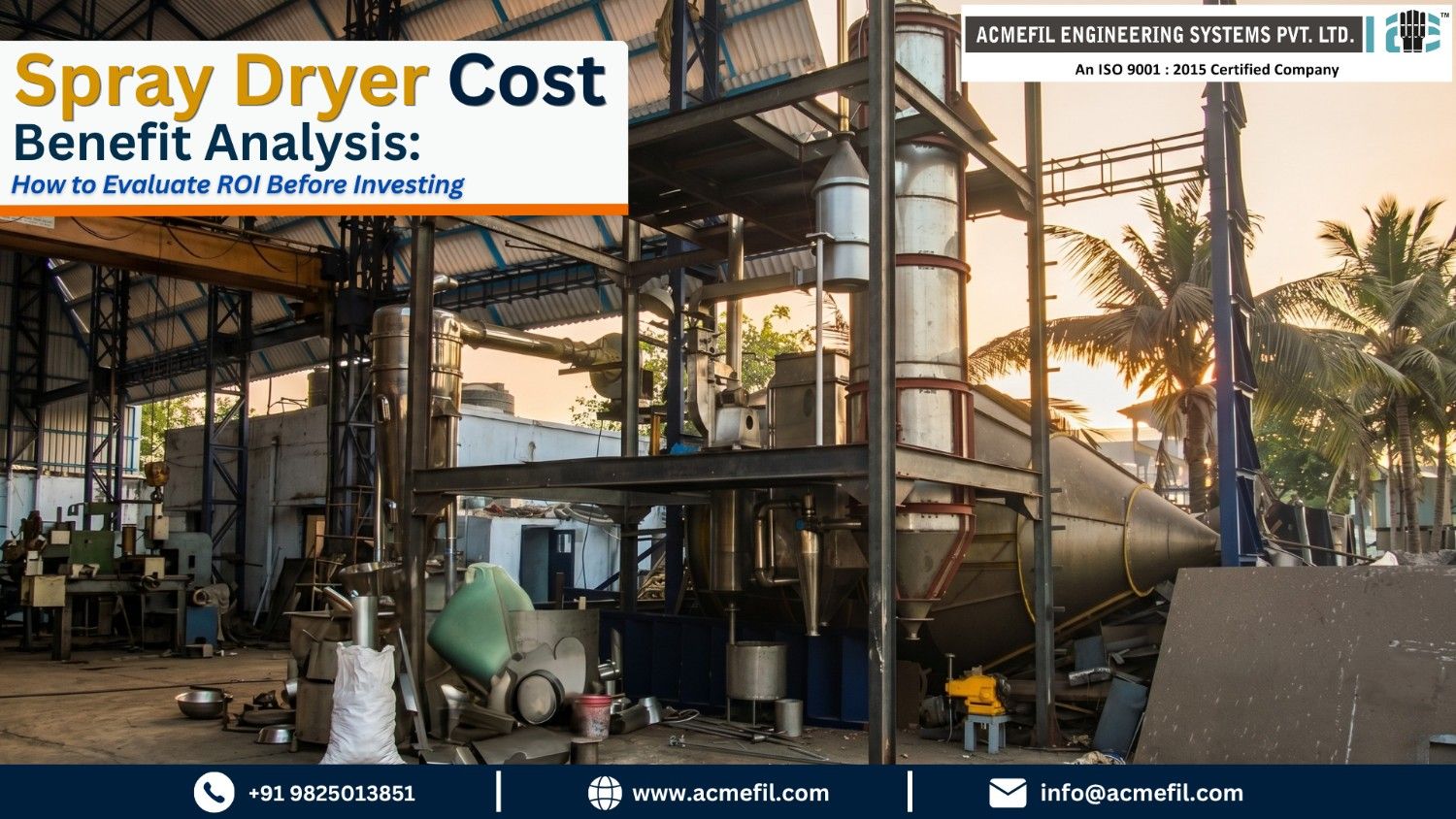
A spray dryer cost benefit analysis should not start with the quoted machine price. It should start with your feed properties, water evaporation load, target powder specification, utilities, production volume, cleaning requirement, and the value of the final powder. In my experience, the wrong spray dryer decision usually happens when buyers compare only CapEx and ignore process risk.
A spray dryer can be a strong investment when it gives you stable powder quality, better shelf life, easier packing, lower transport burden, and access to higher-value products. It becomes a weak investment when the feed is not properly tested, the atomizer is wrongly selected, or the plant is oversized for actual utilization.
If you are still deciding whether spray drying is the right route, first read our guide on choosing the right spray dryer and then use this article to evaluate the financial side.
What Should a Spray Dryer Cost Benefit Analysis Include?
A proper spray dryer investment study should include both CapEx and OpEx.
CapEx is the one-time project cost. OpEx is the recurring cost of running the plant. Both matter, but OpEx usually decides whether the plant remains profitable after installation.
| Cost or Benefit Area | What to Check | Why It Matters |
|---|---|---|
| Feed properties | Solids content, viscosity, stickiness, heat sensitivity, abrasiveness | These decide atomizer type, chamber design, temperature profile, and powder recovery |
| Water evaporation load | Actual kg/hr of water to remove | Spray dryers are sized by evaporation load, not only feed flow |
| Powder specification | Moisture, bulk density, particle size, solubility, flowability | ROI fails if the powder does not meet market or internal process requirements |
| Utility cost | Fuel, steam, electricity, compressed air, chilled water if required | Running cost can become more important than machine price |
| Product value | Selling price, margin, shelf-life improvement, packing advantage | Higher-value powders justify stronger equipment investment |
| Yield and recovery | Product loss in chamber, cyclone, bag filter, fines handling | Small recovery losses become large over continuous operation |
| Cleaning and changeover | CIP need, batch change frequency, contamination risk | Especially important in food, pharma, herbal extract, and enzyme applications |
| Maintenance | Atomizer, nozzle, seals, air filters, rotary valves, bag filters | Maintenance cost is predictable only when the design is matched to duty |
| Compliance and safety | Dust handling, solvent handling, emissions, sanitary requirements | These can add major cost if ignored during budgeting |
| Pilot testing | Product trial before full-scale purchase | Reduces risk before committing to capital equipment |
The key point is simple. Do not ask only, “What is the price of a spray dryer?” Ask, “What will this dryer cost to install, operate, clean, maintain, and validate against my product specification?”
Start With Water Evaporation Load, Not Machine Size
The most common buyer mistake is sizing the spray dryer from liquid feed rate alone.
That is incomplete.
A spray dryer removes water or solvent from feed. The actual evaporation duty depends on the solids in your feed and the final moisture target.
Use this basic logic:
| Calculation Step | Formula |
|---|---|
| Dry solids per hour | Feed flow × feed solids percentage |
| Final powder per hour | Dry solids ÷ (1 – final moisture percentage) |
| Water to evaporate per hour | Feed flow – final powder output |
For example, a plant handling a low-solids feed may need to evaporate far more water than expected. In that case, the right solution may include pre-concentration before spray drying. For some effluent, extract, or chemical applications, a multi-effect evaporator before the dryer can reduce the load on the spray dryer and improve project economics.
This is why the process route matters. A spray dryer is not just a machine. It is part of a heat and mass balance.
Main Capital Cost Areas in a Spray Dryer Project
The base spray dryer is only one part of the total investment. A realistic CapEx estimate should include the complete drying system.
1. Feed Preparation and Feed Pumping
The feed tank, agitator, strainer, transfer pump, and dosing system affect dryer stability. If the feed settles, foams, crystallizes, or changes viscosity during operation, the atomization will not remain stable.
For slurries and suspensions, this section deserves careful review before finalizing the dryer.
2. Atomization System
Atomization has direct impact on particle size, drying rate, chamber size, and final powder quality.
A rotary atomizer type spray dryer is often preferred for many slurries, suspensions, and applications where flexible feed handling is important.
A nozzle atomizer type spray dryer may be preferred when the process needs a specific droplet pattern, particle morphology, or pressure-based atomization.
For a deeper technical comparison, see our article on nozzle vs rotary atomizer spray dryers.
3. Drying Chamber and Air Distribution
The chamber is not just a vessel. Its diameter, height, cone angle, air distributor, residence time, and powder discharge arrangement all affect product recovery.
A cheaper chamber design can become expensive if powder sticks to the wall, moisture remains high, or fines carry over into the exhaust system.
4. Hot Air Generation
The hot air generator can be direct fired or indirect fired depending on the product and contamination sensitivity.
Food, pharma, herbal extract, and certain high-purity chemicals may require more controlled air handling than general industrial powders. That changes project cost.
5. Powder Separation and Recovery
Cyclone separators, bag filters, wet scrubbers, ducting, rotary air locks, and powder collection systems must be included in the cost estimate.
If recovery is poor, the plant loses saleable product every hour. If dust handling is poor, housekeeping and compliance problems begin after commissioning.
6. Automation and Instrumentation
Basic controls may be enough for simple applications. More sensitive products may need better control over inlet temperature, outlet temperature, feed rate, atomizer speed, airflow, and pressure drop.
Automation is not automatically good or bad. It should match the value of the product and the risk of process variation.
7. Building, Utilities, and Installation
A spray dryer needs height, airflow, ducting space, power, fuel, compressed air, drainage, and safe access for cleaning and maintenance.
This is why installed project cost is usually more useful than equipment-only cost.
Operating Costs That Decide Long-Term ROI
A spray dryer may look affordable at purchase stage but become costly if the operating model is weak.
Important OpEx items include:
| Operating Cost | What Drives It | How to Control It |
|---|---|---|
| Fuel or steam | Water evaporation load, inlet and outlet temperature, air volume | Improve feed solids where possible, avoid over-drying, optimize temperature profile |
| Electricity | Blowers, atomizer, pumps, air locks, control system | Select correctly sized motors and avoid oversized air systems |
| Compressed air | Two-fluid nozzles, pneumatic controls, cleaning systems | Use only where technically justified |
| Labour | Loading, monitoring, cleaning, packing, maintenance | Use practical automation and good access design |
| Maintenance | Atomizer/nozzle wear, seals, bearings, filters, rotary valves | Match materials and components to product duty |
| Cleaning | Product changeover, hygiene, stickiness, contamination control | Design for access, CIP where needed, and realistic cleaning cycles |
| Product loss | Chamber deposition, cyclone loss, bag filter loss, fines handling | Validate through trials and proper recovery design |
| Quality control | Moisture checks, particle size checks, contamination control | Define test methods before production starts |
When I review a project commercially, I do not treat maintenance and cleaning as small details. They decide whether the plant runs smoothly after the first few months.
What Benefits Should You Count?
A spray dryer investment can create value in several ways. Some are direct, some are indirect.
Direct Financial Benefits
Direct benefits may include:
- Sale of powder instead of liquid concentrate
- Higher value product format
- Reduced outsourcing or toll drying cost
- Lower transport cost due to water removal
- Lower storage burden compared with liquid products
- Reduced product rejection if powder quality becomes more consistent
- Ability to serve customers who require powder form
Operational Benefits
Operational benefits may include:
- Continuous drying instead of slow batch drying
- Better control over final moisture
- Better packing and handling
- Improved shelf stability for suitable products
- More consistent particle size when atomization is stable
- Faster scale-up after pilot trials
Strategic Benefits
Strategic benefits are harder to calculate, but still important.
A spray dryer can help a company enter powder-based product categories in food ingredients, herbal extracts, dyestuff, pigments, ceramic slurry, detergents, enzymes, and pharmaceutical intermediates.
Do not assign value to these benefits unless your sales team has a realistic market plan. A dryer does not create demand by itself. It only gives you the production capability.
A Simple ROI Framework for Spray Dryer Investment
Use this structure before asking vendors for a final quote.
Annual Net Benefit
Annual net benefit can be estimated as:
Additional gross margin from saleable powder
- Savings from reduced outsourcing
- Savings from lower transport and storage
- Reduction in rework and rejection
- New product margin from powder applications
- Additional fuel, power, labour, maintenance, cleaning, packing, and QC cost
This gives you the practical annual benefit.
Simple Payback Period
Simple payback period = Total installed project cost ÷ Annual net benefit
Total installed project cost should include equipment, auxiliaries, utilities, civil work, electrical work, installation, commissioning, training, and initial spares.
Net Present Value
For larger projects, your finance team should also calculate NPV using:
- Expected production volume
- Product margin
- Utility escalation
- Maintenance escalation
- Depreciation
- Tax treatment
- Discount rate
- Plant life assumption
- Expected utilization
I do not recommend making a major spray dryer decision only on simple payback. It is useful, but it ignores time value of money and future utilization risk.
When Does Investing in a Spray Dryer Make Financial Sense?
A spray dryer investment usually deserves serious evaluation when most of these conditions are present:
- The product has a clear market or internal need in powder form.
- The plant has enough production volume to keep the dryer utilized.
- The feed can be atomized consistently.
- Final powder moisture, particle size, and bulk density can be controlled.
- Product value justifies energy and recovery cost.
- Pilot trials confirm that powder quality is achievable.
- The team can maintain and clean the system properly.
- The supplier can support design, commissioning, training, and troubleshooting.
Acmefil’s in-house pilot spray dryer is useful at this stage because it allows product trials before full-scale procurement. For a capital equipment decision, a trial is often cheaper than discovering a process problem after installation.
When Should You Avoid or Delay the Investment?
A spray dryer may not be the right immediate investment in these cases:
| Situation | Better Decision |
|---|---|
| Production volume is very low | Compare toll drying or pilot-scale production before buying full scale |
| Feed solids are too low | Check whether pre-concentration is needed before spray drying |
| Feed is too sticky or thermoplastic | Run trials before assuming spray drying will work |
| Product has no confirmed powder market | Validate demand before investing in equipment |
| Final moisture or particle size requirement is unclear | Define product specification first |
| Utility cost is not available | Build the energy model before finalizing CapEx |
| Cleaning requirements are severe | Review CIP, access, materials, and changeover plan |
| Filter cake or paste is the actual feed | Check whether spin flash drying or another drying technology is more suitable |
This is where a technical discussion saves money. Not every wet material belongs in a spray dryer. If the feed is a filter cake, paste, or gelatinous sludge, a spray dryer may not be the correct first choice. You may need to compare it with flash drying, spin flash drying, fluid bed drying, or evaporation before final drying.
Our guide on comparing spray drying with other technologies can help at that decision stage.
Spray Dryer Design Choices That Affect Cost and ROI
| Design Choice | Higher Cost Trigger | ROI Impact |
|---|---|---|
| Rotary atomizer | High-speed atomizer, larger chamber, specific disc design | Useful for many slurries and flexible operation |
| Pressure nozzle | High-pressure pumping and nozzle maintenance | Useful where particle morphology and spray pattern are important |
| Two-fluid nozzle | Compressed air demand | Useful for small capacity or finer atomization cases |
| Fluidized spray dryer | Integrated or external fluid bed | Useful for larger particles, agglomeration, and final drying control |
| Closed loop spray dryer | Nitrogen loop, solvent recovery, safety systems | Required for suitable solvent-based or oxidation-sensitive products |
| Sterile spray dryer | HEPA filtration, sanitary design, controlled environment | Important for pharmaceutical and sensitive applications |
| Higher automation | Sensors, PLC, recipe controls, data logging | Useful when repeatability and compliance documentation matter |
| Better recovery system | Cyclone, bag filter, wet scrubber, powder handling | Improves yield and plant cleanliness |
| Better materials of construction | SS grade, corrosion resistance, sanitary finish | Needed for product compatibility and hygiene |
For equipment design details, review the spray dryer design and components guide.
Industry-Specific ROI Considerations
Food and Dairy
In food and dairy, the business case often depends on shelf stability, reconstitution, flavour retention, hygiene, and consistent moisture. Products such as milk powder, egg products, soup mixes, maltodextrin, beverages, and food additives need careful handling of temperature and powder properties.
The investment should include cleaning time, hygienic design, and packing requirements. A dryer that produces powder but creates cleaning delays may still hurt profitability.
Pharmaceuticals, Herbal Extracts, and Biochemicals
For pharmaceutical, herbal extract, enzyme, and biochemical applications, ROI is not only about drying cost. It is also about product quality, contamination control, documentation, and repeatability.
A closed loop spray dryer or sterile configuration may be required depending on the feed and process requirement. These systems cost more, but the cost should be judged against product value and compliance need.
Dyestuff, Pigments, and Inorganic Chemicals
In dyestuff, pigment, ceramic, and inorganic chemical applications, the decision often depends on slurry behaviour, abrasion, recovery, bulk density, and emissions control.
A buyer should check whether the feed behaves consistently during atomization. If the slurry settles or the particle distribution changes, the dryer may require additional feed preparation.
Detergents and Agglomerated Powders
Some detergent and food ingredient applications need larger particles, better flowability, or agglomeration. A fluidized spray dryer may be relevant when a standard single-stage dryer does not meet the final powder requirement.
What Data Should You Prepare Before Requesting a Quote?
A vendor cannot give a reliable techno-commercial recommendation from product name alone.
Prepare these details:
- Feed composition
- Feed solids percentage
- Feed viscosity at operating temperature
- Feed pH and corrosiveness
- Required final moisture
- Required particle size range
- Required bulk density
- Heat sensitivity
- Stickiness or hygroscopic behaviour
- Expected feed rate
- Daily operating hours
- Fuel and power availability
- Cleaning and changeover frequency
- Product recovery expectation
- Area and height available at site
- Existing upstream and downstream equipment
- Any sanitary, solvent, dust, or emission requirement
This is also the right time to review spray dryer operating principles and best practices so that your internal team understands the process variables before vendor discussion.
Pilot Trials Are the Best Insurance Before Full-Scale Investment
A pilot trial does three things that a quotation cannot do.
First, it shows whether the material can be atomized and dried properly.
Second, it gives actual powder samples for moisture, particle size, bulk density, solubility, flowability, colour, and customer approval.
Third, it helps define the operating window before full-scale design.
At Acmefil, we use pilot trials to reduce uncertainty before recommending full-scale drying equipment. This matters because a spray dryer project is not only a purchase decision. It is a process commitment.
If your product is new, sensitive, sticky, or high value, do not skip trials.
Practical Spray Dryer Investment Checklist
Before approving the investment, confirm these points:
- The product has a defined commercial or internal value in powder form.
- Feed solids and target powder moisture are known.
- Water evaporation load has been calculated.
- Product trial has been completed or planned.
- Atomizer type has been selected based on feed behaviour.
- Utility cost has been estimated from actual local rates.
- Cleaning and maintenance access has been reviewed.
- Powder recovery system is included in the scope.
- Required automation level is clear.
- Site height, layout, and utilities are available.
- Supplier scope includes installation, commissioning, and training.
- Internal team understands the operating discipline required.
You can also review spray dryer maintenance tips and the spray dryer troubleshooting guide before finalizing the project plan.
Final Decision: Is a Spray Dryer Worth the Investment?
A spray dryer is worth investing in when the process is technically proven, the powder has clear value, and the plant can run at enough utilization to recover the installed cost. It is not worth buying only because spray drying is common in your industry.
The right question is not, “Can this machine dry my product?”
The right question is, “Can this system produce the powder specification I need, at the operating cost I can accept, with the reliability my plant requires?”
If the answer is uncertain, run a trial first. If the trial confirms the powder quality and the economics make sense, the spray dryer becomes a serious capital investment, not just another equipment purchase.
FAQs
What is included in a spray dryer cost benefit analysis?
A spray dryer cost benefit analysis should include total installed project cost, water evaporation load, feed properties, utility cost, labour, maintenance, cleaning, powder recovery, product value, expected utilization, and pilot trial results. Equipment price alone is not enough for a reliable investment decision.
How do I calculate the payback period for a spray dryer?
Calculate the annual net benefit first. Add the extra gross margin, outsourcing savings, transport and storage savings, rejection reduction, and new product margin. Then subtract extra fuel, power, labour, maintenance, cleaning, packing, and QC costs. Payback period equals total installed project cost divided by annual net benefit.
Is spray drying always better than freeze drying or drum drying?
No. Spray drying is often suitable for continuous powder production from pumpable liquid or slurry feeds, but it is not always the best technology. Freeze drying may suit highly sensitive products. Drum drying may suit certain pastes or flakes. The right choice depends on product quality, heat sensitivity, moisture target, cost, and production volume.
Why is pilot testing important before buying a spray dryer?
Pilot testing shows whether the feed can be atomized, dried, and recovered at the required powder specification. It also gives real product samples for testing. For new, sticky, heat-sensitive, or high-value products, pilot trials reduce the risk of buying a full-scale dryer based on assumptions.
Which industries benefit most from spray dryer investment?
Food, dairy, pharmaceuticals, herbal extracts, enzymes, dyestuff, pigments, ceramics, detergents, and certain chemical applications can benefit from spray drying when the product has value in powder form. The strongest ROI usually comes when powder quality, shelf stability, logistics, or market access improves enough to justify the installed cost.
Need Help Evaluating Spray Dryer ROI?
If you are planning a spray dryer project, do not start with equipment price alone. Share your feed details, target powder specification, required capacity, and utility availability.
Acmefil Engineering Systems can review your process requirement, suggest the right spray dryer configuration, and guide you on whether a pilot trial should be done before full-scale investment.
Use the technical enquiry form or contact Acmefil to discuss your application with the engineering team.

Siddharth Nair is Technical Director at Acmefil Engineering Systems Pvt. Ltd. he leads solution design and applications engineering across the company’s full product range — spray dryers, multi-effect evaporators, agitated thin film dryers, spin flash dryers, fluid bed dryers, and complete ZLD systems.
His work spans process evaluation, equipment sizing, customer application consulting, and technical proposal development for industries including food and dairy, pharmaceuticals, chemicals, dyestuffs, ceramics, and industrial effluent treatment. He has hands-on commissioning experience across Acmefil’s 500+ installations in India and 15+ countries.
He holds a BTech in Mechanical Engineering from CHARUSAT University and also partners at A.S Engineers, working with blowers, sludge dryers, and industrial conveying systems.


