
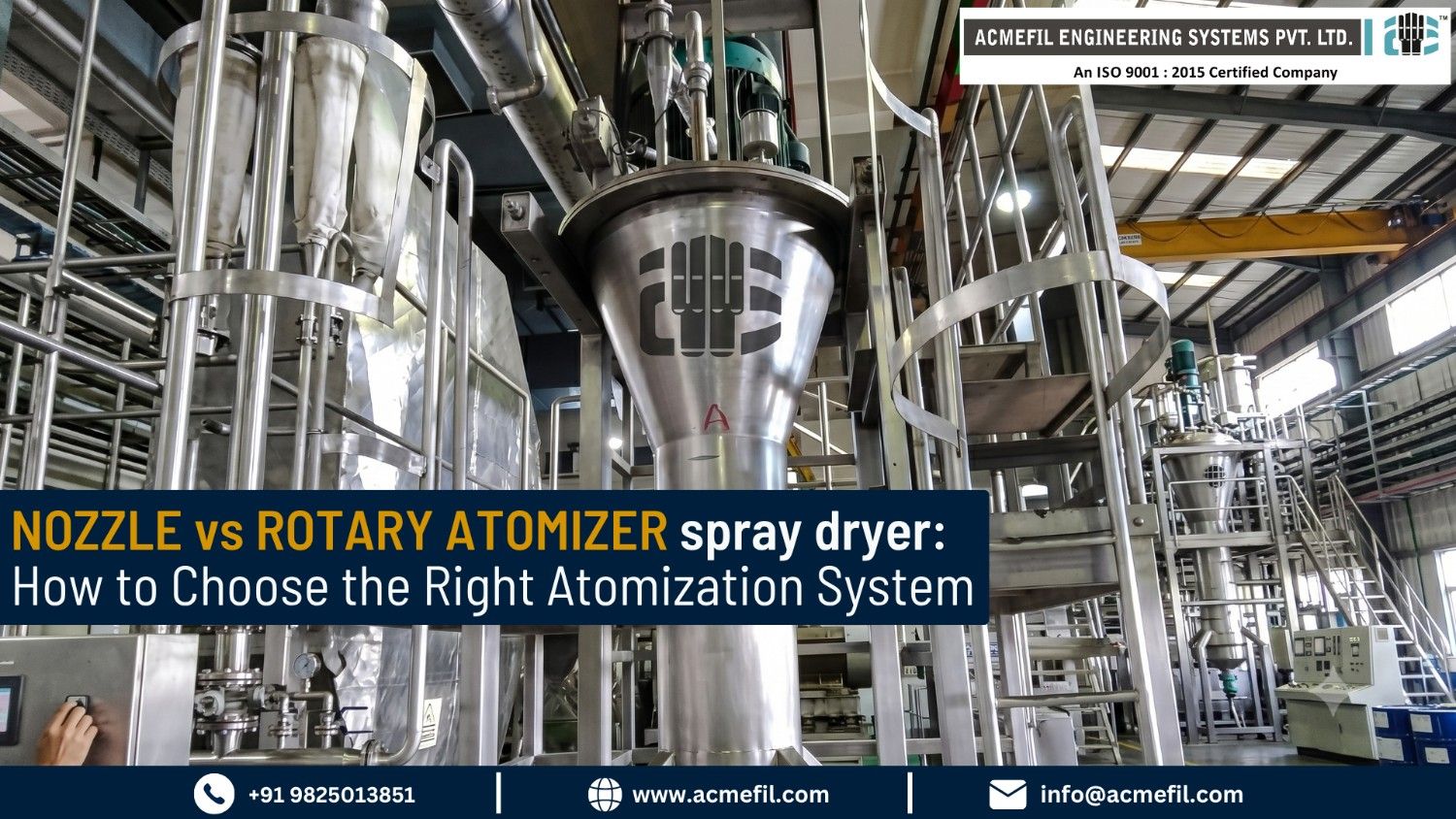
The choice between a nozzle atomizer and a rotary atomizer spray dryer should not start with machine price. It should start with feed behavior, particle size target, solids content, viscosity, powder morphology, blockage risk, and capacity. In simple terms, rotary atomizers are often stronger for slurries, suspended solids, dyes, ceramics, detergents, and variable feeds. Nozzle atomizers are useful when the feed is clean enough and the process needs a more defined particle profile.
I have seen buyers compare atomizers as if they are accessories. They are not. The atomizer is one of the most important parts of the spray dryer because it decides how the liquid feed breaks into droplets. Droplet behavior then affects drying rate, wall deposition, moisture variation, particle size, bulk density, flowability, and final powder recovery.
For a broader foundation, first read this guide on spray dryer atomization techniques and then use this article as the selection framework.
What does the atomizer do in a spray dryer?
A spray dryer converts liquid feed, slurry, or solution into powder by atomizing the feed into droplets and contacting those droplets with hot drying air. The atomizer controls the droplet formation stage.
A poor atomizer choice can create practical problems:
- Droplets too large, leading to wet powder or higher outlet moisture
- Droplets too fine, leading to powder losses or dust handling issues
- Wide droplet distribution, creating uneven drying
- Wall deposition inside the chamber
- Nozzle blockage or unstable spray pattern
- Product degradation because the drying profile does not match the material
This is why atomizer selection must be connected to the full spray dryer design and components decision, not treated as a standalone item.
Rotary atomizer vs nozzle atomizer spray dryer: quick answer
| Selection factor | Rotary atomizer spray dryer | Nozzle atomizer spray dryer | Practical decision point |
|---|---|---|---|
| Atomization method | High-speed rotating disc uses centrifugal force | Pressure nozzle or two-fluid nozzle breaks feed into droplets | Choose based on feed and powder target |
| Feed suitability | Strong for slurries, suspended solids, pigments, dyes, ceramics, detergents | Strong for cleaner feeds, selected food, pharma, flavours, enzymes, and heat-sensitive products | Feed filtration matters more for nozzle systems |
| Blockage risk | Lower than nozzle in many slurry applications | Higher if feed contains unsuitable solids or poor filtration | Check particle load and pre-filtration |
| Particle control | Controlled through disc speed and disc design | Controlled through pressure, orifice, nozzle type, and atomizing air or gas | Define powder specification first |
| Maintenance focus | Disc, drive, bearings, balancing, vibration control | Nozzle wear, orifice cleaning, pump pressure, compressed air system | Different maintenance burden, not zero maintenance |
| Capacity suitability | Often selected for continuous industrial throughput and variable feed behavior | Suitable where nozzle-based particle formation is required | Capacity alone should not decide the route |
| Best-fit industries | Dyes, ceramics, detergents, pigments, inorganic chemicals, selected food and pharma powders | Food processing, pharmaceuticals, flavours, enzymes, selected heat-sensitive applications | Industry matters, but feed data decides |
How does a rotary atomizer spray dryer work?
A rotary atomizer uses a high-speed rotating disc. The feed enters near the center of the disc. Centrifugal force spreads the feed across the disc surface and throws it outward as fine droplets.
In ACMEFIL’s rotary disc type spray dryer design, droplet size is controlled through disc selection and speed. The verified rotary disc spray dryer reference range is fine droplets of 20 to 75 microns. This type is commonly used for dyes, ceramics, food products such as milk, egg and soup mixes, pharmaceuticals, detergents, pigments, and inorganic chemicals.
The key advantage is that the atomization does not depend on a small nozzle orifice in the same way as a pressure nozzle. That makes rotary atomizers a practical option when the feed has slurry behavior, suspended solids, or process variation.
When I would first evaluate a rotary atomizer
I would first evaluate a rotary atomizer when the feed has any of these characteristics:
- Slurry with suspended solids
- Pigment or dye intermediate feed
- Ceramic slurry
- Detergent or inorganic chemical feed
- Feed variation between batches
- Powder quality depends on stable droplet formation over continuous operation
- Nozzle blockage is already known from trials or previous production
A rotary atomizer is also useful when the process team does not yet have perfect feed standardization. In real factories, feed quality is not always as clean as the datasheet suggests. If the feed has solids that can disturb a nozzle spray pattern, the atomizer decision must account for that before procurement.
What are the limitations of rotary atomizers?
A rotary atomizer is not automatically the better choice. It has its own design and maintenance requirements.
The rotating assembly must be selected and maintained properly. Disc design, disc speed, motor load, vibration, bearing condition, and cleaning access matter. If the dryer is designed poorly, the advantage of rotary atomization can be lost through unstable spray formation, chamber deposition, or mechanical maintenance issues.
Rotary atomizers are also not always ideal when the process needs a very specific nozzle-driven particle morphology or when the feed is clean, low-solids, and better suited to pressure nozzle or two-fluid nozzle operation.
This is why I avoid saying “rotary is best” or “nozzle is best.” The correct answer depends on the material.
How does a nozzle atomizer spray dryer work?
A nozzle atomizer spray dryer breaks the liquid feed into droplets through a nozzle. ACMEFIL’s nozzle type spray dryers include two main options.
Pressure nozzle atomization
In pressure nozzle atomization, the feed is pumped under pressure through an orifice. The pressure and nozzle design help form the spray. This can be used to produce fine or coarse granular particles depending on the process requirement.
The important point is filtration. If the feed contains suspended solids, fibers, crystals, lumps, or poorly dissolved material, the nozzle can block or produce an unstable spray pattern. Once the spray pattern changes, drying becomes inconsistent.
Two-fluid nozzle atomization
In two-fluid nozzle atomization, compressed air or gas helps atomize the feed into finer particles. This can be useful for selected fine-particle requirements, R&D work, low-throughput testing, or feeds where pressure alone is not the best atomization route.
The trade-off is that compressed air or gas consumption becomes part of the operating cost and system design. For production-scale plants, this must be calculated carefully.
When I would first evaluate a nozzle atomizer
I would first evaluate a nozzle atomizer when the process needs:
- Defined particle morphology
- Fine powder control
- Clean liquid feed with manageable solids
- Selected food or flavour powder applications
- Selected pharmaceutical or enzyme applications
- Heat-sensitive feed where the droplet and drying profile must be tightly controlled
- Pressure nozzle or two-fluid nozzle behavior proven in trials
A nozzle system can be a good choice when the feed is predictable. It becomes risky when the buyer has not checked filtration, solids behavior, nozzle wear, and spray stability.
For related process tuning, read this guide on how to optimize spray drying parameters.
Rotary vs nozzle atomizer: which gives better particle size control?
Both can control particle size, but they do it differently.
A rotary atomizer controls droplet formation mainly through disc speed, disc design, feed rate, and feed properties. A nozzle atomizer controls droplet formation through pressure, nozzle orifice, flow rate, feed viscosity, and, in two-fluid systems, atomizing air or gas.
The real question is not only “which gives smaller particles?” The better question is:
What particle size distribution, bulk density, moisture level, solubility, and flow behavior does the final powder need?
For example, a food powder may need better solubility and controlled bulk density. A ceramic powder may need consistent particle behavior for downstream forming. A pigment or dye powder may need moisture and particle consistency without heavy wall deposition. These are different goals.
How feed properties change the atomizer decision
Before selecting the atomizer, I want to see the feed data. Without feed data, atomizer selection becomes guesswork.
| Feed property | Why it matters | Atomizer impact |
|---|---|---|
| Total solids | Higher solids affect viscosity, droplet formation, and drying load | May push selection toward rotary if slurry behavior is strong |
| Viscosity | High viscosity changes spray formation | May require trial before selecting nozzle or rotary |
| Suspended solids | Solids can block nozzle orifices | Rotary often becomes safer for slurry feeds |
| Abrasiveness | Affects wear of nozzle or rotary disc components | Material of construction and maintenance plan matter |
| Heat sensitivity | Product may degrade if drying profile is wrong | Atomizer and air flow must control residence time and outlet moisture |
| Required particle size | Defines droplet target and dryer configuration | Nozzle or rotary route must support final powder specification |
| Stickiness | Sticky products can deposit on chamber walls | Trial is strongly recommended |
| Solvent content | Changes safety and dryer configuration | Closed loop design may be required instead of standard open-cycle drying |
This is also why the choosing the right spray dryer decision should include feed testing, not only equipment comparison.
Industry-wise selection guide
| Industry or application | Rotary atomizer is often practical when | Nozzle atomizer is often practical when |
|---|---|---|
| Dyestuff and pigments | Feed behaves like slurry or contains suspended solids | Feed is filtered and a specific powder profile is required |
| Ceramic slurry | Stable slurry atomization and continuous operation are important | Fine particle profile is required and feed is suitable for nozzle operation |
| Detergents | Higher throughput and slurry handling are required | Particle profile is nozzle-driven and feed is clean enough |
| Food powders | Milk, egg, soup mixes, and selected food slurries need stable drying | Flavours, selected enzymes, and heat-sensitive products need fine particle control |
| Pharmaceuticals | Feed and powder specification allow rotary drying | Specific morphology, sterile design, or two-fluid atomization is required |
| Inorganic chemicals | Solids and slurry behavior influence selection | Cleaner solution feed and defined particle requirement support nozzle use |
This table is a starting point, not a final design rule. The final selection should come from process data and, where the product is new or uncertain, pilot testing.
Which atomizer is easier to maintain?
A nozzle atomizer looks simpler mechanically, but it can demand more attention if the feed is not clean. Nozzle cleaning, orifice wear, pressure stability, filtration, and spray pattern inspection become important.
A rotary atomizer has a more mechanical maintenance profile. Disc condition, drive alignment, vibration, bearings, seals, and cleaning access must be checked.
So the maintenance question is not “which is easier?” It is:
Which maintenance risk fits your feed and plant team better?
For troubleshooting after installation, this guide on common spray dryer issues is a useful companion.
Which atomizer is more energy efficient?
There is no universal answer. A nozzle atomizer may need high-pressure pumping or compressed air, especially in two-fluid systems. A rotary atomizer needs high-speed rotation and mechanical drive power. But the largest energy picture in spray drying usually depends on the drying air system, inlet and outlet temperature strategy, evaporation load, feed concentration, heat recovery, and powder separation system.
A buyer mistake I see often is comparing atomizer power without calculating the full drying duty. That can lead to a false decision. The better approach is to compare complete system energy under the same feed rate, same inlet solids, same final moisture target, and same powder specification.
For the operating side, read spray dryer operating principles and best practices.
Do not select the atomizer before defining the powder
The biggest selection mistake is choosing the dryer before defining the final powder.
Before the atomizer decision, define:
- Final moisture percentage
- Particle size range
- Bulk density
- Solubility or dispersibility requirement
- Powder flow behavior
- Colour sensitivity
- Heat sensitivity
- Hygroscopic or sticky behavior
- Recovery requirement
- Cleaning and contamination control requirement
A spray dryer is not only a moisture removal machine. It is a powder-making system. The atomizer is the first major control point in that system.
What data should you share before choosing nozzle or rotary atomizer?
Before asking for a final recommendation, prepare this information:
| Data required | Why it matters |
|---|---|
| Product name and industry | Helps identify known behavior and hygiene requirement |
| Feed type | Solution, slurry, emulsion, suspension, extract, paste-like feed |
| Total solids percentage | Determines evaporation load and droplet behavior |
| Viscosity at feed temperature | Affects atomization quality |
| Suspended solids details | Indicates nozzle blockage risk |
| Feed temperature | Affects viscosity and drying behavior |
| Final moisture target | Defines drying duty |
| Required particle size | Drives atomizer choice |
| Bulk density requirement | Important for food, pharma, and detergent powders |
| Heat sensitivity | Influences residence time and outlet temperature strategy |
| Solvent or flammable content | May require closed loop spray dryer design |
| Current production problem | Helps identify whether atomizer, chamber, air flow, or feed preparation is the real issue |
If the feed is new, sticky, heat-sensitive, solvent-bearing, or commercially important, I would not rely only on theory. Pilot testing is the safer path.
How ACMEFIL supports atomizer selection
ACMEFIL manufactures both rotary atomizer type spray dryers and nozzle atomizer type spray dryers. That matters because the discussion does not need to be forced toward one atomizer type. The selection can start from the product.
For product development, ACMEFIL’s pilot spray dryer has a verified pilot capacity of 3 kg/hr water evaporation. A pilot run can help evaluate atomizer choice, moisture target, wall deposition tendency, powder recovery, spray stability, and scale-up feasibility before full-scale procurement.
ACMEFIL also supplies standalone rotary atomizers and spray nozzles as part of its drying system capability.
My practical recommendation
Choose a rotary atomizer spray dryer when your feed is a slurry, contains suspended solids, behaves inconsistently, or needs stable continuous atomization for industrial production.
Choose a nozzle atomizer spray dryer when your feed is clean enough, filtration is reliable, and the final powder requires a defined particle structure that nozzle atomization can support.
Choose pilot testing when the feed is new, sticky, heat-sensitive, expensive, solvent-based, or not yet standardized.
The atomizer should follow the product. Not the other way around.
FAQs
Which is better, nozzle atomizer or rotary atomizer spray dryer?
Neither is universally better. A rotary atomizer is often stronger for slurries, suspended solids, pigments, ceramics, detergents, and variable feeds. A nozzle atomizer is often better when the feed is clean and the process needs a defined particle profile. Final selection should depend on feed data and powder requirements.
When should I choose a rotary atomizer spray dryer?
Choose a rotary atomizer when the feed has slurry behavior, suspended solids, or process variation, and when stable continuous droplet formation is important. It is commonly evaluated for dyes, ceramics, detergents, pigments, inorganic chemicals, and selected food or pharma powders.
When should I choose a nozzle atomizer spray dryer?
Choose a nozzle atomizer when the feed is clean enough for stable nozzle operation and the powder needs controlled particle morphology. Pressure nozzles and two-fluid nozzles are useful for selected food, pharmaceutical, flavour, enzyme, and heat-sensitive applications.
Why do nozzle atomizers block?
Nozzle atomizers can block when the feed contains unsuitable suspended solids, crystals, fibers, lumps, or poorly filtered material. The problem is not only blockage. Even partial restriction can distort the spray pattern and create uneven drying.
Is pilot testing necessary before selecting a spray dryer atomizer?
Pilot testing is strongly recommended when the feed is new, sticky, heat-sensitive, solvent-bearing, high-value, or not yet standardized. ACMEFIL’s pilot spray dryer helps evaluate atomizer behavior, wall deposition, moisture target, powder recovery, and scale-up risk before full-scale purchase.
Before finalizing a nozzle or rotary atomizer spray dryer, share your feed properties, target powder specification, capacity requirement, and current process challenge. ACMEFIL can review the application and recommend the atomization route based on product behavior, not guesswork.
For a technical discussion, use the SprayDryer.com contact page or review ACMEFIL’s spray dryer manufacturer page for equipment options.

Siddharth Nair is Technical Director at Acmefil Engineering Systems Pvt. Ltd. he leads solution design and applications engineering across the company’s full product range — spray dryers, multi-effect evaporators, agitated thin film dryers, spin flash dryers, fluid bed dryers, and complete ZLD systems.
His work spans process evaluation, equipment sizing, customer application consulting, and technical proposal development for industries including food and dairy, pharmaceuticals, chemicals, dyestuffs, ceramics, and industrial effluent treatment. He has hands-on commissioning experience across Acmefil’s 500+ installations in India and 15+ countries.
He holds a BTech in Mechanical Engineering from CHARUSAT University and also partners at A.S Engineers, working with blowers, sludge dryers, and industrial conveying systems.


