
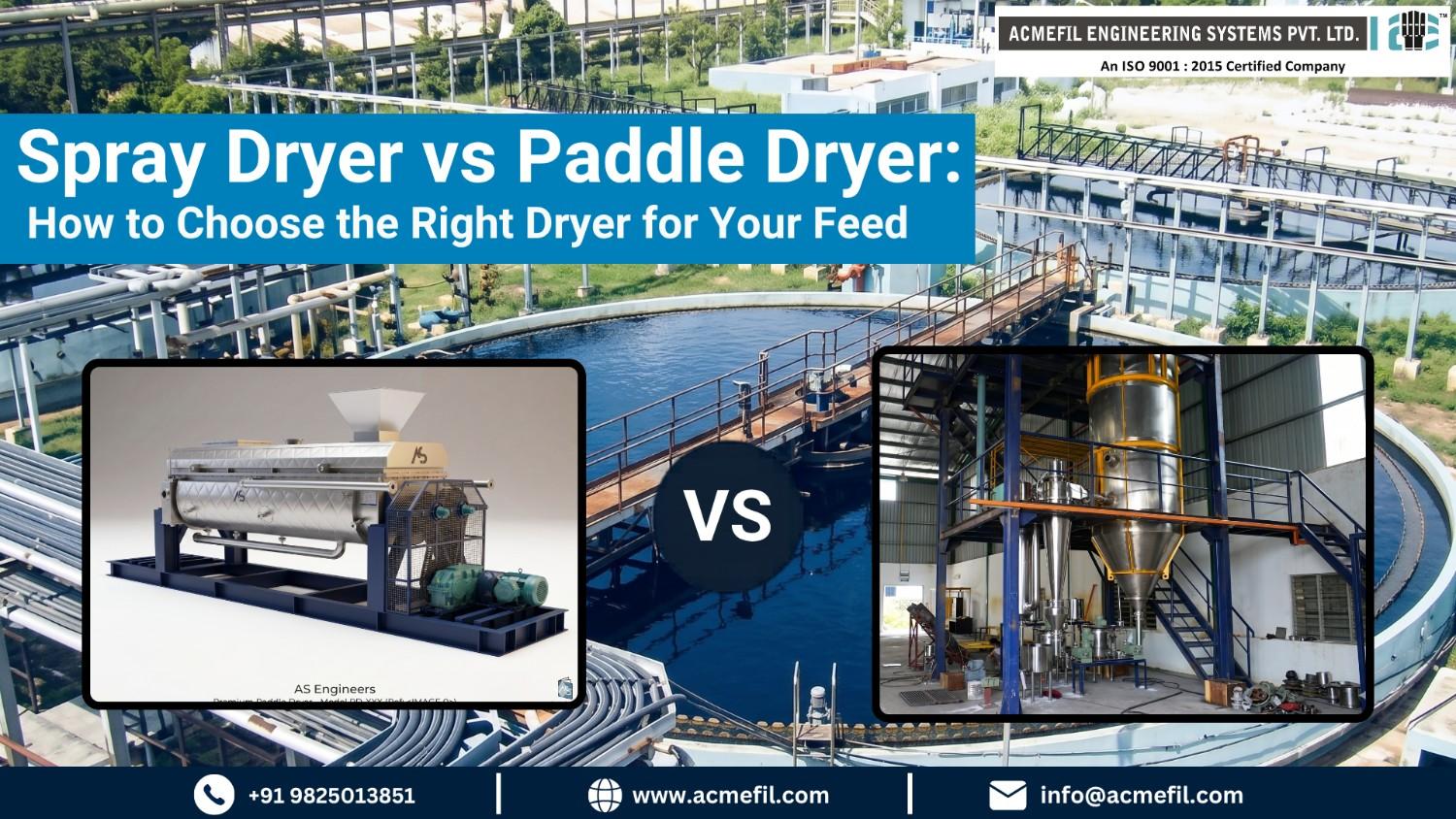
A spray dryer is usually selected when the feed is a pumpable liquid, solution, emulsion, suspension, or slurry that must become a fine powder in one continuous step. A paddle dryer is usually selected when the feed is wet cake, paste, sludge, sticky solid, or non-atomizable material that needs indirect heat and mechanical agitation.
The most important difference is particle formation. In a spray dryer, particle size starts with atomization. Atomizer speed, nozzle pressure, feed viscosity, feed solids, and droplet size all affect the final powder. In a paddle dryer, there is no atomizer. Particle size depends more on feed structure, agitation, residence time, lump formation, discharge condition, and any downstream milling or crushing.
For buyers, this is not a small technical difference. It decides whether your plant gets free-flowing powder, dried granules, dry cake, or an irregular dried solid.
What Is a Spray Dryer?
A spray dryer converts a liquid feed into dried powder by atomizing the feed into fine droplets and contacting those droplets with hot drying air.
In practical terms, the spray dryer does four jobs:
- Atomizes the feed into droplets.
- Mixes droplets with hot air inside the drying chamber.
- Evaporates moisture from each droplet.
- Separates dry powder from exhaust air using equipment such as a cyclone separator or bag filter.
This is why spray drying is common in food, dairy, pharmaceuticals, dyes, pigments, detergents, ceramics, polymers, resins, and inorganic chemicals.
If you want deeper spray dryer basics before comparison, read this guide on how a spray dryer works and the detailed page on spray dryer design and components.
What Is a Paddle Dryer?
A paddle dryer is an indirect dryer. It dries material by transferring heat through heated surfaces while rotating paddles continuously mix, expose, and move the product.
The feed is normally not atomized. It may be:
- Wet cake
- Sludge
- Sticky paste
- Filter cake
- Damp powder
- High-moisture solid
- Material that cannot be pumped cleanly through an atomizer
This makes the paddle dryer useful where spray drying is not practical because the material cannot form a stable spray. In many industrial effluent and sludge applications, this is the first decision point.
A good practical support article is Acmefil’s guide on paddle dryer fundamentals and the application page on paddle dryers in wastewater treatment.
Spray Dryer vs Paddle Dryer Comparison Table
| Selection Factor | Spray Dryer | Paddle Dryer |
|---|---|---|
| Best feed form | Pumpable liquid, solution, emulsion, suspension, slurry | Wet cake, sludge, paste, sticky solid, damp powder |
| Drying method | Direct contact with hot air | Indirect heat transfer through heated surfaces |
| Particle formation | Formed from atomized droplets | Mostly depends on feed form, mixing, shearing, discharge, and downstream processing |
| Particle size control | Strong control through atomizer type, atomizer speed, nozzle pressure, feed rate, and solids | Limited direct control. No atomizer. Product may need crushing, milling, or screening |
| Typical output | Fine powder, granules, agglomerated powder depending design | Dried cake, granules, broken solids, or powder-like discharge depending material |
| Residence time | Short, because droplets have high surface area | Longer, because heat must transfer through material bed |
| Heat exposure | Short time, useful for many heat-sensitive powders if designed correctly | Longer contact time, but indirect heating can be gentler for some pastes and sludge |
| Best applications | Milk powder, dyes, pigments, ceramics, food colours, detergent powder, enzymes, polymers, inorganic salts | Sludge, filter cake, wet solids, chemical paste, sticky feed, wastewater treatment residues |
| Main buyer mistake | Choosing atomizer type only by price instead of powder requirement | Expecting powder-like particle control from a machine that is not designed for atomization |
| Trial importance | Very high when particle size, moisture, bulk density, or solubility matters | Very high when stickiness, lumping, vapour release, and discharge behavior are uncertain |
Feed Type Comes Before Dryer Type
When I evaluate a dryer requirement, I do not start with capacity. I start with the feed.
A liquid feed and a wet cake may both contain moisture, but they behave completely differently inside a dryer. A pumpable liquid can be sprayed. A sticky wet cake cannot. A slurry with controlled solids may atomize well in a spray dryer. A paste that forms lumps at the feed point may fail before drying even begins.
For spray dryer selection, the critical feed data includes:
- Total solids percentage
- Viscosity at feed temperature
- Pumpability
- Abrasiveness
- Heat sensitivity
- Solubility or suspension stability
- Target powder moisture
- Target particle size
- Bulk density requirement
- Hygroscopic behavior
- Whether solvent or water is being evaporated
For paddle dryer selection, the critical feed data changes:
- Wet cake moisture
- Stickiness
- Lump formation tendency
- Sludge or paste consistency
- Heat transfer behavior
- Vapour release rate
- Discharge flowability
- Final dryness target
- Whether the product forms crust, balls, or powder after drying
This is where many purchase decisions go wrong. The buyer says, “I need a dryer for slurry,” but the real question is whether the slurry can be atomized. If it cannot be atomized reliably, it is not a normal spray dryer job.
Atomizer Speed and Particle Size in Spray Dryers
In a spray dryer, atomizer speed and particle size are closely connected because the atomizer creates the droplets that become powder particles.
For a rotary atomizer, higher disc speed generally creates smaller droplets, assuming the feed properties and feed rate remain suitable. Smaller droplets dry faster because they expose more surface area to hot air. Larger droplets need more residence time and often create larger particles.
But atomizer speed is not the only control.
Final particle size depends on:
- Atomizer type
- Rotary disc speed
- Disc design
- Nozzle type
- Nozzle pressure
- Feed flow rate
- Feed viscosity
- Feed solids
- Surface tension
- Drying air temperature
- Chamber size
- Residence time
- Fines return or agglomeration system
This is why I do not recommend selecting a spray dryer based only on “high RPM.” A higher atomizer speed may reduce droplet size, but if the feed viscosity is too high or solids are unstable, the spray pattern can still become poor.
For a deeper technical page, link this section internally to spray dryer atomization techniques and spray dryer parameter optimization.
Why Paddle Dryers Do Not Control Particle Size Like Spray Dryers
A paddle dryer does not create powder through atomized droplets. It dries material as a moving bed or mass of wet solids.
That changes the entire particle size discussion.
In a paddle dryer, particle size is affected by:
- Feed cake structure
- Initial lump size
- Paddle geometry
- Agitation intensity
- Residence time
- Stickiness during drying
- Final moisture
- Discharge mechanism
- Whether dried material breaks naturally
- Whether milling or crushing is used after drying
So if a buyer needs a tight particle size distribution, a paddle dryer alone may not be enough. The system may need downstream milling, screening, granulation, or another finishing step.
This is the main practical difference between spray dryer vs paddle dryer selection. A spray dryer is a particle-forming dryer. A paddle dryer is primarily a moisture-removal dryer for difficult wet solids.
When Should You Choose a Spray Dryer?
Choose a spray dryer when your feed can be atomized and your process requires powder formation in one continuous operation.
Typical cases include:
- Milk powder
- Coffee extract powder
- Food colours
- Egg powder
- Soup mix base
- Herbal extract powder
- Dyestuff
- Pigments
- Detergent powder
- Sodium silicate
- Catalysts
- Ceramic slurry
- PVA and polymers
- Pharmaceutical intermediates where spray drying is technically suitable
A spray dryer becomes especially strong when the buyer cares about:
- Particle size control
- Moisture control
- Bulk density
- Solubility
- Reconstitution behavior
- Powder flowability
- Continuous production
- Fast drying of droplets
For spray dryer type selection, compare nozzle vs rotary atomizer spray dryers and this broader guide on choosing the right spray dryer.
When Should You Choose a Paddle Dryer?
Choose a paddle dryer when the material is too thick, sticky, pasty, or cake-like for atomization.
Typical cases include:
- Chemical sludge
- ETP sludge
- Wet cake from filter press
- Sticky paste
- High-moisture solids
- Sludge from wastewater treatment
- Some chemical residues
- Materials that need indirect heat transfer
The paddle dryer becomes useful when the process problem is not powder engineering, but moisture reduction from difficult wet solids.
In my view, the buyer should ask one simple question:
Can this feed be converted into stable droplets?
If the answer is yes, evaluate a spray dryer.
If the answer is no, evaluate a paddle dryer, spin flash dryer, ATFD, fluid bed dryer, or another solid/paste-handling dryer depending on feed behavior.
Spray Dryer vs Paddle Dryer for Particle Size Control
This is where spray dryers are stronger.
A spray dryer can be designed around a target particle size range because the process starts with droplet formation. Rotary atomizers, pressure nozzles, and two-fluid nozzles give different droplet patterns and powder characteristics.
For example:
| Powder Requirement | Better Starting Point |
|---|---|
| Fine powder from liquid feed | Spray dryer |
| Controlled particle size from slurry | Spray dryer with correct atomizer selection |
| Large agglomerated powder | Fluidized spray dryer or spray dryer with fines return/agglomeration |
| Dried sludge with no tight PSD requirement | Paddle dryer |
| Dried cake requiring downstream size reduction | Paddle dryer plus crusher/mill/screener |
| Sticky paste that cannot be sprayed | Paddle dryer, spin flash dryer, or ATFD depending behavior |
Particle size control is not just a product quality point. It affects packaging, solubility, dusting, transport, tableting, mixing, downstream reaction, and buyer acceptance.
Spray Dryer vs Paddle Dryer for Heat-Sensitive Materials
Both dryers can handle heat-sensitive applications, but in different ways.
A spray dryer may expose droplets to hot inlet air, but the residence time is short. Evaporation also cools the droplet surface during drying. This is why spray drying is widely used for many food, pharma, enzyme, and extract applications when the system is correctly designed.
A paddle dryer uses indirect heat transfer. The product does not normally contact flame or hot combustion gas directly. This can be useful for sludge, paste, or wet solids where controlled surface heating is more important than instant droplet drying.
The choice depends on:
- Product degradation temperature
- Moisture removal target
- Residence time
- Whether the feed can be atomized
- Whether the product must remain powder-like
- Whether vapour handling or solvent recovery is required
Do not select based only on the word “heat-sensitive.” Select based on the actual degradation behavior of the product.
Common Buyer Mistakes in Spray Dryer vs Paddle Dryer Selection
Mistake 1: Calling every wet feed a slurry
A real slurry can flow and may be pumpable. A wet cake may only look like slurry when diluted. If it needs heavy dilution to enter a spray dryer, the evaporation load may become uneconomical.
Mistake 2: Asking for fine powder from a paddle dryer
A paddle dryer may discharge dried solids, granules, or cake-like material. If fine powder is required, you may need downstream size reduction. Do not expect atomizer-level particle size control.
Mistake 3: Ignoring viscosity
A spray dryer depends on stable atomization. High viscosity changes droplet formation, spray angle, drying rate, and wall deposition risk.
Mistake 4: Looking only at evaporation capacity
Two dryers with the same evaporation capacity may produce completely different outputs. Output form matters as much as water removal.
Mistake 5: Skipping pilot trials
If the product is new, sticky, heat-sensitive, or commercially important, trial drying is not a luxury. It prevents expensive design mistakes.
Acmefil’s pilot spray dryer support page is useful when the project needs trial-based validation before final scale-up.
How I Would Decide Between Spray Dryer and Paddle Dryer
For a serious RFQ, I would ask the buyer to send these details before recommending any dryer:
| Question | Why It Matters |
|---|---|
| Is the feed liquid, slurry, paste, cake, or sludge? | Decides whether atomization is possible |
| What is the feed solids percentage? | Impacts evaporation load and powder formation |
| What is the feed viscosity at operating temperature? | Critical for spray dryer atomization |
| What final moisture is required? | Defines drying duty |
| What final form is needed? | Powder, granule, dry cake, or broken solid |
| Is particle size distribution important? | Strong reason to prefer spray drying when feed allows |
| Is the product heat-sensitive? | Defines air temperature, residence time, and indirect heating need |
| Is the feed sticky or hygroscopic? | Impacts wall deposition, lumping, and discharge |
| Is solvent present? | May require closed loop or special vapour handling |
| Is this a new product? | Trial drying should be considered |
This is also the kind of information a buyer should prepare before contacting a dryer manufacturer. A vague inquiry usually produces a vague quotation. A clear process data sheet produces a better engineering answer.
Practical Selection Summary
Choose a spray dryer if your goal is to convert a pumpable liquid feed into powder with controlled moisture and particle characteristics.
Choose a paddle dryer if your goal is to remove moisture from wet cake, sludge, paste, or sticky solids where atomization is not practical.
Choose neither blindly.
If the feed is liquid but too viscous, you may need feed pre-treatment, dilution, heating, different atomization, or a different dryer. If the feed is wet cake but must become uniform powder, you may need a paddle dryer plus downstream milling, or another dryer type altogether.
The right dryer is not the one that looks best in a catalogue. It is the one that matches feed behavior, heat transfer requirement, final product form, and buyer’s quality target.
For broader context, you can also read comparing spray drying with other technologies and advantages of spray drying over other drying methods.
FAQs
Is a spray dryer better than a paddle dryer?
A spray dryer is better when the feed is pumpable and the target product is powder with controlled particle size and moisture. A paddle dryer is better when the feed is wet cake, sludge, paste, or sticky solid that cannot be atomized. Neither dryer is universally better. The correct choice depends on feed form and final product requirement.
Does atomizer speed affect particle size in a spray dryer?
Yes. In rotary atomizer spray drying, higher atomizer speed generally produces smaller droplets, which can lead to smaller powder particles. But final particle size also depends on feed solids, viscosity, feed rate, disc design, drying temperature, chamber residence time, and fines handling. RPM alone does not guarantee the final powder size.
Can a paddle dryer make fine powder?
A paddle dryer can dry wet solids, but it does not create particles through atomization. If fine powder is required, the dried product may need crushing, milling, or screening after drying. For direct fine powder formation from liquid feed, a spray dryer is usually the stronger starting point.
Which dryer is better for sludge?
For sludge, wet cake, and paste-like material, a paddle dryer is often more suitable because it uses indirect heat transfer and mechanical agitation. A spray dryer may work for some pumpable effluent concentrates or liquids, but it is not suitable for every sludge. The material must first be checked for pumpability and atomization behavior.
Which dryer gives better particle size control?
A spray dryer gives better particle size control because the powder starts as atomized droplets. Atomizer type, atomizer speed, nozzle pressure, feed flow, and feed properties can be adjusted to influence particle size. A paddle dryer mainly controls drying and mixing, not droplet-based particle formation.
Need Help Selecting the Right Dryer?
Before you finalize a spray dryer or paddle dryer, share your feed details, moisture level, viscosity, solids percentage, heat sensitivity, and required final product form.
For spray drying projects, start with the feed and powder target. For wet cake, paste, or sludge drying, start with material handling behavior and discharge condition.
You can connect with the technical team through the SprayDryer.com contact page or review Acmefil’s spray dryer manufacturer page for equipment options.

Siddharth Nair is Technical Director at Acmefil Engineering Systems Pvt. Ltd. he leads solution design and applications engineering across the company’s full product range — spray dryers, multi-effect evaporators, agitated thin film dryers, spin flash dryers, fluid bed dryers, and complete ZLD systems.
His work spans process evaluation, equipment sizing, customer application consulting, and technical proposal development for industries including food and dairy, pharmaceuticals, chemicals, dyestuffs, ceramics, and industrial effluent treatment. He has hands-on commissioning experience across Acmefil’s 500+ installations in India and 15+ countries.
He holds a BTech in Mechanical Engineering from CHARUSAT University and also partners at A.S Engineers, working with blowers, sludge dryers, and industrial conveying systems.


