
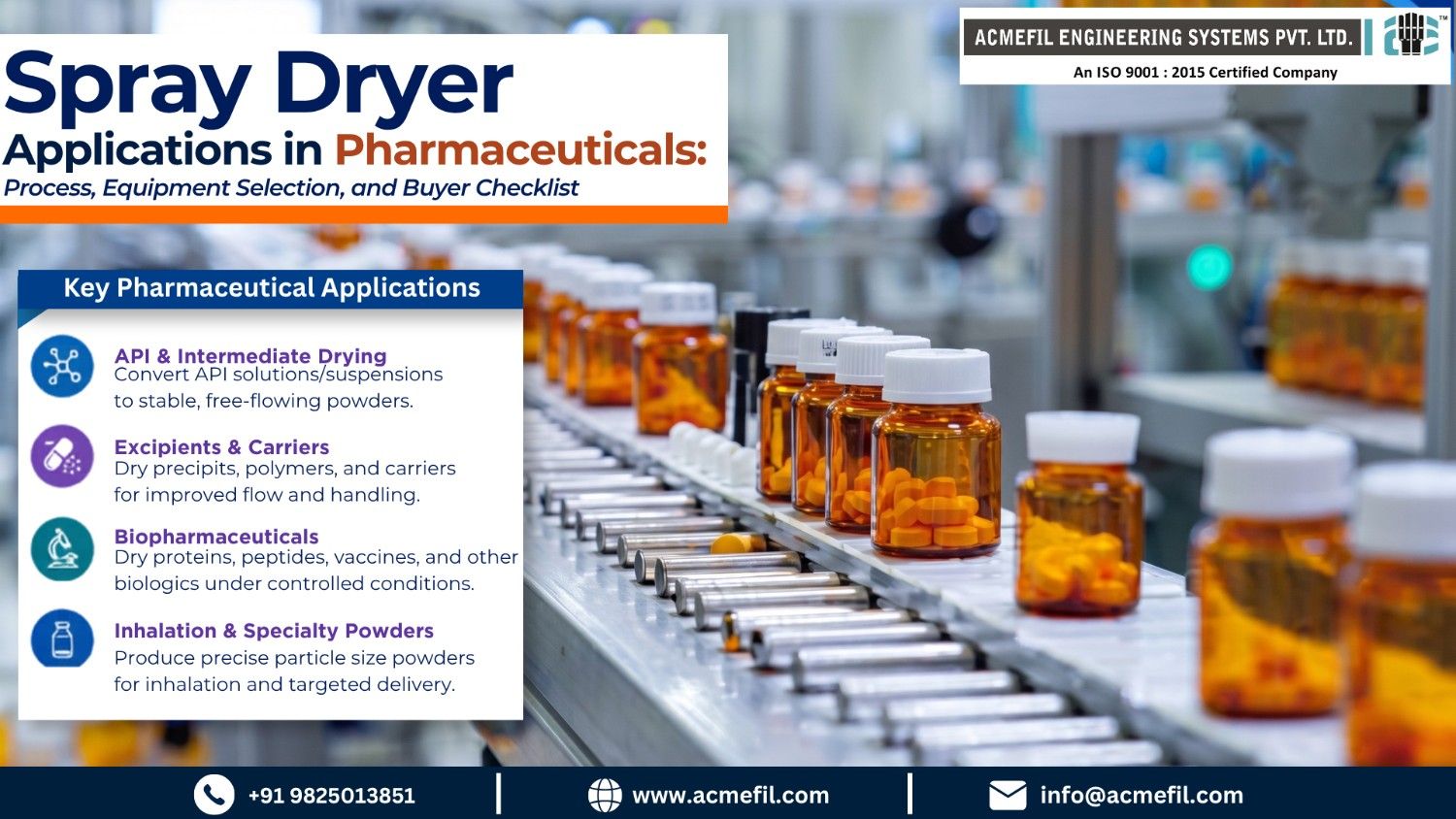
Spray dryer applications in pharmaceuticals include API intermediate drying, herbal extract powders, enzymes, proteins, lactose, dextrose, spray-dried dispersions, microencapsulation support, solvent-based powder production, and sterile powder processing. The important point is this: a pharmaceutical spray dryer is not selected only by capacity. It must be selected by feed chemistry, solvent system, heat sensitivity, target particle size, final moisture, containment requirement, and validation expectations.
In pharma, the dryer becomes part of the product-quality strategy. A small change in atomization, outlet temperature, residence time, or powder recovery can change the final powder.
What Does a Pharmaceutical Spray Dryer Actually Do?
A pharmaceutical spray dryer converts a liquid feed into a dry powder by atomizing the feed into fine droplets, contacting those droplets with hot air or inert gas, evaporating moisture or solvent rapidly, and separating the final powder from the exhaust stream.
The basic process has four stages:
- Atomization of the liquid feed into droplets
- Contact between droplets and drying medium
- Rapid evaporation from each droplet
- Powder separation and collection
For a simple overview of the mechanism, read how a spray dryer works. For pharma projects, however, the basic principle is only the starting point. The real engineering work begins when we study the feed.
A water-based herbal extract, a solvent-based API formulation, and a heat-sensitive enzyme feed may all be called “pharmaceutical spray drying,” but they are not the same application. They may need different atomization, different chamber sizing, different air handling, different filtration, and different powder collection logic.
Main Spray Dryer Applications in Pharmaceuticals
| Pharmaceutical Application | Why Spray Drying Is Used | Engineering Point to Check |
|---|---|---|
| API intermediates | Converts liquid-phase or slurry-stage material into dry powder for downstream processing | Heat sensitivity, solvent system, residual moisture, powder recovery |
| Herbal extracts | Converts concentrated extracts into stable powder form | Stickiness, wall deposition, outlet temperature, carrier requirement |
| Enzymes and proteins | Supports drying of sensitive biochemical materials where exposure time must be controlled | Product temperature, residence time, moisture target, air quality |
| Lactose, dextrose, protein, hemoglobin, mineral extracts | Produces powder form with defined moisture and handling properties | Particle size, flow behaviour, collection efficiency |
| Spray-dried dispersions | Supports formulation work where solubility, dissolution, or powder morphology matters | Feed formulation, polymer/excipient system, solvent removal |
| Microencapsulation support | Helps create powder systems where active ingredients are protected or released in a controlled way | Carrier material, droplet size, inlet/outlet temperature profile |
| Solvent-based pharmaceutical feeds | Converts solvent-containing liquid systems into powder while recovering solvent | Closed loop design, nitrogen atmosphere, solvent safety |
| Sterile powder production | Used where sterile or aseptic powder handling is part of the project requirement | HEPA filtration, sterile micro filtration, cleanability, validation scope |
The buyer mistake is treating all these as one equipment category. In my view, that is where many pharmaceutical spray drying discussions go wrong. The question should not be, “What is your spray dryer capacity?” The first question should be, “What powder property and process condition are we trying to control?”
Why Spray Drying Is Used for API and Formulation Work
In API and formulation development, spray drying is often considered when the liquid feed needs to become a powder with controlled physical properties. It can help when the target is defined particle size, manageable bulk density, improved dispersibility, controlled final moisture, or a powder form suitable for further processing.
For poorly soluble API work, spray drying is often discussed because it can produce amorphous solid dispersions when the API and excipient system are correctly formulated. That does not mean every API should be spray dried. The formulation, solvent, thermal behaviour, and downstream process must support the decision.
This is why pharmaceutical spray drying should be linked with process validation thinking. FDA process validation guidance frames validation as a lifecycle activity from process design through qualification and continued process verification, not as a one-time final test.
Why Herbal Extract Spray Drying Needs Special Attention
Herbal extracts are common pharmaceutical and nutraceutical spray drying applications, but they can be difficult to dry. Many extracts are sticky, hygroscopic, or sensitive to outlet temperature. If the feed solids are low, the dryer has to evaporate more water. If the extract contains sugars or thermoplastic components, wall deposition becomes a serious issue.
For herbal extract spray drying, I would normally want to know:
- Total solids percentage
- Viscosity at feed temperature
- Carrier or excipient requirement
- Maximum acceptable product temperature
- Target final moisture
- Expected powder flow behaviour
- Whether the powder will be filled into capsules, sachets, tablets, or bulk packs
If these points are not known, pilot testing should come before full-scale equipment selection. You can also review spray dryer troubleshooting common issues because wall sticking, moisture variation, and poor powder recovery usually begin with feed and parameter mismatch.
Which Spray Dryer Type Is Suitable for Pharmaceutical Applications?
There is no universal best pharmaceutical spray dryer. The right type depends on the material and the manufacturing objective.
| Dryer Type | Best Fit in Pharma Context | Watch Point |
|---|---|---|
| Rotary atomizer spray dryer | Slurries, suspensions, extracts, and applications where droplet size control and feed flexibility matter | Atomizer speed, disc design, chamber diameter, powder collection |
| Nozzle atomizer spray dryer | Fine particle requirements, controlled droplet generation, pressure-nozzle or two-fluid-nozzle applications | Feed pressure, nozzle wear, clogging risk, particle morphology |
| Closed loop spray dryer | Solvent-based or oxygen-sensitive pharmaceutical feeds | Nitrogen loop, solvent recovery, explosion/fire protection logic |
| Sterile spray dryer | Pharmaceutical sterile or aseptic powder applications | HEPA filtration, sterile micro filters, cleanability, validation |
| Fluidized spray dryer | Larger particle or agglomerated powder requirements | Fluid bed integration, fines return, final powder structure |
| Lab scale pilot spray dryer | R&D trials and process development before full-scale design | Scale-up interpretation and process-window mapping |
For a detailed comparison, use the nozzle vs rotary atomizer comparison and the guide on spray dryer atomization techniques.
At ACMEFIL, pharmaceutical discussions usually move toward one of three routes: rotary atomizer, nozzle atomizer, or closed loop/sterile configuration. The choice is not cosmetic. It changes the dryer layout, utility requirement, safety logic, cleaning approach, and commercial feasibility.
When Does Pharma Need a Closed Loop Spray Dryer?
A closed loop spray dryer is considered when the feed contains organic solvent, when solvent recovery is required, or when the product is oxygen-sensitive. In a closed loop system, drying happens in a nitrogen atmosphere instead of normal open air. This helps manage solvent handling and oxidation-sensitive applications.
For pharmaceutical use, this decision must be taken early. A closed loop dryer is not a standard spray dryer with one extra component added later. It affects:
- Drying gas circuit
- Nitrogen requirement
- Solvent recovery system
- Condensation load
- Explosion and fire protection logic
- Instrumentation and safety interlocks
- Cleaning and containment expectations
For ACMEFIL’s related equipment page, see the closed loop spray dryer.
What About Sterile Spray Drying?
Sterile spray drying is relevant when the product and process require sterile or aseptic handling. ACMEFIL’s sterile spray dryer configuration is listed for pharmaceutical applications with HEPA filters and sterile micro filters.
This is a high-control application. The dryer design alone does not make the process compliant. The user’s facility, cleaning process, sterilization method, environmental controls, operator practices, validation protocol, and QA system must all match the intended pharmaceutical use.
FDA guidance for sterile drug products produced by aseptic processing is intended to help manufacturers meet CGMP requirements under 21 CFR parts 210 and 211 when manufacturing sterile drugs and biological products using aseptic processing.
So the correct position is practical: sterile spray drying can be engineered, but the final suitability must be reviewed by the pharmaceutical manufacturer’s QA, validation, and regulatory teams.
Critical Process Parameters in Pharmaceutical Spray Drying
For pharmaceutical spray drying, process parameters should not be adjusted casually. The important parameters include:
| Parameter | Why It Matters |
|---|---|
| Feed solids | Controls evaporation load, powder yield, and drying behaviour |
| Feed viscosity | Affects atomization, droplet formation, and pump selection |
| Atomizer type | Influences droplet size, particle size, and powder recovery |
| Inlet temperature | Provides drying energy but must be balanced against product sensitivity |
| Outlet temperature | Often more relevant to product exposure and final moisture |
| Residence time | Affects moisture removal, heat exposure, and degradation risk |
| Drying gas type | Air may suit water-based feeds, nitrogen may be needed for solvent-based feeds |
| Powder collection | Impacts yield, dust handling, and downstream processing |
| Filtration | Important for hygiene, dust control, and pharma handling expectations |
| Cleaning access | Critical for batch changeover, validation, and contamination control |
For parameter-level thinking, read optimize spray drying parameters.
Why Pilot Testing Matters Before Full-Scale Pharma Spray Drying
Pilot testing is one of the safest ways to reduce equipment-selection risk. In pharmaceutical applications, the feed can be expensive, sensitive, sticky, solvent-based, or new to the plant. A pilot run helps the engineering team see how the actual feed behaves, not how it is expected to behave on paper.
A useful pilot trial checks:
- Whether the feed atomizes cleanly
- Whether the powder sticks to the chamber wall
- Whether final moisture is achievable
- Whether powder recovery is acceptable
- Whether the outlet temperature window is safe
- Whether rotary or nozzle atomization is more suitable
- Whether closed loop operation needs to be considered
- Whether the process is forgiving or narrow
ACMEFIL has an in-house pilot spray dryer with 3 kg/hr water evaporation capacity for product trials and process development. For buyers, this is especially useful before committing to a full-scale pharmaceutical spray dryer.
You can review ACMEFIL’s pilot spray dryer and SprayDryer.com’s guide on choosing the right spray dryer.
Buyer Checklist Before Selecting a Pharmaceutical Spray Dryer
Before discussing price or capacity, prepare these details:
| Data Required | Why the Manufacturer Needs It |
|---|---|
| Feed type | Solution, slurry, suspension, emulsion, extract, or solvent-based feed |
| Total solids percentage | Determines evaporation load and commercial feasibility |
| Viscosity | Affects feed pumping and atomization |
| Solvent type | Determines open loop, closed loop, recovery, and safety design |
| Heat sensitivity | Defines safe temperature range and residence time strategy |
| Final moisture target | Drives outlet temperature and drying profile |
| Particle size target | Influences atomizer selection and chamber design |
| Bulk density target | Impacts powder handling and downstream filling |
| Sterility expectation | Changes filtration, cleaning, and validation scope |
| Batch or continuous operation | Affects plant layout and control system |
| Utility availability | Steam, power, compressed air, nitrogen, chilled water |
| Scale-up plan | Decides whether pilot trials are required before final design |
A good pharmaceutical spray dryer RFQ should include this information. Without it, the discussion stays too generic.
Common Mistakes in Pharmaceutical Spray Dryer Selection
Choosing capacity before understanding the feed
Capacity is important, but it is not the first design question. A 100 kg/hr evaporation requirement means very little if the feed is sticky, solvent-based, or thermally sensitive.
Treating outlet temperature as a fixed catalogue number
Outlet temperature must be tied to product sensitivity and final moisture. A number copied from another product can create quality issues.
Ignoring powder collection behaviour
Very fine powders may pass through collection systems if the separation design is not correct. Powder recovery must be part of the design conversation.
Using open loop thinking for solvent-based feeds
Solvent-based pharmaceutical feeds need early closed loop evaluation. Waiting until late design creates safety, layout, and utility problems.
Skipping pilot trials for new or high-value products
A pilot trial does not replace pharma validation, but it gives process evidence before major investment.
When Spray Drying May Not Be the Right Choice
Spray drying is powerful, but it is not correct for every pharmaceutical material. A different technology may be better when:
- The product degrades even under short thermal exposure
- The powder becomes too sticky for stable recovery
- The required sterility pathway cannot be validated with the proposed setup
- The feed has very low solids and poor drying economics
- The process requires a powder form better produced through freeze drying, vacuum drying, tray drying, or fluid bed processing
This honest evaluation matters. A good dryer manufacturer should not force every pharmaceutical product into a spray dryer. The job is to select the right drying route for the material.
How ACMEFIL Supports Pharmaceutical Spray Drying Projects
ACMEFIL Engineering Systems Pvt. Ltd. manufactures industrial drying and concentrating equipment from Ahmedabad, India. For pharmaceutical spray drying projects, ACMEFIL’s relevant equipment range includes rotary atomizer spray dryers, nozzle atomizer spray dryers, fluidized spray dryers, closed loop spray dryers, sterile spray dryers, and lab scale pilot spray dryers.
The practical advantage is the ability to evaluate the feed before final design. ACMEFIL’s in-house R&D pilot plant allows buyers to test spray drying behaviour at pilot scale before full-scale procurement.
For pharmaceutical buyers, I would not start with a catalogue model. I would start with the material data, run a technical evaluation, and decide whether the process needs rotary atomization, nozzle atomization, closed loop drying, sterile configuration, pilot testing, or another drying route altogether.
That is how pharmaceutical spray dryer selection should be done.
FAQs
What are the main spray dryer applications in pharmaceuticals?
The main spray dryer applications in pharmaceuticals include API intermediate drying, herbal extract powder production, enzyme and protein drying, lactose and dextrose drying, spray-dried dispersions, microencapsulation support, solvent-based powder production, and sterile powder processing where the correct equipment and validation route are available.
Which spray dryer is best for pharmaceutical products?
There is no single best spray dryer for all pharmaceutical products. Rotary atomizers suit many slurry and extract feeds, nozzle atomizers suit controlled fine-droplet applications, closed loop dryers suit solvent-based or oxygen-sensitive products, and sterile spray dryers are evaluated when aseptic handling is required.
Can spray drying be used for heat-sensitive pharmaceutical materials?
Spray drying can be suitable for some heat-sensitive pharmaceutical materials because droplet drying happens rapidly and exposure time can be short. Suitability still depends on outlet temperature, residence time, product degradation behaviour, solvent system, and final moisture requirement. Pilot testing is strongly recommended.
Why is closed loop spray drying used in pharmaceuticals?
Closed loop spray drying is used when the feed contains organic solvent, requires solvent recovery, or needs an inert nitrogen atmosphere because of oxidation sensitivity or solvent safety requirements. It is not a simple accessory. It changes the full dryer design, utility requirement, and safety logic.
Why is pilot testing important before buying a pharmaceutical spray dryer?
Pilot testing helps confirm atomization behaviour, wall sticking, final moisture, powder recovery, outlet temperature window, and atomizer selection before full-scale procurement. For pharmaceutical products, it reduces selection risk and gives the engineering team better evidence before commercial design.
If you are planning a pharmaceutical spray drying project, do not begin with only capacity and budget. Share your feed composition, solids percentage, viscosity, solvent system, heat sensitivity, final moisture target, and powder requirement.
ACMEFIL can evaluate whether your application needs rotary atomization, nozzle atomization, closed loop drying, sterile spray drying, pilot testing, or a different drying route. For technical evaluation, use the SprayDryer.com contact page and share your process details.

Siddharth Nair is Technical Director at Acmefil Engineering Systems Pvt. Ltd. he leads solution design and applications engineering across the company’s full product range — spray dryers, multi-effect evaporators, agitated thin film dryers, spin flash dryers, fluid bed dryers, and complete ZLD systems.
His work spans process evaluation, equipment sizing, customer application consulting, and technical proposal development for industries including food and dairy, pharmaceuticals, chemicals, dyestuffs, ceramics, and industrial effluent treatment. He has hands-on commissioning experience across Acmefil’s 500+ installations in India and 15+ countries.
He holds a BTech in Mechanical Engineering from CHARUSAT University and also partners at A.S Engineers, working with blowers, sludge dryers, and industrial conveying systems.


