
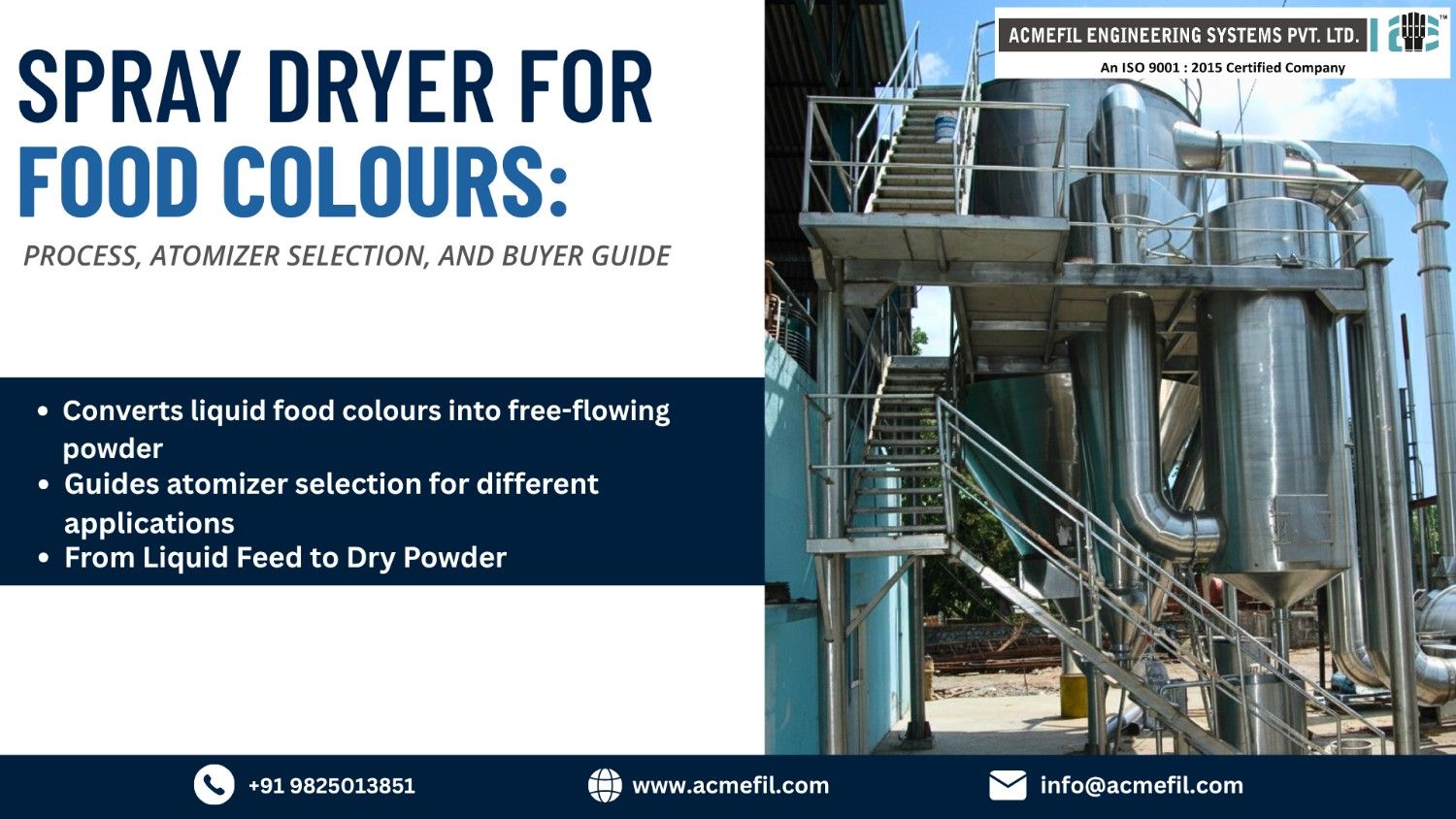
A spray dryer for food colours converts liquid colour preparations, natural colour extracts, emulsions, or carrier-based dispersions into dry powder by atomizing the feed into hot drying air and separating the powder from exhaust air. The real engineering challenge is not just evaporation. It is preserving shade, controlling moisture, avoiding wall sticking, and producing a powder that disperses consistently in the final food application.
For food colour manufacturers, the dryer must be selected around the feed, not around a standard catalogue size.
Why food colour spray drying is different from normal food powder drying
Food colours are not like milk powder, starch, or soup mixes. The commercial value of the powder depends heavily on colour strength, shade consistency, solubility, and stability during storage.
A dryer can remove water efficiently and still fail the product if the final powder becomes dull, sticky, lumpy, hygroscopic, or inconsistent from batch to batch.
In my view, the first question should not be, “What is the spray dryer price?” The first question should be, “What is the colour chemistry, carrier system, feed solids, and final powder requirement?”
Food colour spray drying usually involves one or more of these feed types:
- Water-soluble synthetic food colour preparations
- Natural colour extracts from fruit, vegetable, plant, algae, or spice sources
- Colour emulsions or dispersions
- Carrier-based formulations with maltodextrin, gum arabic, starch, dextrin, lactose, or similar permitted carriers
- Food additive blends requiring controlled moisture and lump-free powder
For India, colour preparations and mixtures must be handled within the current food additive framework, including permitted colours, permitted diluents or fillers, impurity limits, and labelling requirements. FSSAI also states that food additives should have a justified technological function, should not mislead consumers, and should be used under good manufacturing practice at the lowest level needed for the intended effect.
For export to the United States, colour additives generally require FDA approval for the intended use, and many colour additives also require batch certification.
A spray dryer cannot make an unapproved colour approved. It can only convert an approved and correctly formulated liquid or slurry into a usable powder form.
How a spray dryer for food colours works
The basic spray drying process has four stages:
- Feed preparation
- Atomization into fine droplets
- Drying inside the hot air chamber
- Powder separation and collection
In food colour production, each stage affects the shade and powder quality.
The liquid feed is first prepared with the required solids content, viscosity, carrier, stabilizer, and filtration level. It is then pumped to the atomizer. The atomizer converts the liquid into droplets. These droplets meet hot drying air inside the chamber. Water evaporates rapidly. The dried powder is separated using a cyclone, bag filter, or a combination depending on particle size and recovery target.
The basic principle sounds simple. The difficulty is in control.
If droplet size is too large, the powder may remain wet or deposit on the chamber wall. If droplets are too fine, powder recovery may become difficult. If outlet temperature is too high, heat-sensitive natural pigments may lose brightness. If the carrier level is wrong, the powder may become sticky or absorb moisture quickly.
What product data should be checked before selecting the dryer?
Before we recommend a spray dryer for food colours, I would want to see the product data first. Without this, any quotation is mostly guesswork.
| Data Needed | Why It Matters |
|---|---|
| Type of colour | Synthetic, natural extract, lake, dispersion, emulsion, or blended preparation changes drying behaviour |
| Solids percentage | Decides evaporation load, feed rate, and dryer size |
| Viscosity | Affects pump selection, atomization quality, and droplet formation |
| Carrier system | Influences stickiness, solubility, hygroscopicity, and wall deposition |
| Heat sensitivity | Decides allowable inlet and outlet temperature window |
| pH | Some pigments change shade with pH |
| Final moisture target | Controls shelf stability, flowability, and packaging requirements |
| Desired particle size | Affects atomizer selection and powder recovery system |
| Solubility or dispersibility need | Important for beverages, bakery, confectionery, snacks, and instant mixes |
| Regulatory market | India, USA, EU, Middle East, or private label export markets may have different colour-additive requirements |
This is why a spray dryer design and components decision should start with the product, not the equipment drawing.
Which atomizer is better for food colours?
There is no single atomizer that is best for every food colour. The right choice depends on feed properties and powder target.
| Atomizer Type | Best Fit for Food Colours | Key Advantage | Watch-Out Point |
|---|---|---|---|
| Two-fluid nozzle | Small batches, R&D, finer atomization, lower feed rate, heat-sensitive formulations | Good for fine droplets and process development | Compressed air demand and scale-up must be checked |
| Pressure nozzle | Higher feed pressure, controlled particle size, suitable for specific powder morphology | Good for consistent atomization at commercial scale | Feed must be filtered and pumpable |
| Rotary atomizer | Larger capacity, variable feed rate, slurries or feeds needing wider operating flexibility | Good operational flexibility and stable droplet generation | Dryer chamber design must match spray pattern |
For food colours, two-fluid nozzle systems are often considered when the batch size is small or when very fine atomization is needed. Pressure nozzle systems can work well when the feed is clean, pumpable, and requires consistent particle formation. Rotary atomizer systems are useful when the feed and production scale need greater flexibility.
This decision should be made alongside spray dryer atomization techniques and a clear comparison of nozzle vs rotary atomizer spray dryers.
Carrier selection matters more than many buyers think
In food colour spray drying, carriers are not just fillers. They can influence drying yield, powder stickiness, colour protection, solubility, and storage behaviour.
Common carrier or wall-material options include:
- Maltodextrin
- Gum arabic
- Modified starch
- Dextrins
- Lactose
- Pectin
- Gelatin
- Selected permitted gums or stabilizers
The choice depends on the colour source, application, regulatory allowance, cost, and final powder behaviour.
Research on spray drying of bioactive fruit pulp using maltodextrin shows that process temperature and wall-material proportion can strongly affect moisture, hygroscopicity, solubility, yield, and retention of sensitive compounds.
For a food colour manufacturer, this means a carrier cannot be selected only from a cost sheet. It has to be tested with the actual colour feed.
A beetroot red, turmeric yellow, spirulina blue, caramel colour, or synthetic colour blend may behave differently inside the same dryer. Even the same colour can behave differently when the solids percentage, pH, carrier ratio, or inlet air condition changes.
Critical spray drying parameters for food colours
Food colour powders are sensitive to process variation. These are the parameters I would control closely.
| Parameter | What It Controls | Practical Impact |
|---|---|---|
| Feed solids | Evaporation load and powder recovery | Low solids can increase drying cost; high solids can create viscosity and atomization issues |
| Feed viscosity | Pumping and droplet formation | Too viscous feed can give unstable spray and wall deposition |
| Inlet air temperature | Drying intensity | Too high may damage sensitive natural colours; too low may leave powder wet |
| Outlet air temperature | Final moisture indication | Critical for moisture control and powder stability |
| Atomizer type | Droplet size and distribution | Affects particle size, yield, and chamber deposition |
| Feed filtration | Nozzle protection and consistency | Poor filtration can block nozzles and disturb spray pattern |
| Air humidity | Drying capacity | Humid inlet air can reduce drying efficiency and affect powder moisture |
| Powder recovery system | Product yield | Fine powders need correct cyclone or bag filter design |
| Contact material | Hygiene and cleanability | Food-grade contact parts and clean design are important |
| Cleaning system | Batch changeover | Colour changeover needs practical cleaning access |
A common mistake is to copy temperature settings from another food product. Food colours need their own trial window because colour stability and drying behaviour can change significantly with formulation.
For more detailed control logic, read how to optimize spray drying parameters.
Process flow for food colour powder production
A typical food colour spray drying line may include:
- Raw colour extract or colour solution preparation
- Filtration or homogenization where required
- Carrier and stabilizer addition
- Feed tank with agitator
- Feed pump or high-pressure pump
- Atomization system
- Hot air generator and air filtration
- Drying chamber
- Cyclone separator and/or bag filter
- Powder collection system
- Sieving or blending if required
- Moisture and colour-strength testing
- Food-grade packing
For sensitive natural colours, the line may also need better air control, controlled holding time, faster powder cooling, and packaging that protects against humidity, oxygen, and light.
For solvent-based or oxidation-sensitive materials, the dryer configuration must be reviewed separately. A standard open-cycle spray dryer should not be assumed safe or suitable for every material.
Natural food colours need extra attention
Natural food colours are often less stable than many synthetic colour systems. Heat, oxygen, pH, light, moisture, and storage temperature can all affect the final shade.
Examples include:
- Anthocyanin-based red and purple colours
- Beetroot red
- Turmeric or curcumin-based yellow
- Paprika extract
- Caramel colour
- Chlorophyll-based green
- Spirulina or algae-based blue
- Fruit and vegetable extract powders
For these products, I would focus on three questions:
- How much colour loss is acceptable during drying?
- What carrier protects the pigment without affecting the final application?
- What outlet moisture gives stability without making the powder hard to dissolve?
A dryer trial is useful because the answer is rarely visible from the formulation sheet alone.
Synthetic food colour powders also need process discipline
Synthetic food colours may be more stable than many natural colour extracts, but they still require controlled drying.
The main issues are usually:
- Lump formation
- Uneven dye concentration
- Poor flowability
- High moisture
- Nozzle blockage
- Cross-contamination between batches
- Dust control
- Cleaning time during colour changeover
For synthetic colour preparations, the dryer should support consistent powder recovery and practical cleaning. Powder should be reasonably free from lumps and visible foreign matter where relevant to the applicable standard or buyer specification.
Rotary atomizer vs nozzle type for food colours
| Selection Question | Rotary Atomizer | Nozzle Type |
|---|---|---|
| Is the feed variable in solids or viscosity? | Often more forgiving | More sensitive to feed consistency |
| Is fine powder required? | Possible, depending design | Strong option, especially with two-fluid nozzle |
| Is the production scale large? | Often suitable | Suitable, but nozzle count and pressure system matter |
| Is the feed clean and filtered? | Still important | Very important to prevent blockage |
| Is particle size control critical? | Controlled by disc design and speed | Controlled by pressure, nozzle size, and feed properties |
| Is R&D or small-scale trial needed? | Possible in pilot setup | Often practical for small trials |
For buyers, the real answer should come from feed trials. A well-run pilot trial can show powder recovery, wall deposition, moisture, colour shade, and solubility before full-scale procurement.
Why pilot testing is important before buying a food colour spray dryer
Food colour spray drying is a good candidate for pilot testing because small formulation changes can create large process changes.
A pilot trial can answer:
- Does the feed atomize cleanly?
- Does the powder stick to the chamber wall?
- Is the colour shade retained after drying?
- What is the practical moisture range?
- Does the powder dissolve or disperse as required?
- Is the selected carrier suitable?
- Is nozzle or rotary atomization better?
- What powder recovery can be expected under trial conditions?
- Does the powder need post-drying blending or sieving?
This is where Acmefil’s pilot spray dryer capability becomes important. A trial on a small system is much cheaper than discovering a formulation problem after installing a full-scale plant.
If you are developing a new food colour powder, start with a pilot run before freezing the commercial dryer design. You can also review the spray dryer for small scale production guide if you are still at product-development stage.
Common buyer mistakes when selecting a spray dryer for food colours
Mistake 1: Selecting the dryer before finalizing the formulation
The dryer and formulation are connected. If the carrier changes, the drying behaviour can change. If the solids percentage changes, the evaporation load changes. If the pH changes, the shade may change.
Do not finalize the dryer before the feed is reasonably defined.
Mistake 2: Ignoring hygroscopicity
Many food colour powders absorb moisture quickly. If this is ignored, the product may cake during storage even if it looks fine after drying.
The dryer outlet moisture, carrier, powder cooling, and packaging must be planned together.
Mistake 3: Treating all food colours as heat-sensitive in the same way
Some colours tolerate higher thermal exposure better than others. Some lose shade quickly. Some are more sensitive to oxygen, pH, or light than heat alone.
This is why process trials should measure actual colour strength and shade, not only moisture.
Mistake 4: Buying only on evaporation capacity
Evaporation capacity matters, but it is not the complete specification. Powder recovery, contact material, cleaning, atomization system, filtration, and product handling are equally important for food colours.
Mistake 5: Not planning cleaning and colour changeover
If the same dryer handles multiple colours, cleaning design becomes critical. Red-to-yellow, blue-to-white, or dark-to-light changeovers can create product rejection if cleaning access is poor.
What should be included in a spray dryer RFQ for food colours?
A good RFQ should include technical details, not just required capacity.
Share these details with the manufacturer:
- Food colour type and source
- Synthetic or natural colour classification
- Liquid, slurry, extract, emulsion, or dispersion form
- Feed solids percentage
- Feed viscosity at operating temperature
- Feed pH
- Carrier and stabilizer details
- Required powder moisture
- Required particle size or dispersibility
- Required colour strength or shade tolerance
- Heat sensitivity notes
- Daily production requirement
- Batch or continuous operation preference
- Cleaning and colour changeover requirement
- Contact material requirement
- Regulatory target market
- Packing condition
- Trial sample availability
This information helps the manufacturer recommend the correct dryer type, atomizer system, chamber size, heating system, product recovery arrangement, and control system.
Where a spray dryer fits in food colour manufacturing
A spray dryer for food colours is suitable when the product needs to move from liquid or extract form into a dry, stable, and easier-to-handle powder.
It is commonly relevant for:
- Beverage colour powders
- Bakery colour powders
- Confectionery colour powders
- Instant mix colour systems
- Seasoning and snack colour blends
- Dairy and dessert colour preparations
- Natural extract powders
- Food additive powder blends
- Export-ready dry colour preparations
For broader context, see the guide on benefits of using a spray dryer in food processing.
How Acmefil approaches food colour spray dryer selection
For food colour applications, Acmefil’s role is not only to manufacture the drying chamber. The engineering work starts from the product.
The practical selection path is:
- Review the feed and final powder requirement
- Identify whether nozzle or rotary atomization is more suitable
- Check heat sensitivity and colour stability risk
- Define the air handling and product recovery system
- Recommend pilot testing where the product is new or sensitive
- Scale the design from trial learning and required production capacity
Acmefil manufactures spray dryers for food industry applications, including food colours, beverages, food additives, vegetable proteins, herbal extracts, maltodextrin, soup mixes, and enzymes. The company also has pilot spray dryer capability for process development, which is useful when the formulation is not yet proven at production scale.
Final selection checklist
Before you buy a spray dryer for food colours, confirm these points:
- The manufacturer understands food colour formulation behaviour
- Atomizer selection is based on feed properties, not assumption
- The dryer can meet the final moisture and powder recovery target
- The design considers wall sticking and hygroscopicity
- Powder collection is suitable for fine colour powders
- Contact parts and cleaning access match food processing needs
- Pilot trial is available for new or sensitive colours
- The process respects the food-additive rules of the target market
- The RFQ includes formulation and powder quality requirements
- The supplier can support installation, commissioning, training, spares, and troubleshooting
A spray dryer for food colours should be treated as a product-quality system, not only as evaporation equipment. If the colour shade, solubility, and storage stability matter, the correct dryer design has to begin with feed testing and process understanding.
FAQs
What is a spray dryer for food colours?
A spray dryer for food colours converts liquid colour preparations, extracts, emulsions, or dispersions into powder by atomizing the feed into hot drying air. The goal is to produce a dry food colour powder with controlled moisture, good recovery, stable shade, and suitable solubility or dispersibility for the final food application.
Which atomizer is best for food colour spray drying?
The best atomizer depends on feed viscosity, solids content, heat sensitivity, particle size target, and production scale. Two-fluid nozzles are useful for small batches and fine atomization. Pressure nozzles suit clean and pumpable feeds. Rotary atomizers provide flexibility for larger capacities and variable feed conditions.
Can natural food colours be spray dried?
Yes, many natural food colour extracts can be spray dried, but they need careful formulation and process control. Carrier selection, inlet and outlet temperature, pH, oxygen exposure, and final moisture can affect shade stability. Pilot testing is strongly recommended before commercial-scale dryer selection.
Why do food colour powders become sticky after spray drying?
Stickiness usually comes from formulation and moisture behaviour. Low glass-transition components, high hygroscopicity, unsuitable carrier ratio, high outlet moisture, humid inlet air, or insufficient powder cooling can cause sticking or caking. The solution is not only higher temperature. It needs formulation and dryer-condition optimization.
What information is needed to quote a spray dryer for food colours?
A proper quote needs food colour type, feed solids, viscosity, pH, carrier system, heat sensitivity, required final moisture, particle size or solubility target, daily production requirement, cleaning requirement, contact material requirement, and regulatory target market. A product sample for pilot testing is valuable for accurate selection.
If you are developing or scaling food colour powder production, do not finalize the spray dryer only from catalogue capacity. Share your feed details, required powder quality, carrier system, and target application. Acmefil can review the process requirement and recommend whether nozzle, rotary, pilot-scale, or commercial spray drying is the right path for your product.

Siddharth Nair is Technical Director at Acmefil Engineering Systems Pvt. Ltd. he leads solution design and applications engineering across the company’s full product range — spray dryers, multi-effect evaporators, agitated thin film dryers, spin flash dryers, fluid bed dryers, and complete ZLD systems.
His work spans process evaluation, equipment sizing, customer application consulting, and technical proposal development for industries including food and dairy, pharmaceuticals, chemicals, dyestuffs, ceramics, and industrial effluent treatment. He has hands-on commissioning experience across Acmefil’s 500+ installations in India and 15+ countries.
He holds a BTech in Mechanical Engineering from CHARUSAT University and also partners at A.S Engineers, working with blowers, sludge dryers, and industrial conveying systems.


