
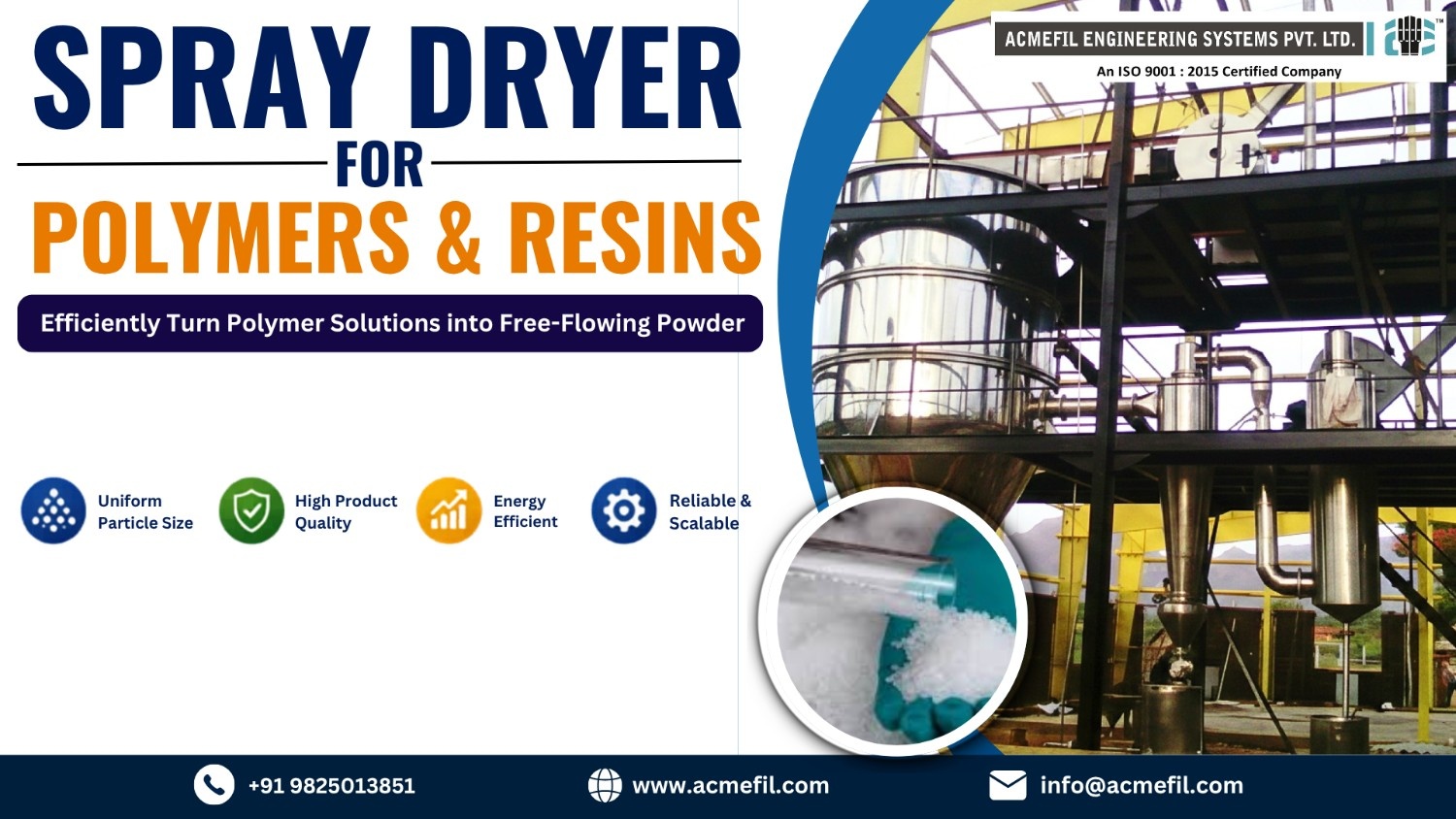
A spray dryer for polymers and resins converts liquid feed, dispersion, emulsion, slurry, or resin solution into dry powder by atomizing the feed into hot drying air. For products such as ABS, acrylic polymer, PVA, melamine-formaldehyde, and urea-formaldehyde, the dryer cannot be selected only by evaporation capacity. The real selection depends on feed viscosity, solids percentage, solvent or water base, tackiness, target moisture, particle size, and thermal sensitivity.
In polymer and resin drying, small mistakes in atomizer selection or outlet temperature can create wall build-up, sticky powder, choking, poor bulk density, or product degradation. That is why I treat polymer and resin spray drying as an application engineering problem, not as a standard dryer quotation.
Why Spray Drying Is Used for Polymers and Resins
Polymer and resin manufacturers use spray drying when the final product must be a powder rather than a liquid dispersion or solution. Spray drying is useful because it combines droplet formation, rapid moisture removal, and powder separation in one continuous process.
Common polymer and resin applications include:
- ABS
- Acrylic polymer
- Melamine-formaldehyde
- PVA
- Urea-formaldehyde
In these materials, the spray dryer must create a controlled powder without overheating the polymer, forming lumps, or allowing sticky semi-dried material to deposit on the chamber wall.
The basic principle is simple. The feed is atomized into fine droplets. Hot air contacts each droplet. Moisture or volatile content evaporates quickly. The dried particle is separated from the exhaust air through a cyclone, bag filter, or a combined separation system.
The difficult part is not the principle. The difficult part is making the powder behave properly inside the dryer.
What Makes Polymer and Resin Spray Drying Different?
Many buyers assume a spray dryer that works for food powder or dye powder will automatically work for resin powder. That is not always correct.
Polymer and resin feeds often create specific design challenges:
| Challenge | Why It Happens | What the Dryer Design Must Address |
|---|---|---|
| Sticky wall deposits | Product remains tacky during partial drying | Correct outlet temperature, chamber sizing, air flow pattern, and atomization |
| Nozzle or atomizer choking | High solids, poor filtration, unstable slurry, or agglomerates | Feed filtration, suitable pump, atomizer selection, and feed conditioning |
| Product degradation | Excessive heat exposure or poor residence time control | Temperature profile, drying air volume, and controlled outlet moisture |
| Fine powder loss | Very small particles escape primary separation | Cyclone and bag filter design |
| Inconsistent bulk density | Unstable droplet size or feed variation | Stable feed solids, atomizer speed or pressure control, and process monitoring |
| Poor redispersibility | Particle surface dries too fast or binder distribution is uneven | Pilot trial and optimized drying curve |
For polymer powders, I normally ask the buyer one question early: “What is more important, moisture, particle size, redispersibility, bulk density, or heat protection?” The answer changes the dryer design.
How a Spray Dryer for Polymers and Resins Works
A polymer or resin spray dryer normally follows four main stages.
Feed Preparation
The feed may enter as a polymer dispersion, resin solution, emulsion, latex-like feed, or slurry. Before it reaches the atomizer, the feed should be checked for:
- Total solids
- Viscosity at operating temperature
- Presence of lumps or undispersed particles
- Filtration requirement
- Foaming tendency
- Solvent or water base
- Thermal sensitivity
- pH and stability, if relevant to the product
A clean, stable feed is important. If the feed changes every hour, the powder will also change every hour.
For resin systems, feed preparation is often where the drying problem starts. A dryer cannot fully correct unstable feed chemistry, poor filtration, or uncontrolled feed solids.
Atomization
Atomization breaks the liquid feed into droplets. Droplet size affects drying time, particle size, bulk density, and wall deposition risk.
For polymer and resin feeds, atomization is one of the most important selection decisions. A rotary atomizer, pressure nozzle, or two-fluid nozzle can all work in different cases, but they do not behave the same.
For a deeper technical comparison, read nozzle vs rotary atomizer spray dryer selection before finalizing the system.
Drying Chamber Contact
After atomization, droplets meet hot drying air inside the chamber. The chamber must provide enough residence time for moisture removal without allowing the product to stick, overheat, or degrade.
The outlet temperature is especially important. Inlet temperature tells you the heat supplied to the dryer. Outlet temperature is usually more closely connected to the product’s final moisture and heat exposure.
In polymer and resin drying, I do not like designing only from a generic inlet temperature. I want the feed data and the target powder behavior first.
Powder Separation
The dried powder is separated from exhaust air. Depending on particle size and product value, the system may use cyclone separation, bag filtration, or both.
Fine polymer powder can be valuable. Losing it into the exhaust stream is not only a yield issue. It can also create housekeeping and dust-handling concerns. This is why the separation system should be discussed early, not treated as an accessory after the chamber is selected.
You can also review spray dryer design and components to understand how the complete plant connects from feed system to powder discharge.
Which Atomizer Is Better for Polymer and Resin Spray Drying?
There is no single best atomizer for every polymer or resin. The right choice depends on the feed and the powder target.
| Atomizer Type | Best Fit | Strength | Watchpoint |
|---|---|---|---|
| Rotary atomizer | Many polymer dispersions, slurries, and resin feeds where droplet control and flexible operation are needed | Handles variable feed rates and can support controlled droplet formation | Atomizer speed, disc selection, and chamber diameter must match the product |
| Pressure nozzle | Resin solutions or feeds where specific particle morphology, coarser powder, or high-pressure atomization is suitable | Simple atomization principle and useful for defined spray patterns | Nozzle wear or choking can occur if feed contains particles or poor filtration |
| Two-fluid nozzle | Small-scale trials, fine powders, lower feed rates, or feeds needing compressed-air atomization | Useful where very fine atomization is required | Compressed air consumption and scale-up must be checked carefully |
For ABS, acrylic polymer, PVA, melamine-formaldehyde, and urea-formaldehyde applications, I would not select the atomizer from the product name alone. The same polymer family can behave differently depending on solids percentage, molecular weight, additive package, solvent base, and final powder requirement.
The safest approach is to test the feed and then size the full system.
Open Cycle or Closed Loop Spray Dryer for Resins?
A water-based polymer dispersion may often be evaluated for an open-cycle spray dryer, depending on the product, plant conditions, and emission requirements.
A solvent-based resin feed needs a more careful discussion. In such cases, a closed loop spray dryer may be required because the system dries in a nitrogen atmosphere and supports solvent recovery. This matters when the feed contains volatile solvent, oxidation-sensitive material, or fire-sensitive conditions.
This is not a point where a buyer should accept a generic answer. The correct selection needs feed composition, solvent details, vapor load, safety review, and local compliance requirements.
For solvent-based or oxygen-sensitive products, review Acmefil’s closed loop spray dryer capability as a support reference, then verify the final design with a process engineer.
Key Design Parameters for a Polymer and Resin Spray Dryer
A useful RFQ for a spray dryer for polymers and resins should include more than “kg per hour capacity.” Capacity matters, but it is not enough.
Here are the parameters that affect the design:
| Parameter | Why It Matters |
|---|---|
| Feed rate | Sets the evaporation load and overall dryer size |
| Feed solids percentage | Changes water or solvent load and powder yield |
| Viscosity | Affects pumping, atomization, and droplet formation |
| Feed temperature | Changes viscosity and drying behavior |
| Solvent or water base | Affects open-cycle vs closed-loop selection |
| Target final moisture | Directly affects outlet temperature and residence time |
| Target particle size | Influences atomizer type and operating settings |
| Bulk density target | Changes atomization and drying strategy |
| Heat sensitivity | Controls maximum safe product exposure |
| Stickiness or glass transition behavior | Affects wall deposition and chamber design |
| Powder recovery requirement | Influences cyclone, bag filter, and discharge design |
| Cleaning requirement | Important when product changeover or hygiene matters |
For deeper parameter control, read how to optimize spray drying parameters.
Common Polymer and Resin Spray Drying Problems
Wall Build-Up
Wall build-up is common when droplets reach the chamber wall before they are dry enough, or when the product remains tacky during drying. The causes may include poor atomization, wrong air flow pattern, high feed rate, unsuitable outlet temperature, or a product that needs a different drying curve.
A larger chamber is not always the full answer. Sometimes the atomizer, feed concentration, or outlet temperature control is the real issue.
Nozzle Choking
Nozzle choking usually points to feed filtration, suspended solids, unstable dispersion, or unsuitable atomizer selection. If a resin feed contains undispersed particles, the nozzle becomes the first failure point.
Before blaming the spray dryer, check the feed tank, filter, pump, and recirculation arrangement.
Sticky Powder at Discharge
Sticky discharge powder means the drying process is not reaching a stable final powder condition. Possible causes include high final moisture, product softening, insufficient residence time, or wrong discharge temperature.
This problem becomes more serious when powder sticks inside the rotary valve, ducting, cyclone, or collection drum.
Poor Powder Flow
A powder can be dry by moisture value and still behave poorly. If the particle size is too fine, irregular, or electrostatically difficult, the powder may bridge, dust, or fail to discharge smoothly.
This is where particle size and bulk density targets should be discussed before fabrication.
Product Degradation
Some polymers and resins cannot tolerate aggressive heat exposure. In such cases, the design must control residence time, outlet temperature, and air distribution carefully.
The target should not be “highest temperature for fastest drying.” The target should be stable powder quality at a safe and repeatable operating condition.
Spray Dryer Selection Guide for Polymer and Resin Buyers
Use this decision table before discussing the plant with a manufacturer.
| Buyer Situation | Dryer Direction to Evaluate |
|---|---|
| Water-based polymer dispersion | Open-cycle spray dryer may be suitable after feed testing |
| Solvent-based resin solution | Closed-loop spray dryer should be evaluated |
| High-viscosity slurry or dispersion | Rotary atomizer may be more suitable, subject to trials |
| Fine powder requirement | Two-fluid nozzle or suitable atomizer configuration may be evaluated |
| Coarser granulated powder target | Pressure nozzle or fluidized spray drying may be considered |
| Heat-sensitive resin | Lower product exposure strategy and careful outlet temperature control |
| Sticky or tacky intermediate stage | Pilot testing is strongly recommended |
| Unknown feed behavior | Start with trial drying before final plant sizing |
A spray dryer is a capital equipment decision. A small pilot trial can prevent an expensive full-scale mistake.
Why Pilot Testing Matters for Polymer and Resin Drying
Polymer and resin feeds can surprise you during scale-up. On paper, two feeds may look similar. In the dryer, one may form a free-flowing powder while the other may coat the chamber wall.
Pilot testing helps answer practical questions:
- Will the feed atomize cleanly?
- Does the powder stick to the chamber?
- What outlet temperature gives target moisture?
- What particle size distribution is realistic?
- Does the powder remain free-flowing after collection?
- Does the product degrade or discolor?
- Is cyclone recovery enough, or is a bag filter essential?
- Is an open-cycle design acceptable, or is closed loop needed?
Acmefil has an in-house pilot spray dryer with 3 kg/hr water evaporation capacity for product trials. For a polymer or resin buyer, that trial is often more valuable than a long quotation discussion based only on assumptions.
What Data Should You Share Before Asking for a Quote?
If you want a technically useful quotation, share this data with the spray dryer manufacturer:
- Product name and polymer or resin type
- Feed form, such as solution, dispersion, emulsion, or slurry
- Solvent or water base
- Feed solids percentage
- Feed viscosity at operating temperature
- Feed pH, if relevant
- Feed rate in kg/hr
- Initial and final moisture target
- Required particle size range
- Bulk density target, if specified
- Heat sensitivity or maximum product temperature
- Stickiness, foaming, or wall build-up history
- Required material of construction
- Powder collection and packaging expectation
- Existing lab or pilot trial data
- Site utility details
- Emission, solvent recovery, or safety requirements
Without this information, the manufacturer can only give a broad estimate. With this information, the discussion becomes engineering-led.
Where Acmefil Fits for Polymer and Resin Spray Drying
Acmefil Engineering Systems manufactures spray dryer systems for multiple industrial applications, including polymers and resins such as ABS, acrylic polymer, melamine-formaldehyde, PVA, and urea-formaldehyde.
For this category, the practical advantage is not only manufacturing the dryer. It is the ability to evaluate the feed, select the right atomization system, and run pilot trials before full-scale design.
Depending on the product, the solution may involve:
- Rotary atomizer type spray dryer
- Nozzle atomizer type spray dryer
- Closed loop spray dryer
- Cyclone and bag filter separation
- Product discharge and powder handling system
- Pilot spray drying trial before scale-up
A good polymer and resin spray dryer is not selected by brochure category. It is selected by feed behavior and powder target.
Final Practical View
If your polymer or resin feed is water-based, stable, and non-sticky, spray drying may be straightforward after proper testing. If the feed is solvent-based, heat-sensitive, tacky, or high-viscosity, the dryer selection becomes more technical.
My recommendation is simple: do not finalize a spray dryer for polymers and resins only from capacity and price. Share the feed data, define the powder target, test the product if the behavior is unknown, and then decide the atomizer, chamber, heat source, and recovery system.
That is how you reduce commissioning risk.
FAQs
What is a spray dryer for polymers and resins?
A spray dryer for polymers and resins is an industrial drying system that converts polymer dispersion, resin solution, emulsion, or slurry into dry powder. It atomizes the liquid feed into hot drying air, evaporates moisture or volatile content, and separates the dry powder through a cyclone, bag filter, or combined recovery system.
Which polymers and resins can be spray dried?
Spray drying can be used for polymer and resin applications such as ABS, acrylic polymer, melamine-formaldehyde, PVA, and urea-formaldehyde. Suitability depends on feed composition, solvent or water base, viscosity, thermal sensitivity, stickiness, solids percentage, and required powder properties.
Which atomizer is best for polymer spray drying?
A rotary atomizer is often evaluated for polymer dispersions, slurries, and variable feed conditions. Pressure nozzles may suit specific resin solutions or coarser particle targets. Two-fluid nozzles may suit small-scale or fine powder applications. The final choice should be based on feed testing and target particle size.
Can solvent-based resins be spray dried?
Solvent-based resins may require a closed loop spray dryer operating in a nitrogen atmosphere with solvent recovery. This must be reviewed carefully because solvent type, vapor load, oxygen sensitivity, safety requirements, and local compliance conditions affect the final design.
Why is pilot testing important before buying a polymer or resin spray dryer?
Pilot testing shows whether the feed atomizes properly, dries without sticking, reaches target moisture, and produces the required powder flow and particle size. For polymers and resins, pilot testing can prevent scale-up problems such as wall build-up, sticky discharge powder, nozzle choking, and product degradation.
Planning a spray dryer for polymers, resins, ABS, acrylic polymer, PVA, melamine-formaldehyde, or urea-formaldehyde?
Share your feed solids, viscosity, solvent or water base, feed rate, final moisture target, particle size requirement, and heat sensitivity. A technical review or pilot drying trial can help confirm whether rotary atomizer, nozzle atomizer, open-cycle, or closed-loop spray drying is the right route for your product.

Siddharth Nair is Technical Director at Acmefil Engineering Systems Pvt. Ltd. he leads solution design and applications engineering across the company’s full product range — spray dryers, multi-effect evaporators, agitated thin film dryers, spin flash dryers, fluid bed dryers, and complete ZLD systems.
His work spans process evaluation, equipment sizing, customer application consulting, and technical proposal development for industries including food and dairy, pharmaceuticals, chemicals, dyestuffs, ceramics, and industrial effluent treatment. He has hands-on commissioning experience across Acmefil’s 500+ installations in India and 15+ countries.
He holds a BTech in Mechanical Engineering from CHARUSAT University and also partners at A.S Engineers, working with blowers, sludge dryers, and industrial conveying systems.


