
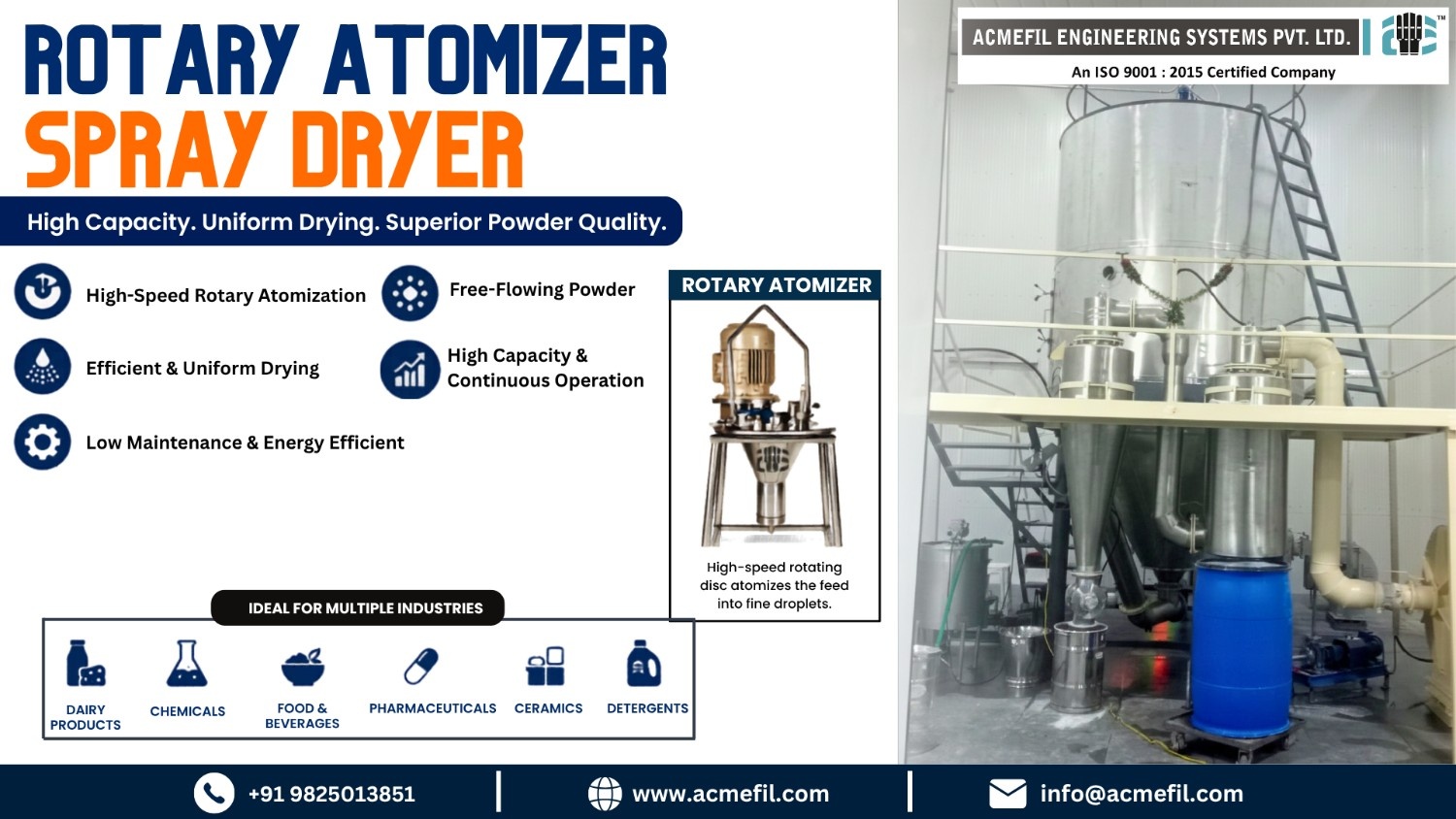
A rotary atomizer spray dryer uses a high-speed rotating disc to convert liquid feed, slurry, or suspension into fine droplets inside a hot drying chamber. I normally recommend this atomization route when the feed has suspended solids, abrasive characteristics, variable viscosity, or when particle size control is more important than using a simple nozzle system. In Acmefil rotary disc type spray dryers, the atomizer selection is not treated as a standard accessory. It directly affects drying rate, powder quality, chamber design, maintenance load, and final product consistency.
For buyers comparing spray dryer technologies, the real question is not “Is rotary better than nozzle?” The better question is, “What does my feed need?”
What Is a Rotary Atomizer Spray Dryer?
A rotary atomizer spray dryer is an industrial drying system where atomization is done by a high-speed centrifugal disc. The liquid feed enters the rotating disc, spreads outward due to centrifugal force, and leaves the disc edge as fine droplets. These droplets meet hot air inside the drying chamber and lose moisture rapidly. The dried powder is then separated from the air stream through a cyclone separator, bag filter, or a combination of separation equipment.
In simple terms, the rotary atomizer decides how the liquid breaks into droplets. The drying chamber decides how those droplets dry. Both must be designed together.
At Acmefil, rotary disc type spray dryers are used for applications such as dyes, ceramics, food products, detergents, pigments, inorganic chemicals, and selected pharmaceutical materials. The technology is especially useful where the feed is not a clean, low-viscosity liquid.
For broader context, you can also compare this topic with spray dryer atomization techniques and spray dryer design and components.
How Does a Rotary Atomizer Spray Dryer Work?
The working principle has four practical stages:
- Feed preparation and pumping
The liquid, slurry, suspension, or emulsion is prepared at the required solids concentration and pumped to the atomizer. Feed properties such as viscosity, density, solids percentage, abrasiveness, and heat sensitivity must be understood before sizing the system. - Rotary disc atomization
The feed reaches a high-speed rotating disc. As the disc rotates, centrifugal force throws the liquid outward. At the disc edge, the liquid breaks into droplets. Disc speed, disc design, feed rate, and liquid properties influence droplet size. - Hot air contact and moisture evaporation
The atomized droplets enter the drying chamber and contact hot air. Because the droplets have a large surface area, moisture evaporates quickly. The residence time must be long enough to reach target moisture but short enough to avoid product degradation. - Powder separation and collection
The dried particles move with the exhaust air toward the separation system. Cyclone separators and bag filters are commonly used to recover powder and control dust carryover.
This is why atomizer selection cannot be separated from chamber design. If droplet size is too large, the powder may remain wet or stick to the chamber wall. If droplets are too fine, you may get excessive fines, poor recovery, or dust handling issues.
Why Rotary Disc Atomization Matters So Much
In a spray dryer, atomization controls the starting point of drying. A poor atomization decision creates problems that cannot be fully corrected later by increasing temperature or changing airflow.
A rotary atomizer helps control:
| Process factor | Why it matters |
|---|---|
| Droplet size | Smaller droplets dry faster, larger droplets need more residence time |
| Particle size distribution | Affects solubility, flowability, bulk density, and powder handling |
| Feed flexibility | Important when viscosity or solids percentage changes during production |
| Wall deposition risk | Oversized or poorly distributed droplets can hit chamber walls before drying |
| Final moisture | Droplet size and airflow pattern influence how consistently moisture is removed |
| Maintenance frequency | Abrasive or sticky feeds can affect atomizer wear and cleaning cycles |
In my experience, many spray dryer issues start before the dryer is even manufactured. The buyer shares the required evaporation capacity, but not enough information about feed behavior. A rotary atomizer spray dryer must be selected based on feed data, not only on kg/hr water evaporation.
Rotary Atomizer vs Nozzle Atomizer: Which One Should You Choose?
A rotary atomizer and a nozzle atomizer both create droplets, but they do it differently.
| Selection point | Rotary atomizer spray dryer | Nozzle atomizer spray dryer |
|---|---|---|
| Atomization method | High-speed centrifugal disc | Pressure nozzle or two-fluid nozzle |
| Best suited for | Slurries, suspensions, variable feeds, some abrasive feeds | Clean liquids, selected fine powder applications, specific particle morphology |
| Droplet control | Controlled by disc speed, disc design, and feed rate | Controlled by pressure, orifice, air/liquid ratio, and nozzle design |
| Feed flexibility | Generally stronger for variable or solids-containing feeds | Better when feed is consistent and nozzle conditions are stable |
| Maintenance focus | Atomizer disc, bearings, drive system, balancing | Nozzle blockage, orifice wear, pump pressure, compressed air system |
| Chamber design | Often needs wider chamber geometry | Often used in taller-form chamber designs |
| Common buyer mistake | Assuming rotary solves every slurry problem | Ignoring nozzle blockage and pressure stability |
A nozzle atomizer is not inferior. It is simply different. For some heat-sensitive products, flavors, enzymes, or applications needing very specific particle morphology, nozzle atomization may be the better route.
For a deeper comparison, use nozzle vs rotary atomizer spray dryer as a supporting internal guide.
When Should You Choose a Rotary Atomizer Spray Dryer?
I would seriously evaluate a rotary atomizer spray dryer when the feed has one or more of these conditions:
- The feed is a slurry or suspension.
- The feed contains suspended solids.
- The product requires controlled particle size.
- The process has variable feed concentration.
- The product is used in dyes, pigments, ceramics, detergents, food powders, or inorganic chemicals.
- The buyer needs flexibility during scale-up.
- The feed may create nozzle blockage or frequent cleaning problems.
- The final powder must be reasonably free-flowing and consistent.
This does not mean every slurry automatically needs rotary atomization. Feed rheology, abrasiveness, solids percentage, product temperature sensitivity, and target moisture must still be checked.
A good spray dryer proposal should ask for feed data before recommending the atomizer.
What Feed Data Is Needed Before Selecting a Rotary Atomizer?
Before I recommend a rotary atomizer spray dryer, I want to understand the feed, not just the capacity. These are the minimum data points I prefer to review:
| Data required | Why it is important |
|---|---|
| Feed composition | Identifies product behavior, solids, salts, organics, or heat-sensitive components |
| Total solids percentage | Impacts evaporation load and powder formation |
| Viscosity at feed temperature | Influences pumping, atomization, and droplet formation |
| Density | Needed for flow and process sizing |
| Particle or suspended solid content | Helps assess abrasiveness, blockage risk, and disc suitability |
| Inlet moisture and target outlet moisture | Defines drying duty |
| Heat sensitivity | Controls inlet and outlet temperature limits |
| Expected bulk density | Helps guide particle size and downstream handling |
| Stickiness or hygroscopic behavior | Impacts chamber wall deposition and cleaning frequency |
| Trial sample availability | Enables pilot testing before full-scale commitment |
The hidden mistake is assuming that a spray dryer is selected from a catalogue. For industrial drying, the catalogue is only the starting point. The real selection comes from material behavior.
Common Applications of Rotary Atomizer Spray Dryers
Rotary atomizer spray dryers are commonly considered in industries where liquid feed must be converted into powder with controlled particle characteristics.
Dyestuff and Pigments
Dyes and pigments often involve suspended solids and process variability. Rotary disc atomization can help create consistent droplets from these feeds, reducing the risk of uneven drying. In dyestuff applications, feed preparation and filtration are still important because abrasive or poorly prepared slurry can increase wear.
Ceramic and Mineral Powders
Ceramic slurry drying needs particle consistency because the powder may later go into pressing, forming, or blending operations. In this application, droplet size and solids concentration directly influence granule behavior.
Food and Dairy Powders
Rotary atomization is used in selected food applications such as milk products, soup mixes, egg products, food additives, vegetable proteins, and maltodextrin-type powders. Food applications also need hygienic design decisions, cleaning access, and contamination control.
For related reading, see spray dryer for milk powder and benefits of spray dryers in food processing.
Detergents and Inorganic Chemicals
Detergent and inorganic chemical powders often require controlled bulk density, flowability, and drying performance. Rotary atomizers can be useful where feed has higher solids loading or where the target powder must be consistent across batches.
Pharmaceuticals and Herbal Extracts
Some pharmaceutical and herbal extract applications may use spray drying, but atomizer selection must be handled carefully. Heat sensitivity, containment, solvent use, product recovery, and hygiene requirements can change the dryer design significantly. In some cases, closed loop or sterile spray drying may be more appropriate than a standard open-cycle dryer.
For this category, refer to spray dryer applications in pharmaceuticals as a supporting guide.
Rotary Atomizer Spray Dryer Design Factors Buyers Should Not Ignore
A rotary atomizer is only one part of the system. The full spray dryer must be designed around the atomization behavior.
Drying Chamber Diameter and Height
Rotary atomizers often create a wider spray pattern than nozzle systems. If the drying chamber is not sized correctly, droplets may reach the wall before drying. This creates deposits, product loss, cleaning issues, and sometimes quality rejection.
Inlet and Outlet Temperature
The inlet temperature supplies drying energy. The outlet temperature is more closely related to final product moisture and heat exposure. Buyers often focus only on inlet temperature, but outlet temperature is usually more useful for understanding product condition.
Airflow Pattern
Co-current airflow, mixed-flow behavior, and air distribution affect residence time and powder recovery. Poor airflow design can create hot zones, wet zones, or powder recirculation problems.
Atomizer Speed and Disc Design
Higher speed generally creates smaller droplets, but the final result also depends on feed rate, viscosity, solids, surface tension, and disc geometry. Disc selection should match the product, not just the motor rating.
Powder Separation System
Cyclone and bag filter sizing affects powder recovery and emissions control. If fines are high, the separation system becomes more important.
Cleaning and Maintenance Access
The atomizer area, chamber, ducting, cyclone, and bag filter must be accessible for inspection. For sticky or hygroscopic powders, cleaning frequency can become a major operating cost.
Common Problems in Rotary Atomizer Spray Drying
When a rotary atomizer spray dryer does not perform well, the problem is usually not one single parameter. It is a combination of feed, atomization, temperature, airflow, and separation.
| Problem | Likely cause | Practical check |
|---|---|---|
| Wet powder | Droplets too large, low outlet temperature, high feed rate | Check atomizer speed, feed solids, outlet temperature |
| Powder sticking to chamber | Droplets hitting wall before drying, sticky product behavior | Review chamber sizing, airflow pattern, feed temperature |
| Excessive fines | Droplets too fine, high atomizer speed, brittle product | Adjust speed, disc design, and collection system |
| Variable moisture | Feed variation, unstable feed rate, airflow imbalance | Stabilize feed preparation and pump control |
| Low powder recovery | Poor cyclone/bag filter performance, very fine particles | Review separation system and air volume |
| Atomizer vibration | Imbalance, bearing issue, buildup on disc | Inspect disc cleaning, balancing, and drive condition |
| Product color change | Excessive heat exposure or long residence time | Review inlet/outlet temperature and product sensitivity |
This is why pilot testing is valuable. A trial can reveal whether the feed dries cleanly, sticks, forms fines, or needs a different atomization route.
Why Pilot Trials Reduce Spray Dryer Buying Risk
For new products, I prefer pilot testing before committing to a full-scale spray dryer. Acmefil’s in-house pilot spray dryer facility is designed for product development and trial runs at 3 kg/hr water evaporation capacity. This is useful when the buyer is unsure about atomizer selection, final moisture, powder flowability, or heat sensitivity.
A pilot trial can answer practical questions:
- Does the feed atomize cleanly?
- Does the powder stick to the drying chamber?
- What outlet temperature gives the target moisture?
- Is the product too fine or too coarse?
- Is rotary atomization better than nozzle atomization for this material?
- Is pre-concentration or filtration needed before drying?
- Is the powder suitable for cyclone recovery, or does it need stronger filtration?
A full-scale spray dryer is a capital equipment decision. It should not be made only from theory when the feed behavior is uncertain.
You can connect this section with small-scale spray dryer production and Acmefil’s pilot spray dryer page.
Rotary Atomizer Spray Dryer Selection Checklist
Use this checklist before sending an RFQ:
| Question | Why it matters |
|---|---|
| What is the exact feed composition? | Prevents wrong dryer and atomizer selection |
| Is the feed a solution, slurry, emulsion, or suspension? | Determines atomization difficulty |
| What is the feed viscosity at operating temperature? | Affects pumping and droplet formation |
| What is the solids percentage? | Defines evaporation load and powder yield |
| What particle size or bulk density is expected? | Guides atomizer disc and speed selection |
| Is the product heat-sensitive? | Controls temperature profile |
| Is the material sticky or hygroscopic? | Affects chamber design and cleaning |
| Is the feed abrasive? | Impacts atomizer wear and material selection |
| Is trial material available? | Reduces scale-up risk |
| What is the required powder collection method? | Affects cyclone, bag filter, and emissions control |
If the supplier does not ask these questions, the proposal may be based on assumption rather than engineering.
How to Compare Rotary Atomizer Spray Dryer Suppliers
A rotary atomizer spray dryer supplier should be evaluated on technical clarity, not only price.
Look for these signals:
- They ask for feed properties before finalizing the design.
- They explain why rotary atomization is suitable for your product.
- They can discuss nozzle atomization as an alternative where relevant.
- They consider chamber sizing, airflow, and separation together.
- They do not promise particle size or moisture without feed data.
- They offer pilot testing when material behavior is uncertain.
- They explain maintenance access and cleaning requirements.
- They can support installation, commissioning, operator training, and troubleshooting.
At Acmefil, we manufacture drying and concentrating equipment from Ahmedabad and support projects through design, engineering, supply, installation, commissioning, and after-sales service. For spray dryer buyers, the important point is simple: the dryer must be selected around the feed, not around a generic model name.
Final Recommendation
A rotary atomizer spray dryer is a strong choice when your process needs flexible atomization, controlled droplet formation, and reliable drying of slurries, suspensions, pigments, ceramics, food ingredients, detergents, or selected chemical products.
But it is not automatically the right answer for every product. If your feed is clean, low-viscosity, heat-sensitive, or requires a very specific particle morphology, a nozzle atomizer or another spray dryer configuration may be better.
Before selecting the dryer, collect feed data, define final powder targets, review drying limitations, and run a pilot trial where possible. That one step can prevent oversized equipment, wrong atomizer selection, wet powder, wall deposits, and avoidable operating cost.
FAQs
What is a rotary atomizer spray dryer?
A rotary atomizer spray dryer is a spray drying system that uses a high-speed rotating disc to break liquid feed into fine droplets. These droplets contact hot air inside the drying chamber, moisture evaporates, and the dried powder is separated through cyclone or filtration equipment.
What is the difference between rotary atomizer and nozzle atomizer in spray drying?
A rotary atomizer uses centrifugal force from a rotating disc. A nozzle atomizer uses pressure or compressed air to break the feed into droplets. Rotary atomizers are often preferred for slurries, suspended solids, and variable feeds, while nozzle atomizers suit selected clean liquids and specific particle morphology requirements.
Which industries use rotary atomizer spray dryers?
Rotary atomizer spray dryers are used in dyestuff, pigments, ceramics, detergents, inorganic chemicals, food ingredients, dairy products, herbal extracts, and selected pharmaceutical applications. The final selection depends on feed properties, heat sensitivity, target moisture, powder size, and recovery requirements.
What data is required before buying a rotary atomizer spray dryer?
The supplier should review feed composition, viscosity, density, solids percentage, heat sensitivity, inlet moisture, target outlet moisture, particle size expectation, bulk density requirement, stickiness, abrasiveness, and available trial material. Without this data, the dryer design may be based on unsafe assumptions.
Is pilot testing necessary before selecting a rotary atomizer spray dryer?
Pilot testing is strongly recommended when the feed is new, sticky, heat-sensitive, abrasive, or difficult to atomize. A pilot trial helps confirm drying behavior, moisture target, powder quality, wall deposition risk, and whether rotary or nozzle atomization is more suitable before full-scale investment.
If you are evaluating a rotary atomizer spray dryer for a new product, slurry, pigment, ceramic feed, food ingredient, detergent, or chemical application, share your feed details before asking for a final quotation. Our team can review the material, target moisture, particle size requirement, and process conditions to recommend the right atomization route.

Siddharth Nair is Technical Director at Acmefil Engineering Systems Pvt. Ltd. he leads solution design and applications engineering across the company’s full product range — spray dryers, multi-effect evaporators, agitated thin film dryers, spin flash dryers, fluid bed dryers, and complete ZLD systems.
His work spans process evaluation, equipment sizing, customer application consulting, and technical proposal development for industries including food and dairy, pharmaceuticals, chemicals, dyestuffs, ceramics, and industrial effluent treatment. He has hands-on commissioning experience across Acmefil’s 500+ installations in India and 15+ countries.
He holds a BTech in Mechanical Engineering from CHARUSAT University and also partners at A.S Engineers, working with blowers, sludge dryers, and industrial conveying systems.


