
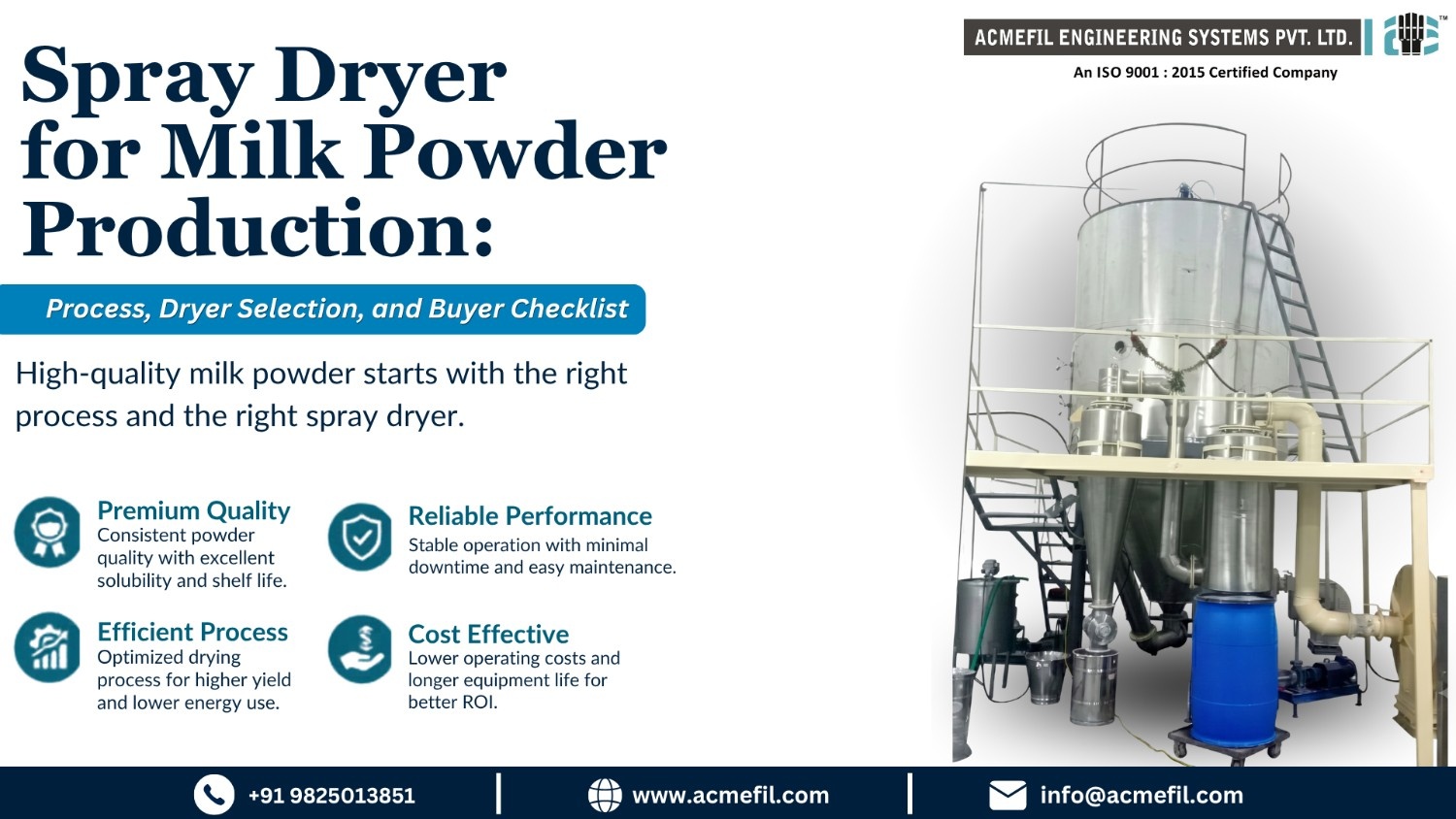
Spray Dryer for Milk Powder Production
A spray dryer for milk powder should not be selected only by chamber size or quoted evaporation capacity. In dairy powder production, the real selection depends on feed solids, viscosity, fat content, heat sensitivity, atomization method, air flow pattern, powder recovery, and the final powder specification. If these inputs are not studied properly, the plant may dry milk, but it may not produce stable powder with the required solubility, moisture, bulk density, and handling behaviour.
I treat milk powder spray drying as a complete process line, not as one standalone machine.
The spray dryer is important, but the quality of the powder is also influenced by what happens before and after the drying chamber.
What does a spray dryer do in milk powder production?
A spray dryer converts concentrated liquid milk into dry powder by atomizing the feed into fine droplets and drying those droplets with hot filtered air.
The basic process has four stages:
- Atomization of concentrated milk into fine droplets
- Contact between the droplets and hot drying air
- Rapid moisture evaporation inside the drying chamber
- Separation of dried milk powder from exhaust air
For dairy plants, this matters because milk is heat-sensitive. The objective is not just to remove water. The objective is to remove water while controlling powder quality.
A good milk powder drying system must support:
- Consistent final moisture
- Good solubility during reconstitution
- Controlled particle size
- Stable bulk density
- Reduced wall deposition
- Hygienic product handling
- Reliable powder recovery
- Practical cleaning and maintenance access
For a broader foundation, you can also read our guide on how a spray dryer works and the technical overview of spray dryer design and components.
Why milk powder production starts before the spray dryer
One mistake I see in spray dryer discussions is that buyers start directly with the drying chamber.
That is too late in the process.
Milk powder production normally starts with feed preparation and concentration. The spray dryer should not receive raw liquid milk directly. The feed usually passes through standardization, heat treatment, and evaporation before it enters the dryer.
A simplified process flow looks like this:
| Process Stage | Purpose | Why It Matters for Dryer Selection |
|---|---|---|
| Milk standardization | Adjust solids and fat level | Changes viscosity, drying behaviour, and final powder properties |
| Heat treatment | Improve microbial and functional control | Affects protein condition, flavour, and powder application |
| Evaporation | Increase feed solids before drying | Reduces the water load on the spray dryer |
| Atomization | Convert concentrate into droplets | Controls drying rate, particle size, and powder morphology |
| Drying chamber operation | Evaporate moisture using hot air | Controls final moisture, thermal exposure, and wall deposition risk |
| Powder separation | Recover powder from air stream | Affects yield, emissions, and housekeeping |
| Cooling and post-drying | Stabilize powder before packing | Reduces caking and improves powder handling |
Acmefil also manufactures multi-effect evaporators used for concentration duties, including milk concentrate from low solids to higher solids before drying. This matters because water removed in an evaporator can reduce the load on the spray dryer and improve the energy balance of the overall plant.
Why spray drying is preferred for milk powder
Spray drying is preferred for milk powder because it gives fast moisture removal with short product exposure time.
The droplets meet hot air, but evaporation cools the droplet surface during the critical drying phase. That is why spray drying is widely used for dairy powders, food ingredients, whey powder, dairy whitener, lactose, proteins, and heat-sensitive food applications.
For dairy processors, the main advantages are practical:
- Liquid milk can be converted into a stable dry powder.
- Powder is easier to store, transport, and dose into food formulations.
- Particle size and solubility can be influenced through atomization and drying conditions.
- Powder recovery can be integrated with cyclone and bag filter systems.
- The plant can be designed for continuous production.
But spray drying is not automatically successful just because the technology is widely used. Poor feed characterization, wrong atomizer selection, unstable outlet moisture, or weak air distribution can create serious operating problems.
For comparison with other food drying methods, see spray drying vs drum drying in the food industry and the broader guide on the benefits of using a spray dryer in food processing.
Which spray dryer type is suitable for milk powder?
The right spray dryer for milk powder depends on the product and target powder properties.
A skim milk powder line, whole milk powder line, whey powder line, dairy whitener line, and specialty food ingredient line do not behave exactly the same way. Fat content, total solids, viscosity, heat sensitivity, and required particle structure all affect the dryer design.
Rotary atomizer spray dryer
A rotary atomizer uses a high-speed rotating disc to break the feed into fine droplets by centrifugal force.
In Acmefil’s rotary disc type spray dryer design, droplet size control is achieved through disc selection and atomizer speed. The verified droplet range for Acmefil rotary disc spray dryers is generally 20 to 75 microns, depending on the disc and operating condition.
This configuration is useful when the plant needs flexible feed handling and controlled droplet generation. It is often considered for food, dairy, dyes, ceramics, pharmaceuticals, detergents, pigments, and inorganic chemical applications.
Read more about rotary atomizer type spray dryers and our internal comparison of nozzle vs rotary atomizer spray dryers.
Nozzle atomizer spray dryer
A nozzle atomizer uses pressure or compressed air to break the feed into droplets.
Acmefil’s nozzle type spray dryer includes pressure nozzle atomization and two-fluid nozzle atomization. Pressure nozzle systems pump feed through an orifice, while two-fluid nozzle systems use compressed air for atomization.
For milk powder and related dairy ingredients, nozzle selection depends on:
- Feed viscosity
- Feed solids
- Desired particle behaviour
- Required powder morphology
- Pumping pressure
- Orifice selection
- Cleaning access
Nozzle systems can be useful when pressure-based droplet formation and defined particle characteristics are required.
Read more about nozzle atomizer type spray dryers and our guide to spray dryer atomization techniques.
Fluidized spray dryer
A fluidized spray dryer is useful when the target is a larger or more agglomerated powder particle.
Acmefil’s fluidized spray dryer is designed to produce larger particles in the range of 50 to 150 microns. Moist powder is dried in an integrated fluid bed at the bottom of the drying chamber, fines can be recycled back to the drying chamber, and tertiary drying can be used where further particle size increase is required.
For dairy powders, this becomes relevant when the buyer is not only asking for “dry milk powder” but also cares about:
- Instant properties
- Flowability
- Bulk density
- Reduced dusting
- Better handling during packing
- Better reconstitution behaviour
Read more about fluidized spray dryers.
Spray dryer selection table for milk powder buyers
| Buyer Requirement | Better Starting Point | What to Verify Before Final Selection |
|---|---|---|
| Standard milk powder production | Rotary or nozzle spray dryer | Feed solids, viscosity, fat level, powder moisture target |
| Fine and consistent powder | Rotary atomizer or nozzle system | Droplet size, outlet moisture, powder recovery system |
| Larger or agglomerated particles | Fluidized spray dryer | Target particle size, fines recycling, post-drying requirement |
| R&D or new dairy formulation | Pilot spray dryer | Feed behaviour, stickiness, solubility, powder handling |
| Heat-sensitive dairy ingredient | Carefully controlled spray drying system | Product temperature exposure, outlet moisture, residence time |
| High powder recovery requirement | Chamber plus cyclone/bag filter system | Separation efficiency, housekeeping, filter design |
| Scale-up from trial to production | Pilot trial followed by full design | Repeatability of feed and powder behaviour |
The best decision is not “rotary is always better” or “nozzle is always better.” The correct answer depends on what powder you want to make.
For a complete buyer-level framework, see choosing the right spray dryer.
Why feed concentration is critical before drying
Milk has too much water to send directly into a spray dryer in most industrial powder projects. Pre-concentration reduces the water load before the dryer.
This matters for three reasons.
First, it affects operating cost. If the spray dryer has to remove unnecessary water, the hot air system, chamber size, and energy load increase.
Second, it affects powder quality. Feed solids influence droplet behaviour, drying speed, viscosity, and stickiness.
Third, it affects dryer stability. A feed that changes concentration during production can create inconsistent outlet moisture and powder properties.
Acmefil’s multi-effect evaporator range includes applications where milk concentrate is taken from approximately 8 to 10 percent solids up to around 45 percent concentration. The exact target for a project must be confirmed from the dairy product, recipe, and powder specification.
Common milk powder spray drying problems
A milk powder spray dryer can run, but still fail commercially if powder quality is unstable.
These are the problems I would investigate first:
| Problem | Likely Area to Check | Why It Happens |
|---|---|---|
| Powder sticks to chamber wall | Feed solids, outlet moisture, air distribution | Droplets remain sticky before they reach the correct dryness |
| Powder has poor solubility | Heat treatment, drying profile, particle structure | Protein condition and particle morphology are not matching the product target |
| Powder moisture fluctuates | Feed flow, inlet air, outlet temperature, control logic | Process variables are not stable |
| Excess fines | Atomization, air flow, separation system | Droplet size or powder recovery design may not match the target |
| Caking during storage | Final moisture, cooling, packing conditions | Powder may not be cooled or stabilized properly before packing |
| Low powder recovery | Cyclone, bag filter, air flow balance | Fine powder may be escaping or depositing inside the system |
| Scorched flavour | Thermal exposure, hot air profile, residence time | Product may be exposed to unsuitable temperature conditions |
| Frequent cleaning shutdowns | Chamber deposition, feed stickiness, hygiene design | Dryer and feed system may not be matched to the product |
For operating stability, also review spray dryer operating principles and best practices and spray dryer troubleshooting common issues.
What data should you share before asking for a milk powder spray dryer quote?
A serious spray dryer quote cannot be prepared from the phrase “milk powder plant required.”
A technical team needs feed and powder data.
Before asking for a quote, prepare these details:
| RFQ Detail | Why It Matters |
|---|---|
| Type of milk or dairy feed | Skim milk, whole milk, whey, dairy whitener, lactose, protein, or other ingredient behaves differently |
| Feed solids before drying | Determines water evaporation load |
| Feed viscosity | Affects pump selection, atomization, and droplet behaviour |
| Fat content | Influences stickiness, flavour, powder handling, and cleaning approach |
| Target final moisture | Drives outlet condition and post-drying needs |
| Target particle size | Helps decide rotary, nozzle, or fluidized configuration |
| Required bulk density | Influences chamber design and agglomeration/post-drying logic |
| Solubility or instant property requirement | May require fluidized drying or fines return |
| Production capacity | Defines evaporation load and plant sizing |
| Utility availability | Steam, electricity, fuel, compressed air, and cooling requirements affect layout |
| Cleaning and hygiene expectation | Important for dairy applications and maintenance planning |
| Packaging method | Powder cooling and handling must match packing conditions |
This is why I recommend process-led evaluation before equipment selection. A spray dryer is not a catalogue item for dairy powder production.
When should a pilot trial be done?
A pilot trial is useful when the buyer is developing a new dairy powder, changing formulation, scaling from lab work, or trying to confirm whether the feed will dry properly.
Acmefil has a pilot spray dryer with 3 kg/hr water evaporation capacity. The same R&D centre also includes pilot equipment for spin flash dryer, vibratory fluid bed dryer, and flash dryer trials at 10 kg/hr water evaporation capacity.
For milk powder and dairy ingredients, a pilot spray dryer trial can help evaluate:
- Whether the feed atomizes properly
- Whether the powder sticks to the chamber
- Whether the final powder meets moisture expectations
- Whether the powder is too fine or too dusty
- Whether a rotary, nozzle, or fluidized configuration is more suitable
- Whether post-drying or cooling is required
- Whether full-scale design assumptions are realistic
This does not replace dairy QA validation. But it reduces technical uncertainty before investing in a full-scale system.
See Acmefil’s pilot spray dryer and our SprayDryer.com guide on spray dryer for small-scale production.
What should a complete milk powder spray drying system include?
A complete milk powder spray drying system may include more than the dryer chamber.
Depending on the project, the system can include:
- Feed preparation tank
- Feed pump
- Pre-filtration or feed conditioning
- Multi-effect evaporator for concentration
- Hot air generator or air heating system
- Air filtration system
- Atomizer or nozzle assembly
- Drying chamber
- Cyclone separator
- Bag filter
- Fluid bed or cooling system
- Powder collection and conveying
- Control panel and instrumentation
- Cleaning access and hygienic design provisions
The exact scope should be frozen only after product trials, utility review, layout review, and final powder specification.
For design understanding, refer to spray dryer design and components and optimize spray drying parameters.
How to avoid wrong dryer selection for milk powder
The wrong dryer selection usually comes from one of these assumptions:
- Assuming all milk powders behave the same
- Selecting only by evaporation capacity
- Ignoring feed concentration before drying
- Treating atomizer choice as a minor detail
- Not defining final powder properties before buying
- Ignoring wall deposition and cleaning access
- Skipping pilot trials for uncertain products
- Not checking utilities before finalizing the offer
If the buyer wants only a budget number, many vendors can quote quickly. If the buyer wants a working plant, the feed data and final powder requirement must come first.
Practical selection framework
Use this sequence before finalizing a spray dryer for milk powder:
- Define the powder: skim milk powder, whole milk powder, whey powder, dairy whitener, lactose, protein, or specialty ingredient.
- Define the powder quality: moisture, solubility, bulk density, particle size, and packing behaviour.
- Define the feed: solids, viscosity, fat content, temperature, and stability.
- Decide the concentration step: evaporator duty before the spray dryer.
- Select atomization: rotary disc, pressure nozzle, or two-fluid nozzle.
- Decide whether fluidized drying is needed.
- Check powder recovery: cyclone, bag filter, and fines handling.
- Confirm utility load: fuel, steam, electricity, compressed air, and cooling.
- Run a pilot trial if the product is new or technically uncertain.
- Finalize layout, controls, cleaning access, and maintenance scope.
This sequence gives a better result than starting with “send me your standard milk powder spray dryer model.”
Why work with Acmefil for dairy spray drying projects?
Acmefil Engineering Systems Pvt. Ltd. is an ISO 9001:2015 certified manufacturer of drying and concentrating equipment, incorporated in 2000 and headquartered in Ahmedabad, Gujarat.
For dairy and food processors, the relevant strength is the combination of spray drying, evaporation, fluid bed drying, powder recovery, pilot testing, and turnkey engineering support.
Acmefil’s verified spray drying portfolio includes:
- Rotary disc type spray dryers
- Nozzle type spray dryers
- Fluidized spray dryers
- Closed loop and sterile spray dryers for applicable process needs
- Lab scale pilot spray dryer
- Rotary atomizers
- Spray nozzles
- Air lock rotary valves
- Hot air generators
- Bag filters and powder separation systems
The company’s application experience includes milk products, egg products, food colours, beverages, food additives, vegetable proteins, herbal extracts, malto dextrine, soup mixes, enzymes, lactose, protein, hemoglobin, and dextrose.
That does not mean every dairy product uses the same system. It means the discussion can start from process behaviour instead of a generic machine list.
Final technical note
A spray dryer for milk powder is successful only when feed preparation, evaporation, atomization, drying, powder recovery, cooling, and packaging are designed as one connected process.
If you are planning a milk powder, whey powder, dairy whitener, lactose, protein, or specialty dairy ingredient project, do not finalize the dryer only from catalogue capacity. Share the feed properties and final powder specification first. That is the only reliable way to decide whether your project needs a rotary atomizer spray dryer, nozzle atomizer spray dryer, fluidized spray dryer, pilot trial, or evaporator-integrated system.
FAQs
What is a spray dryer for milk powder?
A spray dryer for milk powder is an industrial drying system that converts concentrated liquid milk into dry powder. It atomizes the milk concentrate into fine droplets, contacts those droplets with hot drying air, evaporates moisture quickly, and separates the dried powder from the exhaust air using recovery equipment such as cyclones or bag filters.
Which spray dryer is best for milk powder production?
There is no single best spray dryer for every milk powder project. Rotary atomizer, nozzle atomizer, and fluidized spray dryer designs can all be suitable depending on feed solids, viscosity, fat content, target particle size, final moisture, solubility, bulk density, and whether agglomerated or instant powder properties are required.
Why is milk concentrated before spray drying?
Milk is concentrated before spray drying to reduce the amount of water the spray dryer must remove. This reduces evaporation load, improves process economics, and helps stabilize dryer operation. In many dairy projects, evaporation before spray drying is one of the most important steps in total plant performance.
What causes sticking in milk powder spray dryers?
Sticking usually happens when droplets or powder remain sticky inside the chamber. Common causes include unsuitable feed concentration, high outlet moisture, unstable feed flow, poor air distribution, wrong atomization, or product behaviour linked to fat, sugar, or solids composition. A pilot trial helps identify this risk before full-scale design.
Can Acmefil run pilot trials for milk powder spray drying?
Yes. Acmefil has a pilot spray dryer with 3 kg/hr water evaporation capacity for product trials and process development. For milk powder, whey powder, dairy whitener, and specialty food ingredients, pilot testing can help check atomization, drying behaviour, powder stickiness, moisture control, and scale-up assumptions before full-scale procurement.
Planning a milk powder spray dryer project?
Share your feed solids, viscosity, product type, target final moisture, particle size requirement, bulk density target, utility details, and expected production capacity with Acmefil’s technical team. The team can evaluate whether your project needs a rotary atomizer spray dryer, nozzle atomizer spray dryer, fluidized spray dryer, pilot trial, or evaporator-integrated system.

Siddharth Nair is Technical Director at Acmefil Engineering Systems Pvt. Ltd. he leads solution design and applications engineering across the company’s full product range — spray dryers, multi-effect evaporators, agitated thin film dryers, spin flash dryers, fluid bed dryers, and complete ZLD systems.
His work spans process evaluation, equipment sizing, customer application consulting, and technical proposal development for industries including food and dairy, pharmaceuticals, chemicals, dyestuffs, ceramics, and industrial effluent treatment. He has hands-on commissioning experience across Acmefil’s 500+ installations in India and 15+ countries.
He holds a BTech in Mechanical Engineering from CHARUSAT University and also partners at A.S Engineers, working with blowers, sludge dryers, and industrial conveying systems.


