
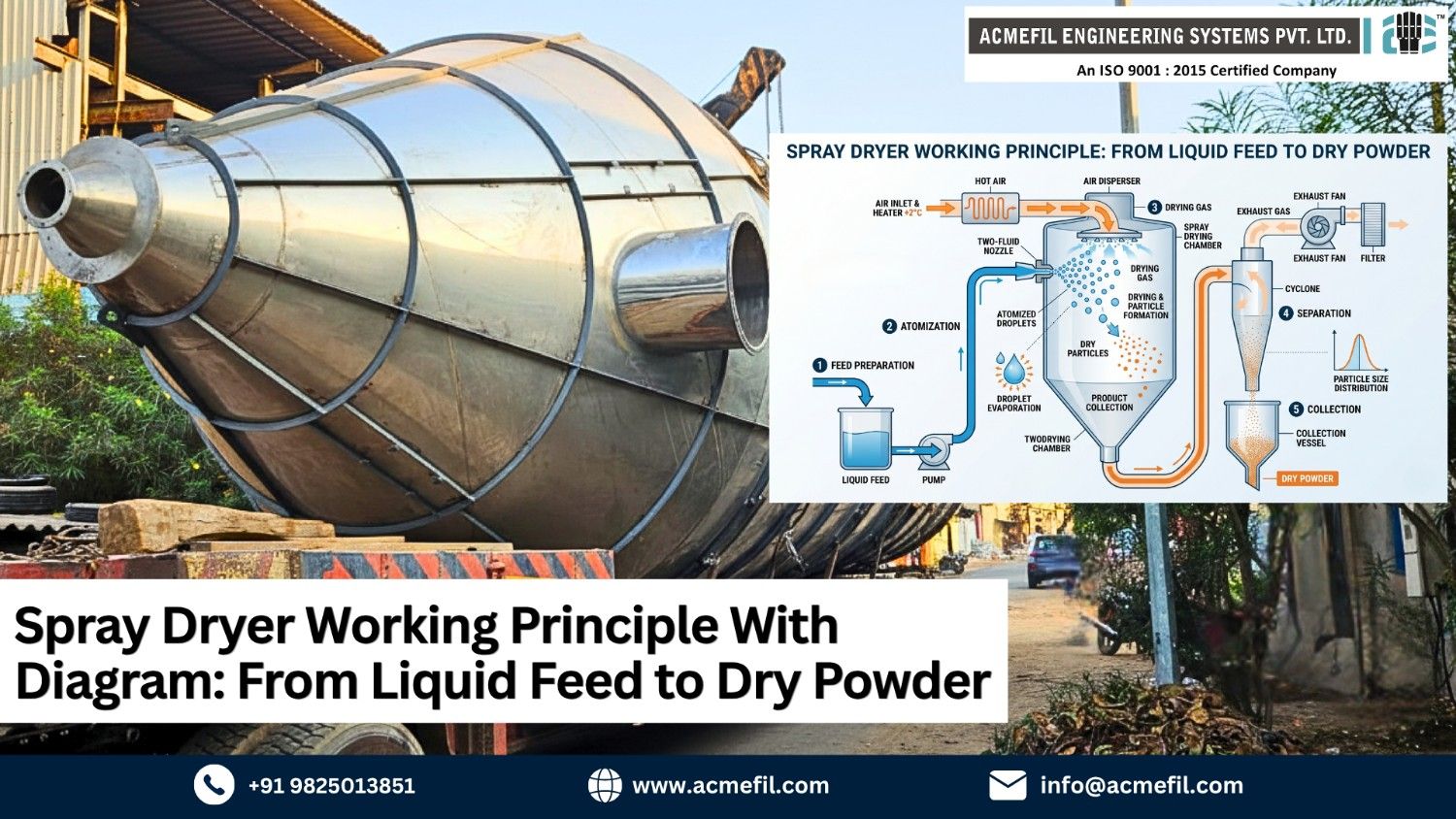
The spray dryer working principle is simple to understand: a pumpable liquid feed is atomized into fine droplets, contacted with hot drying air, dried while suspended inside the chamber, and then separated as dry powder from the exhaust air.
The real engineering challenge is not the definition. It is controlling droplet size, feed solids, inlet temperature, outlet temperature, residence time, powder separation, and wall deposition so the final powder meets the required moisture, particle size, bulk density, and flow behaviour.
In this guide, I will explain the spray dryer working principle with diagram, process flow, main components, and the selection mistakes buyers should avoid before ordering a full-scale spray dryer.
Spray Dryer Working Principle With Diagram
A spray dryer converts a liquid, slurry, emulsion, suspension, or solution into powder in one continuous operation. The feed must first be pumpable. It is then atomized into droplets, dried by hot air, and collected as powder.
Basic spray dryer process flow:
Liquid Feed Tank → Feed Pump → Atomizer → Hot Air Distributor → Drying Chamber → Cyclone Separator → Bag Filter → Powder Collection → Exhaust Air
| Diagram Label | Equipment / Stage | What Happens Inside the Spray Dryer |
|---|---|---|
| 1 | Feed tank | Liquid feed, slurry, or emulsion is prepared and held before drying. |
| 2 | Feed pump | Feed is delivered at the required flow rate and pressure. |
| 3 | Atomizer | The feed is broken into fine droplets using a rotary atomizer, pressure nozzle, or two-fluid nozzle. |
| 4 | Hot air generator / air heater | Air is heated to the required process temperature. |
| 5 | Air distributor | Hot air is distributed uniformly into the drying chamber. |
| 6 | Drying chamber | Droplets contact hot air and moisture evaporates rapidly. |
| 7 | Cyclone separator | Most dry powder is separated from the air stream. |
| 8 | Bag filter | Fine powder is recovered and exhaust air is cleaned. |
| 9 | Rotary airlock / collection system | Powder is discharged without disturbing system air balance. |
| 10 | Exhaust fan | Moist exhaust air is pulled out of the system. |
A simple diagram can show the equipment layout, but it cannot show the most important design decisions. For that, you need feed data, target powder properties, and operating conditions.
How Does a Spray Dryer Work Step by Step?
A spray dryer works through four main process stages: atomization, spray-air contact, drying, and powder separation. In practical plant design, I also treat feed preparation and exhaust handling as critical stages because both can affect powder quality.
1. Feed Preparation
The spray dryer starts with the feed. This may be a solution, slurry, suspension, emulsion, extract, concentrate, or other pumpable liquid.
Before drying, the feed must be checked for:
- Solids percentage
- Viscosity
- Pumpability
- Heat sensitivity
- Abrasive content
- Stickiness tendency
- Target moisture
- Required particle size
- Solvent type, if not water
This is where many spray dryer problems begin. If the feed is not characterized properly, the atomizer selection and chamber design become guesswork. A feed that looks simple in a beaker can behave very differently under atomization.
For example, a ceramic slurry, food colour solution, polymer emulsion, and dyestuff slurry may all be “liquid feeds,” but they do not atomize or dry in the same way.
2. Atomization of Feed Into Droplets
Atomization is the heart of the spray dryer working principle. The feed is broken into small droplets so that moisture can evaporate quickly.
Smaller droplets dry faster because they have more surface area exposed to hot air. Larger droplets need more residence time and may produce larger particles.
Industrial spray dryers mainly use three atomization methods:
| Atomizer Type | How It Works | Typical Use Case |
|---|---|---|
| Rotary atomizer | Feed is thrown from a high-speed rotating disc by centrifugal force. | Useful for many slurries and applications where droplet size control is important. |
| Pressure nozzle | Feed is pumped through a nozzle orifice under pressure. | Suitable where pressure atomization and specific particle characteristics are required. |
| Two-fluid nozzle | Compressed air helps atomize the liquid feed. | Useful for finer atomization, pilot trials, and selected low-capacity or specialty applications. |
On SprayDryer.com, you can also refer to the detailed guide on spray dryer atomization techniques for deeper atomizer selection.
3. Spray-Air Contact Inside the Drying Chamber
After atomization, the droplets enter the drying chamber and meet hot air. This contact between droplets and hot air decides the rate of evaporation.
The goal is to dry the droplets fast enough to form powder, but not so aggressively that the material sticks, degrades, discolours, or loses functional properties.
The spray-air contact pattern may be:
| Airflow Pattern | Meaning | Practical Note |
|---|---|---|
| Co-current flow | Droplets and hot air move in the same direction. | Common for heat-sensitive products because the wet droplet first meets the hottest air and evaporation helps protect the product surface. |
| Counter-current flow | Droplets and hot air move in opposite directions. | Can improve thermal efficiency, but requires careful review for heat-sensitive powders. |
| Mixed flow | Combination of air and spray movement patterns. | Used when product behaviour, chamber geometry, or process requirement demands it. |
For most industrial buyers, airflow pattern should not be selected from a catalogue diagram. It should be selected from product behaviour and powder target.
4. Moisture Evaporation and Particle Formation
As droplets travel through the hot air stream, water or solvent evaporates from the droplet surface. The droplet gradually becomes a particle.
This drying stage decides several powder properties:
- Final moisture
- Particle size
- Particle shape
- Bulk density
- Flowability
- Solubility
- Stickiness
- Thermal exposure
A common buyer mistake is to focus only on inlet temperature. Inlet temperature matters, but outlet temperature is often the more useful indicator of final drying condition because it reflects the actual thermal and moisture balance near the product exit.
If the outlet temperature is too low, powder may leave wet. If it is too high, sensitive products may degrade, discolor, or lose activity.
For process tuning, the guide on how to optimize spray drying parameters is a useful next read.
5. Powder Separation From Exhaust Air
After drying, powder must be separated from the air stream. This is normally done using a cyclone separator, bag filter, or a combination of both.
The cyclone collects the main powder fraction. The bag filter captures finer particles that would otherwise leave with exhaust air.
Poor separation design can cause:
- Powder loss
- Low yield
- Dust emission
- Frequent filter choking
- Product contamination risk
- Inconsistent collection efficiency
In industrial spray dryers, powder recovery is not a secondary detail. It directly affects yield, housekeeping, operating cost, and environmental control.
6. Powder Discharge and Collection
Once separated, powder is discharged through a rotary airlock or suitable discharge system. The discharge system must remove powder without allowing uncontrolled air leakage into or out of the system.
This matters because spray dryers depend on controlled airflow. A poorly selected airlock can disturb pressure balance, reduce collection efficiency, or create dust leakage near the discharge point.
Main Components of a Spray Dryer and Their Functions
A spray dryer is not just a chamber and atomizer. It is a complete process system. Each component has a role in drying performance.
| Component | Function | Buyer’s Checkpoint |
|---|---|---|
| Feed tank | Stores and conditions feed before drying. | Confirm agitation, feed uniformity, and solids settling behaviour. |
| Feed pump | Transfers feed to the atomizer. | Check flow range, pressure, material compatibility, and cleanability. |
| Atomizer | Converts feed into droplets. | Match atomizer type with feed viscosity, solids, target particle size, and capacity. |
| Hot air generator | Produces hot drying air. | Decide direct-fired or indirect-fired based on product sensitivity and contamination risk. |
| Air distributor | Distributes hot air into the chamber. | Poor air distribution can cause wall deposition and uneven drying. |
| Drying chamber | Provides residence time for drying. | Chamber size and geometry must match droplet size and drying load. |
| Cyclone separator | Separates powder from exhaust air. | Important for yield and particle recovery. |
| Bag filter | Captures fines and cleans exhaust air. | Check filter media, cleaning method, and dust load. |
| Exhaust fan | Maintains airflow through the system. | Fan sizing affects system pressure, drying stability, and powder carryover. |
| Control panel | Controls temperature, feed rate, airflow, and safety interlocks. | Automation level should match process sensitivity and operator skill. |
| Rotary airlock | Discharges powder while maintaining air seal. | Leakage or wrong sizing can disturb system balance. |
For a broader equipment-level view, see the SprayDryer.com guide on spray dryer design and components.
What Controls Spray Dryer Performance?
In my experience, buyers often ask for spray dryer capacity first. Capacity is important, but it is not enough. Two spray dryers with the same evaporation capacity can produce very different powder if the feed and atomization behaviour are different.
The most important performance controls are below.
Droplet Size
Droplet size affects drying time, particle size, and powder behaviour. Fine droplets dry faster but may create more fines. Larger droplets can improve flowability but need more residence time.
Rotary atomizers and nozzle atomizers create different droplet patterns. This is why atomizer selection should be based on feed trials or proven application data, not only on brochure preference.
Inlet and Outlet Temperature
The inlet temperature is the hot air temperature entering the chamber. The outlet temperature is the air and product environment near the exit.
Both matter. But for product quality, outlet temperature often deserves closer attention because it is connected to final moisture and product exposure.
For heat-sensitive products like food colours, enzymes, herbal extracts, pharmaceutical intermediates, or flavours, temperature selection needs careful evaluation.
Residence Time
Residence time is the time droplets or particles remain inside the drying zone.
If residence time is too short, powder may leave wet. If it is too long, the product may overheat, stick to the chamber wall, or degrade.
Residence time is influenced by:
- Chamber height and diameter
- Droplet size
- Air velocity
- Feed rate
- Drying load
- Airflow pattern
- Powder separation system
Feed Solids and Viscosity
Higher feed solids can improve drying economy because less water must be evaporated per kilogram of final powder. But high solids can also increase viscosity and make atomization difficult.
Low-solids feed may atomize easily but increases evaporation load and operating cost.
This is why feed concentration should be optimized before final sizing.
Stickiness and Wall Deposition
Sticky powders are difficult in spray drying. Wall deposition reduces yield, increases cleaning frequency, and can cause product degradation if deposits remain exposed to heat.
Sticky behaviour is common in some food, sugar-rich, polymer, resin, and chemical feeds. The design must account for glass transition behaviour, outlet temperature, airflow, chamber surface, and collection method.
Powder Separation Efficiency
A good dryer does not only make powder. It must recover it efficiently.
If too much powder escapes the cyclone and reaches the bag filter, the system may face high filter load, frequent cleaning, and yield loss. If powder is too fine, cyclone design becomes even more important.
Rotary Atomizer vs Nozzle Atomizer in Spray Dryer Working
Atomizer selection changes the entire drying behaviour. This decision should be made early because it affects chamber design, particle size, powder recovery, and cleaning.
| Selection Factor | Rotary Atomizer | Pressure Nozzle | Two-Fluid Nozzle |
|---|---|---|---|
| Atomization energy | Centrifugal force from rotating disc | Feed pressure through orifice | Compressed air plus liquid flow |
| Capacity range | Often used for industrial capacities | Suitable for many production systems | Common in pilot and selected specialty applications |
| Droplet control | Controlled by disc design and speed | Controlled by pressure, orifice, and feed properties | Controlled by air-liquid ratio and nozzle setup |
| Feed suitability | Useful for many slurries and feeds requiring flexible droplet control | Useful when pressure atomization fits product target | Useful for finer atomization and smaller flow rates |
| Maintenance focus | Disc, drive, balance, and wear | Nozzle wear and choking | Air supply, nozzle wear, and cleaning |
| Buyer mistake | Selecting only because it is familiar | Ignoring feed pressure and nozzle choking risk | Ignoring compressed air cost and scale-up limits |
A rotary atomizer is not automatically better than a nozzle atomizer. A nozzle atomizer is not automatically more precise for every product. The correct choice depends on feed behaviour and required powder properties.
For comparison details, refer to nozzle vs rotary atomizer spray dryers.
Open Cycle, Closed Loop, and Sterile Spray Dryer Working
A normal open-cycle spray dryer uses heated air as the drying medium. This is suitable for many water-based products.
A closed-loop spray dryer uses an inert gas such as nitrogen and recirculates the drying gas. This type is considered when the feed contains solvent, oxidation-sensitive material, or other conditions that make open air drying unsuitable.
A sterile spray dryer is designed for pharmaceutical or aseptic applications where filtered air, hygienic design, and contamination control are critical.
The working principle remains atomization, drying, and separation. What changes is the drying medium, recovery system, safety design, filtration level, and control philosophy.
Industrial Applications of Spray Drying
Spray drying is used when a liquid feed must be converted into a powder with controlled moisture and particle characteristics.
Common applications include:
| Industry | Typical Spray Dried Products |
|---|---|
| Food and dairy | Milk powder, food colours, beverages, food additives, vegetable proteins, soup mixes, enzymes |
| Pharmaceuticals and biochemicals | Herbal extracts, proteins, dextrose, lactose, selected heat-sensitive products |
| Dyestuff and pigments | Reactive dyes, disperse dyes, acid dyes, direct dyes, pigments, dye intermediates |
| Ceramics | Alumina, china clay, ferrites, zirconia, glass slurry, ceramic powders |
| Detergents | Detergent powders, zeolite, SLS, bleach activators |
| Polymers and resins | Acrylic polymer, PVA, melamine-formaldehyde, urea-formaldehyde |
| Inorganic chemicals | Sodium silicate, calcium chloride, silica, catalysts, manganese sulphate |
The same spray dryer diagram may look similar across industries, but the design requirement changes with the product. A milk powder dryer, ceramic slurry dryer, dyestuff dryer, and pharmaceutical dryer should not be evaluated with the same assumptions.
Common Mistakes When Reading a Spray Dryer Diagram
A spray dryer diagram is helpful, but it can also mislead buyers if they treat it as a complete design.
Here are the most common mistakes I see in technical discussions.
Mistake 1: Looking Only at Capacity
Capacity tells you how much water can be evaporated. It does not tell you whether the powder will meet particle size, moisture, solubility, or flow requirements.
A 500 kg/hr water evaporation dryer is not automatically suitable for every 500 kg/hr duty.
Mistake 2: Ignoring Feed Properties
Feed properties decide atomization. Atomization decides drying. Drying decides powder quality.
If viscosity, solids percentage, heat sensitivity, and stickiness are not reviewed, the proposal is incomplete.
Mistake 3: Selecting Atomizer Type Too Early
Many buyers ask for rotary or nozzle type before sharing feed data. That is backwards.
First define the feed and powder target. Then select the atomization system.
Mistake 4: Underestimating Separation System Design
The cyclone and bag filter are not accessories. They decide powder recovery, emission control, and housekeeping.
Fine powders need careful separation design.
Mistake 5: Not Planning Pilot Trials for New Products
For new products, uncertain feeds, or export-grade powder requirements, pilot trials can reduce scale-up risk.
Acmefil’s pilot spray dryer facility is available for trials at 3 kg/hr water evaporation capacity. For buyers who are unsure about atomizer selection, powder stickiness, temperature window, or product recovery, a pilot run is often more useful than theoretical discussion.
You can review the pilot spray dryer facility for trial-based evaluation.
What Data Should You Share Before Asking for a Spray Dryer Proposal?
A serious spray dryer proposal needs process data. Without it, the manufacturer can only give a broad estimate.
Before asking for a quote, prepare the following:
| Data Required | Why It Matters |
|---|---|
| Product name and application | Helps identify industry-specific drying risks. |
| Feed type | Solution, slurry, suspension, emulsion, extract, or concentrate. |
| Feed solids percentage | Determines evaporation load and powder output. |
| Feed viscosity | Affects pump and atomizer selection. |
| Feed temperature | Affects heat balance and drying load. |
| Heat sensitivity | Controls inlet and outlet temperature selection. |
| Target final moisture | Defines drying endpoint. |
| Required particle size | Influences atomizer and chamber design. |
| Bulk density target | Important for packaging, handling, and reconstitution. |
| Solvent details | Decides open-cycle or closed-loop design. |
| Required MOC | SS 304, SS 316, or other material based on product compatibility. |
| Cleaning requirement | Important for food, pharma, and colour-change applications. |
| Operating hours | Helps estimate duty and utility requirement. |
If you are comparing suppliers, ask each one how they used this data in their design. A vague answer is a warning sign.
When Spray Drying May Not Be the Right Choice
Spray drying is powerful, but it is not suitable for every wet material.
It may not be the best option when:
- The feed is not pumpable
- The material is a wet cake or paste
- The feed has very high viscosity
- The product needs long residence time as a solid
- The powder is extremely sticky
- The solvent requires special safety handling
- The product cannot tolerate the required drying environment
For filter cakes, pastes, and gelatinous feeds, a spin flash dryer, flash dryer, fluid bed dryer, or another drying technology may be more suitable. A good engineering discussion should include this possibility instead of forcing every product into a spray dryer.
Practical Selection Checklist
Use this checklist when reviewing a spray dryer working diagram or proposal.
| Question | Good Sign | Risk Sign |
|---|---|---|
| Is the feed fully characterized? | Solids, viscosity, temperature, and product behaviour are known. | Only product name and capacity are discussed. |
| Is atomizer type justified? | Selection is linked to feed and powder target. | Rotary or nozzle is selected without explanation. |
| Are inlet and outlet temperatures defined? | Temperature range is connected to product sensitivity and moisture target. | Only inlet temperature is mentioned. |
| Is powder separation explained? | Cyclone, bag filter, and recovery method are clear. | Separation system is treated as an afterthought. |
| Is cleaning considered? | CIP, access, or manual cleaning approach is discussed where relevant. | No cleaning or maintenance discussion. |
| Is pilot testing recommended when needed? | Trials are suggested for uncertain products. | Full-scale design is proposed without validation. |
Final Takeaway
The spray dryer working principle with diagram can be summarized in one line: liquid feed is atomized into droplets, dried by hot air inside a chamber, and recovered as powder through a separation system.
But a working spray dryer is not designed from a diagram alone. The design must match the feed, atomizer, chamber geometry, airflow, temperature window, separation system, cleaning method, and required powder quality.
If you are planning a new spray dryer project, start with the product data. The right technical discussion begins with the feed, not with the equipment price.
FAQs
What is the basic spray dryer working principle?
The basic spray dryer working principle is atomization, hot air drying, and powder separation. A liquid feed is pumped to an atomizer, converted into droplets, dried in hot air inside a chamber, and recovered as powder using a cyclone separator, bag filter, or combined recovery system.
What are the main parts shown in a spray dryer diagram?
A spray dryer diagram usually shows the feed tank, feed pump, atomizer, hot air generator, air distributor, drying chamber, cyclone separator, bag filter, exhaust fan, rotary airlock, and powder collection system. Each part affects drying stability, powder quality, and product recovery.
Why is atomization important in spray drying?
Atomization controls droplet size. Droplet size controls drying time, particle size, moisture removal, and powder behaviour. Poor atomization can cause wet powder, excess fines, wall deposition, inconsistent particle size, or low yield.
Which atomizer is better, rotary atomizer or nozzle atomizer?
Neither atomizer is universally better. A rotary atomizer is often useful for many slurry and industrial powder applications where flexible droplet control is needed. Pressure and two-fluid nozzles are useful where nozzle-based atomization fits the feed and particle target. The correct choice depends on feed properties and final powder requirements.
Can spray drying be used for heat-sensitive products?
Yes, spray drying can be used for many heat-sensitive products because moisture evaporation cools the droplet during the early drying stage. However, inlet temperature, outlet temperature, residence time, airflow pattern, and feed concentration must be selected carefully to avoid degradation, discolouration, or loss of activity.
If you are evaluating a spray dryer for a new powder project, do not finalize the design from a diagram alone. Share your feed properties, solids percentage, viscosity, target moisture, required particle size, heat sensitivity, and operating capacity. Acmefil can review the application and recommend whether a rotary atomizer, nozzle atomizer, fluidized spray dryer, closed-loop spray dryer, or pilot trial is the right next step.
For project discussion, use the SprayDryer.com contact page and send the available process data with your inquiry.

Siddharth Nair is Technical Director at Acmefil Engineering Systems Pvt. Ltd. he leads solution design and applications engineering across the company’s full product range — spray dryers, multi-effect evaporators, agitated thin film dryers, spin flash dryers, fluid bed dryers, and complete ZLD systems.
His work spans process evaluation, equipment sizing, customer application consulting, and technical proposal development for industries including food and dairy, pharmaceuticals, chemicals, dyestuffs, ceramics, and industrial effluent treatment. He has hands-on commissioning experience across Acmefil’s 500+ installations in India and 15+ countries.
He holds a BTech in Mechanical Engineering from CHARUSAT University and also partners at A.S Engineers, working with blowers, sludge dryers, and industrial conveying systems.


