
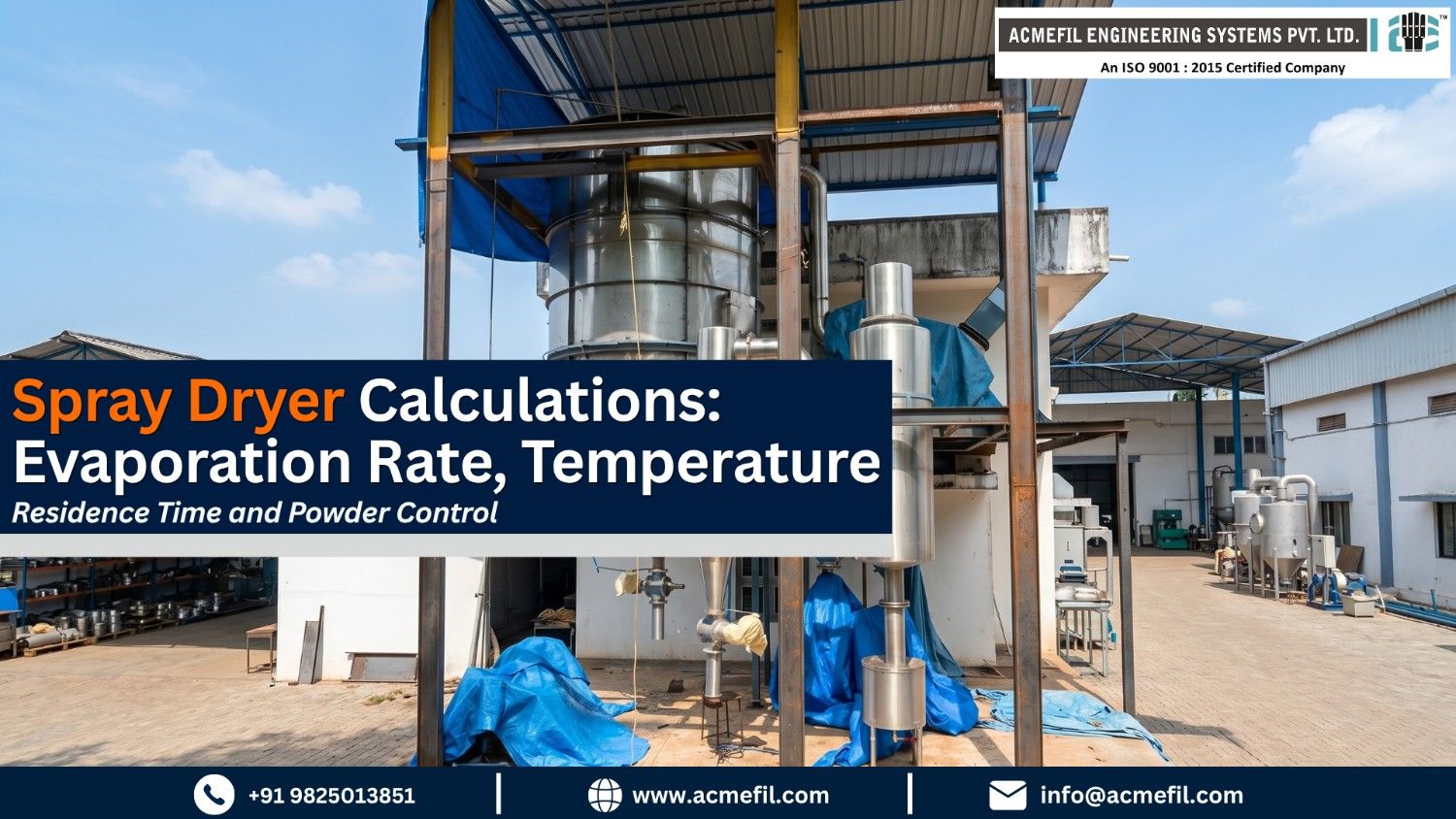
Spray dryer calculations should always start with water evaporation load, not just feed capacity. Feed rate, feed concentration, final powder moisture, inlet outlet temperature, residence time, atomizer type, feed viscosity and particle size target all work together. If one input is wrong, the dryer may produce wet powder, overheated powder, wall deposits, poor recovery or the wrong particle size.
In my experience, the biggest mistake buyers make is asking, “What is the spray dryer capacity?” before defining the feed solids and final moisture target. A 1,000 kg/hr feed at 20% solids and a 1,000 kg/hr feed at 50% solids are not the same dryer duty.
For a broader equipment overview, first read the spray dryer design and components guide and the spray dryer operating principles guide. This article focuses on the calculation logic behind sizing and process control.
What Are Spray Dryer Calculations?
Spray dryer calculations are the engineering calculations used to estimate how much water a dryer must remove, how much dry powder it will produce, how much hot air is needed, what inlet and outlet temperature window is practical, how long droplets need to stay inside the chamber, and how atomization affects final particle size.
A proper calculation normally includes:
| Calculation Area | What It Answers | Why It Matters |
|---|---|---|
| Material balance | How much powder and water are produced | Defines evaporation duty |
| Heat balance | How much thermal energy is needed | Sizes hot air system and fuel load |
| Airflow calculation | How much air is needed to remove moisture | Affects fan, ducting, cyclone and bag filter |
| Temperature profile | What inlet and outlet temperatures are safe | Controls drying rate and product quality |
| Residence time | Whether droplets have enough time to dry | Prevents wet powder and wall deposition |
| Atomization calculation | What droplet size is expected | Controls particle size, bulk density and drying time |
| Moisture control | How final powder moisture is held within target | Prevents sticky or over-dried product |
A spreadsheet can help with early estimation. It cannot replace pilot testing or detailed design for difficult feeds such as herbal extracts, detergent slurry, pigments, ceramic slurry, solvent-based feeds, hygroscopic powders or heat-sensitive pharmaceutical products.
Input Data Needed Before Spray Dryer Capacity Calculation
Before doing a spray dryer capacity calculation, collect these inputs:
| Input Data | Unit | Why It Is Needed |
|---|---|---|
| Feed rate | kg/hr | Defines total feed entering the dryer |
| Feed solids concentration | % w/w | Determines how much water must be evaporated |
| Initial moisture content | % | Used for mass balance |
| Target final powder moisture | % | Defines product specification |
| Feed viscosity | cP or qualitative range | Affects pumping, nozzle choking and atomizer selection |
| Feed temperature | °C | Affects heat duty |
| Product heat sensitivity | Qualitative or temperature limit | Controls inlet and outlet temperature window |
| Target particle size | micron or mesh | Drives rotary vs nozzle atomizer selection |
| Bulk density target | g/cc or kg/m³ | Affects atomization and agglomeration approach |
| Stickiness or hygroscopic nature | Yes or no | Affects chamber wall deposition and powder recovery |
| Solvent presence | Yes or no | May require closed loop spray drying |
| Required recovery system | Cyclone, bag filter, or both | Controls product loss and emission handling |
If the feed is not fully characterized, the calculation should be treated as a preliminary estimate only.
Spray Dryer Capacity Calculation: Start With Dry Solids
Spray dryer capacity is often misunderstood. The dryer is not sized only by total feed rate. It is sized mainly by water evaporation rate, heat load, airflow and drying kinetics.
Use this basic dry solids balance:
Dry solids, kg/hr = Feed rate × Feed solids fraction
Product powder rate, kg/hr = Dry solids ÷ (1 – Final moisture fraction)
Water evaporation rate, kg/hr = Feed rate – Product powder rate
Example: Basic Spray Dryer Capacity Calculation
Assume:
| Parameter | Value |
|---|---|
| Feed rate | 1,000 kg/hr |
| Feed concentration | 40% solids |
| Final powder moisture | 4% |
| Feed water | 60% |
Step 1: Calculate dry solids
Dry solids = 1,000 × 0.40 = 400 kg/hr
Step 2: Calculate final powder output
Product powder = 400 ÷ 0.96 = 416.7 kg/hr
Step 3: Calculate water evaporation rate
Evaporation rate = 1,000 – 416.7 = 583.3 kg/hr
So the dryer is not simply a “1,000 kg/hr spray dryer.” For design discussion, it is closer to a 583 kg/hr water evaporation duty before adding practical margins, product loss assumptions and air system considerations.
How Feed Concentration Changes Spray Dryer Evaporation Rate
Feed concentration has a direct effect on dryer size. Higher feed solids usually reduce evaporation load, but only if the feed can still be pumped and atomized correctly.
Using the same 1,000 kg/hr feed and 4% final moisture:
| Feed Solids | Dry Solids | Final Powder Output | Water Evaporation |
|---|---|---|---|
| 20% | 200 kg/hr | 208.3 kg/hr | 791.7 kg/hr |
| 30% | 300 kg/hr | 312.5 kg/hr | 687.5 kg/hr |
| 40% | 400 kg/hr | 416.7 kg/hr | 583.3 kg/hr |
| 50% | 500 kg/hr | 520.8 kg/hr | 479.2 kg/hr |
This is why spray dryer feed concentration matters so much. A higher solids feed can reduce evaporation duty, fuel load and air volume. But there is a limit. If feed viscosity becomes too high, atomization becomes poor. The dryer may then need larger droplets, longer residence time or a different atomizer.
For practical parameter tuning, also read how to optimize spray drying parameters.
Spray Dryer Evaporation Rate: The Main Sizing Number
Spray dryer evaporation rate is the amount of water removed per hour. In industrial spray drying, this number is usually more useful than total feed capacity.
A basic evaporation rate tells the designer:
- How much water must be removed
- How much thermal energy is required
- How much drying air is needed
- How large the hot air generator may need to be
- How much exhaust air must pass through the cyclone, bag filter and fan
- Whether the chamber volume is realistic for the droplet drying time
Early-stage evaporation calculation is useful. Final design still needs correction for:
- System heat losses
- Inlet air humidity
- Outlet air humidity
- Altitude and ambient condition
- Powder recovery losses
- Wall deposition risk
- Chamber insulation
- Actual product drying kinetics
A safe rule is this: evaporation rate gives direction, not final design approval.
Basic Heat Load Logic for Spray Dryer Calculations
After evaporation rate, the next calculation is heat duty.
A simplified heat duty includes:
Total heat duty = heat for water evaporation + heat for feed temperature rise + heat for dry solids temperature rise + system losses
For early discussion, water evaporation is the dominant load. But final heat duty changes with feed temperature, ambient humidity, insulation, exhaust losses and product temperature limit.
A practical engineering view is:
| Condition | Effect on Design |
|---|---|
| Higher evaporation load | Higher heat duty and air volume |
| Lower inlet temperature | More air may be needed for the same water removal |
| Higher outlet humidity limit | Airflow must be checked carefully |
| Heat-sensitive product | Lower temperature and higher air volume may be required |
| Sticky powder | Outlet temperature and wall temperature become critical |
| High feed viscosity | Atomization and residence time become critical |
For full system selection, heating method also matters. Direct-fired and indirect-fired hot air generators are not interchangeable for every product. Food, pharma, herbal extracts and contamination-sensitive materials may need stricter air quality and heat-source decisions.
Spray Dryer Inlet Outlet Temperature: How They Affect Moisture
Spray dryer inlet outlet temperature is one of the most important control areas.
Inlet temperature is the temperature of the hot drying air entering the chamber. Outlet temperature is the temperature of the exhaust air and powder leaving the drying zone.
In simple terms:
- Inlet temperature controls available drying energy.
- Outlet temperature is more closely linked to final powder moisture.
- Droplet size controls how quickly the feed dries.
- Residence time decides whether drying can finish before powder exits the chamber.
A higher inlet temperature does not automatically mean better drying. If the surface of the droplet dries too quickly, it can form a shell, trap internal moisture or create sticky deposits. If the outlet temperature is too low, powder may remain wet. If it is too high, heat-sensitive products may lose color, activity, aroma or quality.
Practical Temperature Control Table
| Problem Seen in Plant | Likely Temperature Link | What to Check First |
|---|---|---|
| Powder moisture too high | Outlet temperature too low or droplet size too large | Feed rate, outlet temperature, atomizer setting |
| Powder sticking to chamber | Product too sticky at chamber condition | Outlet temperature, feed solids, wall temperature |
| Powder overheated | Outlet temperature too high or residence too long | Air temperature, feed rate, chamber pattern |
| Low powder recovery | Fines escaping or poor separation | Cyclone, bag filter, airflow |
| Large wet particles | Atomization too coarse | Atomizer speed, nozzle pressure, viscosity |
| Fine dusty powder | Atomization too fine | Atomizer speed, feed rate, agglomeration requirement |
To troubleshoot quality problems in running plants, use the spray dryer troubleshooting guide.
Spray Dryer Residence Time: What It Really Means
Spray dryer residence time is the time available for atomized droplets or particles to dry inside the chamber before they exit into the recovery system.
A basic gas residence time estimate is:
Residence time, seconds = Chamber volume ÷ Air volumetric flow rate
This formula is useful, but it is not the full story. Droplet residence time and gas residence time are not always the same. Droplet path depends on atomizer type, spray angle, chamber geometry, airflow pattern, particle size, density and whether the dryer is co-current, counter-current or mixed flow.
Residence time affects:
- Final powder moisture
- Wall deposition
- Thermal exposure
- Particle morphology
- Powder recovery
- Bulk density
- Chamber size
Short residence time is one reason spray drying is suitable for many heat-sensitive materials. But if the droplet is too large or the feed is too sticky, short residence time can become a problem because the particle may leave the drying zone before internal moisture is removed.
Atomizer Speed and Particle Size
Atomizer speed and particle size are connected, but the relationship is not one simple formula for every product.
For a rotary atomizer, higher disc speed generally produces smaller droplets. Lower speed generally produces larger droplets. But feed flow rate, viscosity, surface tension, solids content, disc design and feed distribution also affect droplet formation.
A practical relationship looks like this:
| Change in Operating Factor | Common Effect on Droplet or Particle Size |
|---|---|
| Increase rotary atomizer speed | Smaller droplets, finer powder |
| Decrease rotary atomizer speed | Larger droplets, coarser powder |
| Increase feed viscosity | Larger droplets, harder atomization |
| Increase feed flow rate per atomizer | Larger droplets if atomizer limit is approached |
| Increase feed solids | Can increase particle density or change morphology |
| Use pressure nozzle | Often supports defined particle morphology |
| Use two-fluid nozzle | Useful for fine atomization at smaller scale or specific products |
| Use fluidized spray dryer | Useful when larger agglomerated particles are required |
ACMEFIL’s rotary disc type spray dryer uses high-speed centrifugal atomization and is suited where droplet size control is important. Nozzle systems use pressure or two-fluid atomization depending on the product and particle requirement. To compare atomizer options in detail, read nozzle vs rotary atomizer spray dryers and spray dryer atomization techniques.
Spray Dryer Particle Size Control
Spray dryer particle size control depends on atomization first, then drying behavior and powder recovery.
The main control points are:
- Atomizer type
- Atomizer speed or nozzle pressure
- Feed viscosity
- Feed solids percentage
- Surface tension
- Feed rate
- Drying temperature profile
- Chamber geometry
- Fines recycling or agglomeration
- Cyclone and bag filter performance
Rotary atomizer systems are often selected for flexible particle size control and feeds containing suspended solids or slurries. Nozzle atomizers are selected when spray pattern, particle morphology or dryer layout requires them. Fluidized spray dryers are used when the target is larger particles or agglomerated powder.
The correct decision should be based on product behavior, not only on the buyer’s preferred atomizer.
Spray Dryer Powder Moisture Control
Spray dryer powder moisture control is usually managed through outlet temperature, feed rate, airflow, atomization and feed solids.
If powder moisture is high, do not only increase inlet temperature. First check:
- Has feed solids changed?
- Has feed viscosity increased?
- Has feed rate increased?
- Is the atomizer producing larger droplets than expected?
- Is outlet temperature stable?
- Is airflow stable?
- Is the cyclone or bag filter causing pressure changes?
- Is powder sticking inside the chamber?
- Is the product hygroscopic after discharge?
For many products, outlet temperature is a better control signal than inlet temperature. A stable inlet temperature with an unstable feed rate can still produce variable powder moisture.
Practical moisture control needs a stable relationship between:
Feed rate + feed concentration + droplet size + air temperature + airflow + residence time
If one changes, the moisture result changes.
Spray Dryer Feed Viscosity and Atomization
Spray dryer feed viscosity affects the entire calculation. A feed may look acceptable in a beaker but behave badly at the atomizer.
High viscosity can cause:
- Poor atomization
- Larger droplets
- Longer drying time
- Nozzle blockage
- Higher pump load
- Uneven particle size
- Wall deposition
- Moist powder at outlet
This is why feed concentration cannot be increased blindly. Higher solids may reduce evaporation rate, but if viscosity crosses the atomizer’s practical limit, the dryer may become unstable.
For dyes, pigments, ceramics, detergent slurries, herbal extracts and food products, pilot testing is often the safest way to confirm whether the feed can atomize properly.
Calculation Sequence for a New Spray Dryer Project
Use this sequence before asking for a final spray dryer quotation:
- Define feed product and application
- Confirm feed rate in kg/hr
- Measure feed solids percentage
- Define target final powder moisture
- Calculate dry solids flow
- Calculate expected powder output
- Calculate water evaporation rate
- Check feed viscosity and pumpability
- Define heat sensitivity and maximum product temperature
- Select tentative inlet and outlet temperature window
- Estimate heat duty
- Estimate drying air requirement
- Choose tentative atomizer type
- Check residence time and chamber sizing logic
- Select powder recovery arrangement, cyclone, bag filter or both
- Validate with pilot trial or detailed engineering review
For equipment selection, this sequence should be used along with the choosing the right spray dryer guide.
Example Calculation: From Feed Data to Evaporation Load
Let us calculate a simple case.
Given Data
| Parameter | Value |
|---|---|
| Feed rate | 1,500 kg/hr |
| Feed solids | 35% |
| Target final powder moisture | 5% |
| Feed viscosity | Medium |
| Product type | Heat-sensitive food ingredient |
| Particle target | Fine to medium powder |
Step 1: Dry Solids
Dry solids = 1,500 × 0.35 = 525 kg/hr
Step 2: Product Powder Output
Product powder = 525 ÷ 0.95 = 552.6 kg/hr
Step 3: Water Evaporation Rate
Evaporation rate = 1,500 – 552.6 = 947.4 kg/hr
Step 4: What This Means
This project should be discussed as approximately 947 kg/hr water evaporation duty, not only as 1,500 kg/hr feed capacity.
Because the feed is heat-sensitive, the inlet outlet temperature window must be selected carefully. Because viscosity is medium, the atomizer type should not be finalized without feed behavior review. Because the particle target is fine to medium, rotary atomizer speed, nozzle pressure or two-fluid atomization must be evaluated against the final powder requirement.
Where Basic Calculations Are Not Enough
Basic spray dryer calculations become risky when any of these conditions are present:
| Condition | Why It Needs Engineering Review |
|---|---|
| Heat-sensitive ingredient | Temperature damage risk |
| Sticky feed | Chamber wall deposition risk |
| High viscosity | Atomization failure risk |
| Suspended solids | Nozzle wear or blockage risk |
| Solvent-based feed | Closed loop design may be needed |
| Hygroscopic powder | Moisture pickup after drying |
| Very fine powder | Dust, recovery and explosion risk must be assessed |
| Pharma or food-grade product | Hygiene, filtration and material contact requirements |
| Unknown product | Lab behavior may not scale directly |
ACMEFIL has an in-house pilot spray dryer facility for product trials. For new products, this trial can confirm atomization behavior, outlet moisture, powder recovery, wall deposition and the practical temperature window before full-scale plant design. For related equipment options, see ACMEFIL’s rotary atomizer type spray dryer, nozzle atomizer type spray dryer and fluidized spray dryer pages.
Practical RFQ Data Sheet for Spray Dryer Calculation
Before contacting a spray dryer manufacturer, prepare this data:
| RFQ Field | What to Provide |
|---|---|
| Product name | Material to be dried |
| Industry | Food, pharma, dye, chemical, ceramic, detergent, effluent, other |
| Feed rate | kg/hr |
| Feed solids | % |
| Initial moisture | % |
| Target final moisture | % |
| Feed viscosity | cP if available, otherwise low, medium or high |
| Feed temperature | °C |
| Heat sensitivity | Maximum safe product temperature |
| Target particle size | micron, mesh or bulk density requirement |
| Atomizer preference | Rotary, pressure nozzle, two-fluid nozzle or open to recommendation |
| Powder recovery expectation | Cyclone, bag filter or both |
| Cleaning requirement | Standard, food-grade, pharma-grade or CIP need |
| Trial sample available | Yes or no |
| Utility available | Fuel, steam, electricity, compressed air |
| Installation location | Indoor, outdoor, existing plant or new project |
This data allows the manufacturer to calculate capacity, evaporation duty, airflow, heating load, atomizer selection and chamber sizing with fewer assumptions.
Final Takeaway
Spray dryer calculations are not just mathematics. They are process decisions. Feed concentration decides evaporation rate. Evaporation rate drives heat and airflow. Inlet outlet temperature controls drying behavior. Residence time decides whether droplets finish drying inside the chamber. Atomizer speed and particle size control the final powder. Feed viscosity decides whether the whole plan is practical.
If you want a reliable spray dryer calculation, start with feed data, not machine size. Then validate the calculation through engineering review or pilot testing before committing to full-scale equipment.
FAQs
What is the most important spray dryer calculation?
The most important spray dryer calculation is water evaporation rate. It is calculated from feed rate, feed solids and final powder moisture. Feed capacity alone is not enough because two feeds with the same kg/hr rate can require very different evaporation duty.
How do you calculate spray dryer capacity?
Start with dry solids. Dry solids = feed rate × feed solids fraction. Then calculate product powder rate by dividing dry solids by 1 minus final moisture fraction. Water evaporation rate equals feed rate minus final powder output. This gives the core spray dryer capacity requirement.
How does inlet outlet temperature affect spray dryer powder moisture?
Inlet temperature supplies the drying energy. Outlet temperature is usually more closely linked to final powder moisture. If outlet temperature is too low, powder may remain wet. If it is too high, heat-sensitive powder may degrade or become over-dried.
How does atomizer speed affect particle size?
In a rotary atomizer, higher atomizer speed generally produces smaller droplets and finer powder. Lower speed generally produces larger droplets. The final particle size also depends on feed viscosity, feed flow rate, solids concentration, surface tension, disc design and drying conditions.
Why does feed viscosity matter in spray dryer calculations?
Feed viscosity affects pumping, atomization, droplet size and drying time. A high-viscosity feed may produce larger droplets, clog nozzles or create wall deposits. That is why feed concentration should not be increased only to reduce evaporation load. Atomization must remain practical.
For a practical spray dryer calculation, prepare your feed rate, feed solids, target final moisture, viscosity, heat sensitivity, particle size target and available utilities. Then share the data with ACMEFIL’s engineering team for review. If the product behavior is uncertain, ask for a pilot trial before finalizing the dryer size.
Recommended next step: use the SprayDryer.com contact page or review ACMEFIL’s pilot spray dryer option before full-scale procurement.

Siddharth Nair is Technical Director at Acmefil Engineering Systems Pvt. Ltd. he leads solution design and applications engineering across the company’s full product range — spray dryers, multi-effect evaporators, agitated thin film dryers, spin flash dryers, fluid bed dryers, and complete ZLD systems.
His work spans process evaluation, equipment sizing, customer application consulting, and technical proposal development for industries including food and dairy, pharmaceuticals, chemicals, dyestuffs, ceramics, and industrial effluent treatment. He has hands-on commissioning experience across Acmefil’s 500+ installations in India and 15+ countries.
He holds a BTech in Mechanical Engineering from CHARUSAT University and also partners at A.S Engineers, working with blowers, sludge dryers, and industrial conveying systems.


