
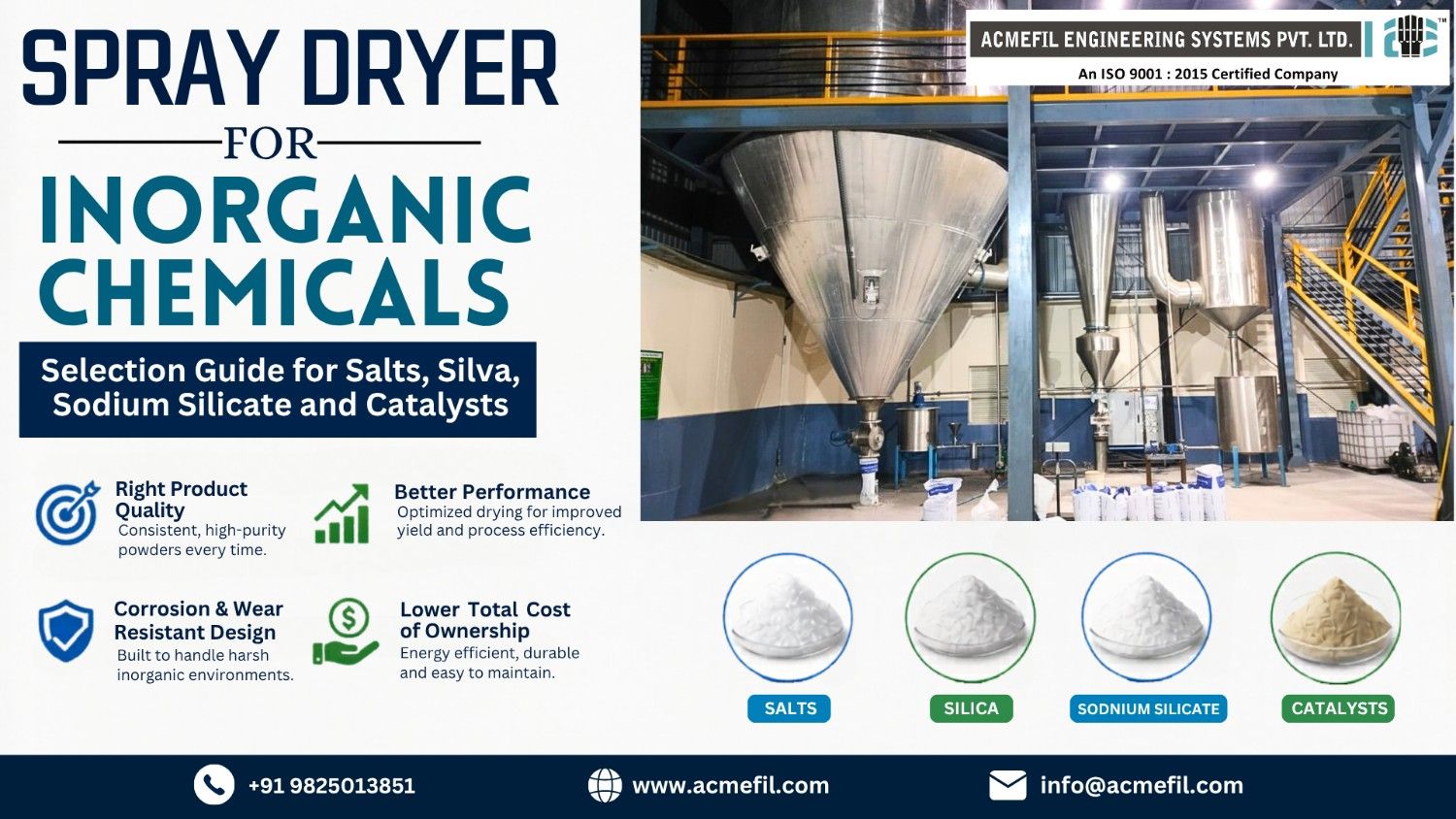
A spray dryer for inorganic chemicals converts a solution, slurry or suspension into a dry powder by atomizing the feed into hot air, drying the droplets rapidly, and separating the powder from the exhaust air. For inorganic products such as aluminum chloride, barium sulphate, calcium chloride, manganese sulphate, silica, sodium silicate and catalysts, the main design question is not only “Can it dry?” The real question is whether the dryer can handle the feed behavior, particle size requirement, stickiness, abrasiveness, moisture target and downstream powder handling.
I normally ask for feed data before recommending a spray dryer. In inorganic chemicals, two products with the same final powder name can behave very differently inside the drying chamber.
What Is a Spray Dryer for Inorganic Chemicals?
A spray dryer for inorganic chemicals is an industrial drying system used to produce powder from liquid or pumpable feed materials such as salt solutions, mineral suspensions, catalyst slurries, silica dispersions and sodium silicate solutions.
The process normally has four core stages:
- Atomization of feed into droplets
- Contact between droplets and hot drying air
- Rapid moisture evaporation from the droplets
- Separation of dried powder from the exhaust air
For a broader process overview, you can read the guide on spray dryer operating principles. The principle is simple, but the engineering is not simple when the material is hygroscopic, abrasive, heat-sensitive, sticky or prone to wall deposition.
Inorganic chemical drying is usually more demanding than basic food powder drying because the material may create scaling, hard deposits, dust load, corrosive conditions or variable particle morphology.
Which Inorganic Chemicals Are Commonly Spray Dried?
Spray drying is used in several inorganic chemical and mineral-based applications, including:
| Inorganic chemical application | Typical drying concern |
|---|---|
| Aluminum chloride | Moisture control, material compatibility, handling behavior |
| Barium sulphate | Slurry dispersion, powder fineness, abrasive handling |
| Calcium chloride | Hygroscopic nature, outlet moisture control, wall sticking risk |
| Manganese sulphate | Salt crystallization behavior and final powder handling |
| Silica | Slurry stability, particle size, dust collection |
| Sodium silicate | Feed concentration, viscosity, sticking tendency |
| Catalysts | Particle morphology, residual moisture, activity-sensitive handling |
This list is not a shortcut for design. It is a starting point. The same spray dryer chamber may behave differently if feed solids, viscosity, pH, inlet temperature, outlet temperature or atomizer selection changes.
For chemical-sector context, also see the related SprayDryer.com article on spray drying chemical products.
Why Inorganic Chemicals Need Careful Spray Dryer Selection
In food applications, the main concerns are often solubility, flavor, nutrition, density and heat exposure. In inorganic chemicals, the concerns are different.
A plant may need to control:
- Final moisture content
- Particle size distribution
- Bulk density
- Flowability
- Dust load
- Wall deposition
- Stickiness during drying
- Corrosion risk
- Abrasion inside the atomizer and ducting
- Powder collection efficiency
- Cleaning frequency
- Downstream packing behavior
The buyer mistake I see most often is treating all inorganic feeds as “just chemical slurry.” That is risky. A silica slurry, sodium silicate solution and calcium chloride solution do not behave like one another. Their drying behavior must be checked through feed characterization and, where possible, pilot testing.
How Does Spray Drying Work for Inorganic Salts and Mineral Slurries?
In a typical inorganic chemical spray drying process, the feed is prepared as a solution, suspension or slurry. A pump sends it to an atomizer. The atomizer converts it into droplets. Hot air enters the drying chamber and evaporates moisture from the droplets before the dried particles are collected through a cyclone, bag filter or combined separation system.
The key drying sequence is:
| Stage | What happens | Why it matters for inorganic chemicals |
|---|---|---|
| Feed preparation | Feed is filtered, mixed or conditioned before drying | Poor feed preparation causes nozzle choking, uneven drying or deposition |
| Atomization | Feed is broken into fine droplets | Droplet size controls drying speed and powder size |
| Hot air contact | Droplets meet controlled drying air | Airflow pattern affects residence time and wall sticking |
| Moisture evaporation | Water or solvent evaporates from the droplet surface | Outlet temperature helps control final moisture |
| Powder separation | Dried powder is separated from exhaust air | Fine inorganic powders need efficient collection |
| Powder discharge | Powder exits through rotary valve or collection system | Hygroscopic powders need controlled handling after drying |
For a visual explanation of the system layout, use the guide on spray dryer design and components.
Rotary Atomizer or Nozzle Atomizer for Inorganic Chemicals?
The atomizer is one of the most important decisions in a spray dryer for inorganic chemicals. It controls droplet formation, which affects drying time, powder size and chamber behavior.
| Selection factor | Rotary atomizer spray dryer | Nozzle atomizer spray dryer |
|---|---|---|
| Best suited for | Slurries, suspensions, variable feeds, products needing droplet control | Pumpable solutions, feeds needing specific particle shape or density |
| Droplet control | Controlled through disc design and speed | Controlled through pressure, orifice and nozzle type |
| Feed sensitivity | Often more tolerant of suspended solids than fine nozzles | More sensitive to choking if feed is not filtered correctly |
| Powder outcome | Useful for fine to controlled powder formation | Useful where coarse or specific particle structure is required |
| Buyer concern | Atomizer wear and chamber diameter | Nozzle choking, pressure control and pump selection |
A rotary atomizer spray dryer is commonly considered when the feed contains suspended solids or when droplet size control is important. A nozzle atomizer spray dryer may be suitable when the feed is a clean pumpable solution and the powder specification calls for a particular particle structure.
For a deeper comparison, read comparing spray dryers, nozzle vs rotary atomizer.
When Is Rotary Atomizer Spray Drying Better?
A rotary atomizer can be a strong choice for many inorganic chemical feeds because it breaks the feed through a high-speed rotating disc. This is useful when the feed behaves like a slurry or suspension and when the process needs stable droplet formation over changing feed conditions.
In inorganic chemicals, rotary atomization is often worth evaluating for:
- Silica slurries
- Barium sulphate suspensions
- Catalyst slurries
- Ceramic and mineral-type feeds
- Pigment-like inorganic materials
- Feeds with moderate solids variation
The practical advantage is operating flexibility. The limitation is that the atomizer and chamber must be designed for the abrasive or corrosive nature of the feed. This is not a catalogue decision. It is an application decision.
When Is Nozzle Atomizer Spray Drying Better?
Nozzle atomization can work well when the inorganic feed is a pumpable solution with controlled solids and low choking risk. Pressure nozzles and two-fluid nozzles are used for different particle size and flow requirements.
Nozzle atomization may be considered for:
- Clean inorganic salt solutions
- Specific particle morphology requirements
- Lower-capacity product development
- Feeds where pressure control can be maintained steadily
- Applications where powder density needs close control
The caution is simple. If the feed contains suspended solids, crystals, undissolved particles or scale-forming material, nozzle choking becomes a real operational issue. Good filtration and feed conditioning become part of the dryer design, not an afterthought.
Key Process Data Required Before Selecting the Dryer
A serious spray dryer recommendation for inorganic chemicals needs process data. Without this, the design becomes guesswork.
Before sizing the dryer, prepare the following:
| Required data | Why it matters |
|---|---|
| Chemical name and composition | Helps decide material compatibility and process risk |
| Feed type | Solution, slurry, suspension, emulsion or paste |
| Feed solids percentage | Influences evaporation load and powder output |
| Feed viscosity | Affects pumping and atomization |
| Feed temperature | Affects drying energy and stability |
| pH and corrosive nature | Impacts metallurgy and component selection |
| Target final moisture | Defines outlet temperature and residence time |
| Required particle size | Influences atomizer and chamber design |
| Bulk density target | Affects downstream packing and handling |
| Heat sensitivity | Determines allowable inlet and outlet temperature window |
| Abrasiveness | Affects atomizer, ducting and collection system wear |
| Expected capacity | Defines evaporation load and dryer size |
| Safety/MSDS information | Required for safe material handling and plant design |
A common mistake is giving only “kg/hr powder output” and asking for a price. For inorganic chemicals, powder output is not enough. The water evaporation load, feed solids and target moisture determine the real dryer duty.
Important Design Factors for Inorganic Chemical Spray Dryers
Feed concentration
Higher feed solids can reduce evaporation load, but they may increase viscosity, pumping difficulty and atomization stress. Lower feed solids may dry more easily, but the dryer must evaporate more water.
Inlet and outlet temperature
Inlet temperature affects heat transfer. Outlet temperature is closely linked to product moisture and thermal exposure. For inorganic chemicals, the safe temperature window must be checked against product stability and plant safety requirements.
Particle size
Fine powders may need different atomization and collection arrangements than coarse powders. A small change in droplet size can shift drying behavior and powder recovery.
Chamber design
The chamber must provide enough residence time for droplets to dry before reaching the wall or discharge zone. Wall deposition is one of the most expensive problems in poorly selected spray dryers.
Air distribution
Good air distribution reduces uneven drying, hot zones and uncontrolled deposition. Poor air distribution creates powder variation and cleaning problems.
Powder recovery
Inorganic powders can be fine and dusty. Cyclone separators, bag filters and collection arrangements must be selected according to particle size and dust load.
Material of construction
The metallurgy and contact parts must match the chemical nature of the feed. Corrosive salts, abrasive minerals and hygroscopic powders need careful component selection.
Spray Dryer Configuration for Inorganic Chemicals
A typical spray dryer system for inorganic chemicals may include:
- Feed preparation tank
- Agitator or recirculation arrangement
- Feed pump
- Rotary atomizer or nozzle atomizer
- Hot air generator
- Drying chamber
- Cyclone separator
- Bag filter
- Exhaust fan
- Rotary air lock valve
- Powder collection system
- Control panel
- Optional scrubber or air pollution control system, depending on process requirement
For buyers comparing system layouts, choosing the right spray dryer is a useful supporting guide.
Common Problems in Inorganic Chemical Spray Drying
| Problem | Likely cause | What to check first |
|---|---|---|
| Powder sticks to chamber wall | Droplet not fully dried, wrong outlet temperature, sticky feed behavior | Outlet temperature, feed solids, atomization pattern |
| Nozzle choking | Suspended particles, poor filtration, crystallization at nozzle | Feed filtration, particle content, nozzle size |
| Uneven moisture | Poor air distribution or unstable feed rate | Airflow, feed pump control, outlet temperature |
| Low powder recovery | Very fine particles or weak separation system | Cyclone efficiency, bag filter condition |
| High cleaning frequency | Feed deposits, wrong chamber temperature, poor airflow | Feed characterization and chamber design |
| Atomizer wear | Abrasive feed or unsuitable contact parts | Feed abrasiveness and material selection |
| Poor flowability | Particle size or moisture not matching target | Atomizer setting, outlet moisture, collection handling |
For operational diagnosis, use the spray dryer troubleshooting guide before changing major equipment.
Why Pilot Trials Matter for Inorganic Chemicals
Pilot trials are especially valuable when the feed is unfamiliar, high-value or technically uncertain. A pilot test helps check whether the selected atomizer, temperature profile and chamber behavior can produce the required powder.
For inorganic chemicals, pilot trials can help evaluate:
- Whether the feed atomizes properly
- Whether the powder sticks to the wall
- Whether the product reaches the target moisture
- Whether the powder separates efficiently
- Whether particle size is close to the requirement
- Whether filtration or feed conditioning is needed before drying
At Acmefil, the pilot spray dryer facility is available for product development trials with 3 kg/hr water evaporation capacity. This matters because a small trial can reveal issues that are expensive to discover after full-scale fabrication.
You can review the pilot spray dryer support page for trial-related context.
How to Choose the Right Spray Dryer for Inorganic Chemicals
Use this decision framework before asking for a quotation.
| Question | Why it matters | Practical decision |
|---|---|---|
| Is the feed a solution or slurry? | Atomization behavior changes | Clean solution may suit nozzle, slurry may need rotary atomizer |
| Is the product abrasive? | Contact parts may wear | Check material of construction and atomizer design |
| Is the powder hygroscopic? | Product may absorb moisture after drying | Plan powder handling and packing conditions |
| Is fine powder acceptable? | Fine powder increases dust load | Review cyclone and bag filter selection |
| Is particle size critical? | Atomizer choice depends on it | Define target particle size range before sizing |
| Is the feed corrosive? | Wrong metallurgy creates failure risk | Share pH and chemical compatibility data |
| Is heat exposure risky? | Temperature profile must be controlled | Define maximum product temperature |
| Is the process new? | Unknown feeds carry scale-up risk | Run a pilot test before full-scale order |
The best spray dryer for inorganic chemicals is not the dryer with the biggest chamber or the lowest quoted price. It is the dryer that matches the feed behavior, drying duty and powder specification.
Buyer Mistakes to Avoid
Choosing only by evaporation capacity
Evaporation capacity is important, but it is not the full design. A dryer that can evaporate enough water may still fail if the atomizer, chamber geometry or powder recovery system is wrong.
Ignoring feed viscosity
Feed viscosity affects pumpability and atomization. If viscosity changes during production, the dryer may not behave the same way it behaved during a short trial.
Treating all salts as the same
Inorganic salts differ in solubility, hygroscopic nature, crystallization behavior and heat response. Calcium chloride and sodium silicate cannot be treated as identical design cases.
Underestimating dust collection
Fine inorganic powders can overload weak collection systems. The cyclone and bag filter must be considered part of the spray dryer, not accessories added at the end.
Skipping pilot trials for new products
For unknown inorganic feeds, pilot trials reduce technical risk. They also help the buyer and manufacturer agree on realistic powder properties before full-scale equipment is built.
Where Acmefil Fits
Acmefil Engineering Systems manufactures spray dryers, rotary atomizer systems, nozzle atomizer systems, fluidized spray dryers, closed loop spray dryers and lab scale pilot spray dryers for industrial applications. The company is an ISO 9001:2015 certified manufacturer incorporated in 2000, with 500+ installations across India and international markets.
For inorganic chemical applications, the useful point is not only manufacturing capability. It is application evaluation. Before committing to a full-scale dryer, the feed should be reviewed for solids percentage, viscosity, pH, temperature sensitivity, particle size requirement and powder handling behavior.
For main equipment details, visit Acmefil’s spray dryer manufacturer page.
Final Recommendation
For inorganic chemicals, I would not finalize a spray dryer from the product name alone. I would first classify the feed as a solution, slurry or suspension. Then I would check solids percentage, viscosity, corrosive nature, abrasiveness, required particle size, final moisture and capacity. Only after that should the discussion move to rotary atomizer, nozzle atomizer, chamber size, hot air system, cyclone, bag filter and powder discharge.
A properly selected spray dryer can produce consistent inorganic chemical powder. A poorly selected dryer can create wall deposits, nozzle choking, variable moisture, dust losses and repeated cleaning shutdowns.
That difference is decided before the purchase order, not after installation.
FAQs
What is the best spray dryer for inorganic chemicals?
There is no single best spray dryer for all inorganic chemicals. A rotary atomizer spray dryer is often considered for slurries, suspensions and feeds with solids. A nozzle atomizer spray dryer may suit clean pumpable solutions. The right selection depends on feed solids, viscosity, particle size target, moisture target and chemical behavior.
Can sodium silicate be spray dried?
Sodium silicate can be evaluated for spray drying, but the feed concentration, viscosity, sticking tendency and final powder requirement must be checked carefully. It is not a product where the dryer should be selected only from a generic catalogue. Pilot testing is useful when the process data is incomplete.
Which inorganic salts are commonly processed in spray dryers?
Inorganic chemical spray dryer applications can include aluminum chloride, barium sulphate, calcium chloride, manganese sulphate, silica, sodium silicate and catalysts. Each product needs its own feed and powder evaluation because drying behavior changes with concentration, crystallization tendency and final moisture target.
What data is needed to size a spray dryer for inorganic chemicals?
The minimum data includes chemical composition, feed type, feed solids, viscosity, pH, feed temperature, target final moisture, required powder particle size, bulk density target, expected capacity, heat sensitivity, abrasiveness and MSDS information. Without this data, sizing and atomizer selection remain uncertain.
Is pilot testing necessary before buying a spray dryer?
Pilot testing is strongly recommended for new, high-value or technically uncertain inorganic chemical feeds. It helps confirm atomization behavior, drying temperature window, wall sticking risk, powder recovery and final moisture before investing in a full-scale spray dryer.
Need help selecting a spray dryer for inorganic chemicals? Share your feed composition, solids percentage, viscosity, target moisture, required particle size and expected capacity. The engineering team can review whether rotary atomizer, nozzle atomizer or another drying configuration is more suitable for your application.

Siddharth Nair is Technical Director at Acmefil Engineering Systems Pvt. Ltd. he leads solution design and applications engineering across the company’s full product range — spray dryers, multi-effect evaporators, agitated thin film dryers, spin flash dryers, fluid bed dryers, and complete ZLD systems.
His work spans process evaluation, equipment sizing, customer application consulting, and technical proposal development for industries including food and dairy, pharmaceuticals, chemicals, dyestuffs, ceramics, and industrial effluent treatment. He has hands-on commissioning experience across Acmefil’s 500+ installations in India and 15+ countries.
He holds a BTech in Mechanical Engineering from CHARUSAT University and also partners at A.S Engineers, working with blowers, sludge dryers, and industrial conveying systems.


