
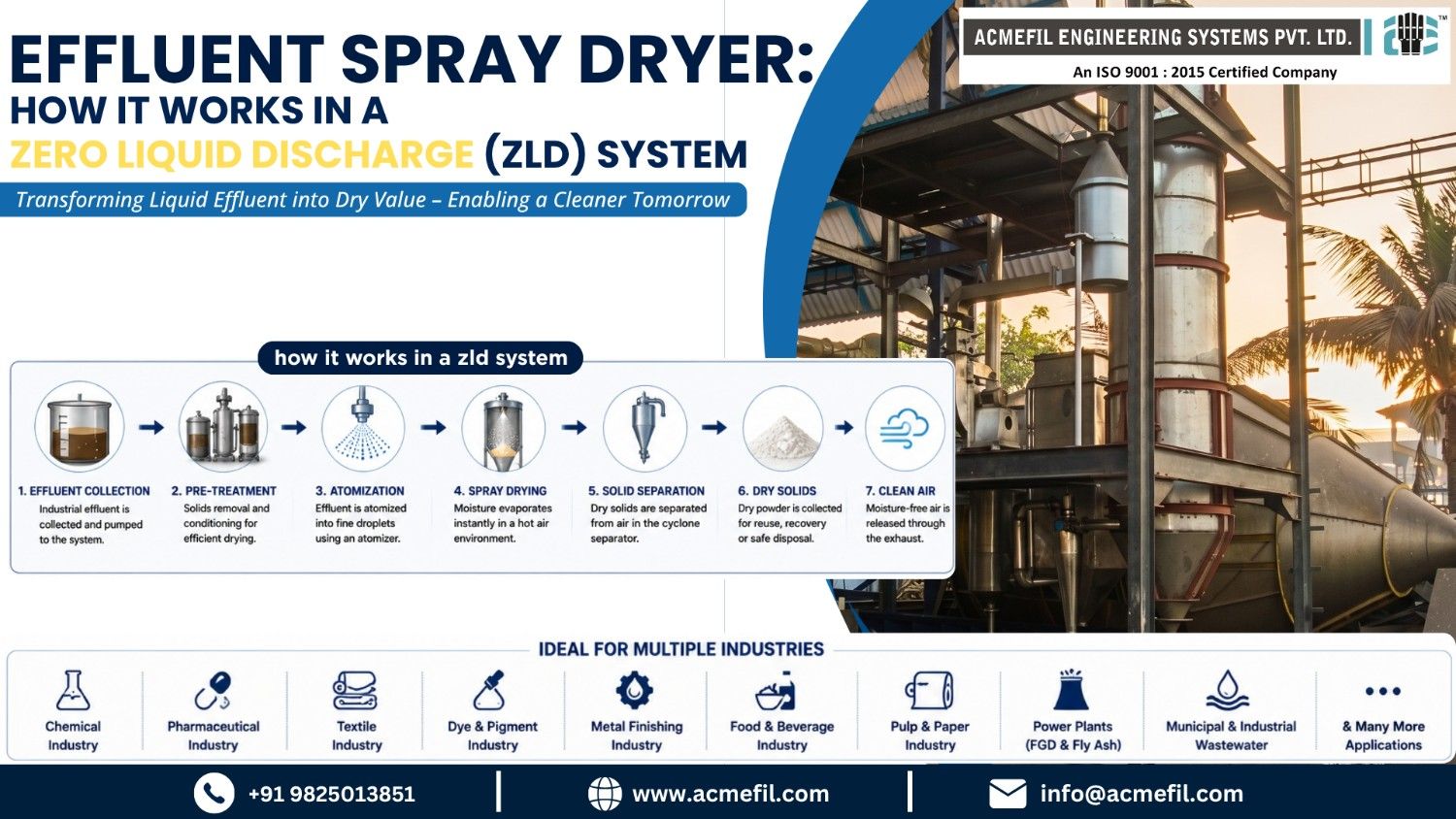
An effluent spray dryer is used in a zero liquid discharge system to convert concentrated industrial effluent into a dry powder or solid residue. It is normally not the first treatment step. It comes after upstream treatment, membrane concentration, evaporation, and, in many cases, ATFD concentration.
In simple terms, the effluent spray dryer handles the last and most difficult part of ZLD: removing remaining moisture from concentrated waste so that the plant does not send liquid discharge outside the facility.
I do not look at an effluent spray dryer as only a spray drying machine. I look at it as the final decision point in the whole wastewater treatment system. If the feed characterization is wrong, the spray dryer will suffer. If evaporation is undersized, the dryer will receive too much load. If solid handling is ignored, the plant may dry the material but still struggle to discharge it cleanly.
For a basic understanding of the drying mechanism, you can also read this guide on how a spray dryer works.
What Is an Effluent Spray Dryer?
An effluent spray dryer is an industrial spray drying system designed to dry concentrated wastewater, mother liquor, or effluent concentrate into a dry powder or solid residue.
The process is based on the same principle as industrial spray drying:
- The concentrated effluent is atomized into fine droplets.
- Hot air comes into contact with the droplets inside the drying chamber.
- Moisture evaporates rapidly.
- Dried solids are separated through a cyclone, bag filter, or suitable separation system.
The main difference is the feed.
A milk powder spray dryer handles a product that must be recovered as a useful powder. An effluent spray dryer handles a waste stream where the main objective is moisture removal, solid residue handling, and ZLD compliance support.
That difference changes the design priorities.
For product spray drying, particle quality, solubility, bulk density, and product recovery are major concerns. For effluent drying, the key questions are:
- Can the concentrate be atomized properly?
- Will salts or solids stick inside the chamber?
- What is the moisture target in the final residue?
- Will the dried material discharge cleanly?
- What air pollution control equipment is required after drying?
- Is the upstream ZLD system reducing the load enough before the dryer?
Where Does an Effluent Spray Dryer Fit in a ZLD System?
A properly designed ZLD system is a sequence. The spray dryer should not be forced to do the work of every previous stage.
A practical sequence often looks like this:
| Stage | Main Function | Why It Matters Before Spray Drying |
|---|---|---|
| Primary and secondary treatment | Removes suspended solids, organic load, and unstable contaminants | Reduces shock load on downstream equipment |
| Membrane system | Recovers reusable water and concentrates dissolved solids | Reduces liquid volume before thermal treatment |
| Multi-effect evaporator | Concentrates the effluent further using thermal evaporation | Lowers the final load going to drying |
| ATFD or final concentrator | Handles viscous concentrate and pushes solids concentration higher | Makes final drying more practical |
| Effluent spray dryer | Converts remaining concentrate into dry residue | Supports final ZLD objective |
ACMEFIL’s ZLD equipment path connects membrane technology, multi-effect evaporators, agitated thin film dryers, and final effluent drying as part of the larger zero liquid discharge system.
This sequence matters because the spray dryer is sensitive to feed condition. If the concentrate is too dilute, the energy load becomes high. If it is too viscous or unstable, atomization becomes difficult. If the salts are sticky, chamber deposition and outlet choking become real operating problems.
How Does an Effluent Spray Dryer Work?
An effluent spray dryer works by turning liquid concentrate into droplets and drying those droplets in hot air.
The basic operating steps are:
Feed Preparation
The feed should be characterized before drying. At minimum, the engineering team should know the feed flow rate, total solids, dissolved salts, suspended solids, viscosity, pH, expected variation, and any crystallization or stickiness tendency.
This is where many ZLD projects become weak. The buyer gives only the daily wastewater volume and expects a spray dryer selection. That is not enough.
For effluent drying, the dryer is not selected from flow rate alone. It is selected from the full mass balance and heat balance.
Atomization
The concentrated effluent is broken into droplets. Droplet size affects drying time, chamber deposition risk, powder characteristics, and final moisture.
If the droplets are too large, they may not dry completely before reaching the chamber wall or discharge section. If they are too fine, separation load can increase.
For more detail on atomization choices, read spray dryer atomization techniques.
Spray-Air Contact
The droplets meet hot drying air inside the chamber. Moisture evaporates from the droplet surface. In effluent drying, the solids left behind may contain salts, inorganic materials, chemical residues, or mixed industrial solids depending on the upstream process.
The chamber design must support enough residence time for drying without excessive wall buildup.
Solid Separation
The dried powder or residue is separated from the exhaust air. Depending on the dust load and particle behavior, this may involve a cyclone, pulse jet bag filter, or other air pollution control equipment.
ACMEFIL also manufactures bag filter systems that can support dust handling and emission control in drying systems.
Effluent Spray Dryer vs Evaporator vs ATFD
Many buyers confuse these three technologies. They are connected, but they do not do the same job.
| Equipment | Best Role in ZLD | What It Should Not Be Expected to Do |
|---|---|---|
| Multi-effect evaporator | Concentrates large liquid volumes efficiently before final drying | Handle every sticky or crystallizing concentrate alone |
| ATFD | Handles viscous concentrate and thin-film drying before final residue handling | Replace the complete evaporation system where bulk water removal is needed |
| Effluent spray dryer | Final drying of suitable concentrate into dry solid residue | Process poorly characterized wastewater directly from ETP without upstream concentration |
A strong ZLD design does not choose one machine in isolation. It decides how much work each stage should do.
That is why a project engineer should review the full wastewater treatment path before finalizing the effluent spray dryer. You can use this guide on choosing the right spray dryer as a starting point, but effluent applications need deeper feed study than many standard drying applications.
When Should You Consider an Effluent Spray Dryer?
An effluent spray dryer is worth considering when the plant needs to minimize or eliminate liquid discharge and the remaining concentrate can be dried into manageable solids.
Common application areas include:
- Textile and dye effluent
- Chemical process wastewater
- Pharmaceutical effluent
- Food processing wastewater
- High-TDS industrial wastewater
- Concentrated mother liquor after evaporation
- Final ZLD drying after MEE or ATFD
In chemical clusters, especially where discharge permissions are tight, the question is not only whether water can be treated. The question is whether the plant can close the final liquid discharge route reliably.
This is where an effluent spray dryer becomes important. It is not a decorative add-on. It is often the final equipment that decides whether the ZLD system performs as intended.
Key Design Factors Before Selecting an Effluent Spray Dryer
The right effluent spray dryer design depends on the feed. Not the brochure capacity. Not the chamber size alone. The feed.
| Design Factor | Why It Matters | What the Buyer Should Provide |
|---|---|---|
| Feed flow rate | Decides evaporation load | Hourly and daily concentrate quantity |
| Total solids | Affects drying load and final residue | Lab analysis of concentrate |
| Salt composition | Impacts stickiness, crystallization, and corrosion risk | Chloride, sulphate, sodium, calcium, magnesium, and relevant salts |
| Viscosity | Affects pumping and atomization | Viscosity at operating concentration |
| pH | Impacts material compatibility | Minimum, maximum, and normal pH |
| Organic content | Affects odor, emissions, and drying behavior | COD/BOD and organic load data where relevant |
| Temperature sensitivity | Decides safe thermal window | Feed behavior under heat |
| Final residue handling | Determines discharge system design | Powder, sticky solid, salt cake, or mixed residue target |
| Air pollution control need | Protects downstream air quality | Expected dust load and emission requirements |
A proper RFQ for an effluent spray dryer should include this data. Without it, the vendor can only give a broad estimate, not a reliable engineering selection.
Common Buyer Mistakes in Effluent Spray Dryer Projects
Mistake 1: Treating the Spray Dryer as a Standalone Machine
An effluent spray dryer depends on upstream treatment. If the membrane system, evaporator, or ATFD is not designed correctly, the spray dryer receives an unstable feed.
The result can be chamber deposition, incomplete drying, variable powder discharge, or high operating cost.
Mistake 2: Sharing Only Wastewater Flow Rate
Flow rate is only one part of the calculation. Two plants may both generate 10,000 liters per day of wastewater, but the drying load can be completely different if one stream has low dissolved solids and the other has high salts and sticky organics.
Mistake 3: Ignoring Atomization Behavior
Not every concentrate atomizes cleanly. Viscosity, suspended solids, and crystallization tendency can change droplet formation. Poor atomization leads to poor drying.
Mistake 4: Not Planning Solids Discharge
Drying is only successful if the dried residue can be discharged, collected, and handled. A system that dries material but blocks at the discharge point is not a successful ZLD system.
Mistake 5: Ignoring Maintenance Access
Effluent applications are harsher than many food or pharma spray drying applications. The design must consider inspection, cleaning, access doors, dust collection, and maintenance of the hot air and separation system.
You can also review spray dryer troubleshooting issues and spray dryer maintenance tips to understand how drying problems usually show up in operation.
Effluent Spray Dryer for Chemical and Dye Industry
In dye, pigment, and chemical industries, wastewater composition can vary widely. One batch may behave differently from the next. Salts, colorants, intermediates, and residual chemicals can affect drying behavior.
For such applications, I prefer a cautious engineering approach:
- Study the effluent source and process variation.
- Concentrate the feed through the correct upstream stages.
- Test or validate drying behavior where possible.
- Select atomization and chamber design based on the concentrate, not only on water evaporation.
- Plan solid discharge and air pollution control from the beginning.
ACMEFIL’s background in spray dryers, evaporators, ATFD, and ZLD systems makes this integrated thinking important. A plant buyer does not need four disconnected machines. The buyer needs one working process line.
What Data Should You Send Before Asking for a Quote?
For a serious effluent spray dryer recommendation, send this information:
- Industry and process source of effluent
- Feed flow rate to the spray dryer
- Total solids percentage
- TDS and major salt analysis
- COD/BOD where relevant
- pH range
- Viscosity of concentrate
- Upstream treatment details
- MEE or ATFD outlet condition
- Expected final moisture or residue condition
- Available fuel or heat source
- Site utilities
- Space constraints
- Required material of construction
- Pollution control requirements
- Existing plant layout, if available
This data allows the engineering team to check whether spray drying is suitable and what configuration is practical.
Why Pilot Testing Matters
Pilot testing is useful when the feed behavior is uncertain. It helps answer questions that a spreadsheet cannot answer confidently.
Will the concentrate atomize? Will the residue be powdery or sticky? Will solids deposit on the wall? Will the final discharge be manageable? Does the feed need further concentration before spray drying?
ACMEFIL has an in-house pilot spray dryer facility with 3 kg/hr water evaporation capacity for process development trials. For buyers working with difficult effluent, this type of trial can reduce risk before committing to a full-scale system.
You can learn more about the pilot spray dryer facility and the role of pilot trials in scale-up.
Effluent Spray Dryer Selection Checklist
Before finalizing an effluent spray dryer, check the following:
| Question | Why It Matters |
|---|---|
| Is the feed already concentrated enough? | Prevents oversizing and high energy load |
| Has the full ZLD sequence been reviewed? | Avoids overloading the final dryer |
| Is the concentrate pumpable and atomizable? | Prevents nozzle or feed system problems |
| Is the material sticky during drying? | Affects chamber design and cleaning frequency |
| Is the dry residue easy to discharge? | Determines whether the system works continuously |
| Is air pollution control included? | Supports dust and emission management |
| Is there enough maintenance access? | Reduces downtime after installation |
| Has pilot testing been considered? | Reduces uncertainty for difficult feeds |
How ACMEFIL Approaches Effluent Spray Dryer Projects
At ACMEFIL, we do not start with only the spray dryer chamber. We start with the process.
For effluent and ZLD projects, the first engineering question is: what is entering the dryer, and what condition should leave the dryer?
From there, the design discussion moves to:
- Upstream treatment sequence
- Membrane and evaporation load
- ATFD or final concentration requirement
- Feed atomization behavior
- Chamber sizing
- Hot air system
- Solid separation
- Residue handling
- Installation and commissioning support
ACMEFIL manufactures drying and concentrating equipment from Ahmedabad, including spray dryers, evaporators, ATFD systems, membrane systems, and ZLD equipment. The stronger project is usually the one where these stages are engineered as one process line instead of purchased as isolated equipment.
For a wider view of industrial spray dryer selection, see top spray dryer manufacturer guide and ACMEFIL’s spray dryer manufacturer page.
Final Practical View
An effluent spray dryer is not the first tool for wastewater treatment. It is the final thermal drying stage for concentrated effluent in a properly designed ZLD system.
If the feed is well characterized, upstream evaporation is correctly sized, atomization is stable, and solids discharge is planned properly, the spray dryer can help convert remaining concentrate into dry residue for handling.
If those basics are skipped, even a good spray dryer will struggle.
The right question is not, “What is the capacity of the effluent spray dryer?”
The right question is, “What is the complete ZLD mass balance, and what exactly are we asking the spray dryer to finish?”
FAQs
What is an effluent spray dryer?
An effluent spray dryer is an industrial drying system used to convert concentrated wastewater or effluent concentrate into dry solid residue. It is commonly used as the final drying stage in a zero liquid discharge system after upstream treatment, membrane concentration, evaporation, and final concentration equipment.
Is an effluent spray dryer the same as a normal spray dryer?
The basic drying principle is similar, but the application is different. A normal spray dryer may focus on product recovery and powder quality. An effluent spray dryer focuses on moisture removal, residue handling, ZLD support, air pollution control, and reliable operation with difficult industrial concentrate.
Where is an effluent spray dryer used?
Effluent spray dryers are used in textile, chemical, pharmaceutical, food processing, dye, and high-TDS wastewater applications where plants need to reduce or eliminate liquid discharge. They are especially relevant when an industrial wastewater stream has already been concentrated through upstream ZLD equipment.
What data is required to size an effluent spray dryer?
The important data includes feed flow rate, total solids, TDS, salt composition, pH, viscosity, upstream treatment details, expected final residue condition, utilities, and emission control requirements. Flow rate alone is not enough for reliable spray dryer selection.
Can an effluent spray dryer directly treat raw wastewater?
Usually, no. Raw wastewater should first pass through suitable treatment and concentration stages. The effluent spray dryer is typically used for concentrated effluent, not untreated wastewater. Direct drying without proper upstream treatment can create serious operating and cost problems.
Need help evaluating whether your effluent concentrate is suitable for spray drying?
Share your process details, feed analysis, upstream ZLD sequence, and expected final residue condition. ACMEFIL’s engineering team can review the application and suggest whether an effluent spray dryer, MEE, ATFD, or integrated ZLD configuration is the right route for your plant.

Siddharth Nair is Technical Director at Acmefil Engineering Systems Pvt. Ltd. he leads solution design and applications engineering across the company’s full product range — spray dryers, multi-effect evaporators, agitated thin film dryers, spin flash dryers, fluid bed dryers, and complete ZLD systems.
His work spans process evaluation, equipment sizing, customer application consulting, and technical proposal development for industries including food and dairy, pharmaceuticals, chemicals, dyestuffs, ceramics, and industrial effluent treatment. He has hands-on commissioning experience across Acmefil’s 500+ installations in India and 15+ countries.
He holds a BTech in Mechanical Engineering from CHARUSAT University and also partners at A.S Engineers, working with blowers, sludge dryers, and industrial conveying systems.


