
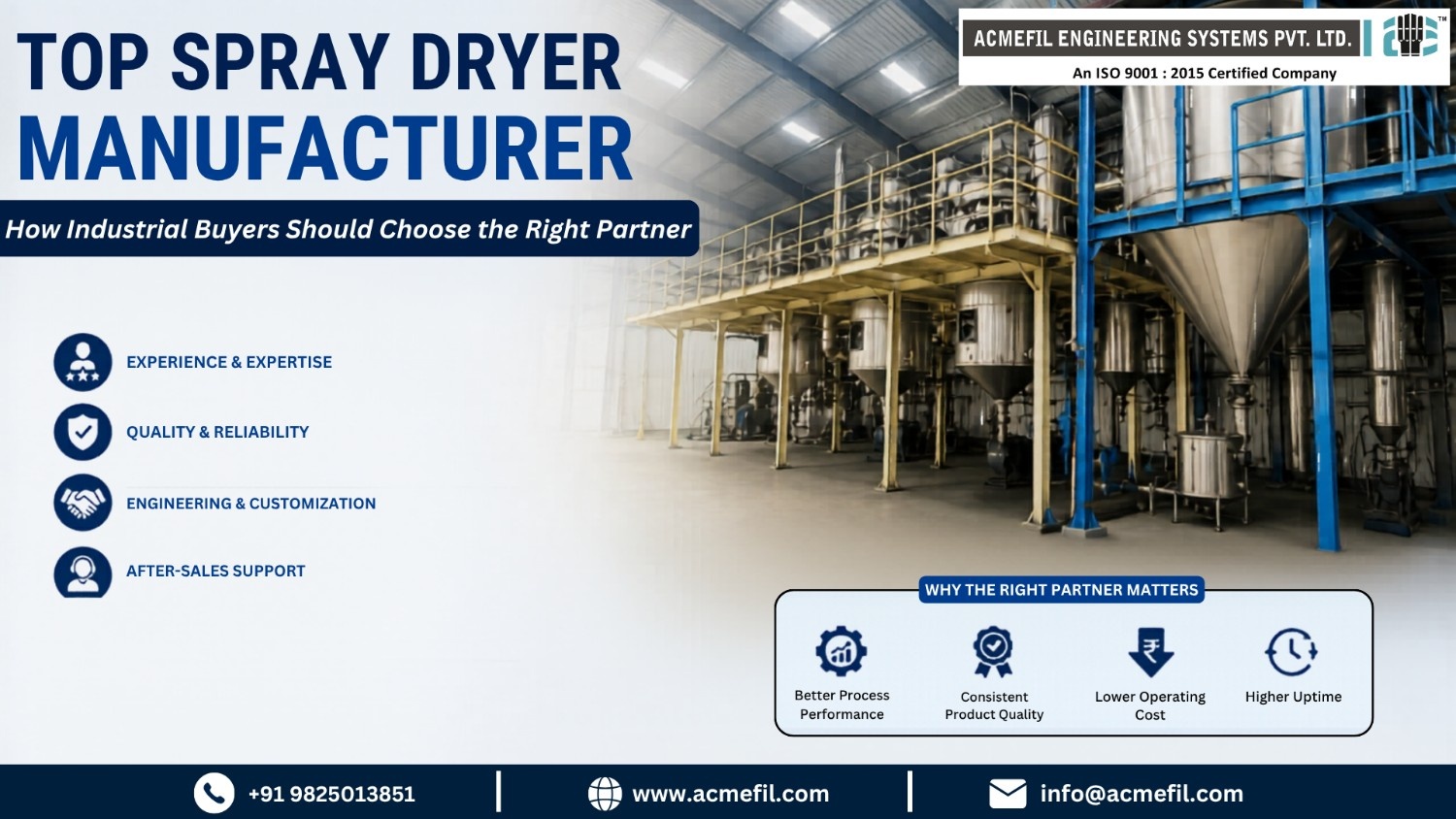
A top spray dryer manufacturer should not be judged only by price, brochure language, or the size of the drying chamber. For an industrial buyer, the right manufacturer is the one that studies your feed properties, powder target, atomization method, inlet and outlet temperature window, moisture specification, material of construction, and validation route before recommending a plant.
In spray drying, the expensive mistake is not buying a dryer. The expensive mistake is buying a dryer before the process has been understood.
At Acmefil, we approach spray dryer selection as an engineering problem first and a quotation problem second. That is the difference buyers should look for.
What makes a spray dryer manufacturer worth shortlisting?
A spray dryer manufacturer is worth shortlisting when they can answer five questions clearly:
- What type of atomization is suitable for my feed?
- What powder particle size and moisture range can be targeted?
- What happens if my feed viscosity, solids percentage, or heat sensitivity changes?
- Can the process be tested before full-scale procurement?
- Does the manufacturer understand my industry application, not just the machine?
If a supplier jumps directly to capacity and price without asking for feed details, that is a warning sign.
Spray drying looks simple from outside. Liquid goes in, powder comes out. In practice, the result depends on droplet size, hot air contact, residence time, chamber geometry, outlet temperature, and separation efficiency. A small error in atomization or heat balance can lead to sticky powder, wall deposition, poor solubility, high moisture, or low yield.
For a stronger technical foundation, start with this guide on how a spray dryer works and then compare it with the practical points below.
Start with feed characterization, not machine size
When I review a spray drying inquiry, I do not start with the plant size. I start with the feed.
The important questions are:
- Is the feed a solution, slurry, emulsion, suspension, or extract?
- What is the total solids percentage?
- What is the viscosity at feed temperature?
- Is the product heat-sensitive?
- Is the product hygroscopic or sticky?
- What is the required final moisture?
- What particle size is acceptable?
- Is the product food-grade, pharmaceutical, chemical, ceramic, dye, detergent, or effluent-related?
- Is the solvent water-based or solvent-based?
- Does the powder need to be free-flowing, agglomerated, fine, or coarse?
A good spray dryer manufacturer uses these answers to select the atomizer, chamber design, air flow pattern, heating system, powder separation system, and material of construction.
A weak selection process usually creates problems after installation. The dryer may run, but it may not produce the right powder consistently.
Rotary atomizer or nozzle atomizer: this choice matters
The atomization system is one of the most important decisions in spray dryer design.
A rotary atomizer uses a high-speed rotating disc to break the feed into fine droplets. It is commonly considered when droplet size control is important and the feed behaves well under centrifugal atomization. A nozzle atomizer uses pressure or compressed air to atomize the liquid feed through a nozzle.
Neither option is universally better. The right choice depends on feed behavior and powder target.
| Selection factor | Rotary atomizer spray dryer | Nozzle atomizer spray dryer |
|---|---|---|
| Atomization principle | High-speed centrifugal disc | Pressure nozzle or two-fluid nozzle |
| Typical fit | Slurries, dyes, ceramics, food, pigments, chemicals | Heat-sensitive products, food, pharma, flavours, enzymes, fine particle applications |
| Main control variable | Disc design and atomizer speed | Nozzle type, pressure, feed rate, compressed air if two-fluid |
| Buyer risk if selected wrongly | Unstable particle size, wall deposition, poor drying profile | Nozzle choking, inconsistent droplet formation, poor moisture control |
| What to validate | Droplet behavior, feed solids, viscosity, powder target | Nozzle suitability, pressure stability, feed filtration, particle target |
For a deeper comparison, use the detailed guide on nozzle vs rotary atomizer spray dryers and the article on spray dryer atomization techniques.
A top spray dryer manufacturer should explain the trade-off
I do not trust one-answer recommendations for spray drying.
If someone says, “Use rotary atomizer for everything,” that is not engineering. If someone says, “Use nozzle type because it is cheaper,” that is also not engineering.
The correct answer depends on the process.
For example, a ceramic slurry may need particle uniformity and bulk density control. A pharmaceutical extract may need lower outlet temperature and better protection from heat exposure. A detergent powder may need larger agglomerated particles. A solvent-based product may need closed-loop drying instead of an open hot air system.
The manufacturer should be able to explain the trade-off in plain language.
Spray dryer types a serious manufacturer should understand
A strong industrial spray dryer manufacturer should not treat every application as one standard dryer. Different products require different spray dryer configurations.
| Spray dryer type | Where it is generally used | What the buyer should check |
|---|---|---|
| Rotary disc type spray dryer | Dyes, pigments, ceramics, food powders, detergents, inorganic chemicals | Feed viscosity, solids loading, particle size target, drying chamber sizing |
| Nozzle type spray dryer | Heat-sensitive products, food processing, flavours, enzymes, pharmaceutical applications | Nozzle selection, pressure range, feed filtration, droplet size behavior |
| Fluidized spray dryer | Larger particle or agglomerated powder applications such as detergents and food ingredients | Particle size target, fines recycle, final moisture, fluid bed drying section |
| Closed loop spray dryer | Solvent-based or oxidation-sensitive materials | Solvent recovery requirement, inert atmosphere design, safety review, compliance review |
| Lab scale or pilot spray dryer | R&D, product development, process validation, new formulation trials | Trial objective, sample quantity, target moisture, scale-up assumptions |
Acmefil’s spray dryer range includes rotary disc type, nozzle type, fluidized spray dryer, closed loop / sterile spray dryer, and lab scale pilot spray dryer systems. For a complete equipment overview, see Acmefil’s spray dryer manufacturer page.
Why pilot trials reduce procurement risk
Pilot testing is one of the strongest ways to reduce risk before buying a full-scale spray dryer.
A brochure can tell you what a dryer is designed to do. A pilot trial tells you how your actual feed behaves.
At Acmefil, the in-house R&D facility includes a pilot spray dryer with 3 kg/hr water evaporation capacity. This helps buyers test drying behavior, powder recovery, moisture target, wall deposition tendency, and scale-up direction before committing to a larger plant.
Pilot trials are especially useful when:
- The product is new.
- The feed composition is variable.
- The material is sticky or hygroscopic.
- The buyer is moving from batch drying to spray drying.
- The powder must meet strict moisture or solubility requirements.
- The project involves food, pharma, dyestuff, ceramic, or chemical applications.
You can also compare this with the guide on spray dryer for small-scale production and Acmefil’s pilot spray dryer page.
Manufacturer selection checklist
Before selecting a spray dryer manufacturer, use this checklist.
| Evaluation point | Why it matters | What to ask the supplier |
|---|---|---|
| Feed study | The dryer design depends on feed properties | What feed data do you need before sizing the dryer? |
| Atomizer selection | Particle size and drying behavior depend on atomization | Why are you recommending rotary, nozzle, or another system? |
| Pilot testing | Reduces scale-up and product quality risk | Can we run a trial before full-scale procurement? |
| Industry experience | Different products behave differently | Have you handled food, pharma, dye, ceramic, detergent, or chemical applications similar to ours? |
| Product recovery system | Poor separation reduces yield and creates dust issues | What cyclone, bag filter, or collection system is recommended? |
| Material of construction | Product compatibility and hygiene depend on MOC | Which contact material is suitable for our product? |
| Turnkey support | Installation and commissioning affect actual plant performance | Do you support installation, commissioning, training, and troubleshooting? |
| After-sales support | Dryers need operational tuning after installation | Who supports the plant after dispatch and commissioning? |
A good spray dryer manufacturer will not hesitate to discuss these points. A weak supplier will try to close the quotation before asking the right questions.
Where Acmefil fits in the shortlist
Acmefil Engineering Systems Pvt. Ltd. is an ISO 9001:2015 certified manufacturer, supplier, and exporter of drying and concentrating equipment based in Ahmedabad, Gujarat. The company was incorporated in 2000 and has 500+ installations across India and international markets.
For spray drying projects, Acmefil’s strength is not only the dryer itself. It is the combination of:
- Spray dryer manufacturing
- Feed and application evaluation
- Rotary and nozzle atomizer understanding
- Pilot plant trial availability
- Turnkey project support
- Related process equipment knowledge, including evaporators, fluid bed dryers, spin flash dryers, flash dryers, membrane systems, and ZLD systems
That wider process background matters because many projects do not exist in isolation. A spray dryer may sit after an evaporator. A drying plant may need a hot air generator, cyclone separator, bag filter, air lock rotary valve, or powder handling system. A chemical or effluent project may require integration with upstream concentration or downstream pollution control.
This is why buyers should evaluate the manufacturer’s process understanding, not only the dryer quotation.
What RFQ data should you send to a spray dryer manufacturer?
If you want a meaningful technical quotation, send more than capacity.
Use this RFQ data format:
| RFQ data point | Example of what to share |
|---|---|
| Product name and industry | Milk powder, herbal extract, dye intermediate, ceramic slurry, detergent base |
| Feed type | Solution, slurry, emulsion, suspension, extract |
| Feed solids | Percentage of total solids |
| Feed viscosity | Viscosity at operating temperature, if available |
| Feed temperature | Ambient, heated, or process temperature |
| Moisture target | Final powder moisture requirement |
| Particle size target | Fine powder, coarse powder, agglomerated powder, free-flowing powder |
| Heat sensitivity | Product degradation temperature or acceptable outlet temperature range |
| Solvent type | Water-based or solvent-based |
| Production requirement | kg/hr powder output or kg/hr water evaporation |
| Contact material preference | SS304, SS316, or other verified requirement |
| Existing process | Current dryer, evaporator, filtration, or concentration step |
| Trial requirement | Whether pilot testing is required before final sizing |
If this data is incomplete, the manufacturer may still give a budgetary quote, but final design confidence will be limited.
Common mistakes buyers make when selecting a spray dryer manufacturer
Mistake 1: Comparing only price
Two spray dryer quotes may look similar, but the scope may be different. One may include proper powder collection, automation, installation support, and testing. Another may be only a basic system.
Compare scope before price.
Mistake 2: Ignoring atomizer selection
Wrong atomizer selection can affect particle size, drying behavior, powder recovery, and cleaning frequency.
Mistake 3: Not testing difficult feeds
Sticky, hygroscopic, viscous, heat-sensitive, or solvent-based feeds should not be taken lightly. A pilot trial can reveal issues that a quotation cannot.
Mistake 4: Treating all spray dryers as standard equipment
Spray drying is not a catalogue-only purchase. Chamber geometry, air distribution, atomization, feed handling, hot air generation, and collection system must match the process.
Mistake 5: Not planning for commissioning and operator training
A spray dryer often needs tuning during commissioning. Feed rate, air temperature, atomizer speed, outlet temperature, and collection behavior must be stabilized under real plant conditions.
For operational context, read the guide on spray dryer operating principles and best practices and spray dryer troubleshooting common issues.
Which industries need careful spray dryer manufacturer selection?
Spray dryers are used across many industries, but the selection logic changes by application.
| Industry | Typical spray drying requirement | Selection risk |
|---|---|---|
| Food and dairy | Milk powder, egg products, soup mixes, beverages, maltodextrin, herbal extracts | Heat sensitivity, solubility, hygiene, powder flow |
| Pharmaceutical and biochemical | Herbal extracts, enzymes, proteins, dextrose, lactose | Temperature control, contamination risk, particle consistency |
| Dyestuff and pigments | Reactive dyes, disperse dyes, acid dyes, pigments | Slurry behavior, particle size, wall deposition |
| Ceramic industry | Alumina, china clay, ferrites, zirconia, ceramic slurry | Bulk density, granule size, abrasion, moisture control |
| Detergents | Zeolite, SLS, detergent base powders | Agglomeration, larger particle size, moisture control |
| Inorganic chemicals | Sodium silicate, catalysts, salts, silica | Corrosion, product recovery, dust handling |
For industry-specific reading, use these supporting guides:
- Applications of spray dryers
- Spray dryer applications in pharmaceuticals
- Spray dryer for milk powder
- Spray drying in the food industry
My practical recommendation
If you are selecting a top spray dryer manufacturer, do not start with the question, “Who is cheapest?”
Start with:
- Who understands my feed?
- Who can explain the atomizer selection?
- Who can validate the process through trial?
- Who has handled my industry type?
- Who can support installation and commissioning?
- Who is willing to say when spray drying is not the right fit?
That last point matters. A serious manufacturer should not force every product into a spray dryer. Some feeds may need pre-concentration, filtration, spin flash drying, fluid bed drying, or another process route before spray drying makes sense.
If you are still comparing options, this guide on choosing the right spray dryer will help you structure the decision.
FAQs
Who is a top spray dryer manufacturer in India?
A top spray dryer manufacturer in India should be evaluated by engineering capability, spray dryer range, pilot trial support, industry application knowledge, installation support, and after-sales service. Acmefil Engineering Systems is an ISO 9001:2015 certified spray dryer manufacturer in Ahmedabad with 500+ installations across India and international markets.
What should I check before buying a spray dryer?
Check feed solids, viscosity, heat sensitivity, required final moisture, target particle size, atomization method, material of construction, product recovery system, and pilot trial requirement. Do not finalize a spray dryer only from capacity and price.
Is rotary atomizer better than nozzle atomizer?
Not always. Rotary atomizers are useful where centrifugal atomization and particle size control fit the feed behavior. Nozzle atomizers are useful for many heat-sensitive, food, pharmaceutical, and fine particle applications. The better choice depends on feed properties and powder target.
Why is pilot testing important in spray drying?
Pilot testing shows how the actual feed behaves during atomization and drying. It helps identify wall deposition, moisture control, powder recovery, and scale-up concerns before full-scale procurement. This is especially useful for new, sticky, viscous, or heat-sensitive products.
What information should I send for a spray dryer quotation?
Send product name, industry, feed type, solids percentage, viscosity, feed temperature, final moisture requirement, particle size target, heat sensitivity, solvent type, expected capacity, contact material requirement, and whether a pilot trial is needed.
Discuss Your Spray Drying Application with Acmefil
If you are evaluating a spray dryer for food, pharmaceutical, chemical, dyestuff, detergent, ceramic, or effluent-related applications, share your feed details before asking for a final quotation.
Acmefil can review your application, recommend the suitable spray dryer configuration, and guide whether a pilot trial is required before full-scale selection.
Request a technical discussion with Acmefil
Explore Acmefil spray dryer systems

Siddharth Nair is Technical Director at Acmefil Engineering Systems Pvt. Ltd. he leads solution design and applications engineering across the company’s full product range — spray dryers, multi-effect evaporators, agitated thin film dryers, spin flash dryers, fluid bed dryers, and complete ZLD systems.
His work spans process evaluation, equipment sizing, customer application consulting, and technical proposal development for industries including food and dairy, pharmaceuticals, chemicals, dyestuffs, ceramics, and industrial effluent treatment. He has hands-on commissioning experience across Acmefil’s 500+ installations in India and 15+ countries.
He holds a BTech in Mechanical Engineering from CHARUSAT University and also partners at A.S Engineers, working with blowers, sludge dryers, and industrial conveying systems.


