
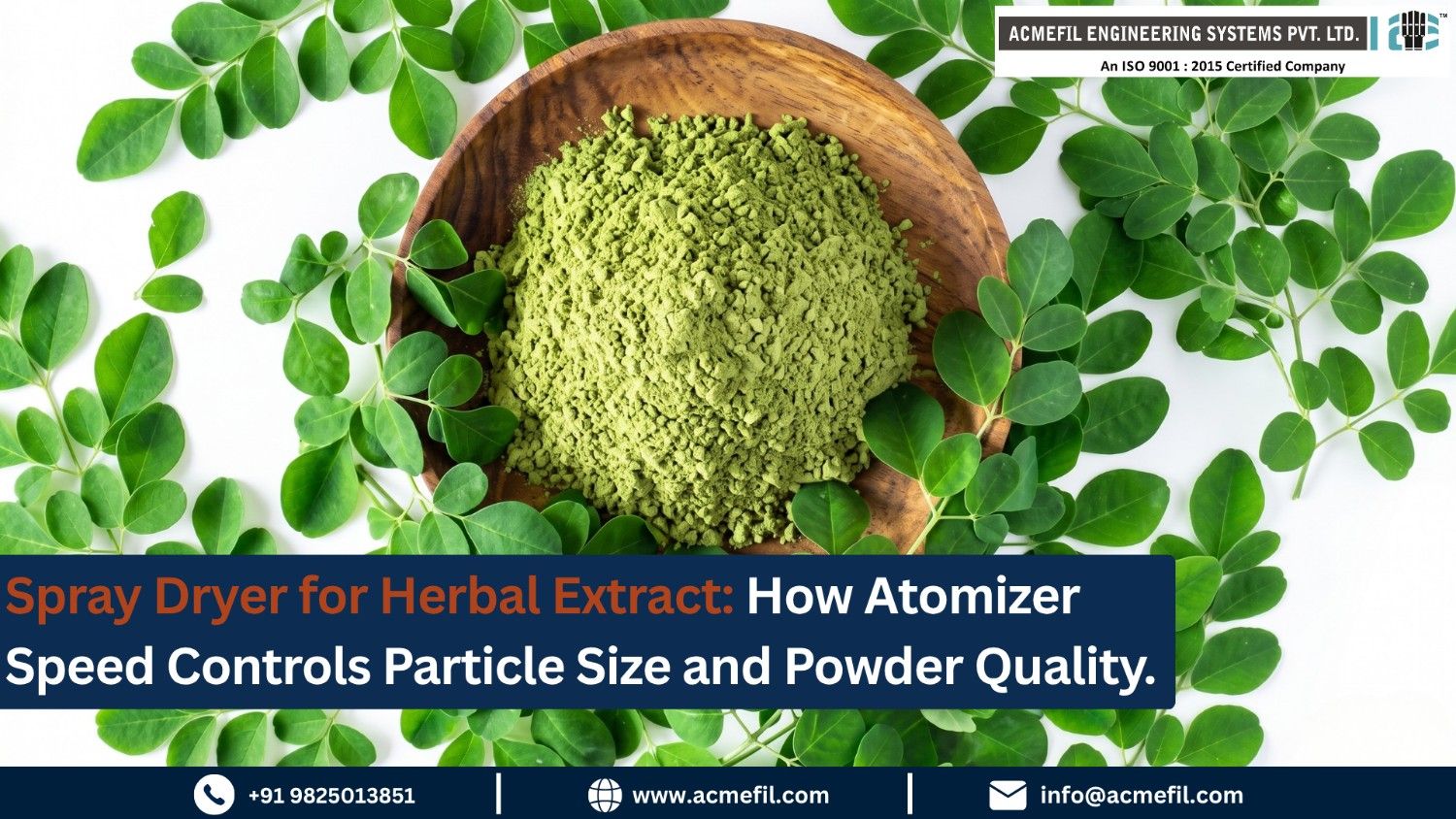
A spray dryer for herbal extract converts liquid or concentrated botanical extract into a stable powder by atomizing the feed into fine droplets and drying those droplets in hot air. For herbal products, the real challenge is not simply “removing water.” The challenge is protecting active compounds, controlling stickiness, achieving the required particle size, and producing a powder that flows, dissolves, and packs consistently.
In my view, atomizer speed and particle size are two of the most important variables to study before buying or scaling a herbal extract spray dryer.
Why Herbal Extract Spray Drying Is Different
Herbal extracts are not simple liquids. They may contain plant solids, sugars, organic acids, tannins, pigments, volatile compounds, and heat-sensitive active ingredients. Some extracts behave like thin liquids. Others behave like sticky syrups after concentration.
That difference changes the dryer design.
A herbal extract spray dryer must be evaluated around:
- Feed concentration and viscosity
- Heat sensitivity of the active compounds
- Stickiness and wall deposition tendency
- Carrier or excipient requirement
- Solvent or water-based feed condition
- Target moisture content
- Final particle size distribution
- Powder solubility and bulk density
- Hygiene and cleanability requirements
This is why I do not recommend selecting a dryer only from catalogue capacity. A 100 kg/hr water evaporation plant may still fail if the feed viscosity, atomization method, and drying chamber design do not match the extract.
For a broader foundation, you can also read this guide on spray dryer applications and the practical article on spray dryer atomization techniques.
Where Spray Dryers Are Used for Herbal Extract Powder
Spray drying is commonly used when herbal extract needs to be converted into a dry, usable powder for commercial handling. Typical end-use areas include:
- Nutraceutical powders
- Ayurvedic and botanical formulations
- Instant herbal beverages
- Food and beverage ingredients
- Herbal cosmetic actives
- Pharmaceutical and phytopharmaceutical intermediates
- Encapsulated active compounds
- Functional food blends
The benefit is simple: powder is easier to store, transport, dose, blend, and pack than liquid extract. But the powder must retain the expected colour, aroma, solubility, and active profile. Poor drying can darken the powder, create lumps, reduce solubility, or reduce product recovery because sticky material deposits on the dryer wall.
How a Spray Dryer Converts Herbal Extract into Powder
The basic spray drying process has four stages.
| Stage | What Happens | Why It Matters for Herbal Extract |
|---|---|---|
| Atomization | Liquid extract is broken into droplets | Droplet size strongly affects drying rate and powder particle size |
| Spray-air contact | Droplets meet controlled hot air | Poor air contact causes uneven drying and sticky deposits |
| Drying | Moisture evaporates from each droplet | Heat-sensitive actives need controlled exposure |
| Powder separation | Powder is recovered through cyclone and bag filter | Fine particles need efficient recovery to reduce loss |
The feed may be a water-based extract, concentrated extract, emulsion, or formulated liquid containing carrier solids. If the feed contains alcohol or another solvent, the dryer configuration changes. In such cases, a closed-loop spray dryer with nitrogen atmosphere and solvent recovery may be required instead of a standard open-cycle air system.
Atomizer Speed and Particle Size in Herbal Extract Spray Drying
Atomizer speed directly affects droplet size in a rotary atomizer spray dryer. In general, higher rotary atomizer speed produces smaller droplets. Smaller droplets usually dry faster and produce finer powder. Lower speed generally produces larger droplets, which may create coarser powder and require more drying time.
But this is not a one-variable equation.
Final particle size also depends on:
- Feed solids concentration
- Feed viscosity
- Feed rate
- Surface tension
- Carrier type and dosage
- Atomizer disc design
- Inlet and outlet air temperature
- Chamber residence time
- Fines return or agglomeration system
- Powder collection system
For herbal extract, this is especially important because sticky extracts can behave differently from clean aqueous solutions. Increasing atomizer speed may create finer droplets, but it may also increase the amount of fine powder reaching the cyclone and bag filter. If the powder is hygroscopic, very fine particles may become difficult to recover cleanly.
What Happens When Particle Size Is Too Fine?
Fine herbal extract powder can be useful when the product must dissolve quickly or disperse into a beverage, capsule blend, or formulation. But very fine powder is not always better.
Possible issues include:
- Higher dusting during packing
- Lower bulk density
- Poor flowability
- Higher cyclone and bag filter loading
- More powder loss if recovery is not designed correctly
- Higher chance of sticky deposits if particles contact humid surfaces
- More handling difficulty in downstream blending
This is one common buyer mistake. They ask for “very fine powder” without defining whether the powder must flow, dissolve, compress, blend, or fill into sachets. Particle size must be connected to the final use of the powder.
What Happens When Particle Size Is Too Coarse?
Coarser particles can improve flow and reduce dusting, but large droplets may not dry fully if the dryer does not provide enough residence time. In herbal extract drying, this can lead to:
- Wet or tacky powder
- Higher final moisture
- Lumps in the collection bin
- Wall deposition in the chamber
- Poor shelf stability
- Uneven solubility
- Reduced powder recovery
The correct particle size is not the smallest possible size. It is the particle size that matches the product’s drying behaviour, moisture target, and downstream use.
Rotary Atomizer vs Nozzle Atomizer for Herbal Extract
Both rotary atomizer and nozzle atomizer systems can be used in spray drying. The better choice depends on the feed and the powder target.
| Selection Point | Rotary Atomizer | Pressure / Two-Fluid Nozzle |
|---|---|---|
| Feed flexibility | Better for variable feed rates and many slurry-like feeds | Better when feed can be pumped and atomized consistently |
| Particle size control | Controlled through disc design and atomizer speed | Controlled through nozzle design, pressure, compressed air, and flow |
| Typical powder profile | Useful for fine to medium powders with controlled droplet formation | Useful when a specific morphology or finer atomization is required |
| Maintenance sensitivity | Atomizer disc condition matters | Nozzle blockage and wear must be managed |
| Herbal extract fit | Often suitable when feed viscosity varies after concentration | Useful for low-viscosity extract or trial-scale formulation work |
| Scale-up concern | Speed, feed rate, and chamber airflow must be matched | Nozzle pressure, orifice, and compressed air demand must be validated |
For many herbal extracts, I prefer to evaluate both feed behaviour and target powder property before selecting the atomizer. A rotary atomizer may be better when droplet size control and feed flexibility are important. A nozzle system may be preferred where a specific particle morphology or very fine powder target is required.
You can compare both technologies in more detail in this guide on nozzle vs rotary atomizer spray dryers.
Why Feed Concentration Matters Before Atomizer Speed
Atomizer speed cannot solve a badly prepared feed.
If the herbal extract is too dilute, the dryer must evaporate unnecessary water. This increases utility consumption and reduces throughput. If the feed is too concentrated, viscosity may rise sharply, atomization may become poor, and sticky wall deposits may increase.
The right feed concentration depends on:
- Extract type
- Solids content
- Viscosity curve
- Carrier requirement
- Thermal sensitivity
- Pumpability
- Required final moisture
- Powder recovery target
For some herbal extracts, upstream concentration using an evaporator may be required before spray drying. The aim is to increase solids without damaging heat-sensitive compounds. Where concentration is part of the process, the drying system should not be treated as a standalone machine. It should be designed as a complete process line.
Carrier Selection for Sticky Herbal Extracts
Many herbal extracts are sticky because they contain sugars, acids, or low glass-transition compounds. In such cases, spray drying without a carrier may produce powder that sticks to the chamber wall instead of flowing to the collection system.
Common carrier or formulation decisions may include:
- Maltodextrin or similar drying carriers
- Gum-based carriers where permitted
- Starch or compatible excipients
- Anti-caking support where formulation allows
- Solids ratio adjustment
- Emulsion or dispersion preparation
The carrier should not be added blindly. Too little carrier may not solve stickiness. Too much carrier may dilute the active content and change taste, colour, solubility, or label claims.
For commercial herbal extract powder, the carrier decision is both a process decision and a product formulation decision.
Inlet and Outlet Temperature for Herbal Extract Powder
In spray drying, buyers often focus only on inlet air temperature. That is incomplete.
The outlet air temperature is usually a stronger practical indicator of the drying condition experienced by the product. If outlet temperature is too low, powder may remain moist and sticky. If it is too high, heat-sensitive actives, aroma, or colour may be affected.
The correct temperature profile depends on:
- Type of herbal extract
- Active compound sensitivity
- Feed solids
- Droplet size
- Residence time
- Desired moisture
- Carrier system
- Powder recovery design
I avoid giving one universal temperature for herbal extract spray drying because different botanical extracts behave differently. Rose hip, camomile, turmeric, ashwagandha, green tea, amla, aloe, and other extracts will not necessarily respond the same way.
A good process engineer does not copy temperature settings from another product. He validates the extract.
Practical Trial Matrix Before Full-Scale Spray Dryer Selection
Before finalizing a spray dryer for herbal extract, run trials with a defined matrix. The aim is not only to “make powder.” The aim is to find a stable operating window.
| Trial Variable | What to Test | What to Observe |
|---|---|---|
| Feed solids | Low, medium, high concentration | Viscosity, pumpability, dryer load |
| Carrier dosage | Different carrier ratios | Stickiness, active dilution, solubility |
| Atomizer speed | Multiple rotary speed settings | Particle size, wall deposition, powder recovery |
| Feed rate | Gradual increase | Outlet temperature stability and moisture |
| Inlet/outlet temperature | Controlled drying profile | Colour, aroma, final moisture |
| Powder recovery | Cyclone and bag filter performance | Fine powder loss and dust loading |
| Final powder | Moisture, solubility, bulk density, flow | Suitability for packing and downstream use |
At Acmefil, this is where pilot plant work becomes useful. A pilot spray dryer trial helps the buyer understand whether the extract can be dried cleanly before committing to full-scale procurement.
For early-stage work, see the article on small-scale spray dryer production and Acmefil’s pilot spray dryer support page.
How to Control Particle Size Without Damaging the Product
Particle size control should be done through a balanced process, not only through atomizer speed.
A practical control sequence is:
- Fix the product objective first
Define whether the powder is for capsules, sachets, beverage mix, tablet granulation, cosmetic active blending, or bulk ingredient supply. - Characterize the feed
Measure solids, viscosity, pH, density, surface behaviour, and heat sensitivity. - Select atomizer type
Choose rotary atomizer, pressure nozzle, or two-fluid nozzle based on feed and powder target. - Adjust atomizer energy
Increase or reduce rotary speed, nozzle pressure, or compressed air based on droplet size and powder result. - Match drying air and residence time
Smaller droplets dry faster. Larger droplets need enough time and air contact. - Validate powder properties
Measure moisture, particle size distribution, bulk density, flowability, solubility, colour, and active content where required.
This is the difference between “spray drying a sample” and designing a reliable herbal extract powder process.
Common Mistakes in Herbal Extract Spray Drying
Choosing the dryer only by evaporation capacity
Capacity matters, but it is not the full design. Herbal extract feed behaviour can reduce practical throughput if viscosity, stickiness, or heat sensitivity is not handled.
Ignoring atomizer speed during trials
If particle size is not measured at different atomizer speeds, the buyer may not know the best operating range. This creates scale-up risk.
Running trials without checking powder recovery
A trial that produces powder but loses a large percentage in cyclone fines is not a successful trial. Powder recovery must be evaluated.
Overheating to solve stickiness
Higher temperature may reduce moisture but can also affect colour, aroma, and active compounds. Stickiness should be solved through formulation, solids, atomization, and drying profile together.
Using too much carrier
Carrier can improve drying, but excess carrier can reduce active strength and affect commercial value. The formulation must match the final product claim.
Skipping pilot validation
A herbal extract spray dryer is capital equipment. If the extract is commercially important, pilot trials are not an extra step. They are risk control.
What Data Should You Share Before Asking for a Spray Dryer Quote?
To recommend the right spray dryer for herbal extract, the equipment manufacturer needs more than the product name.
Share these details:
- Name of herbal extract
- Water-based or solvent-based feed
- Feed solids percentage
- Feed viscosity at operating temperature
- Current concentration method
- Desired final moisture
- Target particle size range
- Required bulk density
- Heat-sensitive active compounds, if known
- Carrier or excipient allowed or not allowed
- Food, nutraceutical, cosmetic, or pharma use
- Batch or continuous production requirement
- Expected water evaporation load
- Cleaning and hygiene requirement
- Available utilities
- Powder packing method
This information helps avoid under-designed chambers, wrong atomizer selection, poor recovery, and unrealistic capacity assumptions.
When Should You Use a Closed Loop Spray Dryer?
A closed loop spray dryer should be considered when the herbal extract feed contains flammable solvent or when oxidation-sensitive material needs controlled atmosphere drying.
In a closed loop system, drying is carried out in a nitrogen atmosphere and solvent recovery becomes part of the design. This is not the same as a normal open-cycle hot air spray dryer.
For solvent-based herbal extracts, the dryer selection must include safety, solvent recovery, oxygen control, and explosion risk evaluation. This should be reviewed technically before final proposal.
What Makes a Good Spray Dryer for Herbal Extract?
A good herbal extract spray dryer is not defined by shiny stainless steel alone. It is defined by process stability.
Look for these design factors:
- Correct atomizer selection
- Stable outlet temperature control
- Suitable drying chamber residence time
- Proper cyclone and bag filter sizing
- Low wall deposition tendency
- Hygienic construction where required
- Easy cleaning access
- Feed system suitable for viscosity
- Trial-backed operating parameters
- Ability to scale from pilot data
- Support for formulation and process optimization
For a deeper operating view, read spray dryer operating principles and best practices and optimize spray drying parameters.
Acmefil’s Approach to Herbal Extract Spray Dryer Selection
At Acmefil, we do not treat herbal extract drying as a standard machine sale. We first look at the feed and the powder target.
The first questions I would ask are:
- Is the extract water-based or solvent-based?
- What is the feed solids percentage?
- What particle size is required and why?
- Is the powder meant for instant solubility, capsule filling, tablet blending, or bulk ingredient supply?
- Is the extract sticky or hygroscopic?
- Is a carrier permitted?
- What final moisture and active retention are expected?
- Has the product been tested at pilot scale?
Acmefil manufactures rotary atomizer, nozzle type, fluidized, closed loop, sterile, and pilot spray dryer systems. For herbal extract applications, the most important step is selecting the correct configuration before scale-up.
Buyers can review Acmefil’s rotary atomizer type spray dryer, nozzle atomizer type spray dryer, and spray dryer manufacturer pages for equipment-level context.
Final Takeaway
A spray dryer for herbal extract must be designed around the extract, not around a generic catalogue capacity. Atomizer speed affects droplet size, and droplet size affects particle size, drying rate, recovery, flowability, and powder quality. But atomizer speed works together with feed solids, viscosity, carrier formulation, drying temperature, residence time, and powder collection.
For serious commercial herbal extract powder production, validate the process on a pilot spray dryer before finalizing the full-scale plant. That one step can prevent wrong atomizer selection, poor powder recovery, wall deposition, and unstable product quality.
FAQs
Which spray dryer is best for herbal extract?
The best spray dryer for herbal extract depends on feed type, solvent condition, viscosity, heat sensitivity, and target particle size. Rotary atomizer dryers are often suitable for flexible feed handling and particle size control. Nozzle atomizer dryers may suit lower-viscosity feeds or specific morphology targets. Solvent-based extracts may require closed loop drying.
How does atomizer speed affect particle size in herbal extract spray drying?
In a rotary atomizer spray dryer, higher atomizer speed generally creates smaller droplets. Smaller droplets usually dry faster and produce finer powder. However, final particle size also depends on feed solids, viscosity, feed rate, carrier, drying temperature, and powder recovery system.
Why does herbal extract powder become sticky during spray drying?
Herbal extract powder may become sticky because many extracts contain sugars, acids, pigments, or low glass-transition compounds. If the outlet moisture is high, carrier selection is poor, or droplets are not dried properly, powder can deposit on the chamber wall or form lumps.
Do herbal extracts need carriers before spray drying?
Some herbal extracts need carriers to reduce stickiness and improve powder recovery. Carrier selection depends on the extract, permitted formulation, active content target, solubility, and end-use requirement. Carrier should be tested in trials rather than selected blindly.
Can lab spray dryer results be scaled directly to industrial spray dryers?
Lab results are useful, but direct scale-up without pilot validation is risky. Industrial spray dryers have different chamber geometry, airflow, residence time, atomization behaviour, and recovery systems. Pilot trials help define a more reliable operating window before full-scale investment.
Planning to convert herbal extract into stable powder? Share your feed concentration, solvent condition, target moisture, particle size requirement, and end-use application. Acmefil can review the process data and recommend whether rotary atomizer, nozzle atomizer, closed loop, or pilot-scale testing is the right next step.
For process discussion, use the SprayDryer.com contact page or review Acmefil’s pilot spray dryer support option before full-scale procurement.

Siddharth Nair is Technical Director at Acmefil Engineering Systems Pvt. Ltd. he leads solution design and applications engineering across the company’s full product range — spray dryers, multi-effect evaporators, agitated thin film dryers, spin flash dryers, fluid bed dryers, and complete ZLD systems.
His work spans process evaluation, equipment sizing, customer application consulting, and technical proposal development for industries including food and dairy, pharmaceuticals, chemicals, dyestuffs, ceramics, and industrial effluent treatment. He has hands-on commissioning experience across Acmefil’s 500+ installations in India and 15+ countries.
He holds a BTech in Mechanical Engineering from CHARUSAT University and also partners at A.S Engineers, working with blowers, sludge dryers, and industrial conveying systems.


