
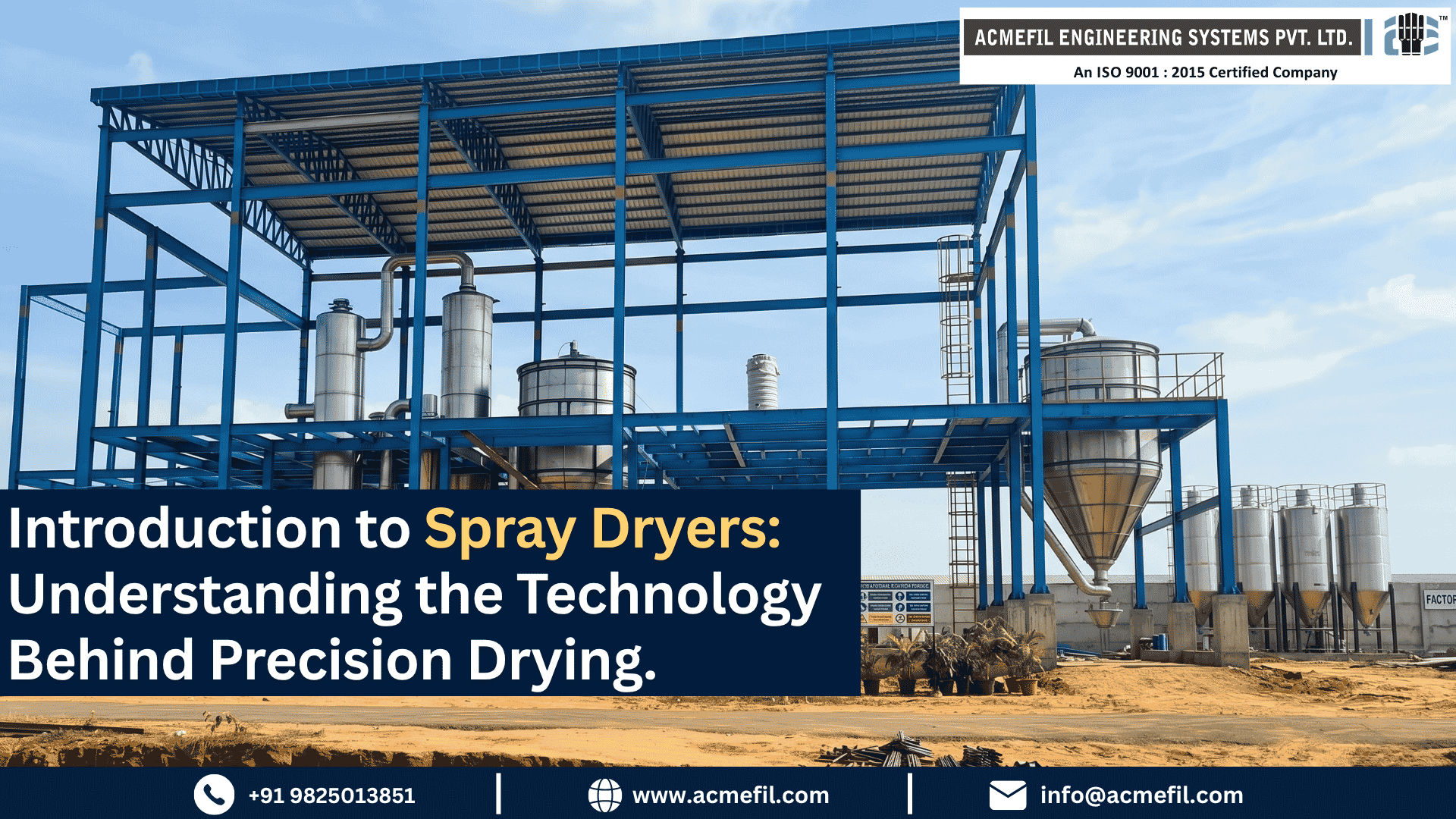
A spray dryer converts a pumpable liquid, slurry, suspension, or emulsion into dry powder by atomizing the feed into fine droplets, contacting those droplets with hot air, evaporating moisture, and separating the dried particles from the exhaust air. In my view, spray drying becomes precision drying only when feed properties, atomizer selection, air temperature, residence time, and powder separation are designed as one system.
I have seen buyers treat a spray dryer as a simple “liquid in, powder out” machine. That is where mistakes begin. The dryer does not only remove water. It decides particle size, moisture content, bulk density, solubility, heat exposure, powder flow, and sometimes whether the product is usable at all.
For a wider technical foundation, also read our guide on spray dryer design and components and the practical guide on choosing the right spray dryer.
What Is a Spray Dryer?
A spray dryer is an industrial drying system used to convert liquid feed into dry particulate powder in a continuous process.
The feed may be a solution, slurry, suspension, emulsion, extract, concentrate, or pumpable paste depending on the product. The liquid is first broken into droplets by an atomizer. These droplets meet hot drying air inside a chamber. Moisture evaporates quickly because the droplet surface area is very high. The dried powder is then recovered through a cyclone, bag filter, or combined separation system.
The important point is this: the spray dryer is not just a heater. It is a particle formation system.
That is why spray dryers are widely used for:
| Industry | Typical Spray Drying Applications |
|---|---|
| Food and dairy | Milk products, egg products, beverages, food colours, maltodextrin, soup mixes, enzymes |
| Pharmaceuticals and biochemicals | Herbal extracts, dextrose, lactose, proteins, hemoglobin, heat-sensitive powders |
| Dyestuff and pigments | Reactive dyes, disperse dyes, acid dyes, direct dyes, vat dyes, pigments |
| Ceramics | Alumina, aluminium silicate, china clay, ferrites, zirconia, steatites |
| Inorganic chemicals | Sodium silicate, barium sulphate, calcium chloride, manganese sulphate, catalysts |
| Detergents | Zeolite, SLS, alkyl benzene sulphonate, detergent powder ingredients |
If your feed can be atomized and your final product must be a powder, granule, or particulate solid, spray drying is often worth evaluating.
How Does the Spray Drying Process Work?
The spray drying process has four core stages.
| Stage | What Happens | Why It Matters |
|---|---|---|
| Atomization | Liquid feed is broken into droplets using a rotary atomizer, pressure nozzle, or two-fluid nozzle. | Droplet size influences drying time, particle size, powder shape, and moisture uniformity. |
| Spray-air contact | Droplets meet hot drying air inside the chamber. | Airflow pattern affects residence time, wall deposition, heat exposure, and final powder quality. |
| Drying of droplets | Moisture evaporates from the droplet surface and the particle forms. | Inlet and outlet temperature control product moisture and heat damage risk. |
| Powder separation | Dried powder is separated from exhaust air using cyclone, bag filter, or other collection systems. | Poor separation leads to product loss, dust issues, and inconsistent recovery. |
Each stage depends on the previous one. If atomization is wrong, the chamber cannot correct it. If the feed solids are too low, the hot air system has to evaporate unnecessary water. If outlet temperature is not controlled, final moisture may drift. If separation is undersized, good powder can still be lost.
This is why proper spray dryer design begins with process data, not only machine capacity.
Why Is Atomization So Important in Spray Dryers?
Atomization decides the starting droplet size. Starting droplet size strongly influences final powder behavior.
In a rotary disc type spray dryer, atomization is achieved through a high-speed centrifugal disc. In Acmefil’s rotary disc spray dryer range, fine droplets in the 20 to 75 micron range are formed by centrifugal force. This is useful for slurries and applications where droplet size control is important.
In a nozzle type spray dryer, the feed is atomized through either:
- Pressure nozzle atomization, where feed is pumped through an orifice under pressure.
- Two-fluid nozzle atomization, where compressed air assists atomization for finer particles.
For a deeper comparison, read our guide on nozzle vs rotary atomizer spray dryers and our article on spray dryer atomization techniques.
Rotary Atomizer vs Nozzle Atomizer: Which One Should You Choose?
There is no universal answer. The right atomizer depends on feed properties, particle size target, chamber design, operating pressure, maintenance preference, and product behavior.
| Selection Factor | Rotary Atomizer | Pressure Nozzle | Two-Fluid Nozzle |
|---|---|---|---|
| Basic mechanism | High-speed rotating disc throws liquid outward into droplets. | Pressurized liquid passes through a nozzle orifice. | Liquid is atomized with compressed air or gas. |
| Good fit | Slurries, suspended solids, dye, ceramic, food, pigment applications. | Granular or coarser powder where nozzle geometry is suitable. | Fine powders, lab trials, small batch development, sensitive feeds. |
| Design caution | Needs correct disc selection, speed control, and maintenance access. | Orifice wear and clogging must be considered. | Compressed air cost and capacity limitations must be checked. |
| Buyer mistake | Selecting only by price instead of feed behavior. | Assuming all liquid feeds will pass through the nozzle consistently. | Using pilot-scale logic without checking full-scale economics. |
At Acmefil, this selection is not treated as a catalogue choice. The feed characteristics and powder target decide the technology.
Relevant Acmefil equipment pages include rotary atomizer type spray dryer, nozzle atomizer type spray dryer, rotary atomizer, and spray nozzles.
What Happens Inside the Drying Chamber?
The drying chamber is where liquid droplets become particles.
Hot air enters the chamber and contacts the atomized feed. Moisture begins evaporating from the droplet surface almost immediately. During the early stage of drying, evaporation protects the product from direct heat damage because energy is consumed in moisture removal. As the particle dries, the remaining moisture becomes harder to remove and the particle temperature can rise.
This is why outlet temperature is so important. Operators often watch inlet temperature, but outlet temperature usually gives a better indication of final moisture and thermal load on the product.
For heat-sensitive materials such as enzymes, herbal extracts, food ingredients, and pharmaceutical intermediates, the drying profile matters more than the maximum heater capacity.
A good spray dryer design must answer:
- How much moisture has to be removed?
- What is the feed solids percentage?
- What is the inlet and outlet moisture target?
- Is the product heat-sensitive?
- Is the feed water-based, solvent-based, or oxygen-sensitive?
- What particle size and bulk density are required?
- Is the powder sticky, hygroscopic, dusty, or abrasive?
- What recovery system is needed after the chamber?
If these questions are not answered before design, the buyer is only purchasing steel, not a process solution.
Main Types of Spray Dryers
Spray dryers are not all the same. Different product requirements need different dryer configurations.
| Spray Dryer Type | How It Works | Suitable Applications | Practical Selection Note |
|---|---|---|---|
| Rotary Disc Type Spray Dryer | Uses high-speed centrifugal disc atomization. | Dyes, ceramics, food, milk products, pharmaceuticals, detergents, pigments, inorganic chemicals. | Useful where droplet size control and slurry handling are important. |
| Nozzle Type Spray Dryer | Uses pressure nozzle or two-fluid nozzle atomization. | Heat-sensitive products, enzymes, flavours, food processing, pharmaceutical applications. | Nozzle selection must consider viscosity, solids, pressure, and clogging risk. |
| Fluidized Spray Dryer | Produces larger particles and uses integrated fluid bed drying. | Detergents, food ingredients, agglomerated powders. | Acmefil’s fluidized spray dryer range is suited where larger particle size is required. |
| Closed Loop Spray Dryer | Uses nitrogen atmosphere with solvent recovery. | Solvent-based and oxygen-sensitive products. | Required when open hot air drying would create solvent or oxidation risk. |
| Sterile Spray Dryer | Uses sterile filtration and controlled drying environment. | Pharmaceutical and aseptic powder applications. | Needs hygienic design, filtration, and process control. |
| Lab Scale Pilot Spray Dryer | Small-scale system for trials and process development. | R&D, universities, research institutes, new product trials. | Useful before committing to full-scale plant design. |
Acmefil manufactures multiple spray dryer configurations, including fluidized spray dryer, closed loop spray dryer, and pilot spray dryer.
What Makes Spray Drying a Precision Drying Technology?
Spray drying gives process engineers control over more than moisture removal.
Precision comes from controlling these variables together:
| Control Variable | What It Influences |
|---|---|
| Feed solids percentage | Energy load, drying time, powder density, throughput |
| Feed viscosity | Atomization quality, nozzle selection, pumpability |
| Atomizer type and speed | Droplet size, particle size, distribution pattern |
| Inlet temperature | Evaporation rate and thermal energy input |
| Outlet temperature | Final moisture and product heat exposure |
| Airflow pattern | Residence time, drying uniformity, wall deposition |
| Chamber geometry | Particle path, drying time, wall contact |
| Separation system | Powder recovery, dust control, product loss |
| Fluid bed integration | Agglomeration, final moisture correction, larger particles |
A spray dryer is precise only when these variables are matched to the product. A dye slurry, milk concentrate, ceramic slurry, herbal extract, and enzyme solution cannot be treated as the same feed.
Where Do Spray Dryers Create the Most Value?
Spray dryers are valuable when the final product needs to be a powder with controlled properties.
Common reasons to use spray drying include:
- Converting liquid feed into free-flowing powder.
- Reducing transport weight and storage volume.
- Improving shelf stability where moisture reduction is required.
- Producing controlled particle size.
- Drying heat-sensitive products quickly.
- Creating powders suitable for mixing, packaging, dosing, or further processing.
- Supporting continuous production instead of slow batch drying.
For food applications, see our guide on benefits of using a spray dryer in food processing. For pharmaceutical use cases, read spray dryer applications in pharmaceuticals.
When Is Spray Drying Not the Right First Choice?
This is important. Spray drying is powerful, but it is not the correct answer for every drying problem.
You should evaluate another technology when:
- The feed cannot be pumped or atomized reliably.
- The product is too sticky at the expected outlet condition.
- The required powder form is flakes, not particles.
- Energy cost becomes too high because feed solids are too low.
- The product requires extremely low-temperature drying that spray drying cannot support.
- The material is solvent-based and the buyer is not ready for closed loop design.
- The expected capacity is too low for industrial economics unless pilot or lab production is the goal.
In some cases, a spin flash dryer, flash dryer, fluid bed dryer, evaporator, or ATFD may be more suitable. That decision should come from feed testing and process economics, not from preference.
For broader comparison, read comparing spray drying with other technologies.
What Process Data Is Needed Before Designing a Spray Dryer?
A serious spray dryer proposal should begin with the feed and powder target.
Before asking for a quotation, prepare these details:
| Data Required | Why It Matters |
|---|---|
| Feed type | Solution, slurry, suspension, emulsion, extract, concentrate, or paste |
| Feed solids percentage | Determines water evaporation load and energy requirement |
| Feed viscosity | Affects pump selection and atomization method |
| Feed temperature | Influences thermal balance |
| Required capacity | Defines chamber size, air handling, heat load, and collection system |
| Final moisture target | Controls outlet temperature and drying duty |
| Particle size target | Influences atomizer and chamber selection |
| Heat sensitivity | Determines air temperature limits and residence time |
| Solvent or water base | Decides open cycle or closed loop system |
| Stickiness or hygroscopicity | Affects wall deposition and powder handling |
| Bulk density requirement | Influences atomization, agglomeration, and fluid bed integration |
| Product recovery expectation | Decides cyclone, bag filter, or combined separation approach |
| Cleaning requirement | Important for food, pharma, and product changeover |
At Acmefil, we use this data to decide whether the project needs a rotary atomizer type, nozzle atomizer type, fluidized spray dryer, closed loop design, sterile configuration, or pilot trial before scale-up.
Common Spray Dryer Problems and What They Usually Indicate
Spray dryer problems often look like operating issues, but many begin with design or feed mismatch.
| Problem | Possible Cause |
|---|---|
| Powder moisture is too high | Outlet temperature too low, feed rate too high, poor atomization, insufficient residence time |
| Powder is burnt or degraded | Outlet temperature too high, residence time too long, incorrect air pattern |
| Wall deposition | Sticky product behavior, wrong chamber design, incorrect inlet/outlet condition, poor droplet trajectory |
| Inconsistent particle size | Atomizer wear, unstable feed pressure, variable solids, incorrect atomizer selection |
| Low powder recovery | Cyclone or bag filter mismatch, fine particles, air leakage, incorrect separation design |
| Nozzle clogging | High solids, poor filtration, unsuitable nozzle design, unstable feed |
| Dusty powder | Particle size too fine, poor agglomeration, incorrect atomization setting |
| Poor flowability | Particle morphology, moisture, fines content, lack of agglomeration |
For operation-focused guidance, read spray dryer troubleshooting common issues and optimize spray drying parameters.
How Acmefil Approaches Spray Dryer Selection
Acmefil Engineering Systems Pvt. Ltd. is an ISO 9001:2015 certified manufacturer of drying and concentrating equipment, incorporated in 2000 and headquartered in Ahmedabad, Gujarat.
For spray dryer projects, we do not begin with only a machine model. We begin with the process.
The practical evaluation usually includes:
- Understanding feed composition, solids, viscosity, and heat sensitivity.
- Defining the target powder properties.
- Selecting the right atomization system.
- Designing chamber geometry and air pattern.
- Selecting hot air generation and air handling.
- Planning powder recovery through cyclone, bag filter, or combined system.
- Reviewing cleaning, automation, and installation requirements.
- Recommending pilot testing where product behavior is uncertain.
Acmefil’s in-house R&D pilot plant includes a spray dryer with 3 kg/hr water evaporation capacity. Pilot testing is useful when the buyer needs to validate powder behavior, moisture target, atomization method, or scale-up assumptions before full-scale procurement.
You can also review Acmefil’s spray dryer manufacturer page for equipment options and the lab scale spray dryers page for trial and development context.
Buyer Mistakes I Would Avoid
If you are evaluating spray dryers for a new project, avoid these mistakes.
- Do not compare vendors only by chamber diameter or price.
- Do not finalize atomizer type before testing feed behavior.
- Do not ignore feed solids percentage. It directly affects heat load.
- Do not assume a lab result will scale automatically to full production.
- Do not treat outlet temperature as a minor operating number.
- Do not select open cycle drying for solvent-based or oxygen-sensitive products without reviewing closed loop requirements.
- Do not forget powder separation. Product recovery is part of the drying system.
- Do not finalize the dryer without discussing cleaning, maintenance access, and spares.
Spray drying is a process decision before it is a purchase decision.
Practical Selection Summary
| If Your Priority Is… | Focus On… | Likely Direction |
|---|---|---|
| Fine powder from slurry | Droplet size control, feed solids, rotary disc design | Rotary disc type spray dryer |
| Heat-sensitive product | Outlet temperature, residence time, air pattern | Co-current or suitable nozzle/rotary design |
| Solvent recovery | Nitrogen atmosphere, safety controls, condenser/recovery | Closed loop spray dryer |
| Larger agglomerated particles | Fluid bed integration, fines recycling | Fluidized spray dryer |
| Pharmaceutical sterile powder | Filtration, hygiene, closed/sterile design | Sterile spray dryer |
| New product development | Trial batch, data collection, atomizer comparison | Pilot spray dryer |
| Moisture troubleshooting | Outlet temperature, feed rate, atomization, separation | Process optimization review |
Final Technical Takeaway
A spray dryer is the right technology when you need to convert a liquid feed into a controlled powder in one continuous operation. But the quality of that powder depends on engineering decisions made before fabrication: feed characterization, atomizer type, chamber design, air temperature profile, residence time, and recovery system.
The best spray dryer is not the largest one or the cheapest one. It is the one designed around your product.
For the next step, study spray dryer operating principles and best practices or send your feed details through the spray dryer enquiry page so our team can review your application.
FAQs
What is the basic working principle of a spray dryer?
A spray dryer works by atomizing liquid feed into fine droplets, contacting those droplets with hot drying air, evaporating moisture, and separating the dried powder from the exhaust air. The process is continuous and is used when the final product must be a powder or granular material.
What products can be dried in a spray dryer?
Spray dryers can process many pumpable feeds, including food ingredients, milk products, herbal extracts, enzymes, dyestuff, pigments, ceramics, detergents, inorganic chemicals, and pharmaceutical intermediates. Suitability depends on feed viscosity, solids content, heat sensitivity, stickiness, solvent content, and the required powder properties.
What is the difference between a rotary atomizer and a nozzle atomizer?
A rotary atomizer uses a high-speed rotating disc to form droplets by centrifugal force. A nozzle atomizer uses pressure or compressed air to break the liquid into droplets. Rotary atomizers are often useful for slurries and suspended solids, while nozzle systems are selected where pressure, particle target, and feed behavior make them suitable.
Why is outlet temperature important in spray drying?
Outlet temperature is closely linked to final moisture and product heat exposure. If the outlet temperature is too low, the powder may remain wet. If it is too high, heat-sensitive products may degrade. In practical operation, outlet temperature often tells more about drying performance than inlet temperature alone.
Should I run a pilot trial before buying a spray dryer?
A pilot trial is recommended when the product is new, heat-sensitive, sticky, solvent-based, high-value, or difficult to atomize. Acmefil’s R&D pilot plant includes a spray dryer with 3 kg/hr water evaporation capacity, which helps buyers validate process behavior before committing to a full-scale system.
Need Help Selecting the Right Spray Dryer?
Share your feed details, solids percentage, target moisture, required capacity, heat sensitivity, particle size target, and whether the feed is water-based or solvent-based.
Acmefil can review the application and recommend whether your process needs a rotary atomizer spray dryer, nozzle atomizer spray dryer, fluidized spray dryer, closed loop spray dryer, sterile spray dryer, or pilot trial.
Send Your Spray Dryer Requirement

Siddharth Nair is Technical Director at Acmefil Engineering Systems Pvt. Ltd. he leads solution design and applications engineering across the company’s full product range — spray dryers, multi-effect evaporators, agitated thin film dryers, spin flash dryers, fluid bed dryers, and complete ZLD systems.
His work spans process evaluation, equipment sizing, customer application consulting, and technical proposal development for industries including food and dairy, pharmaceuticals, chemicals, dyestuffs, ceramics, and industrial effluent treatment. He has hands-on commissioning experience across Acmefil’s 500+ installations in India and 15+ countries.
He holds a BTech in Mechanical Engineering from CHARUSAT University and also partners at A.S Engineers, working with blowers, sludge dryers, and industrial conveying systems.


