
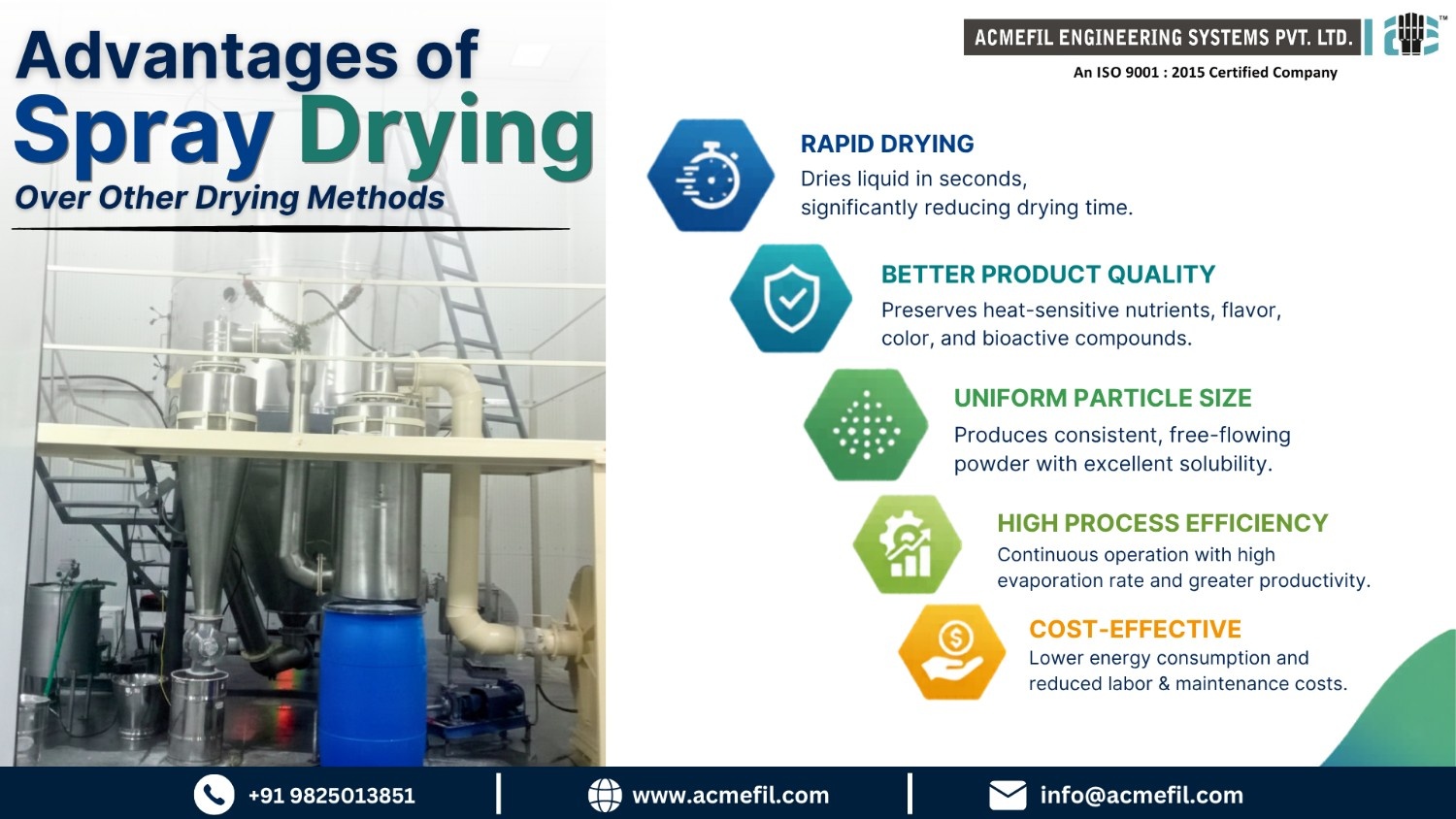
Spray drying is usually the better drying method when your feed is a pumpable liquid, slurry, emulsion, or solution and your final product must be a free-flowing powder with controlled moisture, particle size, solubility, and bulk density. It is not automatically better for every material. Freeze drying, drum drying, tray drying, flash drying, and fluid bed drying each have their place. The advantage of spray drying is that it can convert liquid feed into powder in one continuous process when the product and plant economics justify it.
I see buyers make one common mistake during dryer selection. They compare dryer names before they compare the feed material.
That is the wrong starting point.
A drying method should be selected from the material first. Is the feed liquid or solid? Is it heat-sensitive? Does it contain suspended solids? What final powder size do you need? Will the product be packed, blended, tableted, dispersed in water, or used as an intermediate?
Once these answers are clear, the advantages of spray drying over other drying methods become much easier to judge.
What makes spray drying different?
In spray drying, the feed is atomized into fine droplets and brought into contact with hot drying air. Moisture evaporates rapidly from the droplet surface, and the dried product is separated from the air stream using equipment such as a cyclone, bag filter, or combined separation system.
The process has four basic stages:
- Atomization of liquid feed into droplets
- Contact between spray and hot air
- Rapid drying of droplets into particles
- Separation of dried powder from the air stream
This is why spray drying is different from methods such as tray drying or drum drying. The product is not dried as a thick bed, sheet, cake, or lump. It is dried as individual droplets with a very high surface area.
That surface area is the main reason spray drying can be fast, continuous, and useful for powder engineering.
For a deeper process explanation, read how a spray dryer works and spray dryer operating principles.
Main advantages of spray drying over other drying methods
| Advantage | Why it matters in production | Where it helps most |
|---|---|---|
| Liquid-to-powder conversion in one operation | Reduces the need for separate concentration, drying, crushing, and milling steps in many applications | Food, dairy, chemicals, pharmaceuticals, dyes |
| Controlled particle size | Atomizer type, feed rate, temperature profile, and chamber design influence powder properties | Instant powders, pigments, ceramics, pharma powders |
| Continuous production | Better fit for industrial throughput than many batch drying methods | Large-scale food, chemical, detergent, and ceramic plants |
| Good powder flowability | Spray-dried powders are generally easier to handle, pack, dose, and blend | Milk powder, instant mixes, detergents, pigments |
| Short heat exposure time | Heat-sensitive materials may tolerate the process better than long-duration heating methods when parameters are correct | Flavours, enzymes, herbal extracts, selected pharma feeds |
| Product customization | Moisture, bulk density, solubility, agglomeration, and morphology can be engineered | R&D, formulation development, specialty chemicals |
| Scalability | Pilot trials can be used to reduce risk before full-scale plant design | New product development and export-oriented manufacturing |
| Broad application range | Works with solutions, emulsions, suspensions, and selected slurries | Food, pharma, dyestuff, ceramic, detergents, inorganic chemicals |
Spray drying vs freeze drying
Freeze drying is often selected when maximum preservation of highly sensitive biological, pharmaceutical, or premium food material is the main requirement. It removes moisture through freezing and vacuum sublimation.
Spray drying is usually selected when the requirement is continuous powder production at industrial scale.
In practical terms:
| Selection factor | Spray drying | Freeze drying |
|---|---|---|
| Feed form | Liquid, slurry, emulsion, solution | Usually liquid or frozen product |
| Process style | Continuous or semi-continuous | Mostly batch |
| Drying speed | Faster in many industrial applications | Slower because freezing and sublimation are involved |
| Powder engineering | Strong control over particle size, moisture, bulk density, and solubility | Strong product preservation, less focused on high-throughput powder engineering |
| Best fit | Milk powder, coffee, flavours, detergents, dyes, pigments, ceramics, pharma powders | Very heat-sensitive biologicals, premium ingredients, lab-scale sensitive products |
| Main limitation | Heat and shear must be evaluated carefully | Higher time and capital intensity |
My practical view is simple. If your product cannot tolerate the temperature and shear exposure of atomization and hot air contact, freeze drying may be safer. But if your product can tolerate controlled spray drying conditions and you need industrial powder production, spray drying is usually the more commercially practical route.
For a deeper comparison, see spray dryer vs freeze dryer.
Spray drying vs drum drying
Drum drying works by applying material onto a heated rotating drum. The material dries as a film and is scraped off.
This can be useful for certain pastes or products where sheet-like drying is acceptable. But it is not ideal when the final requirement is a uniform, free-flowing powder with controlled particle size.
Spray drying has the advantage when:
- The feed can be pumped and atomized
- The buyer wants powder directly, not flakes or sheets
- Solubility and dispersibility matter
- Particle size control matters
- Heat exposure must be short and controlled
- Product appearance and flow behavior are important
Drum drying can still make sense for some robust materials where low equipment complexity is more important than powder morphology. But for milk powder, flavours, pigments, detergents, ceramics, and many chemical powders, spray drying gives better control over the final powder form.
For food-specific context, read spray drying vs drum drying in the food industry.
Spray drying vs tray drying
Tray drying is simple and familiar. Wet material is spread on trays and dried using heated air. It is useful for small batches, solids, granules, and products where drying time and manual handling are acceptable.
Spray drying is different because the material does not sit in a bed or layer. It is atomized into droplets.
That gives spray drying three major advantages over tray drying:
- Faster moisture removal because droplets have high surface area
- More uniform powder formation when process conditions are controlled
- Lower manual handling for industrial continuous production
Tray drying may still be suitable for low-volume or non-powder products. But when the final target is a repeatable powder with defined moisture, particle size, solubility, and handling behaviour, spray drying becomes a stronger option.
Spray drying vs fluid bed drying
Fluid bed drying is excellent when the feed is already a solid particle, granule, crystal, or powder. Air passes upward through the product bed and fluidizes the particles. It is widely used for drying, cooling, granulation, and final moisture adjustment.
Spray drying is stronger when the feed starts as a liquid.
That distinction is important.
A spray dryer converts liquid feed into powder. A fluid bed dryer usually dries or conditions an existing solid. In many plants, both technologies can even work together. A spray dryer may create the powder first, and an integrated or external fluid bed may complete final drying, cooling, or agglomeration.
This is why a fluidized spray dryer is useful for applications where larger agglomerated particles are required.
Spray drying vs flash drying
Flash drying is a pneumatic drying method. It is suited for powders, granules, and some filter cakes where moisture is mainly surface moisture and residence time must be short.
Spray drying is preferred when the feed is a liquid or slurry that must become powder.
Flash drying is preferred when:
- The material is already a wet solid or cake
- The requirement is surface moisture removal
- The product does not need atomization
- The process can use pneumatic conveying with hot air
At Acmefil, the distinction matters because a buyer may ask for a spray dryer when the material is actually better suited for a flash dryer or spin flash dryer. If your feed is a slimy paste, gelatinous wet cake, or filter cake, a spin flash dryer may be more practical than a spray dryer.
For broader comparison, read comparing spray drying with other technologies.
Why spray drying gives better particle control
The biggest technical advantage of spray drying is not just speed. It is powder control.
A spray dryer allows the engineer to influence powder properties through:
- Feed concentration
- Feed viscosity
- Atomizer type
- Atomizer speed or nozzle pressure
- Inlet air temperature
- Outlet air temperature
- Chamber residence time
- Airflow pattern
- Separation system
- Optional fluid bed integration
For example, a rotary disc atomizer can be suitable for slurries and applications where droplet control is important. A nozzle atomizer may be selected where the product needs a specific particle morphology, density, or powder behavior. The wrong atomizer can create fines, wall deposition, poor solubility, inconsistent bulk density, or low yield.
That is why I do not recommend selecting a spray dryer only by capacity. Capacity matters, but atomization and product behavior matter just as much.
Read spray dryer atomization techniques and nozzle vs rotary atomizer comparison before finalizing the design route.
Why spray drying is useful for heat-sensitive products
Many buyers assume that hot air always means product damage. That is not always true.
In spray drying, the droplet dries quickly. The product exposure time is short compared with many slow drying methods. Also, evaporating moisture absorbs heat, which can help keep the particle temperature lower than the inlet air temperature during much of the drying process.
This does not mean every heat-sensitive product is safe for spray drying. It means the product must be tested under realistic conditions.
Heat-sensitive spray drying applications can include:
- Flavours
- Herbal extracts
- Enzymes
- Selected pharmaceutical powders
- Food ingredients
- Dairy products
- Certain biochemical feeds
The safe operating window depends on feed solids, thermal sensitivity, viscosity, target outlet temperature, final moisture, and residence time.
This is exactly where pilot trials matter. Acmefil’s pilot spray dryer is used for process development before full-scale design, especially when the product behavior is uncertain.
Industry applications where spray drying has strong advantages
Spray drying is most useful when powder quality and process repeatability both matter.
Common industrial applications include:
| Industry | Typical spray drying use |
|---|---|
| Food and dairy | Milk powder, egg products, beverages, food colours, malto dextrin, soup mixes, vegetable proteins |
| Pharmaceuticals and biochemicals | Herbal extracts, proteins, dextrose, lactose, selected pharma powders |
| Dyestuff and pigments | Reactive dyes, disperse dyes, acid dyes, direct dyes, pigments, dye intermediates |
| Ceramics | Alumina, aluminium silicate, china clay, ferrites, zirconia, steatites |
| Inorganic chemicals | Sodium silicate, silica, catalysts, calcium chloride, manganese sulphate |
| Detergents | Zeolite, detergents, SLS, bleach activators |
| Polymers and resins | ABS, acrylic polymer, PVA, melamine-formaldehyde, urea-formaldehyde |
Acmefil manufactures multiple spray dryer configurations for these application groups, including rotary atomizer type spray dryers, nozzle atomizer type spray dryers, fluidized spray dryers, and closed loop spray dryers.
You can also review applications of spray dryers for a wider overview.
When spray drying is not the best method
A good spray dryer supplier should also tell you when spray drying is not the right answer.
Spray drying may not be the best choice when:
- The feed cannot be pumped or atomized reliably
- The feed viscosity is too high without dilution
- The product cannot tolerate atomization shear
- The product is extremely temperature-sensitive
- The material is already a wet cake better suited to spin flash drying
- The final product does not need powder form
- The production volume does not justify plant investment
- The product requires freeze-dried structure, not spray-dried powder morphology
- Solvent handling or explosion risk has not been engineered properly
For solvent-based or oxidation-sensitive products, open-cycle hot air spray drying is not the answer. A closed loop system using an inert drying medium may be required, and that selection needs proper process and safety review.
This is why process data is not optional. Before recommending equipment, I would want to know the feed composition, feed solids, viscosity, pH, thermal sensitivity, solvent content, target moisture, desired particle size, bulk density, and required production rate.
Practical selection guide: should you choose spray drying?
Use this quick check before speaking with a spray dryer manufacturer.
| Question | If your answer is yes |
|---|---|
| Is your feed a liquid, slurry, solution, or emulsion? | Spray drying may be suitable |
| Do you need free-flowing powder as the final product? | Spray drying becomes stronger |
| Do particle size, solubility, and bulk density matter? | Spray drying gives better engineering control |
| Is continuous production important? | Spray drying may outperform batch methods |
| Is the product heat-sensitive but not extremely fragile? | Pilot spray drying should be tested |
| Is your feed a wet cake or paste? | Check spin flash drying before spray drying |
| Is your product already granular or powdery? | Fluid bed or flash drying may be more suitable |
| Is maximum biological activity preservation the main requirement? | Freeze drying may need evaluation |
How Acmefil reduces spray dryer selection risk
At Acmefil, we do not treat spray drying as only an equipment purchase. It is a process design decision.
The right system depends on:
- Product properties
- Feed behavior
- Required powder characteristics
- Atomizer selection
- Chamber design
- Heating system
- Separation system
- Cleaning requirements
- Plant layout
- Operator skill level
- Utilities and long-term operating cost
Acmefil Engineering Systems Pvt. Ltd. is an ISO 9001:2015 certified manufacturer of drying and concentrating equipment, incorporated in 2000. The company has supplied 500+ installations across India and international markets, with products covering spray dryers, spin flash dryers, flash dryers, fluid bed dryers, multi-effect evaporators, ZLD systems, membrane systems, hot air generators, bag filters, and ancillary equipment.
For new products or uncertain feeds, the in-house R&D pilot plant is a major advantage. Acmefil’s pilot spray dryer has 3 kg/hr water evaporation capacity and can be used for product trials before committing to full-scale procurement.
That trial can answer questions that a brochure cannot:
- Will the feed atomize properly?
- What outlet temperature gives the right moisture?
- Is wall deposition manageable?
- Is the powder free-flowing?
- Does the product retain the required quality?
- Does rotary or nozzle atomization give a better result?
- Is spray drying even the correct method?
Read how to optimize spray drying parameters if you are already operating a spray dryer and want better control over moisture, yield, or powder consistency.
Final view
The main advantages of spray drying over other drying methods are speed, continuous operation, liquid-to-powder conversion, powder property control, and scalability. But the best drying method is not selected from a generic advantages list. It is selected from the feed material and the final product requirement.
Choose spray drying when you need to convert a pumpable feed into a controlled powder at industrial scale.
Choose freeze drying when preservation of extremely sensitive material is more important than throughput.
Choose drum drying when a robust product can tolerate heated surface contact.
Choose tray drying when volume is small and manual batch drying is acceptable.
Choose fluid bed drying when the material is already a solid particle or granule.
Choose flash or spin flash drying when the feed is a wet solid, cake, paste, or powder rather than a liquid feed.
If your material sits between two options, do not guess. Run a pilot trial, review the powder result, and then size the full-scale dryer.
FAQs
What are the main advantages of spray drying?
The main advantages of spray drying are fast liquid-to-powder conversion, controlled particle size, continuous operation, good powder flowability, improved solubility, and flexible process control. It is especially useful when the feed is a solution, slurry, or emulsion and the final product must be a free-flowing powder.
Is spray drying better than freeze drying?
Spray drying is better when industrial throughput, powder engineering, shorter processing time, and continuous production matter. Freeze drying is better when the product is extremely heat-sensitive or requires maximum preservation under low-temperature vacuum conditions. The right choice depends on product sensitivity, final powder requirement, and commercial scale.
Is spray drying suitable for heat-sensitive products?
Spray drying can be suitable for some heat-sensitive products because droplet drying is rapid and exposure time is short. However, it is not safe to assume suitability without testing. Feed composition, outlet temperature, residence time, atomizer selection, and final quality requirement must be evaluated, preferably through pilot trials.
What products are commonly made using spray drying?
Spray drying is commonly used for milk powder, coffee, flavours, food colours, herbal extracts, pharmaceutical powders, detergents, dyes, pigments, ceramic powders, inorganic chemicals, polymers, resins, and certain biochemical products. Suitability depends on whether the feed can be atomized and whether the final powder properties can be achieved.
When should I avoid spray drying?
Avoid spray drying when the feed cannot be pumped or atomized, when the material is a wet cake better suited to spin flash drying, when the product is extremely sensitive to heat or shear, or when the production scale does not justify a spray dryer. A pilot trial should be used when product behavior is uncertain.
If you are comparing spray drying with freeze drying, drum drying, tray drying, fluid bed drying, or flash drying, start with the material data, not the machine name. Share your feed details, target moisture, required particle size, production capacity, and final powder application with Acmefil’s technical team. We can help you evaluate whether a spray dryer, pilot trial, or another drying route is the safer engineering decision.
Start here: contact Acmefil for spray dryer selection support

Siddharth Nair is Technical Director at Acmefil Engineering Systems Pvt. Ltd. he leads solution design and applications engineering across the company’s full product range — spray dryers, multi-effect evaporators, agitated thin film dryers, spin flash dryers, fluid bed dryers, and complete ZLD systems.
His work spans process evaluation, equipment sizing, customer application consulting, and technical proposal development for industries including food and dairy, pharmaceuticals, chemicals, dyestuffs, ceramics, and industrial effluent treatment. He has hands-on commissioning experience across Acmefil’s 500+ installations in India and 15+ countries.
He holds a BTech in Mechanical Engineering from CHARUSAT University and also partners at A.S Engineers, working with blowers, sludge dryers, and industrial conveying systems.


