
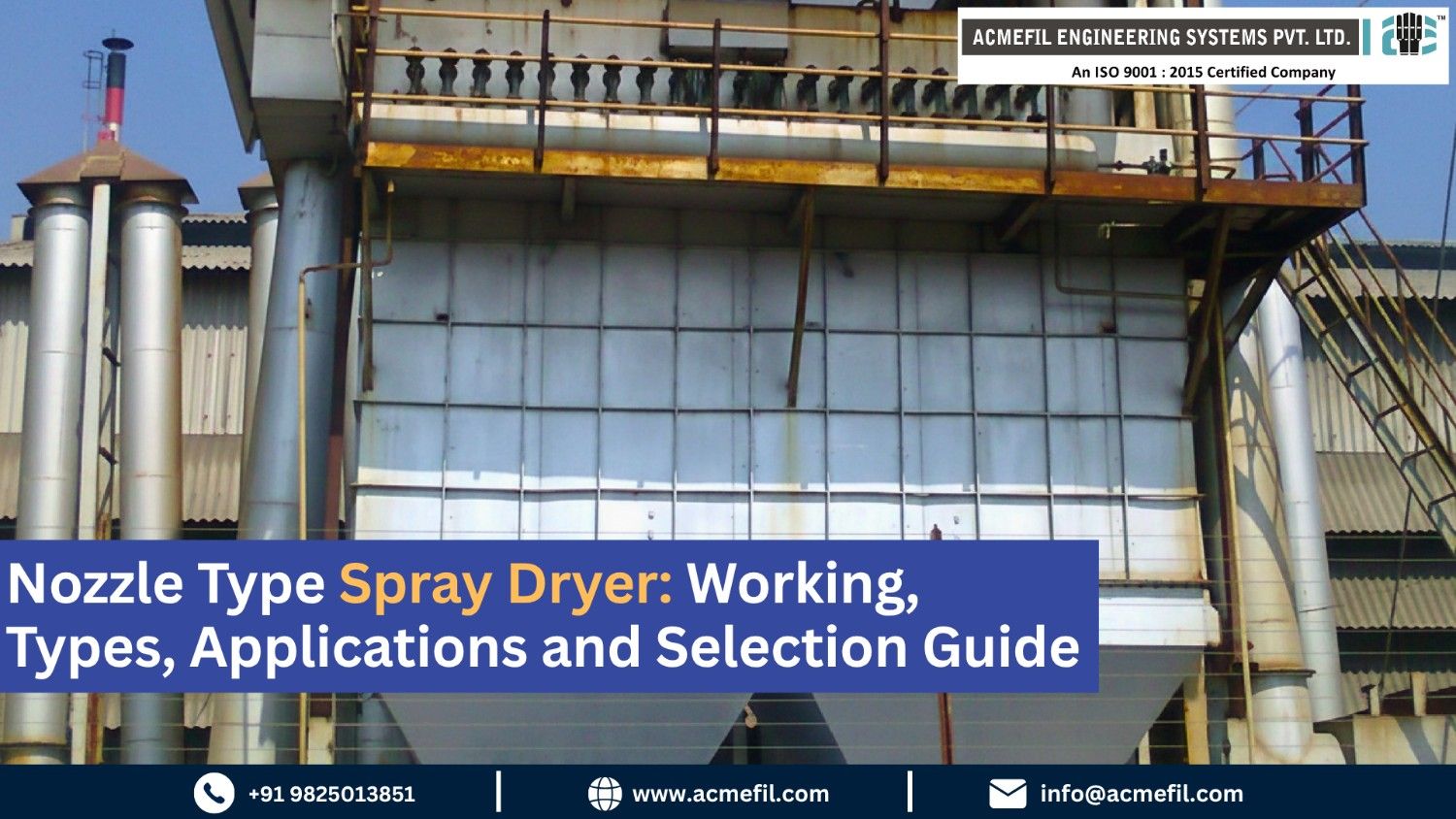
A nozzle type spray dryer is a spray drying system where the liquid feed is atomized through a pressure nozzle or a two-fluid nozzle before it meets hot drying air. I usually recommend this configuration when the product needs controlled atomization, fine powder formation, or careful drying of heat-sensitive materials such as enzymes, flavours, pharmaceutical products, and food ingredients.
The most important point is this: a nozzle type spray dryer should not be selected only because it looks simpler than a rotary atomizer system. The right choice depends on feed viscosity, solids content, target particle size, required bulk density, drying chamber geometry, and how stable the feed remains during pumping.
For a broader understanding of atomizer selection, you can also read our guide on spray dryer atomization techniques and the comparison of nozzle vs rotary atomizer spray dryers.
What Is a Nozzle Type Spray Dryer?
A nozzle type spray dryer converts liquid feed into powder by forcing the feed through a spray nozzle and exposing the droplets to hot air inside the drying chamber.
The basic process has four stages:
- Liquid feed is pumped to the atomization system.
- The nozzle breaks the feed into droplets.
- Droplets contact hot air inside the drying chamber.
- Moisture evaporates and dry powder is separated from the exhaust air.
In Acmefil’s product range, nozzle type spray dryers are available in two main configurations:
| Nozzle system | How atomization happens | Typical use case |
|---|---|---|
| Pressure nozzle atomization | Feed is pumped under high pressure through an orifice | Fine or coarse granular particles where pressure atomization suits the feed |
| Two-fluid nozzle atomization | Compressed air is used to atomize the liquid feed | Finer particles, smaller capacities, R&D work, and heat-sensitive product trials |
This distinction matters because both systems are called nozzle type spray dryers, but they behave differently in actual operation.
How Does a Nozzle Type Spray Dryer Work?
In a nozzle atomizer spray dryer, the feed pump does more than transfer liquid. It directly affects atomization quality. If the pressure, feed concentration, and nozzle condition are not stable, the droplet pattern changes. Once the droplet pattern changes, drying behavior also changes.
A typical nozzle type spray drying sequence works like this:
The prepared feed is filtered, mixed, and pumped to the atomization point. In a pressure nozzle system, the liquid passes through a small orifice at high pressure. The pressure energy breaks the liquid into droplets. In a two-fluid nozzle system, compressed air helps break the feed into a fine spray.
Once droplets enter the drying chamber, hot air removes moisture rapidly. The goal is not simply to “dry faster.” The goal is to dry the droplets evenly enough to achieve the required moisture, particle size, solubility, flowability, and thermal quality.
If droplets are too large, the product may leave the chamber with high moisture. If droplets are too fine, powder losses, wall deposition, or dust handling issues may increase. This is why nozzle selection must be connected to chamber design, air flow pattern, outlet temperature, and powder recovery system.
For readers who want the full machine-level explanation, the article on how a spray dryer works covers the complete process from atomization to powder separation.
Pressure Nozzle Spray Dryer
A pressure nozzle spray dryer uses hydraulic pressure to push the feed through a nozzle orifice. The feed breaks into droplets because of pressure energy and nozzle geometry.
This arrangement is useful when the feed can be pumped consistently and when the desired particle characteristics match pressure nozzle atomization.
Where pressure nozzle atomization works well
Pressure nozzle atomization can be suitable for:
- Food ingredients
- Flavours
- Pharmaceutical powders
- Heat-sensitive products
- Selected chemical products
- Feed systems where pump pressure and feed properties are stable
The major advantage is that the system can produce controlled spray patterns when the feed is properly prepared. The major risk is that any issue in feed filtration, solids suspension, viscosity control, or nozzle wear can affect spray quality.
In my view, this is where many buyers make a mistake. They discuss the dryer capacity but not the feed behavior. A pressure nozzle is not just an accessory. It is one of the most sensitive decision points in the entire plant.
Two-Fluid Nozzle Spray Dryer
A two-fluid nozzle spray dryer uses compressed air to help atomize the liquid feed. The two fluids are the liquid feed and the atomizing air.
This type of nozzle is often considered when a finer spray is required, when the capacity is smaller, or when product development work needs flexible atomization during trials.
Where two-fluid nozzle atomization works well
Two-fluid nozzle systems are commonly considered for:
- R&D and pilot-scale work
- Heat-sensitive feed materials
- Fine powder requirements
- Pharmaceutical and food applications
- Enzymes, flavours, and specialty products
- Feeds where air-assisted atomization gives better control during trials
The trade-off is that compressed air becomes part of the atomization system. This means utility availability, air quality, nozzle maintenance, and process repeatability must be evaluated carefully.
For early product development, a two-fluid nozzle can be useful because it gives the process team more flexibility before committing to full-scale design. At Acmefil, pilot plant trials are important for this reason. A small trial can reveal whether a product dries cleanly, sticks to the chamber, forms fine powder, or requires a different atomization route.
Pressure Nozzle vs Two-Fluid Nozzle: Which One Should You Choose?
There is no universal answer. The correct nozzle system depends on the product and the operating objective.
| Selection factor | Pressure nozzle | Two-fluid nozzle |
|---|---|---|
| Atomization energy | Mainly from liquid pressure | From compressed air plus liquid flow |
| Particle control | Good when feed and pressure are stable | Useful for fine atomization and flexible trials |
| Feed preparation sensitivity | High | High, but often more adjustable at trial scale |
| Utility requirement | High-pressure feed pumping | Compressed air requirement |
| Common fit | Stable liquid feeds and defined particle targets | Fine powders, specialty materials, R&D, heat-sensitive products |
| Buyer risk | Nozzle blockage, wear, pressure instability | Air consumption, air quality, scale-up behavior |
For a new product, I prefer not to finalize this choice only from a catalogue. The better route is to test feed behavior at pilot scale, observe powder quality, and then size the full system.
You can compare the broader atomizer decision in our guide on choosing the right spray dryer.
When Is a Nozzle Type Spray Dryer the Right Choice?
A nozzle type spray dryer is often a strong option when the product needs fine atomization, controlled droplet formation, and careful drying.
It may be suitable when:
- The feed is a solution, emulsion, or pumpable suspension.
- The target product is a fine or controlled powder.
- Heat sensitivity is a concern.
- The application is in food, pharma, flavours, enzymes, or specialty chemicals.
- The plant needs defined particle quality, not just moisture removal.
- Pilot testing is possible before full-scale procurement.
For example, in pharmaceutical and food applications, the product may be sensitive to both temperature and residence time. The outlet moisture target must be achieved without damaging the active ingredient, flavour, solubility, or functional property of the powder.
This is why nozzle selection must be connected to drying temperature, residence time, air flow, chamber dimensions, powder recovery, and cleaning requirements.
When Should You Avoid a Nozzle Type Spray Dryer?
A nozzle atomizer is not the best fit for every feed.
You should be careful with nozzle selection when:
- The feed has high suspended solids.
- The feed has abrasive particles.
- The feed viscosity changes during operation.
- The feed is not filtered properly.
- The process has unstable feed concentration.
- The product is likely to clog the orifice.
- Very large capacity and wide feed variation are expected.
In such cases, a rotary atomizer spray dryer may be more suitable. Rotary atomizers are often preferred for slurries and applications where droplet size control through disc selection and speed is important.
The wrong atomizer choice usually shows up as production trouble later. Common symptoms include wet powder, chamber wall deposits, poor solubility, inconsistent bulk density, high exhaust losses, and frequent nozzle cleaning.
The troubleshooting guide on common spray dryer issues is useful if your existing system is already showing these symptoms.
Key Applications of Nozzle Type Spray Dryers
Nozzle type spray dryers are used where the feed and target product quality support nozzle atomization.
Food and flavour products
Nozzle spray drying can be used for selected food ingredients, flavours, enzymes, and other heat-sensitive materials. The objective is usually to preserve quality while converting liquid feed into a stable powder.
For related context, read our guide on spray dryers in food processing.
Pharmaceutical products
Pharmaceutical drying requires careful attention to material compatibility, thermal exposure, moisture target, and powder recovery. Nozzle type spray dryers can be considered for selected pharmaceutical and biochemical products where fine atomization is needed.
You can also review our article on spray dryer applications in pharmaceuticals.
Enzymes and heat-sensitive materials
Enzymes and biological materials need controlled drying because overheating or poor residence-time control can reduce product functionality. A nozzle type spray dryer may be suitable when the process is validated through trials and the inlet and outlet temperature profile is selected correctly.
Flavours and specialty powders
Flavours often require careful powder formation, controlled moisture, and protection of volatile properties. The atomization system directly affects droplet drying behavior, which then affects final powder characteristics.
Chemical products
Nozzle type spray dryers may also be used in selected chemical applications where the feed is pumpable and compatible with nozzle atomization. For slurries, abrasive feeds, or high-solids materials, rotary atomization may be a better direction.
Nozzle Type Spray Dryer Design Factors Buyers Should Check
Before buying a nozzle type spray dryer, the buyer should not ask only for “capacity.” Capacity is only one part of the design.
A serious RFQ should include:
| Design input | Why it matters |
|---|---|
| Feed composition | Determines drying behavior, stickiness, solids loading, and thermal sensitivity |
| Feed viscosity | Affects pumpability and atomization quality |
| Total solids percentage | Influences water evaporation load and powder yield |
| Target moisture | Defines drying endpoint and outlet condition |
| Target particle size | Drives nozzle type, chamber design, and separation system |
| Heat sensitivity | Controls allowable thermal profile |
| Bulk density requirement | Influences atomization and drying conditions |
| Solubility requirement | Important for food, pharma, and specialty powders |
| Expected operating hours | Affects automation, cleaning, maintenance, and utility design |
| Cleaning requirement | Important for food, pharma, and product changeover |
If these details are not available, the safest next step is a pilot trial.
Why Pilot Testing Matters Before Final Selection
Spray drying looks simple from the outside. Feed goes in, powder comes out. In real plant operation, the behavior of the feed decides the success of the dryer.
This is especially true for nozzle type spray dryers.
A pilot trial helps answer practical questions:
- Does the feed atomize cleanly?
- Does the powder stick to the chamber wall?
- Is the final moisture achievable?
- Is the powder too fine or too coarse?
- Does the product lose quality during drying?
- Is a pressure nozzle or two-fluid nozzle more suitable?
- Is the dryer configuration scalable?
Acmefil has an in-house R&D pilot plant with a lab scale pilot spray dryer of 3 kg/hr water evaporation capacity. For a buyer developing a new product, this is often the most useful stage of the project. It reduces guesswork before committing to a full-scale plant.
For trial-related context, see Acmefil’s pilot spray dryer page and the support page on nozzle atomizer type spray dryers.
Common Buyer Mistakes in Nozzle Type Spray Dryer Selection
Mistake 1: Choosing nozzle type only by price
A lower-cost atomization system can become expensive if it creates downtime, nozzle choking, wet powder, or poor recovery. The atomizer must match the feed and product target.
Mistake 2: Ignoring feed filtration
Nozzle systems are sensitive to particles, lumps, and inconsistent feed quality. Filtration and feed preparation are not small details. They protect the atomization system.
Mistake 3: Treating pressure nozzle and two-fluid nozzle as the same
Both are nozzle systems, but their behavior is different. Pressure nozzle atomization depends mainly on feed pressure and orifice behavior. Two-fluid atomization depends on liquid flow and compressed air interaction.
Mistake 4: Not defining particle size target early
If the buyer cannot define the required powder characteristic, the designer cannot properly select the nozzle, drying chamber, air flow pattern, and separation system.
Mistake 5: Skipping pilot testing for new products
For a proven product, existing operating data may be enough. For a new feed, pilot testing is the practical way to reduce scale-up risk.
Nozzle Type Spray Dryer vs Rotary Atomizer Spray Dryer
The decision between nozzle and rotary atomizer is one of the most important spray dryer design choices.
| Factor | Nozzle type spray dryer | Rotary atomizer spray dryer |
|---|---|---|
| Atomization method | Pressure nozzle or two-fluid nozzle | High-speed rotating centrifugal disc |
| Best suited for | Fine powders, heat-sensitive products, selected food and pharma feeds | Slurries, higher solids, dyes, ceramics, detergents, pigments |
| Droplet control | Through nozzle type, pressure, air, and feed condition | Through disc selection and atomizer speed |
| Feed tolerance | Sensitive to clogging and feed instability | Often better for slurries and suspended solids |
| Scale-up concern | Nozzle behavior, chamber fit, air system | Atomizer speed, disc design, chamber diameter |
| Best validation method | Pilot trial and feed characterization | Pilot trial and atomizer selection |
A nozzle type spray dryer is not “better” than a rotary atomizer dryer. It is better only when the feed characteristics and powder target match nozzle atomization.
What Information Should You Share Before Asking for a Quote?
For an accurate recommendation, share these details with the equipment manufacturer:
- Product name and industry
- Liquid feed composition
- Feed solids percentage
- Feed viscosity
- Feed temperature
- Required final moisture
- Required particle size or bulk density
- Heat sensitivity
- Solvent or water-based feed
- Current batch size or plant capacity
- Operating hours per day
- Cleaning or hygienic requirements
- Existing plant layout, if any
- Whether pilot trial is required
This information helps the engineering team decide whether the project needs a pressure nozzle, two-fluid nozzle, rotary atomizer, fluidized spray dryer, or another drying route.
Final View: Choose the Nozzle, Not Just the Dryer
A nozzle type spray dryer is a good choice when controlled atomization, fine powder formation, and heat-sensitive drying are important. But the nozzle cannot be selected in isolation.
The right design depends on the relationship between feed behavior, droplet formation, hot air contact, chamber geometry, powder recovery, and final product quality.
My practical recommendation is simple: if the product is new, do not finalize the nozzle type only from a brochure. Test the feed, check the powder, study the drying behavior, and then scale the plant. A well-selected nozzle type spray dryer can give stable powder quality. A wrongly selected nozzle will create operating problems from the first production run.
FAQs
What is a nozzle type spray dryer?
A nozzle type spray dryer is a spray dryer that atomizes liquid feed using either a pressure nozzle or a two-fluid nozzle. The nozzle breaks the feed into droplets, which contact hot air inside the drying chamber and convert into dry powder after moisture evaporation.
What is the difference between pressure nozzle and two-fluid nozzle spray drying?
A pressure nozzle uses liquid pressure to push feed through an orifice and form droplets. A two-fluid nozzle uses compressed air along with liquid feed to create atomization. Pressure nozzles depend strongly on feed pressure and nozzle condition, while two-fluid nozzles offer more flexibility for fine atomization and trials.
Which products are suitable for nozzle type spray dryers?
Nozzle type spray dryers are commonly considered for heat-sensitive products, enzymes, flavours, pharmaceutical materials, food ingredients, and selected chemical products. The final suitability depends on feed viscosity, solids content, heat sensitivity, target particle size, and pilot trial results.
Is a nozzle type spray dryer better than a rotary atomizer spray dryer?
No. A nozzle type spray dryer is better only for specific feed and product requirements. Rotary atomizers are often more suitable for slurries, suspended solids, and certain high-solids applications. The correct choice depends on feed behavior, particle target, capacity, and chamber design.
Why is pilot testing important for nozzle spray drying?
Pilot testing shows how the real feed behaves during atomization and drying. It helps identify wall deposition, moisture issues, powder fineness, heat sensitivity, and nozzle suitability before investing in a full-scale spray dryer.
If you are evaluating a nozzle type spray dryer for food, pharmaceutical, flavour, enzyme, or specialty chemical powder production, share your feed details before asking for a final quote. Acmefil can review the application, suggest whether pressure nozzle, two-fluid nozzle, rotary atomizer, or another configuration is more suitable, and support pilot-level validation where required.
For technical inquiry, use the SprayDryer.com contact page or review Acmefil’s nozzle atomizer type spray dryer page.

Siddharth Nair is Technical Director at Acmefil Engineering Systems Pvt. Ltd. he leads solution design and applications engineering across the company’s full product range — spray dryers, multi-effect evaporators, agitated thin film dryers, spin flash dryers, fluid bed dryers, and complete ZLD systems.
His work spans process evaluation, equipment sizing, customer application consulting, and technical proposal development for industries including food and dairy, pharmaceuticals, chemicals, dyestuffs, ceramics, and industrial effluent treatment. He has hands-on commissioning experience across Acmefil’s 500+ installations in India and 15+ countries.
He holds a BTech in Mechanical Engineering from CHARUSAT University and also partners at A.S Engineers, working with blowers, sludge dryers, and industrial conveying systems.


