
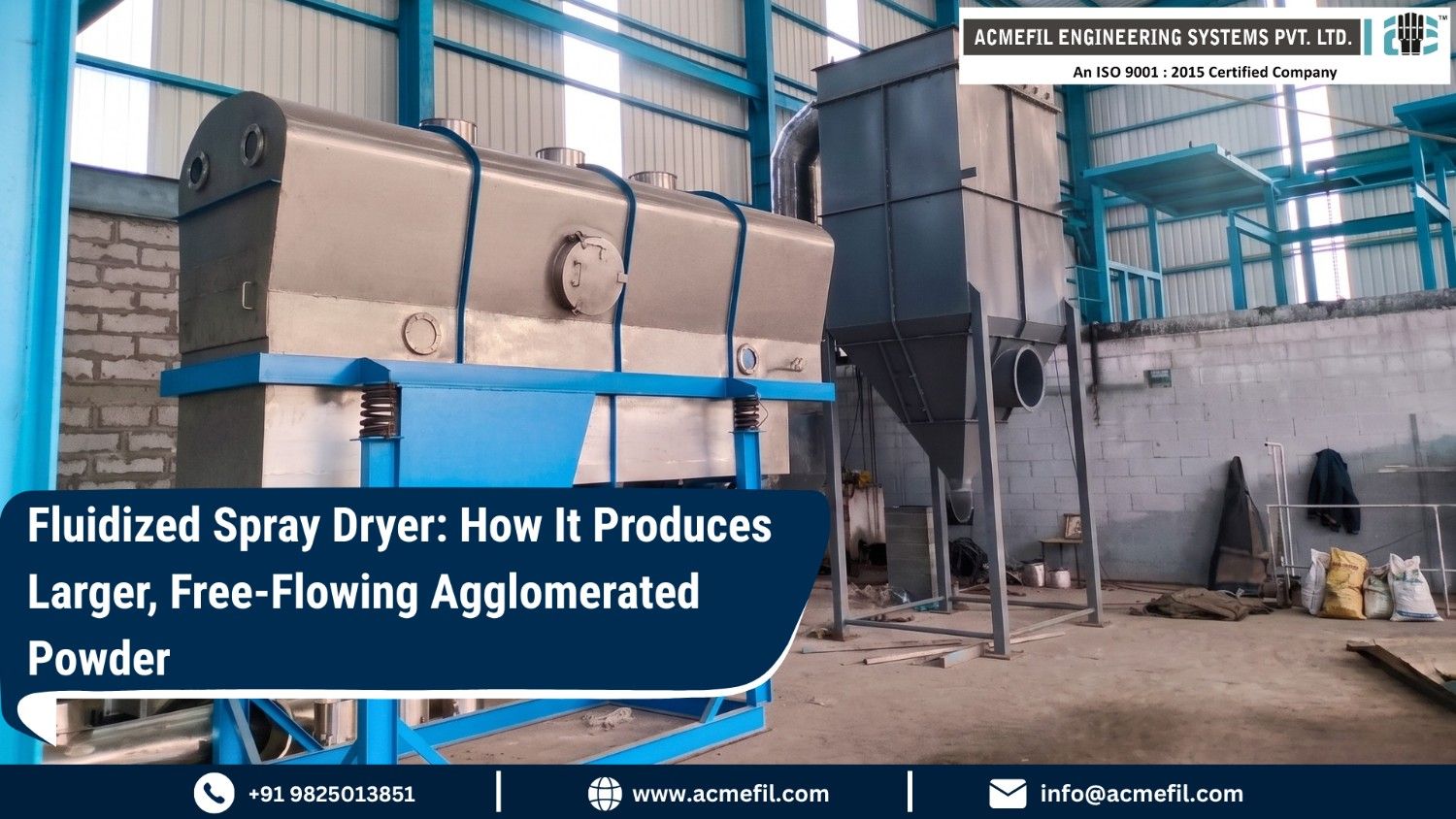
A fluidized spray dryer is used when a plant needs larger, more free-flowing, less dusty powder than a standard single-stage spray dryer normally produces. Instead of finishing drying only in the main chamber, the moist powder enters an integrated or external fluid bed, where final drying, agglomeration, and sometimes cooling are controlled more gently.
I usually look at this technology when the buyer is not just asking, “Can we dry this liquid?” but “Can we make a powder that handles well after drying?”
That second question is important in food ingredients, detergents, dairy powders, instant products, and agglomerated chemical powders.
What Is a Fluidized Spray Dryer?
A fluidized spray dryer combines spray drying and fluid bed drying in one process route.
The spray dryer first converts a liquid feed, solution, slurry, or emulsion into droplets through atomization. Hot air removes a major part of the moisture in the drying chamber. Then the partially dried powder is handled in a fluidized bed, where upward air keeps the particles suspended and moving like a fluid.
This second stage allows better control over:
- Final moisture
- Particle growth
- Powder flowability
- Dust reduction
- Agglomeration
- Product cooling, when needed
At Acmefil, the fluidized spray dryer design is used for applications where larger particle size is required. The verified particle range for Acmefil fluidized spray dryers is 50 to 150 microns, with moist powder dried in an integrated fluid bed at the bottom of the drying chamber. Fines are recycled back into the drying chamber, and tertiary drying can be added when further particle size increase is required.
If you are comparing spray dryer technologies, also read our guide on spray dryer design and components and spray dryer atomization techniques.
How a Fluidized Spray Dryer Works
A fluidized spray dryer is not just a normal spray dryer with a fluid bed attached. The process logic is different because moisture is deliberately managed across stages.
1. Feed Preparation and Atomization
The feed is prepared based on solids content, viscosity, temperature sensitivity, and target powder properties. Atomization converts the feed into droplets.
Depending on the product and particle requirement, the atomization system may use nozzle-based atomization or rotary atomization. The choice affects droplet size, drying load, and final particle structure.
For a deeper comparison, see nozzle vs rotary atomizer spray dryers.
2. Primary Drying in the Spray Chamber
The atomized droplets meet hot drying air inside the chamber. Moisture evaporates quickly from the droplets.
In a conventional single-stage dryer, the powder is usually dried closer to final moisture inside the chamber itself. In a fluidized spray dryer, the chamber can discharge powder with controlled residual moisture so agglomeration can continue in the next stage.
This matters because powder that is completely dry too early may not agglomerate well. Powder that is too wet may stick, cake, or create deposits.
3. Integrated Fluid Bed Drying
The moist powder enters the fluid bed at the bottom of the drying chamber. Air passes upward through a perforated plate or distribution system. The particles remain suspended and mixed.
This stage finishes drying more uniformly and gives the powder more time to build structure. For heat-sensitive products, this staged drying approach can be useful because the final moisture can be removed under more controlled conditions instead of forcing all drying inside the main chamber.
4. Fines Return and Agglomeration
Fine particles are carried with the exhaust air and separated through collection equipment such as cyclones or filters. In a fluidized spray dryer, these fines can be recycled back into the drying chamber.
This is one of the main differences from simple spray drying. Recycled fines attach to moist particles and help form larger agglomerates.
The result is usually a powder with better flowability and lower dust tendency compared with a very fine powder from a single-stage system.
5. External Fluid Bed or Tertiary Drying
For some powders, an external fluid bed or tertiary drying stage is added. This is useful when the buyer needs larger particle size, more uniform final moisture, or controlled cooling before packing.
Acmefil’s fluidized spray dryer variants include single-stage, two-stage with external fluid bed, and three-stage with tertiary drying.
Why Particle Size Matters in Fluidized Spray Drying
Many buyers focus only on moisture percentage. That is a mistake.
In powder handling, particle size and structure often decide whether the product performs well after it leaves the dryer. A powder may meet moisture specification but still create problems in packing, conveying, blending, storage, or reconstitution.
A fluidized spray dryer is selected when the target is not just dry powder, but engineered powder behavior.
| Powder Requirement | Why It Matters | Fluidized Spray Dryer Relevance |
|---|---|---|
| Larger particle size | Improves handling and reduces excessive dust | Acmefil fluidized spray dryers are designed for 50 to 150 micron particles |
| Better flowability | Reduces packing and conveying problems | Agglomeration helps reduce fine, cohesive powder behavior |
| Lower dustiness | Improves plant hygiene and reduces product loss | Fines return helps bind fine particles into larger agglomerates |
| Controlled final moisture | Prevents caking, under-drying, or over-drying | Fluid bed stage allows final drying control |
| Better instant properties | Useful for selected food and ingredient powders | Agglomerated particles can wet and disperse better than very fine powders |
Fluidized Spray Dryer vs Conventional Spray Dryer
A conventional spray dryer is often the right choice when the main objective is to convert liquid feed into fine powder efficiently.
A fluidized spray dryer becomes more relevant when powder behavior after drying is equally important.
| Criteria | Conventional Spray Dryer | Fluidized Spray Dryer |
|---|---|---|
| Main purpose | Produce dry powder from liquid feed | Produce larger, agglomerated, free-flowing powder |
| Drying stages | Usually single-stage chamber drying | Multi-stage drying with integrated or external fluid bed |
| Particle size tendency | Fine to medium powder, depending on atomization | Larger particles, Acmefil range 50 to 150 microns |
| Dust reduction | Limited unless separate agglomeration is used | Better because fines can be recycled and agglomerated |
| Best fit | Fine powders, standard drying applications | Detergents, food ingredients, agglomerated powders |
| Process complexity | Lower | Higher, because fluidization and fines return must be controlled |
| Buyer mistake | Selecting only by evaporation capacity | Ignoring flowability, dust, bulk density, and reconstitution behavior |
Fluidized Spray Dryer vs Fluid Bed Dryer
A fluidized spray dryer and a fluid bed dryer are not the same equipment.
A spray dryer starts with a liquid feed. A fluid bed dryer usually starts with wet solids, granules, or powder.
A fluidized spray dryer combines both principles. It starts with liquid feed like a spray dryer, then uses fluid bed drying to finish the powder and support agglomeration.
| Question | Fluidized Spray Dryer | Fluid Bed Dryer |
|---|---|---|
| Starting material | Liquid, slurry, solution, or emulsion | Wet granules, powder, crystals, or solids |
| Main function | Convert liquid into agglomerated dry powder | Dry or cool already formed particles |
| Atomization required? | Yes | No |
| Agglomeration role | Built into the spray drying route | Possible, depending on design and process |
| Typical selection reason | Need powder from liquid feed with larger particles | Need uniform drying of existing solids |
This distinction is important during RFQ discussions. If the feed is a liquid, a standalone fluid bed dryer will not solve the problem. If the feed is already a wet granular solid, a spray dryer may not be needed.
When Should You Choose a Fluidized Spray Dryer?
You should evaluate a fluidized spray dryer when the final powder must do more than simply meet moisture specification.
I would consider it in these situations:
- The product is too dusty after conventional spray drying.
- The buyer needs larger agglomerated particles.
- The powder must flow better during packing or conveying.
- The application requires better wettability or dispersibility.
- Fine powder recovery and fines return are important to the process.
- A single-stage dryer gives uneven final powder behavior.
- The plant needs staged drying with better final moisture control.
For general spray dryer selection, see our guide on choosing the right spray dryer.
Where Fluidized Spray Dryers Are Used
Acmefil’s verified application areas for fluidized spray dryers include detergents, food ingredients, and agglomerated powders requiring large particle size.
In practical terms, these systems are relevant for:
Detergent Powders
Detergent powders often require controlled particle size, flowability, and reduced dust. Fine dusty powder creates handling issues and can affect packing performance.
A fluidized spray dryer helps because fines can be returned and built into larger agglomerates.
Food Ingredients
Food ingredient powders may need better dispersibility, flow, and storage behavior. Agglomerated particles can be easier to handle than very fine spray-dried powder.
This is especially important where downstream packing, mixing, or reconstitution matters.
For dairy-specific reading, see spray dryer for milk powder.
Agglomerated Powders
Any powder where particle structure matters can become a candidate for fluidized spray drying. The decision depends on feed behavior, thermal sensitivity, target moisture, bulk density, and final particle size.
Single-Stage, Two-Stage, and Three-Stage Fluidized Spray Drying
Not every fluidized spray dryer needs the same process arrangement. The system must match the powder target.
| System Type | Process Arrangement | Best Use Case |
|---|---|---|
| Single-stage fluidized spray dryer | Main spray dryer with integrated fluid bed | When moderate agglomeration and final drying control are enough |
| Two-stage system | Spray dryer plus external fluid bed | When more final drying or cooling control is needed |
| Three-stage system | Spray dryer, external fluid bed, and tertiary drying | When larger particle size or more controlled powder finishing is required |
The correct choice depends on the product. I would not select a three-stage system just because it sounds more complete. Additional stages add cost, footprint, controls, and cleaning requirements. They are justified only when the powder target requires them.
Key Parameters to Share Before Asking for a Quote
A fluidized spray dryer quotation should not start with only “capacity per hour.” Capacity matters, but it is not enough.
Before you ask any manufacturer for a technical recommendation, prepare these details:
| RFQ Input | Why It Matters |
|---|---|
| Feed type | Solution, slurry, emulsion, suspension, or concentrate behave differently |
| Solids percentage | Affects evaporation load and powder formation |
| Feed viscosity | Impacts atomization and droplet formation |
| Target moisture | Decides final drying duty |
| Desired particle size | Critical for fluidized spray dryer selection |
| Bulk density target | Affects packing and handling |
| Heat sensitivity | Influences inlet and outlet temperature strategy |
| Hygroscopic behavior | Helps avoid caking and wall deposits |
| Final application | Detergent, food ingredient, dairy, chemical, or other use |
| Cleaning requirement | Important for food, pharma, and multi-product plants |
| Available utilities | Hot air system, fuel, power, compressed air, and plant space |
For process tuning after installation, read how to optimize spray drying parameters.
Common Buyer Mistakes in Fluidized Spray Dryer Selection
Mistake 1: Treating It Like a Normal Spray Dryer
A fluidized spray dryer must be designed around powder properties, not only evaporation capacity. If the system is sized only for water evaporation, the final powder may still be dusty, sticky, or inconsistent.
Mistake 2: Ignoring Fines Behavior
Fines are not always waste. In a fluidized spray dryer, fines return can help build agglomerated particles. But if fines return is poorly controlled, it can create deposits, unstable powder size, or inconsistent moisture.
Mistake 3: Asking for Large Particles Without Defining the Range
“Large particle” is not an engineering specification. Give the expected particle size range, bulk density, flow behavior, and application requirement.
Acmefil’s verified fluidized spray dryer particle range is 50 to 150 microns. If your required range is outside this, it should be discussed during technical evaluation.
Mistake 4: Not Testing the Feed
Spray drying behavior changes with solids concentration, viscosity, dissolved solids, insoluble content, and thermal sensitivity. Two feeds with the same moisture target may behave very differently inside the dryer.
This is where pilot trials become valuable. Acmefil has an in-house pilot spray dryer facility with 3 kg/hr water evaporation capacity for process development and trials. Buyers can use pilot testing to validate drying behavior before committing to full-scale plant design.
You can also review Acmefil’s pilot spray dryer facility for trial-related evaluation.
Design Considerations That Decide Performance
A fluidized spray dryer should be designed around the target product, not around a catalogue model.
Key design considerations include:
- Atomizer type and droplet size
- Air inlet and outlet temperature relationship
- Chamber diameter and residence time
- Fluid bed air distribution
- Moisture profile between chamber and fluid bed
- Fines separation and return path
- Powder discharge arrangement
- Cleaning and accessibility
- Product contact material
- Explosion, fire, or solvent risk where applicable
- Bag filter, cyclone, and air handling design
For basic equipment architecture, our article on how a spray dryer works gives a useful foundation.
When a Fluidized Spray Dryer May Not Be the Right Choice
This is not the right technology for every drying problem.
A fluidized spray dryer may not be justified when:
- The product only needs fine powder.
- Agglomeration is not required.
- The feed is too sticky for stable operation without formulation changes.
- The plant does not have space for additional fluid bed stages.
- The budget does not justify multi-stage drying.
- Cleaning complexity is unacceptable for frequent product changeovers.
- The process needs solvent recovery, where a closed loop spray dryer may be more suitable.
If the product is solvent-based or oxygen-sensitive, review closed loop spray dryer options instead of assuming an open fluidized spray dryer is suitable.
Fluidized Spray Dryer Selection Checklist
Use this checklist before finalizing the design discussion.
| Selection Question | Good Sign | Risk Sign |
|---|---|---|
| Is the target particle size defined? | Particle range is documented | Buyer only says “large powder” |
| Is final moisture defined? | Moisture target and test method are clear | Moisture target is approximate |
| Is feed viscosity known? | Viscosity at operating temperature is available | Only product name is shared |
| Is heat sensitivity known? | Maximum safe product temperature is known | No thermal data available |
| Is agglomeration required? | Flowability, wettability, or dust issue is defined | Agglomeration requested without reason |
| Is pilot testing possible? | Trial quantity and feed sample can be arranged | Full-scale design expected without validation |
| Is downstream handling considered? | Packing, conveying, and storage are considered | Dryer selected without powder handling review |
Why Acmefil’s Pilot Plant Matters for This Technology
For standard products, experience may be enough to prepare an initial design. For difficult powders, I prefer a trial whenever possible.
Pilot testing helps answer questions that drawings alone cannot answer:
- Does the feed atomize properly?
- Does the powder stick to the chamber wall?
- What outlet temperature gives the expected moisture?
- Does the powder remain too fine?
- Can fines be managed?
- Does the material agglomerate as expected?
- Is the final powder free-flowing enough for packing?
Acmefil’s in-house R&D and pilot plant facility includes a spray dryer with 3 kg/hr water evaporation capacity. This gives buyers a way to test product behavior before scaling the design.
For a capital equipment decision, that trial can reduce uncertainty more than a long technical brochure.
Final Takeaway
A fluidized spray dryer is the right direction when your process needs agglomerated, larger, free-flowing powder from a liquid feed. It is especially useful when a conventional spray dryer makes powder that is technically dry but too fine, dusty, or difficult to handle.
The key is to define the powder target before selecting the dryer. Moisture percentage, particle size, bulk density, flowability, heat sensitivity, and downstream handling must be part of the discussion.
At Acmefil, we evaluate fluidized spray dryers around the actual product behavior, not only the evaporation load. If your product needs large particle formation, fines return, and staged final drying, a fluidized spray dryer should be considered seriously.
FAQs
What is a fluidized spray dryer?
A fluidized spray dryer is a spray drying system that combines chamber drying with fluid bed drying. The feed is atomized into droplets, partially dried in hot air, then finished in an integrated or external fluid bed. This helps produce larger, more free-flowing agglomerated powder.
What particle size can a fluidized spray dryer produce?
Acmefil’s verified fluidized spray dryer range is 50 to 150 microns for large particle applications. The actual result depends on feed properties, atomization, moisture profile, fines return, and the fluid bed drying arrangement.
What is the difference between a spray dryer and a fluidized spray dryer?
A standard spray dryer dries atomized liquid mainly inside the drying chamber. A fluidized spray dryer adds integrated or external fluid bed drying, allowing better final moisture control, agglomeration, fines return, and larger particle formation.
Where is a fluidized spray dryer used?
Fluidized spray dryers are used for detergents, food ingredients, and agglomerated powders requiring larger particle size. They are useful when powder flowability, dust reduction, and downstream handling are important.
Is pilot testing required before buying a fluidized spray dryer?
Pilot testing is strongly recommended when the feed is new, sticky, heat-sensitive, or when particle size and flowability are critical. Acmefil has a pilot spray dryer facility with 3 kg/hr water evaporation capacity for product trials and process development.
Need to Check Whether Your Product Needs a Fluidized Spray Dryer?
If your existing spray drying process gives fine, dusty, sticky, or poorly flowing powder, the issue may not be only drying capacity. It may be particle engineering.
Share your feed details, target moisture, particle size requirement, and downstream handling problem with Acmefil’s technical team. We can help evaluate whether a fluidized spray dryer, nozzle atomizer spray dryer, rotary atomizer spray dryer, or another drying route fits your process better.

Siddharth Nair is Technical Director at Acmefil Engineering Systems Pvt. Ltd. he leads solution design and applications engineering across the company’s full product range — spray dryers, multi-effect evaporators, agitated thin film dryers, spin flash dryers, fluid bed dryers, and complete ZLD systems.
His work spans process evaluation, equipment sizing, customer application consulting, and technical proposal development for industries including food and dairy, pharmaceuticals, chemicals, dyestuffs, ceramics, and industrial effluent treatment. He has hands-on commissioning experience across Acmefil’s 500+ installations in India and 15+ countries.
He holds a BTech in Mechanical Engineering from CHARUSAT University and also partners at A.S Engineers, working with blowers, sludge dryers, and industrial conveying systems.


