
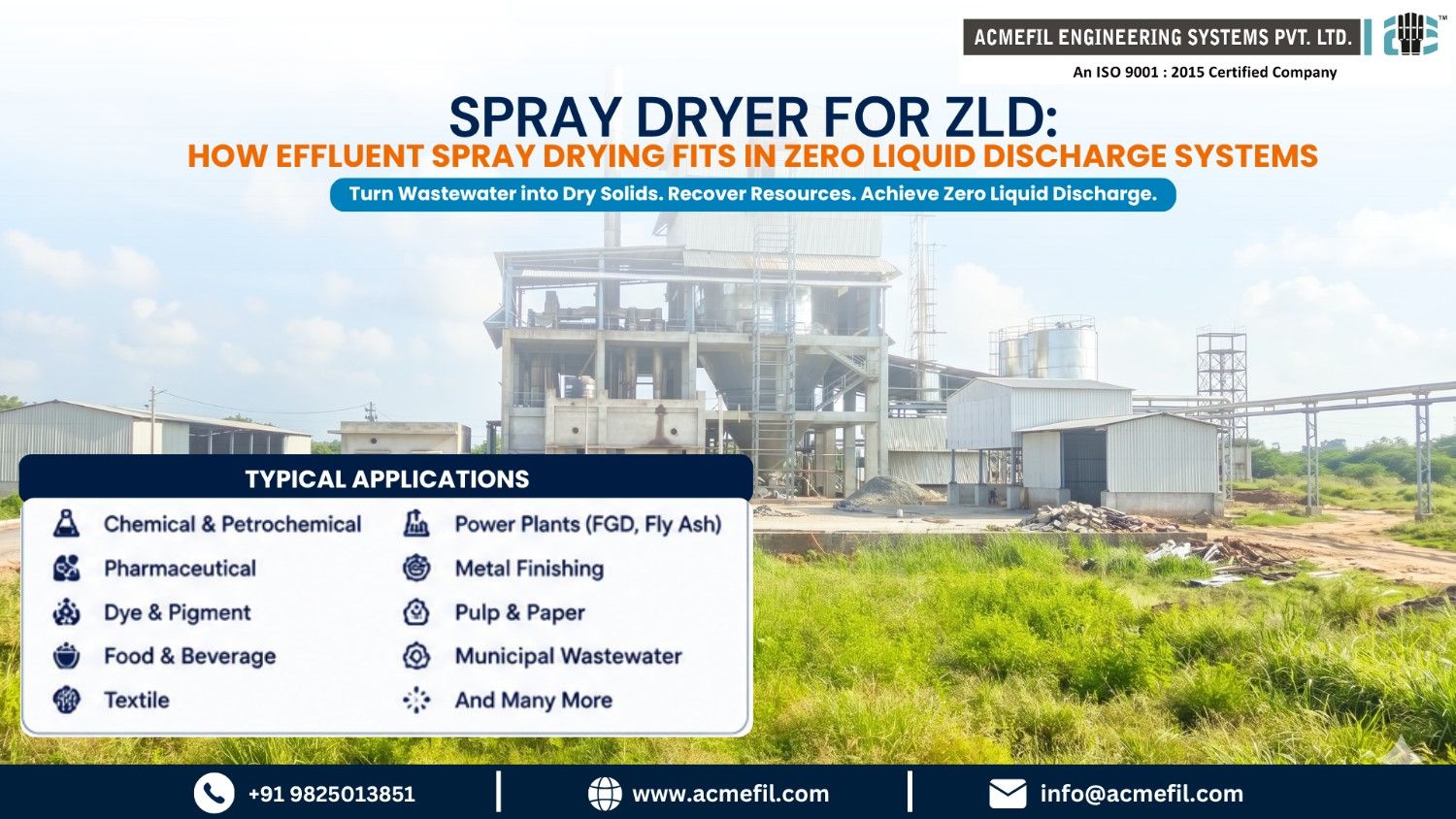
A spray dryer for ZLD is used near the final stage of a zero liquid discharge system to convert concentrated liquid effluent into dry solid residue. It is not a standalone wastewater treatment plant. It works after upstream treatment, membrane concentration, evaporation, or slurry concentration stages. When selected correctly, an effluent spray dryer helps reduce the remaining liquid load into a manageable dry powder or salt-rich solid for disposal or further handling.
In ZLD projects, I look at the spray dryer as the final discipline test of the whole system. If the feed characterization is wrong, the dryer will expose the problem quickly.
What Is a Spray Dryer for ZLD?
A spray dryer for ZLD is an industrial drying system designed to handle concentrated effluent, brine, or slurry from a zero liquid discharge process. The liquid is atomized into fine droplets inside a hot air stream. Water evaporates rapidly, and the remaining dissolved and suspended solids are collected as dry powder or semi-dry residue through a cyclone, bag filter, or suitable separation system.
The principle is similar to normal spray drying, but the purpose is different.
A food spray dryer is designed to protect product quality, solubility, flavor, and particle structure. A ZLD spray dryer is designed to remove the final water load from difficult effluent concentrate. The buyer’s main concern is not taste or appearance. It is stable drying, safe solids collection, fouling control, utility consumption, and reliable operation with variable effluent chemistry.
For a detailed foundation on the drying process, read this guide on how a spray dryer works.
Where Does a Spray Dryer Fit in a ZLD System?
A spray dryer normally comes after the liquid has already passed through treatment and concentration stages. In many industrial ZLD flowsheets, the path looks like this:
| Stage | Purpose | Typical Equipment |
|---|---|---|
| Primary treatment | Neutralization, coagulation, settling, filtration | ETP, clarifier, filters |
| Secondary treatment | Organic load reduction where applicable | Biological treatment, aeration, activated carbon |
| Tertiary treatment | Further polishing and recovery | MF, UF, NF, RO membrane systems |
| Thermal concentration | Reduce water load before final drying | Multi-effect evaporator |
| Final drying | Convert concentrate into dry residue | ATFD, sludge dryer, or effluent spray dryer |
The spray dryer is most useful when the final concentrate can be atomized and dried consistently. If the feed becomes too viscous, sticky, foaming, or scaling-prone, the design must be reviewed carefully. In some cases, an agitated thin film dryer or sludge dryer may be more suitable than a spray dryer.
That is why equipment selection should not start with the question, “What is the capacity?” It should start with, “What is the feed?”
Why Is Spray Drying Used in Zero Liquid Discharge?
Spray drying is used in ZLD when the plant needs to remove remaining water from concentrated liquid effluent and collect the dissolved solids in dry form.
The main technical reasons are:
- High evaporation rate because atomization creates a large droplet surface area.
- Short residence time compared with many conventional drying methods.
- Continuous operation when the feed is suitable and stable.
- Ability to integrate with dust collection and air pollution control systems.
- Useful handling of salt-rich concentrate where liquid discharge is not permitted.
But spray drying is not a magic shortcut. If upstream evaporation is weak, the spray dryer becomes oversized and expensive to operate. If the feed has unstable TDS, high suspended solids, silica, chloride, or sticky organic content, the dryer needs proper testing and design margins.
For the broader operating logic, this article on spray dryer operating principles and best practices is a useful supporting read.
Effluent Spray Dryer vs Normal Product Spray Dryer
A ZLD spray dryer is not selected the same way as a product spray dryer. The design priorities change.
| Factor | Product Spray Dryer | Spray Dryer for ZLD |
|---|---|---|
| Main objective | Produce usable powder | Convert effluent concentrate into dry residue |
| Feed concern | Product quality, heat sensitivity, solubility | TDS, viscosity, scaling, salts, suspended solids |
| Powder value | Usually valuable product | Usually waste or recoverable salt/solid |
| Atomization concern | Particle size and product performance | Droplet drying stability and fouling control |
| Collection system | Product recovery | Dust control and safe residue handling |
| Design risk | Product degradation | Wall deposition, choking, corrosion, unstable operation |
This difference is important. I have seen buyers compare a ZLD spray dryer with a food or chemical spray dryer only on evaporation capacity. That is a weak comparison. In ZLD, the dryer must be matched to the complete wastewater treatment chain.
What Feed Data Is Required Before Selecting a ZLD Spray Dryer?
Before recommending a spray dryer for ZLD, the following data should be collected:
| Feed Data | Why It Matters |
|---|---|
| Flow rate to dryer | Defines evaporation load and dryer size |
| Total dissolved solids | Affects salt load and final residue quantity |
| Total suspended solids | Affects atomization, deposits, and collection |
| Viscosity at operating concentration | Determines whether the feed can atomize properly |
| pH and chloride level | Influences material of construction and corrosion risk |
| COD and organic content | Affects stickiness, odor, and thermal behavior |
| Silica and scaling compounds | Can create deposits in upstream evaporation and dryer sections |
| Inlet concentration from MEE | Determines whether the spray dryer is being overloaded |
| Target final moisture | Affects outlet temperature and residence time |
| Solids disposal method | Determines collection and handling design |
If this data is missing, the quotation may look clean on paper, but the plant can struggle after commissioning. ZLD failures often begin before fabrication, at the process data stage.
Spray Dryer for ZLD After MEE
A multi-effect evaporator reduces the water load before final drying. This is important because thermal drying is expensive if it is used too early.
A properly designed MEE concentrates the effluent so that the spray dryer receives a smaller, more concentrated stream. The dryer then handles the final water removal. This division of duty is practical:
- MEE removes bulk water with better steam economy.
- Spray dryer converts the remaining concentrate into dry solids.
- Separation equipment collects the residue and controls particulate carryover.
If the MEE outlet concentration is too low, the spray dryer becomes unnecessarily large. If it is too high and viscous, atomization becomes difficult. The correct balance depends on the effluent chemistry.
Spray Dryer vs ATFD in ZLD
Both spray dryers and ATFDs can appear in ZLD discussions, but they are not interchangeable in every case.
| Selection Point | Spray Dryer | ATFD |
|---|---|---|
| Feed condition | Pumpable concentrate that can be atomized | Viscous concentrate, slurry, or thick material |
| Drying mechanism | Atomized droplets in hot air | Thin film on heated wall with scraper |
| Best fit | Fast evaporation of atomizable liquid concentrate | Sticky, viscous, or difficult final concentrate |
| Risk area | Wall deposition, dust handling, atomizer issues | Scraper wear, heat transfer surface fouling |
| Output | Dry powder or salt-rich solid | Dry or semi-dry solids depending feed behavior |
In many ZLD systems, the choice is not emotional. It is mechanical. If the material can atomize and dry cleanly, a spray dryer may be suitable. If it behaves like a paste or viscous slurry, an ATFD may be a safer final dryer.
That is why I do not recommend choosing based only on brochure names. Run the feed behavior discussion first.
Which Industries Use Spray Dryers for ZLD?
A spray dryer for ZLD is relevant where industrial effluent contains dissolved solids, salts, dyes, chemicals, or process residues that must not be discharged as liquid waste.
Common industry contexts include:
- Textile and dye processing
- Chemical manufacturing
- Pharmaceutical intermediate plants
- Food processing effluent streams
- Ceramic and inorganic chemical units
- Industrial clusters where pollution control norms require strict liquid discharge control
In Gujarat industrial clusters, ZLD discussions are common because dye, chemical, pharmaceutical, and effluent treatment applications are concentrated close to each other. The engineering challenge is not only to install equipment. It is to make the complete system run with variable feed conditions.
For related spray drying applications, see applications of spray dryers.
Key Design Factors in a ZLD Spray Dryer
Atomization
Atomization decides droplet size. Droplet size decides drying behavior. If droplets are too large, they may not dry fully before reaching the chamber wall or collection system. If droplets are too fine, dust load and carryover can increase.
For ZLD applications, the atomization system must tolerate the feed’s solids, viscosity, and scaling tendency. Read this guide on spray dryer atomization techniques for the technical background.
Inlet and Outlet Temperature
A higher inlet temperature increases drying potential, but the outlet temperature must be controlled based on final moisture, powder behavior, and system safety. Effluent concentrates may contain salts and compounds that behave differently from normal product powders.
Temperature is not selected by guesswork. It must be tied to the evaporation load, residence time, wall deposition risk, and material compatibility.
Chamber Design
The drying chamber must provide enough residence time for complete drying. In ZLD applications, chamber design also affects wall deposits. If the feed is sticky or partially dried droplets hit the wall, buildup begins. Once buildup starts, cleaning frequency increases and uptime drops.
For a deeper component-level view, read spray dryer design and components.
Air and Solid Separation
A ZLD spray dryer must be paired with suitable solid separation. Cyclones, bag filters, and air pollution control equipment are not accessories. They are part of the system’s operating reliability.
The final residue may contain fine salts or process solids. Collection efficiency, filter cleaning, discharge sealing, and dust handling must be included in the design discussion.
Material of Construction
Effluent streams can be corrosive. Chlorides, pH, dissolved salts, and temperature influence material selection. Stainless steel may be required for some sections, but the correct grade depends on the actual chemistry.
Do not finalize material of construction without feed analysis.
Common Buyer Mistakes When Selecting a Spray Dryer for ZLD
Mistake 1: Treating ZLD Spray Dryer Capacity Like a Simple kg/hr Number
Evaporation capacity alone does not define performance. Feed concentration, solids load, and outlet moisture target matter equally.
Mistake 2: Ignoring the Upstream MEE Design
If the evaporator is undersized or unstable, the spray dryer receives inconsistent feed. The dryer then gets blamed for a problem created upstream.
Mistake 3: Not Testing Feed Behavior
Some concentrates look pumpable at room temperature but become difficult after heating or concentration. Some create foam. Some create sticky deposits. These behaviors cannot be understood from TDS alone.
Mistake 4: Underestimating Dust Collection
Drying is only half the job. The residue must be separated, discharged, and handled without continuous filter problems.
Mistake 5: Asking for the Lowest Equipment Price
ZLD is a lifecycle-cost decision. A cheaper dryer that needs frequent shutdowns, cleaning, or rework will become expensive after installation.
When Should You Choose a Spray Dryer for ZLD?
Choose a spray dryer for ZLD when:
- The final concentrate is pumpable and atomizable.
- The solids can dry into a powder or manageable residue.
- The upstream MEE or concentration system is correctly sized.
- The plant has adequate fuel, hot air, and power provisions.
- The residue handling and air pollution control system are properly planned.
- Pilot testing or feed evaluation supports the design basis.
Do not choose a spray dryer blindly when the feed is highly viscous, sticky, foaming, corrosive beyond selected MOC, or inconsistent from batch to batch. In these cases, review ATFD, sludge dryer, or other final drying arrangements.
This buyer-side decision logic is also covered in choosing the right spray dryer.
How ACMEFIL Approaches Spray Dryer Selection for ZLD
At ACMEFIL, we evaluate the spray dryer as part of the complete ZLD system, not as an isolated machine. The practical sequence includes upstream treatment, membrane concentration where applicable, multi-effect evaporation, and final drying through suitable equipment such as an effluent spray dryer, ATFD, or sludge dryer.
ACMEFIL manufactures drying and concentrating systems including spray dryers, multi-effect evaporators, ATFDs, membrane systems, and zero liquid discharge systems. This matters because ZLD design is a system problem. A spray dryer quote without evaporation and feed concentration context is incomplete.
For process development, ACMEFIL also has pilot plant facilities, including a pilot spray dryer with 3 kg/hr water evaporation capacity. Pilot testing does not remove the need for engineering judgment, but it helps reveal drying behavior before full-scale investment.
You can review the related ACMEFIL zero liquid discharge system, membrane system, and pilot spray dryer pages for the broader system context.
Practical RFQ Checklist for a ZLD Spray Dryer
Before requesting a technical quotation, prepare these details:
- Industry and effluent source
- Current ETP and RO/MEE arrangement
- Feed flow rate to dryer
- Inlet solids concentration
- TDS, TSS, COD, chloride, silica, pH
- Viscosity at operating concentration
- Current evaporation capacity
- Target final moisture or solid form
- Available fuel or heat source
- Daily operating hours
- Material of construction preference, if already specified by consultant
- Site layout and height constraints
- Solid disposal method
- Pollution control requirements
- Whether pilot testing is required
A good RFQ reduces guesswork. A weak RFQ creates a weak design discussion.
Final Takeaway
A spray dryer for ZLD is valuable when it is placed in the correct part of the zero liquid discharge system. It should normally receive concentrated effluent after upstream treatment and evaporation, then convert the remaining liquid load into dry residue.
The most important selection point is feed behavior. If the concentrate can be atomized and dried reliably, an effluent spray dryer can be a strong final drying option. If the feed is too viscous, sticky, or unstable, ATFD or other drying systems may be safer.
For ZLD projects, do not buy only a dryer. Evaluate the complete chain: membrane, MEE, ATFD or effluent spray dryer, residue collection, and operating cost.
FAQs
What is a spray dryer for ZLD?
A spray dryer for ZLD is an industrial dryer used near the final stage of a zero liquid discharge system. It atomizes concentrated effluent into a hot air stream, evaporates the remaining water, and collects dissolved or suspended solids as dry residue.
Is a spray dryer enough to achieve ZLD?
No. A spray dryer alone is not a complete ZLD system. It normally works after primary treatment, biological or secondary treatment where required, membrane concentration, and multi-effect evaporation. Final compliance depends on the complete system design, operation, monitoring, and regulatory approval.
What is the difference between an effluent spray dryer and an ATFD?
An effluent spray dryer dries atomized liquid droplets in hot air. An ATFD spreads viscous concentrate as a thin film over a heated surface using an agitator and scraper. Spray dryers suit atomizable concentrates. ATFDs are often preferred for viscous, sticky, or slurry-like final concentrates.
Which industries use spray dryers in ZLD systems?
Spray dryers for ZLD are used in chemical, textile, dye, pharmaceutical, food processing, ceramic, and industrial effluent treatment applications where concentrated wastewater must be converted into dry solids instead of discharged as liquid waste.
What data is needed before designing a ZLD spray dryer?
The key data includes feed flow rate, TDS, TSS, COD, chloride, silica, pH, viscosity, inlet concentration from MEE, target final moisture, available heat source, operating hours, and solids disposal method. Without these details, dryer sizing and performance expectations remain uncertain.
If your plant is evaluating a spray dryer for ZLD, do not start with only capacity and price. Share your effluent analysis, MEE outlet concentration, operating hours, and target final residue condition. ACMEFIL’s engineering team can review whether an effluent spray dryer, ATFD, or another final drying arrangement is the correct fit for your ZLD process.
For a technical discussion, use the SprayDryer.com contact page or review ACMEFIL’s ZLD systems for complete process context.

Siddharth Nair is Technical Director at Acmefil Engineering Systems Pvt. Ltd. he leads solution design and applications engineering across the company’s full product range — spray dryers, multi-effect evaporators, agitated thin film dryers, spin flash dryers, fluid bed dryers, and complete ZLD systems.
His work spans process evaluation, equipment sizing, customer application consulting, and technical proposal development for industries including food and dairy, pharmaceuticals, chemicals, dyestuffs, ceramics, and industrial effluent treatment. He has hands-on commissioning experience across Acmefil’s 500+ installations in India and 15+ countries.
He holds a BTech in Mechanical Engineering from CHARUSAT University and also partners at A.S Engineers, working with blowers, sludge dryers, and industrial conveying systems.


