
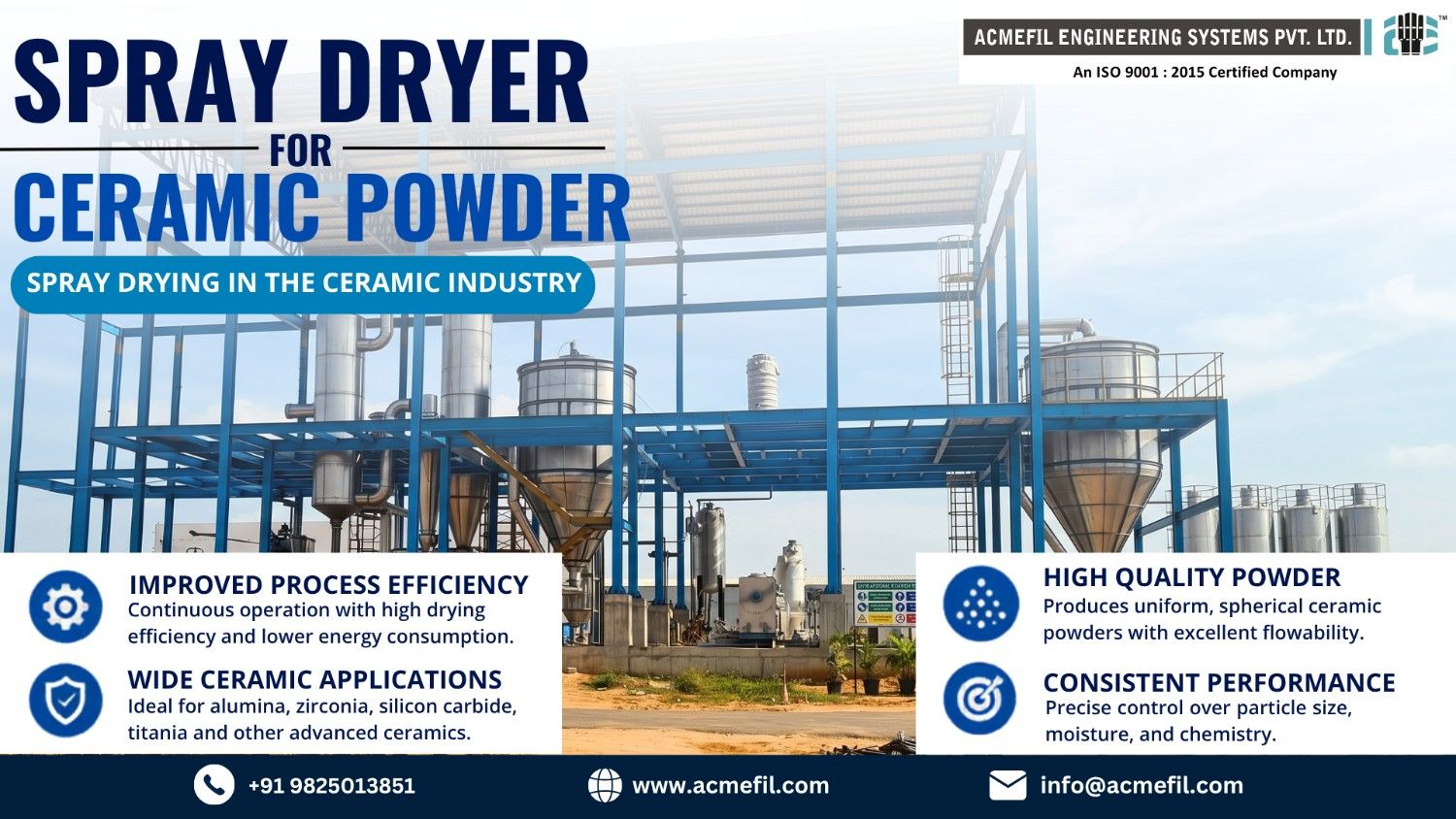
A spray dryer for ceramic powder converts pumpable ceramic slurry into dry, free-flowing granules by atomizing the slurry into hot drying air. In the ceramic industry, this step is important because powder flow, particle behavior, moisture consistency, die filling, pressing, and sintering performance all depend on how the slurry is dried.
The mistake I see buyers make is simple. They compare spray dryer capacity and price first. For ceramic applications, the first question should be different: can the slurry be atomized consistently, and will the dried powder behave correctly in the next process?
Spray drying is widely studied for ceramic powders because slurry formulation, solids content, viscosity, binder type, and atomization technique can influence the final granule character. Research on alumina and zirconia systems also shows a direct relationship between slurry characteristics and spray-dried granule morphology.
What Is a Spray Dryer for Ceramic Powder?
A spray dryer for ceramic powder is an industrial drying system used to convert ceramic slurry into dry powder or granules. The slurry is pumped into the dryer, atomized into droplets, contacted with hot drying air, dried rapidly, and then separated from exhaust air through collection equipment such as cyclones and bag filters.
For ceramic manufacturers, the goal is not just “dry powder.” The real goal is controlled powder behavior.
A good ceramic spray drying system should help the plant achieve:
- Consistent residual moisture
- Controlled granule formation
- Better flowability for handling and pressing
- Reduced lump formation
- Stable downstream compaction behavior
- Reliable powder recovery
- Cleaner discharge and collection
That is why ceramic spray dryer design must start from feed behavior and final powder requirement, not only from evaporation capacity.
For readers new to the basic system layout, the spray dryer design and components guide explains how the drying chamber, atomizer, air handling, separator, and discharge system work together.
How Spray Drying Works in the Ceramic Industry
In ceramic processing, the feed is usually a water-based slurry containing fine ceramic solids, binders, dispersants, and other formulation additives. Spray drying turns this slurry into a dry powder through four main stages.
| Stage | What Happens | Why It Matters in Ceramic Powder |
|---|---|---|
| Atomization | The slurry is broken into fine droplets using a rotary atomizer or nozzle | Droplet size affects powder size, shape, flow, and drying uniformity |
| Spray-air contact | Droplets meet hot drying air inside the chamber | Air pattern affects residence time, wall deposition, and moisture removal |
| Drying | Moisture evaporates from droplets rapidly | Poor drying control can create hollow, sticky, weak, or uneven granules |
| Powder separation | Dried powder is separated from exhaust air | Cyclone and bag filter design affects recovery, dust load, and plant cleanliness |
A spray dryer looks simple in a flow diagram, but ceramic powder quality is created by the full system. Atomization, air distribution, chamber geometry, feed stability, powder separation, discharge, and dust collection all affect the final result.
For deeper process tuning, the spray drying parameter optimization guide is useful because parameters such as feed rate, inlet temperature, outlet temperature, atomizer speed, and airflow cannot be treated separately.
Which Ceramic Materials Can Be Spray Dried?
Ceramic spray drying is used for oxide ceramics, technical ceramics, clay-based ceramics, magnetic ceramics, and glass-related slurry systems. ACMEFIL’s verified ceramic spray drying application list includes alumina, aluminum silicate, ceramics, china clay, ferrites, silicon carbides, zirconia, steatites, titanates, and glass slurry.
| Ceramic Material | Spray Drying Objective | Selection Note |
|---|---|---|
| Alumina | Prepare controlled ceramic powder for forming and further processing | Abrasiveness, particle size, and slurry stability should be reviewed |
| Aluminum silicate | Convert slurry into powder for ceramic formulations | Feed consistency affects atomization stability |
| China clay | Produce powder for ceramic body preparation | Solids content and viscosity are important |
| Ferrites | Prepare powder for magnetic ceramic applications | Batch consistency is often more important than maximum throughput |
| Silicon carbide | Dry abrasive ceramic slurry | Contact-part wear and maintenance access need careful review |
| Zirconia | Prepare technical ceramic powder | Contamination control and powder behavior matter |
| Steatites | Prepare powder for electrical ceramic applications | Flowability and moisture consistency affect pressing |
| Titanates | Process technical ceramic powder | Particle behavior should be validated before scale-up |
| Glass slurry | Convert slurry into dry powder | Stickiness, fines, and exhaust separation should be checked early |
The key point is that ceramic materials should not be grouped under one generic “powder” category. Alumina, zirconia, ferrites, silicon carbide, china clay, and glass slurry do not behave the same inside a spray dryer.
Why Ceramic Powder Quality Depends on Slurry Behavior
In ceramic spray drying, the spray dryer does not repair a poorly prepared slurry. It exposes the slurry behavior.
The most important feed-side factors are:
- Solids percentage
- Viscosity
- Density
- Particle size distribution
- Slurry stability
- Binder type and dosage
- Dispersant system
- pH
- Abrasive nature of the solids
- Pumpability
- Tendency to settle, foam, or form lumps
Studies on ceramic spray drying show that slurry formulation and dispersion can influence whether granules become solid, hollow, spherical, irregular, or weak. This is why ceramic spray drying should be treated as powder engineering, not only as moisture removal.
For a ceramic manufacturer, this matters in practical terms. A powder may look dry, but if the granules are weak, too hollow, too dusty, too sticky, or too inconsistent, the downstream process will show the problem.
You may see:
- Uneven die filling
- Poor powder flow
- Dusting during handling
- Segregation in storage
- Pressing variation
- Higher rejection during forming
- More cleaning around powder collection points
- Inconsistent sintering behavior
This is why I always prefer to discuss the slurry and target powder behavior before discussing dryer model size.
Rotary Atomizer vs Nozzle Atomizer for Ceramic Spray Drying
The atomizer is one of the most important decisions in a ceramic spray dryer. It controls droplet formation, spray pattern, chamber loading, powder size behavior, and maintenance sensitivity.
| Selection Factor | Rotary Atomizer | Pressure Nozzle / Two-Fluid Nozzle |
|---|---|---|
| Basic mechanism | High-speed centrifugal disc breaks slurry into droplets | Feed is atomized through pressure or compressed air |
| Common fit | Ceramic slurry where stable spray pattern and suspended solids handling are important | Applications needing specific spray geometry or finer atomization behavior |
| Droplet control | Managed through disc design and atomizer speed | Managed through nozzle size, pressure, and air/liquid interaction |
| Abrasive slurry concern | Disc and contact area wear must be reviewed | Nozzle wear and blockage risk must be reviewed |
| Maintenance focus | Atomizer disc, drive, balance, and wear parts | Nozzle orifice, pump pressure, compressed air, and clogging |
| Best decision method | Review slurry data and target powder behavior | Review slurry data and target powder behavior |
There is no universal answer that rotary atomizers are always better or nozzles are always better. For ceramic slurry, the correct choice depends on feed solids, viscosity, abrasiveness, required powder behavior, and the dryer chamber design.
The spray dryer atomization techniques guide and the nozzle vs rotary atomizer comparison are useful supporting resources before final selection.
When Is Spray Drying the Right Choice for Ceramic Powder?
Spray drying is a strong fit when the feed is a pumpable ceramic slurry and the plant needs controlled, free-flowing powder for downstream forming, pressing, or sintering.
| Buyer Condition | Spray Dryer Fit | Engineering Reason |
|---|---|---|
| Feed is pumpable ceramic slurry | Strong fit | Spray drying is designed to convert slurry into dry powder |
| Powder must flow well for pressing | Strong fit | Atomization and rapid drying support controlled granule formation |
| Feed is highly abrasive | Possible, but needs review | Wear protection, material contact surfaces, and maintenance access matter |
| Powder has strict particle behavior requirement | Strong fit with trials | Atomizer selection and drying profile should be validated |
| Feed is not pumpable and behaves like wet cake | Weak fit | Spin flash or another drying route may be more suitable |
| Buyer has no slurry data | High risk | Dryer sizing without feed data increases scale-up uncertainty |
| Product is in R&D or new material development | Pilot testing recommended | Trial data helps avoid wrong full-scale selection |
The most expensive mistake is not always buying the wrong capacity. Often, it is buying the wrong drying route for the material behavior.
Common Mistakes When Selecting a Ceramic Spray Dryer
Mistake 1: Selecting the Dryer Only by Evaporation Capacity
Evaporation capacity is necessary, but it is not enough. Two dryers with similar water evaporation capacity can produce different powder behavior if atomization, chamber geometry, airflow, and powder recovery are not suited to the slurry.
Mistake 2: Ignoring Slurry Viscosity and Stability
If the slurry settles, thickens, foams, or changes viscosity during operation, atomization will not remain stable. That instability appears later as powder variation, wall deposition, or nozzle/atomizer issues.
Mistake 3: Treating Abrasive Ceramic Slurry Like Food or Chemical Feed
Silicon carbide, alumina, zirconia, and other abrasive ceramic materials require careful review of contact parts, atomizer wear, bends, discharge points, and maintenance access.
Mistake 4: Not Defining Target Powder Behavior
“Dry powder” is not a proper specification. A ceramic plant should define target moisture, powder flowability, granule behavior, downstream pressing requirement, and acceptable fines level.
Mistake 5: Skipping Pilot Testing When Product Behavior Is Uncertain
For new ceramic formulations, pilot testing can reduce risk. It helps confirm whether the slurry atomizes properly, dries consistently, and gives powder suitable for the next manufacturing step.
What Data Should a Buyer Share Before Spray Dryer Selection?
Before selecting a spray dryer for ceramic powder, share practical process data. This helps the equipment manufacturer evaluate atomizer type, chamber configuration, heating system, powder separation, and discharge design.
| Data Required | Why It Matters |
|---|---|
| Ceramic material name | Alumina, zirconia, ferrite, china clay, silicon carbide, and glass slurry behave differently |
| Slurry composition | Determines drying behavior and possible stickiness |
| Solids percentage | Affects evaporation load, viscosity, and atomization |
| Viscosity | Critical for feed pumping and atomization |
| Density | Impacts feed system sizing and spray behavior |
| Particle size distribution | Influences slurry stability and final powder properties |
| Binder/dispersant details | Affects granule structure and drying behavior |
| Abrasive nature | Impacts contact-part material and maintenance planning |
| Target moisture | Determines drying profile and outlet condition |
| Required powder behavior | Helps select atomizer and chamber design |
| Capacity and operating hours | Supports plant sizing and utility estimation |
| Heating source | Influences hot air generator selection |
| Downstream process | Pressing, compaction, sintering, or storage requirements affect powder specification |
This is also where an experienced manufacturer should push back if the data is incomplete. A quote without feed data may look fast, but it can create problems during commissioning.
For broader selection logic, see how to choose the right spray dryer.
Where Do Cyclones, Bag Filters, and Air Locks Fit?
Ceramic spray drying does not end at the chamber outlet. Once the powder is formed, the system must separate dry particles from exhaust air and discharge them without disturbing the air balance.
The downstream system may include:
- Cyclone separator
- Bag filter
- Exhaust fan
- Air lock rotary valve
- Powder discharge arrangement
- Ducting
- Dust handling and recovery points
- Control panel and instrumentation
For ceramic powders, fines and dust control need attention. If the separation system is weak, powder recovery suffers. If discharge is poorly designed, the plant can face powder leakage, cleaning problems, unstable pressure, and inconsistent collection.
This is why I prefer to evaluate the dryer as a complete powder handling system, not only as a drying chamber.
Why Pilot Testing Matters for Ceramic Spray Drying
Pilot testing is valuable when the ceramic formulation is new, abrasive, high-value, or sensitive to granule behavior.
A pilot spray dryer trial can help answer practical questions:
- Does the slurry atomize without blockage?
- Is the spray pattern stable?
- Does the powder stick to the chamber wall?
- What outlet condition gives acceptable moisture?
- How much fine powder is generated?
- Does the powder flow well after drying?
- Does the powder meet downstream pressing or handling expectations?
- Are there signs of excessive wear or deposition risk?
ACMEFIL has an in-house pilot spray dryer with 3 kg/hr water evaporation capacity, available for product trials and process development. For ceramic buyers, this is useful because trial data can reduce uncertainty before selecting a full-scale system.
You can also review ACMEFIL’s pilot spray dryer and rotary atomizer type spray dryer pages for equipment-specific support.
ACMEFIL’s Approach to Ceramic Spray Dryer Selection
For ceramic powder applications, ACMEFIL does not start only from chamber size. The selection discussion normally moves through seven questions:
- Is the ceramic feed pumpable and stable enough for spray drying?
- What solids percentage, viscosity, density, and particle size data are available?
- Should the system use rotary atomization or nozzle atomization?
- What drying chamber and hot air pattern are suitable for the spray behavior?
- What material contact surfaces and wear considerations apply?
- What cyclone, bag filter, discharge, and air lock arrangement is needed?
- Should pilot testing be done before commercial sizing?
ACMEFIL Engineering Systems Pvt. Ltd. is an ISO 9001:2015 certified manufacturer of drying and concentrating equipment, incorporated in 2000, with 500+ installations across India and international markets. The company manufactures spray dryers, rotary atomizer systems, nozzle type spray dryers, fluidized spray dryers, lab scale pilot spray dryers, and related drying systems for industries including ceramics, dyes, chemicals, food, pharmaceuticals, detergents, and effluent treatment.
For ceramic applications, the practical value is not just manufacturing the dryer. It is matching slurry behavior, atomizer selection, hot air design, powder separation, and pilot validation into one workable drying solution.
Final Selection Checklist for Ceramic Manufacturers
Before placing an order for a ceramic spray dryer, confirm these points:
- Feed slurry is pumpable and stable
- Solids percentage and viscosity are measured
- Binder and dispersant system is defined
- Target moisture is clear
- Required powder behavior is defined
- Abrasiveness is reviewed
- Rotary vs nozzle atomizer selection is technically justified
- Chamber size is matched to spray behavior
- Hot air generator and airflow are properly selected
- Cyclone and bag filter are sized for powder recovery
- Discharge system and air locks are considered
- Pilot testing is planned where uncertainty is high
- Utility consumption and maintenance access are reviewed
- Downstream pressing, compaction, or sintering requirements are considered
If these points are not discussed, the proposal is incomplete.
Conclusion
A spray dryer for ceramic powder should be selected around slurry behavior and powder requirement, not only around capacity. In the ceramic industry, spray drying affects flowability, moisture consistency, granule structure, pressing behavior, and downstream product quality.
The right system depends on the material, slurry formulation, atomizer selection, drying profile, powder separation, and discharge design. For alumina, zirconia, ferrites, china clay, silicon carbide, steatites, titanates, and glass slurry, technical review and pilot testing can prevent expensive scale-up errors.
FAQs
What is a spray dryer for ceramic powder?
A spray dryer for ceramic powder is an industrial system that converts pumpable ceramic slurry into dry powder or granules. The slurry is atomized into droplets, contacted with hot drying air, dried rapidly, and separated from exhaust air. It is commonly used for ceramic materials such as alumina, zirconia, ferrites, china clay, silicon carbide, titanates, steatites, and glass slurry.
Why is spray drying used in the ceramic industry?
Spray drying is used in the ceramic industry because it converts slurry into free-flowing powder with controlled moisture and granule behavior. This helps downstream handling, die filling, pressing, compaction, and sintering. It is especially useful when the plant needs repeatable powder preparation instead of irregular dried lumps or poorly flowing powder.
Which atomizer is better for ceramic slurry, rotary or nozzle?
The right atomizer depends on slurry viscosity, solids loading, abrasiveness, particle size, and required powder behavior. Rotary atomizers are often evaluated for suspended solids and stable spray patterns. Nozzle atomizers may be selected when a specific spray geometry or fine atomization behavior is required. Ceramic slurry should be technically reviewed before final selection.
Can abrasive ceramic materials be spray dried?
Yes, abrasive ceramic materials such as alumina, zirconia, and silicon carbide can be spray dried, but the system must be reviewed for wear. Atomizer selection, contact-part material, bends, discharge points, maintenance access, cyclone design, and bag filter loading should be checked before finalizing the system.
What information is needed to design a ceramic powder spray dryer?
A buyer should share slurry composition, solids percentage, viscosity, density, particle size distribution, binder or dispersant details, target moisture, required capacity, abrasive nature, heating source, operating hours, and downstream process requirement. Without this information, spray dryer selection becomes less reliable.
If you are evaluating a spray dryer for ceramic powder, start with the slurry, not the equipment size. Share your ceramic material, feed properties, target moisture, expected powder behavior, and downstream process requirement. ACMEFIL’s engineering team can evaluate the right spray dryer configuration, atomizer type, pilot testing need, and powder recovery system for your application.
For technical discussion, use the SprayDryer.com contact page or review ACMEFIL’s detailed guide on spray dryers in the ceramic industry.

Siddharth Nair is Technical Director at Acmefil Engineering Systems Pvt. Ltd. he leads solution design and applications engineering across the company’s full product range — spray dryers, multi-effect evaporators, agitated thin film dryers, spin flash dryers, fluid bed dryers, and complete ZLD systems.
His work spans process evaluation, equipment sizing, customer application consulting, and technical proposal development for industries including food and dairy, pharmaceuticals, chemicals, dyestuffs, ceramics, and industrial effluent treatment. He has hands-on commissioning experience across Acmefil’s 500+ installations in India and 15+ countries.
He holds a BTech in Mechanical Engineering from CHARUSAT University and also partners at A.S Engineers, working with blowers, sludge dryers, and industrial conveying systems.


