
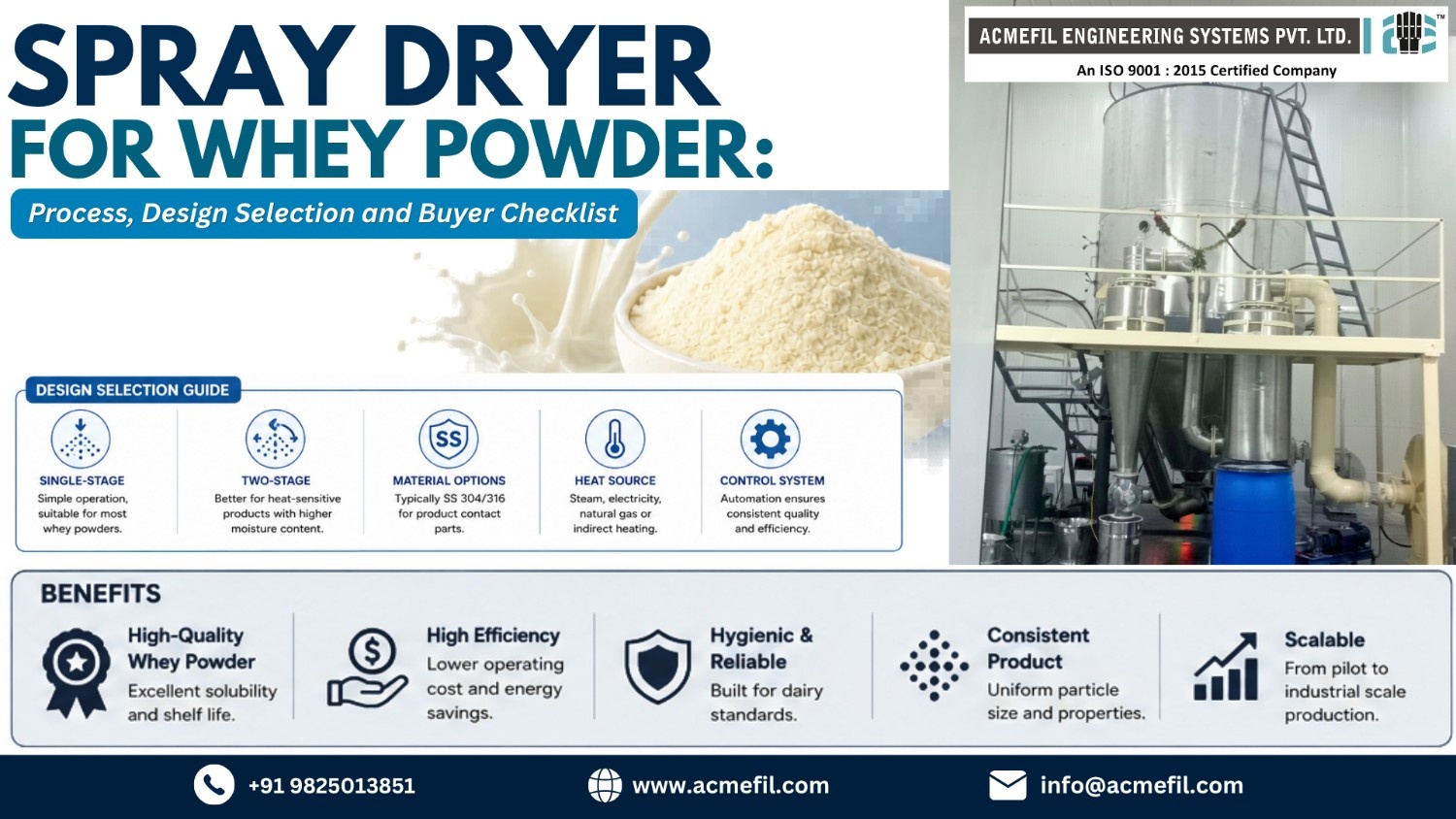
A spray dryer for whey powder converts concentrated whey into a stable dry powder by atomizing the liquid feed into fine droplets, drying it rapidly with hot air, and separating the powder from the drying air. For whey, the main challenge is not only moisture removal. The real challenge is preserving solubility, colour, flavour, protein quality, flowability, and low scorched-particle content while handling a lactose-rich and sometimes sticky feed.
In dairy plants, whey powder is usually not dried directly from raw liquid whey. The whey is first clarified, pasteurized, often membrane-processed or evaporated, and then spray dried. Sweet whey powder, for example, is obtained by drying pasteurized fresh whey from cheese manufacture, and typical sweet whey powder contains around 11.0% to 14.5% protein, 63.0% to 75.0% lactose, and 3.5% to 5.0% moisture.
For a plant owner or project engineer, this means one thing: the spray dryer must be selected around the whey composition, feed solids, atomization method, outlet moisture target, powder property target, and cleaning requirement. Buying a generic dryer without testing the feed is where many whey powder projects become unstable.
Why Whey Powder Needs Careful Spray Dryer Selection
Whey is a valuable dairy stream, but it is not the easiest liquid to dry. It contains lactose, minerals, whey proteins, and organic acids depending on whether the source is sweet whey, acid whey, whey permeate, WPC, or WPI.
A basic spray drying explanation says: atomize liquid, expose it to hot gas, evaporate water, collect powder. That is true, but for whey it is incomplete.
Whey drying has four practical risks:
- Lactose-rich powder can become sticky if the drying profile and powder cooling are not controlled.
- Protein functionality can suffer if heat exposure is too aggressive.
- Powder can show poor solubility or scorched particles if deposits form on the dryer wall.
- Final powder may fail on bulk density, flowability, dispersibility, or moisture stability.
The Dairy Processing Handbook explains that spray drying is widely used to convert liquids or slurries into dry powders and that it is especially suitable for continuous production of thermally sensitive products where particle size, residual moisture, bulk density, flowability, and dissolvability matter.
That is exactly why whey drying should be treated as an engineered powder process, not just a heat-and-air process.
How the Whey Spray Drying Process Works
A typical whey spray drying process follows this sequence:
| Stage | What Happens | Why It Matters |
|---|---|---|
| Feed preparation | Whey is clarified, pasteurized, filtered, concentrated, or crystallized depending on product type | Determines viscosity, solids load, lactose behaviour, and dryer load |
| Pre-concentration | Water is removed before spray drying, usually through evaporation or membrane concentration | Reduces energy load on the spray dryer |
| Atomization | Concentrated whey is converted into fine droplets by nozzle or rotary atomizer | Controls drying rate, particle size, and powder morphology |
| Hot air drying | Droplets meet controlled hot air inside the drying chamber | Removes moisture rapidly while limiting product overheating |
| Powder separation | Cyclone, bag filter, or powder recovery system separates dry powder from air | Affects yield, dust control, and housekeeping |
| Final cooling/handling | Powder is cooled, packed, or further conditioned | Reduces caking and improves storage stability |
USDEC describes whey spray drying as atomizing concentrated whey into hot air, where water rapidly evaporates. It also notes that atomizer type, droplet size, air temperature, and airflow influence moisture removal while helping protect whey proteins from heat damage.
In my view, the most important design question is not “What is the spray dryer capacity?” The better question is, “What powder property must the dryer deliver at the outlet?”
Sweet Whey, Acid Whey, WPC and Whey Permeate Are Not the Same Feed
A spray dryer for whey powder must be matched to the exact whey stream. Sweet whey powder and acid whey powder may look similar to a non-technical buyer, but they behave differently during processing.
| Whey Product | Typical Drying Concern | Design Focus |
|---|---|---|
| Sweet whey powder | Lactose crystallization, stickiness, solubility, colour | Stable drying profile and powder cooling |
| Acid whey powder | Higher mineral/acidity impact, stickiness, flavour control | Feed characterization and controlled outlet conditions |
| Whey protein concentrate | Protein functionality, solubility, flavour, denaturation risk | Gentle drying and controlled residence time |
| Whey protein isolate | Higher value product, strict quality expectation | Hygienic design, careful heat exposure, validated trials |
| Whey permeate powder | High lactose and mineral content | Crystallization, caking control, powder handling |
The Dairy Processing Handbook notes that sweet whey powder may be produced by drying whey concentrate directly from the evaporator or by drying pre-crystallised whey concentrate, with pre-crystallisation being the more common process.
That single point is important. If the feed is not prepared correctly before drying, even a well-built spray dryer will struggle.
Which Type of Spray Dryer Is Suitable for Whey Powder?
For whey powder, the best spray dryer configuration depends on feed solids, viscosity, desired particle size, powder density, solubility target, and whether the product needs agglomeration.
Rotary Atomizer Spray Dryer
A rotary atomizer uses a high-speed disc to break concentrated liquid into droplets. This can be useful where flexible feed handling and controlled particle formation are important.
At Acmefil, rotary disc type spray dryers are part of the verified spray dryer range. The documented rotary atomizer design forms fine droplets in the 20 to 75 micron range, with droplet size influenced by disc selection and speed.
For whey powder, a rotary atomizer may be considered when:
- Feed rate variation is expected
- Wider operating flexibility is needed
- Powder morphology and bulk density need tuning
- The plant wants stable operation across multiple dairy powder recipes
You can read more about atomizer choice in the related guide on spray dryer atomization techniques.
Pressure Nozzle Spray Dryer
A pressure nozzle atomizes feed by pumping it through an orifice at high pressure. This can be useful where the plant wants more defined particle properties or a specific powder density profile.
For whey powder, pressure nozzles need careful attention to feed filtration, viscosity, solids consistency, and nozzle wear. Any instability at the nozzle can show up as inconsistent moisture, wall deposits, or powder variation.
Two-Fluid Nozzle Spray Dryer
A two-fluid nozzle uses compressed air for atomization. It is more common in small-scale, pilot, or specialized drying applications where fine atomization is required at lower liquid flow rates.
For R&D teams working on whey protein powder, functional dairy ingredients, or trial batches, two-fluid nozzle testing can help understand how the material responds before scaling to production.
Fluidized Spray Dryer or Integrated Fluid Bed System
A fluidized spray dryer or dryer with a fluid bed stage is useful where larger particles, agglomeration, improved dispersibility, or final moisture conditioning are required.
Acmefil’s verified fluidized spray dryer range is designed for larger particles in the 50 to 150 micron range and includes drying through an integrated fluid bed at the bottom of the chamber. For whey powders that need better instant properties, an agglomerated powder route may be evaluated.
For broader background, see this guide on types of spray dryers.
Main Design Factors for a Whey Powder Spray Dryer
A buyer should not finalize a whey powder spray dryer only from capacity in kg/hr. Capacity is important, but it is not enough.
The technical data sheet should answer these points.
| Design Factor | Why It Matters for Whey Powder |
|---|---|
| Feed type | Sweet whey, acid whey, WPC, WPI, and permeate behave differently |
| Feed solids | Higher solids reduce dryer load but increase viscosity and stickiness risk |
| Lactose condition | Poor lactose crystallization can cause caking and wall deposits |
| Atomizer type | Affects droplet size, drying rate, particle size, and powder density |
| Inlet and outlet air temperature | Controls drying speed, residual moisture, colour, and heat exposure |
| Airflow pattern | Affects residence time, wall deposition, and powder collection |
| Powder recovery system | Cyclone and bag filter design affects yield and dust control |
| CIP requirement | Dairy-grade cleaning needs must be considered early |
| Final powder target | Moisture, solubility, bulk density, flowability, and colour drive the design |
The common buyer mistake is to ask only for evaporation capacity. In whey drying, evaporation capacity must be tied to feed solids and powder specifications. A dryer that evaporates water is not automatically a dryer that makes saleable whey powder.
What Powder Quality Problems Happen in Whey Spray Drying?
Sticky Powder and Wall Deposition
Whey powders can become sticky because lactose and minerals influence the glass transition behaviour of the powder. When the outlet air temperature, final moisture, or powder cooling is not controlled, sticky powder can deposit on dryer walls.
Wall deposition creates three problems:
- Lower yield
- Cleaning difficulty
- Risk of scorched particles
USDEC notes that particles adhering to the dryer wall can later dry and fall into the product. These particles may brown, become less soluble, and limit some whey powder applications.
Poor Solubility
Solubility is critical for whey powder used in beverages, bakery, nutrition mixes, dairy blends, and processed foods. Solubility can be affected by overheating, poor drying balance, wall deposits, or incorrect pre-treatment.
The dryer should be selected to protect powder functionality, not only to hit low moisture.
Caking During Storage
Whey powder can cake if moisture, temperature, lactose condition, or packaging environment is not controlled. Spray drying alone does not solve storage stability. The full process must consider cooling, powder handling, packing, and warehouse conditions.
Colour and Flavour Changes
Excessive heat exposure can affect colour and flavour. For high-value whey protein ingredients, this is especially important because buyers often evaluate flavour, colour, solubility, and functional performance together.
Why Pre-Concentration Matters Before Spray Drying
Spray drying is energy-intensive compared with evaporation or membrane concentration. That is why whey feed is normally concentrated before entering the spray dryer.
The Dairy Processing Handbook explains that to minimize spray drying energy costs, solids in the liquid feed are maximized by removing water through membrane filtration and/or evaporation, which requires only about 10% to 12% of the energy used for spray drying.
This is why a serious whey powder project often needs a full process view:
- Membrane filtration for concentration or fractionation
- Evaporation to increase feed solids
- Crystallization where lactose control is required
- Spray drying for final powder formation
- Powder cooling and packing for storage stability
A buyer who evaluates only the spray dryer may miss the upstream condition that actually determines dryer stability.
Spray Dryer for Whey Powder vs Milk Powder
Whey powder and milk powder are both dairy powders, but they are not identical drying problems.
| Factor | Whey Powder | Milk Powder |
|---|---|---|
| Main solid concern | Lactose, minerals, whey proteins | Casein, fat, lactose, milk solids |
| Stickiness risk | Often higher, especially with poor lactose control | Present but usually different behaviour |
| Functional priority | Solubility, dispersibility, protein functionality, colour | Solubility, flavour, bulk density, fat control |
| Feed preparation | Often needs concentration, crystallization, or membrane processing | Usually evaporation before drying |
| Buyer concern | Powder stability and ingredient functionality | Consumer or industrial dairy powder quality |
For related dairy drying context, read our article on spray dryer for milk powder. It helps compare how dairy spray drying changes when the feed composition changes.
Recommended Buyer Checklist Before Buying a Whey Powder Spray Dryer
Before requesting a quote, prepare this information:
- Type of whey: sweet whey, acid whey, WPC, WPI, permeate, or blend
- Feed solids percentage
- Feed viscosity at operating temperature
- Feed temperature before atomization
- pH and mineral load
- Target powder moisture
- Target bulk density
- Solubility or dispersibility requirement
- Required particle size range
- Expected operating hours per day
- Cleaning and CIP requirement
- Hygienic material requirement
- Powder packing method
- Available utilities: steam, electricity, fuel, compressed air
- Space limitation and building height
- Whether pilot drying data is available
For process engineers, I would add one more item: send the actual feed for trial if the product is new, high-value, or variable. A lab report is helpful, but spray drying behaviour must be seen in the dryer.
You can also review the broader spray dryer design and components guide before preparing the RFQ.
Why Pilot Testing Is Valuable for Whey Powder
A pilot trial is not a formality for whey. It answers questions that a datasheet cannot fully answer.
A trial can show:
- Whether the feed atomizes cleanly
- Whether wall deposition occurs
- Whether the powder reaches target moisture
- Whether powder solubility remains acceptable
- Whether the chosen atomizer is suitable
- Whether the powder needs post-drying or agglomeration
- Whether the process can be scaled safely
Acmefil’s verified R&D facility includes a pilot spray dryer with 3 kg/hr water evaporation capacity, used for product trials and process development. For whey powder projects, this is useful because the feed behaviour can be checked before committing to full-scale equipment.
For trial-oriented buyers, see Acmefil’s pilot spray dryer resource and SprayDryer.com’s guide on spray dryer for small scale production.
How to Optimize Whey Spray Drying Parameters
The main spray drying parameters are linked. You cannot change one parameter in isolation and expect stable powder quality.
| Parameter | What It Influences | Practical Warning |
|---|---|---|
| Inlet air temperature | Drying force and evaporation rate | Too aggressive a profile can affect colour and functionality |
| Outlet air temperature | Final moisture and thermal exposure | Must be matched to powder moisture target |
| Feed flow rate | Residence time and drying load | Overfeeding can raise moisture and wall deposits |
| Atomizer speed or pressure | Droplet size and powder particle size | Too fine or too coarse can change drying behaviour |
| Airflow | Drying rate and powder movement | Poor airflow balance can increase deposition |
| Feed solids | Dryer load and viscosity | Higher solids save energy but can create atomization issues |
| Powder cooling | Caking and packing stability | Hot powder packed too early may create storage problems |
For a deeper parameter guide, use optimize spray drying parameters.
When Is a Spray Dryer Not Enough?
A spray dryer is the final powder-forming machine, but whey powder quality may require more than the dryer.
You may need upstream or downstream equipment when:
- The whey has low solids and needs evaporation first
- The whey needs membrane concentration or fractionation
- Lactose crystallization is needed before drying
- Final powder needs agglomeration
- Hygienic cleaning requirements are strict
- Powder must be cooled before packing
- Fine powder recovery needs a stronger bag filter design
This is where a turnkey process view matters. A dryer manufacturer must understand the feed preparation, drying chamber, hot air system, powder recovery, cleaning arrangement, and powder handling route.
For equipment background, Acmefil’s industrial spray dryers and spray dryer manufacturer pages are useful supporting resources.
Final Recommendation
For whey powder, do not buy a spray dryer only on price, chamber size, or evaporation capacity. Start with the product: sweet whey, acid whey, WPC, WPI, or permeate. Then define the target powder: moisture, solubility, bulk density, flowability, colour, flavour, and storage stability.
A good spray dryer for whey powder must balance heat transfer, atomization, residence time, powder recovery, cleaning, and powder cooling. The safest route is to run a pilot trial, confirm the drying behaviour, and then scale the plant around validated parameters.
If you are preparing a whey powder drying project, share your feed details, powder target, and operating conditions before asking for final equipment selection. That one step can prevent an expensive mismatch between the dryer and the product.
FAQs
What type of spray dryer is best for whey powder?
The best spray dryer for whey powder depends on the whey type, feed solids, viscosity, particle size target, and powder quality requirement. Rotary atomizer, pressure nozzle, two-fluid nozzle, and fluidized spray dryer designs can all be suitable in different cases. A pilot trial is recommended before final selection.
Why is whey powder difficult to spray dry?
Whey powder is difficult to spray dry because lactose, minerals, proteins, feed solids, and acidity affect stickiness, solubility, wall deposition, colour, and storage stability. If feed preparation and drying parameters are not controlled, the powder may cake, deposit on the dryer wall, or lose functional quality.
Is pre-concentration required before whey spray drying?
Yes, in most industrial whey powder plants, whey is concentrated before spray drying. Pre-concentration through evaporation or membrane processing reduces the water load on the spray dryer and improves energy efficiency. The final solids level should be selected based on feed behaviour and powder quality targets.
Can the same spray dryer produce milk powder and whey powder?
Sometimes yes, but only if the dryer design, cleaning system, atomization system, powder recovery, and operating parameters suit both products. Milk powder and whey powder have different feed behaviour. Product trials and cleaning validation are important before using one dryer for multiple dairy powders.
What information is needed for a whey powder spray dryer quotation?
A technical quotation should include whey type, feed solids, feed flow rate, viscosity, inlet feed temperature, pH, target powder moisture, bulk density, solubility target, particle size requirement, operating hours, utilities, cleaning requirements, and whether pilot drying data is available.
Planning a whey powder drying project? Share your feed type, target powder moisture, required capacity, and powder quality expectations. Our team can review the process requirement and help you evaluate the right spray dryer configuration before you commit to full-scale procurement.

Siddharth Nair is Technical Director at Acmefil Engineering Systems Pvt. Ltd. he leads solution design and applications engineering across the company’s full product range — spray dryers, multi-effect evaporators, agitated thin film dryers, spin flash dryers, fluid bed dryers, and complete ZLD systems.
His work spans process evaluation, equipment sizing, customer application consulting, and technical proposal development for industries including food and dairy, pharmaceuticals, chemicals, dyestuffs, ceramics, and industrial effluent treatment. He has hands-on commissioning experience across Acmefil’s 500+ installations in India and 15+ countries.
He holds a BTech in Mechanical Engineering from CHARUSAT University and also partners at A.S Engineers, working with blowers, sludge dryers, and industrial conveying systems.


