
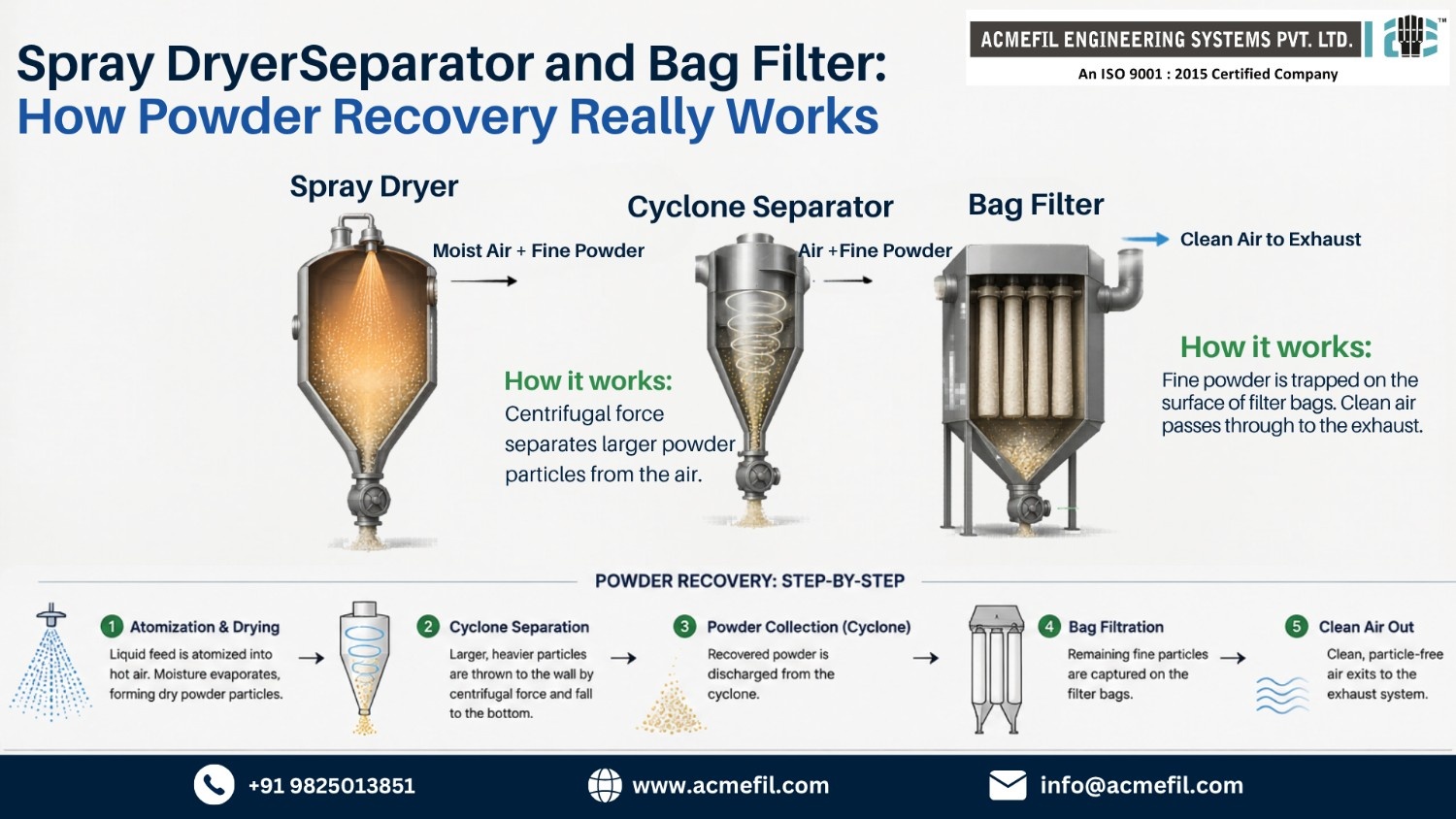
A spray dryer cyclone separator and spray dryer bag filter are not small accessories at the end of the plant. They decide how much saleable powder you recover, how clean your exhaust air remains, and how stable your spray dryer runs over time. In most spray drying systems, the cyclone handles the primary powder separation. The bag filter captures finer dust that escapes the cyclone. When both are selected properly, product loss reduces, pressure drop stays manageable, and the dryer becomes easier to operate.
I have seen buyers focus heavily on the atomizer, chamber size, and hot air generator, but leave the separation system as an afterthought. That is a mistake. A good powder recovery system must be designed with the same seriousness as the drying chamber.
For a broader view of the complete plant layout, read our guide on spray dryer design and components.
What Does a Cyclone Separator Do in a Spray Dryer?
A cyclone separator in a spray dryer separates dried powder particles from the exhaust air leaving the drying chamber. The air enters the cyclone tangentially at high velocity. This creates a rotating flow. Heavier powder particles move toward the cyclone wall due to centrifugal action, lose velocity, and fall into the bottom cone for collection.
The cyclone is usually the first major powder recovery device after the chamber.
In practical terms, it does three jobs:
- It recovers the main powder fraction.
- It reduces dust load before the bag filter or scrubber.
- It protects downstream equipment from excessive powder carryover.
A cyclone works best when the powder is dry, free-flowing, and not extremely fine or sticky. In food powders, dyestuff, pigments, ceramics, inorganic chemicals, and detergents, the cyclone design has to match the particle size distribution and bulk density of the powder.
What Does a Bag Filter Do in a Spray Dryer?
A spray dryer bag filter captures fine powder particles that remain in the exhaust air after cyclone separation. The air passes through filter bags. Fine dust collects on the bag surface, and cleaned air passes through to the outlet side.
In a pulse jet bag filter, compressed air pulses periodically clean the filter bags so that the accumulated powder drops into the hopper.
The bag filter becomes especially important when:
- The powder has a high fine-particle fraction.
- Product recovery is valuable.
- Outlet air cleanliness is critical.
- The cyclone alone cannot meet recovery or dust control expectations.
- The process creates light, low-density powder that easily travels with exhaust air.
A cyclone removes powder by inertia. A bag filter removes powder by filtration. That difference matters because the finest particles are usually the hardest to capture in the cyclone.
Cyclone Separator vs Bag Filter in Spray Drying
| Parameter | Spray Dryer Cyclone Separator | Spray Dryer Bag Filter |
|---|---|---|
| Main function | Primary powder separation from drying air | Fine dust recovery and final filtration |
| Separation method | Centrifugal force and inertia | Fabric filtration |
| Best suited for | Coarser, dry, free-flowing powder | Fine powder and dust-laden air |
| Pressure drop | Usually lower than bag filter | Higher and more sensitive to choking |
| Maintenance focus | Cone, airlock, wear, leakage, build-up | Filter bags, pulse cleaning, pressure drop, leakage |
| Common problem | Fine powder escape if cyclone is undersized or poorly matched | Bag blinding if powder is sticky, moist, or condensing |
| Typical role in plant | First-stage recovery | Second-stage or final recovery |
| Buyer mistake | Expecting cyclone alone to recover all fines | Selecting bag filter without checking moisture, temperature, and powder stickiness |
The right answer is not always cyclone versus bag filter. In many industrial spray drying plants, the better answer is cyclone plus bag filter, because each device solves a different part of the separation problem.
Why Many Spray Dryers Use Both Cyclone and Bag Filter
A spray dryer produces powder inside the drying chamber, but the powder does not politely fall only at the chamber bottom. A portion of the dried product travels with exhaust air. The lighter and finer the powder, the more likely it is to move downstream.
A typical recovery sequence is:
Drying chamber → cyclone separator → bag filter → ID fan → exhaust
The cyclone collects the main powder fraction. The bag filter captures the fine carryover. This two-stage arrangement reduces the load on the filter bags and improves total powder recovery.
When a bag filter is placed directly after the chamber without adequate pre-separation, the filter area and cleaning system must handle a much higher dust load. That can increase pressure drop, cleaning frequency, filter wear, and maintenance cost.
When only a cyclone is used for a very fine powder, product loss can become visible in the exhaust path or stack area. In that case, the saving made by avoiding a bag filter can be lost through poor recovery and repeated cleaning issues.
Where the Powder Is Collected
In a spray dryer with cyclone and bag filter, powder is collected at more than one point.
The heavier or more easily separable powder is collected at the cyclone bottom. Fine powder that escapes the cyclone is collected at the bag filter hopper. Depending on the product and quality requirement, the plant owner may decide whether to combine both fractions, keep them separate, or treat bag filter fines differently.
This is an important quality decision.
For example, in some products, cyclone powder may have a different bulk density or particle size compared with bag filter fines. In food, pharma, ceramics, dyestuff, and pigment applications, that difference can affect blending, flowability, solubility, or downstream packing behavior.
What Happens When the Cyclone Is Not Designed Properly?
A cyclone separator looks simple from outside, but small design mistakes can create large operating problems.
Common symptoms include:
- Powder escaping to the bag filter in high quantity
- High dust load on filter bags
- Poor powder yield
- Product build-up inside ducting
- Uneven powder discharge from rotary airlock
- Abrasion in cyclone cone or inlet section
- Unstable pressure balance in the drying system
The cyclone must be selected around actual process data, not just pipe diameter. I would look at air volume, powder loading, expected particle size, powder bulk density, outlet temperature, moisture tendency, and whether the material is abrasive or sticky.
A cyclone that works for ceramic slurry powder may not behave the same way for food colors, herbal extracts, or dyestuff powder.
What Happens When the Bag Filter Is Not Selected Properly?
A bag filter usually gives trouble when the powder or air conditions are not understood properly. The most common issue is bag blinding. This happens when fine powder sticks to the filter surface and does not release properly during pulse cleaning.
Common causes include:
- Outlet air temperature too close to dew point
- Powder still carrying excess moisture
- Hygroscopic powder absorbing moisture from air
- Sticky or oily powder depositing on fabric
- Wrong filter media selection
- Weak or excessive pulse cleaning
- Poor hopper discharge design
- Air leakage causing condensation or unstable flow
Once the bag filter starts choking, the whole spray dryer feels it. Pressure drop increases. Airflow reduces. Outlet temperature behavior changes. Powder moisture may drift. Operators then try to adjust feed rate or temperature, but the real problem may be at the filtration end.
That is why troubleshooting should not stop at the drying chamber. Read our detailed guide on spray dryer troubleshooting and common operating issues if your plant is showing unstable moisture, low recovery, or pressure drop problems.
Selection Criteria for Spray Dryer Cyclone and Bag Filter
Before selecting a cyclone separator or bag filter for a spray dryer, the process engineer should ask for the following information.
| Selection Data | Why It Matters |
|---|---|
| Feed solids and feed behavior | Influences powder load and drying behavior |
| Target outlet moisture | Affects stickiness and bag filter choking risk |
| Expected particle size | Determines cyclone efficiency and fine dust load |
| Bulk density | Impacts separation and discharge behavior |
| Powder stickiness or hygroscopic nature | Critical for bag filter media and temperature margin |
| Air volume | Determines cyclone size, filter area, and pressure drop |
| Outlet air temperature | Important for filter media and condensation risk |
| Material abrasiveness | Affects cyclone wear and construction material |
| Product recovery requirement | Decides whether cyclone alone is enough |
| Air pollution requirement | Decides final filtration or scrubber need |
| Cleaning and access requirement | Affects maintenance layout and downtime |
This is where many budget-focused purchases fail. The buyer asks for “one cyclone and one bag filter,” but does not provide enough product data. The supplier then gives a standard arrangement. Later, the plant struggles because the actual powder is finer, stickier, or more abrasive than expected.
When Is a Cyclone Separator Enough?
A cyclone separator may be enough when the powder is relatively coarse, dry, free-flowing, and product recovery requirements are moderate. It can also be suitable when downstream air cleaning is handled by another device, depending on process and local requirements.
Cyclone-only systems are more common when:
- The powder is not extremely fine.
- The product is not very high value.
- The process allows some fine carryover to be handled separately.
- The plant has suitable downstream dust control.
- The outlet air conditions do not create heavy fine dust escape.
But I would not decide this from product name alone. “Chemical powder” or “food powder” is not enough information. A spray dried powder’s behavior depends on solids content, atomization, drying temperature, particle morphology, and moisture profile.
When Should You Add a Bag Filter?
A bag filter should be considered when the powder has a fine fraction that the cyclone cannot economically capture, or where clean exhaust and higher product recovery are important.
A bag filter is usually a stronger choice when:
- The powder is fine, light, or low-density.
- Product loss through exhaust is costly.
- Dust emission expectations are tighter.
- The process has valuable product fines.
- Cyclone discharge is not capturing enough powder.
- The plant wants two-stage recovery.
For example, dyestuff, pigments, food colors, pharmaceutical powders, and some inorganic chemicals can create fine dust that needs careful recovery. In those cases, the bag filter is not just an air pollution control device. It becomes part of the product recovery system.
For equipment-side details, Acmefil has a dedicated page on industrial bag filters and a technical article on bag filter selection, design, and maintenance.
Cyclone and Bag Filter Layout in a Spray Dryer Plant
A practical layout usually includes:
- Drying chamber outlet duct
- Cyclone separator
- Rotary airlock below cyclone
- Bag filter inlet duct
- Bag filter housing and hopper
- Pulse jet cleaning system
- Rotary airlock or discharge valve below bag filter
- ID fan
- Exhaust stack or further air pollution control system
The ID fan is generally placed after the separation equipment so that the system can pull air through the dryer and recovery units. Air leakage must be controlled because false air changes the flow balance and can disturb drying temperature, collection efficiency, and filter behavior.
The rotary airlock also matters. If the airlock leaks badly or does not discharge powder smoothly, the cyclone or bag filter cannot perform as intended. Powder recovery is not only about separation. It is also about controlled discharge.
Spray Dryer Bag Filter Media: What Should Buyers Check?
The filter bag material should be selected based on temperature, powder chemistry, moisture behavior, cleaning method, and product contact requirement.
Key checks include:
- Can the filter media handle the operating temperature?
- Is the powder abrasive?
- Is the powder hygroscopic or sticky?
- Is the gas stream corrosive?
- Is the application food, pharma, chemical, ceramic, or effluent-related?
- Is antistatic media needed?
- Will the bags be cleaned by pulse jet?
- How accessible are the bags for inspection and replacement?
Do not select filter media only by price. A cheaper bag that blinds early or fails under actual process conditions becomes expensive through downtime, powder loss, and frequent replacement.
Spray Dryer Cyclone Design: What Should Buyers Check?
For the cyclone, the buyer should review:
- Cyclone diameter and height
- Inlet geometry
- Cone angle
- Air velocity
- Expected pressure drop
- Powder loading
- Particle size distribution
- MOC based on abrasion or corrosion
- Airlock sealing
- Access for cleaning
- Duct layout before and after cyclone
In abrasive powders such as ceramics or some inorganic chemicals, wear protection becomes important. In food or pharma applications, cleanability and hygienic construction may matter more. In dyestuff and pigment applications, staining, dust containment, and maintenance access become serious considerations.
How Separation Affects Product Quality
Poor separation does not only reduce yield. It can affect powder quality.
Here are practical examples:
| Separation Issue | Possible Product or Plant Impact |
|---|---|
| Excess fines escape cyclone | Lower yield, higher bag filter load |
| Bag filter choking | Reduced airflow, unstable dryer operation |
| Condensation in filter | Sticky deposits, hygiene risk, difficult cleaning |
| Poor airlock sealing | False air entry, unstable pressure balance |
| Abrasive powder in cyclone | Wear, leakage, contamination risk |
| Uneven powder discharge | Build-up, blockage, inconsistent collection |
| Wrong collection strategy | Different powder fractions mixed without control |
This is why the cyclone and bag filter should be reviewed during process design, not after installation problems start.
Common Buyer Mistakes
The most common mistake is treating the cyclone separator and bag filter as standard accessories.
They are not.
Here are the mistakes I would avoid:
- Selecting cyclone size without particle size and air volume data
- Assuming cyclone alone will capture all powder
- Adding a bag filter without checking powder moisture and stickiness
- Ignoring pressure drop across the recovery system
- Using the wrong filter media for temperature or product chemistry
- Poor hopper and airlock design
- No access for bag inspection and replacement
- No allowance for safe dust handling where fine combustible powder may be present
- Combining cyclone powder and bag filter fines without checking quality impact
For related operating guidance, read spray dryer operating principles and best practices.
How I Would Approach the Design
When I review a spray dryer recovery system, I do not start by asking, “cyclone or bag filter?”
I start with the powder.
What is the feed? What solids percentage? What is the target moisture? Is the powder sticky, abrasive, hygroscopic, heat-sensitive, or fine? What particle size does the buyer want? Is the powder high value? Is the plant trying to meet a specific outlet dust expectation? Does the buyer need separate collection of main powder and fines?
Only after that does the equipment selection become meaningful.
A well-designed spray dryer does four things in sequence:
- Atomizes the feed properly.
- Contacts droplets with hot air correctly.
- Dries the droplets into stable powder.
- Separates the powder from air efficiently.
If the fourth step is weak, the first three steps cannot deliver full value.
RFQ Checklist for Cyclone and Bag Filter in Spray Dryer
When you send an inquiry for a spray dryer cyclone separator or spray dryer bag filter, include these details:
| RFQ Detail | What to Share |
|---|---|
| Product name | Food color, dyestuff, ceramic slurry, milk powder, resin, inorganic salt, etc. |
| Feed condition | Solid content, viscosity, temperature, and solvent or water base |
| Final powder target | Moisture, particle size, bulk density, flow behavior |
| Drying capacity | Water evaporation requirement or feed rate |
| Air temperature | Expected inlet and outlet temperature |
| Powder behavior | Sticky, hygroscopic, abrasive, heat-sensitive, corrosive |
| Recovery expectation | Cyclone only, cyclone plus bag filter, or final scrubber |
| MOC requirement | MS, SS 304, SS 316, or product-specific requirement |
| Installation context | New plant, replacement, upgrade, or troubleshooting |
| Compliance need | Dust control, GMP, solvent recovery, or plant-specific requirement |
This information helps the supplier avoid guesswork. It also helps the buyer compare proposals on design logic, not only on price.
Final Takeaway
A spray dryer cyclone separator is the primary powder recovery device. A spray dryer bag filter is the fine-particle recovery and final filtration device. The cyclone reduces the dust load. The bag filter captures what the cyclone cannot. In many spray drying applications, both are needed for stable operation, better product recovery, and cleaner exhaust handling.
The right system depends on powder behavior, particle size, moisture, temperature, air volume, and recovery target. Do not buy the separation system as a standard add-on. Treat it as part of the core spray dryer design.
For a complete process view, read how a spray dryer works or review the broader spray dryer working principle resource from Acmefil.
FAQs
What is the role of a cyclone separator in a spray dryer?
A cyclone separator removes dried powder from the exhaust air leaving the spray dryer chamber. Air enters the cyclone tangentially, creating a rotating flow. Heavier powder particles move to the cyclone wall and fall into the bottom hopper for collection. It is usually the first-stage powder recovery device.
What is the role of a bag filter in a spray dryer?
A bag filter captures fine powder particles that escape the cyclone separator. Dust-laden air passes through fabric filter bags, fine particles collect on the bag surface, and cleaner air exits the system. In pulse jet bag filters, compressed air pulses clean the bags periodically.
Is a cyclone separator enough for a spray dryer?
A cyclone separator may be enough for coarse, dry, free-flowing powders where fine dust recovery is not critical. For fine, light, valuable, or dust-sensitive powders, a bag filter is often added after the cyclone to improve recovery and reduce powder carryover.
Why does a spray dryer bag filter choke?
A spray dryer bag filter can choke when powder is sticky, moist, hygroscopic, or when exhaust air temperature is too close to the dew point. Wrong filter media, weak pulse cleaning, high dust loading, or poor hopper discharge can also increase pressure drop and reduce airflow.
Should cyclone powder and bag filter powder be mixed?
Not automatically. Cyclone powder and bag filter fines may have different particle size, bulk density, or flow behavior. For some products, both fractions can be blended. For others, they should be checked separately before mixing, especially in food, pharma, pigment, and ceramic applications.
Need help selecting the right cyclone separator and bag filter arrangement for a spray drying plant? Share your feed properties, expected powder output, capacity, outlet moisture target, and powder behavior. Acmefil can review the application and suggest a practical recovery system for your spray dryer project.
Contact Acmefil for spray dryer and powder recovery system discussion

Siddharth Nair is Technical Director at Acmefil Engineering Systems Pvt. Ltd. he leads solution design and applications engineering across the company’s full product range — spray dryers, multi-effect evaporators, agitated thin film dryers, spin flash dryers, fluid bed dryers, and complete ZLD systems.
His work spans process evaluation, equipment sizing, customer application consulting, and technical proposal development for industries including food and dairy, pharmaceuticals, chemicals, dyestuffs, ceramics, and industrial effluent treatment. He has hands-on commissioning experience across Acmefil’s 500+ installations in India and 15+ countries.
He holds a BTech in Mechanical Engineering from CHARUSAT University and also partners at A.S Engineers, working with blowers, sludge dryers, and industrial conveying systems.


