
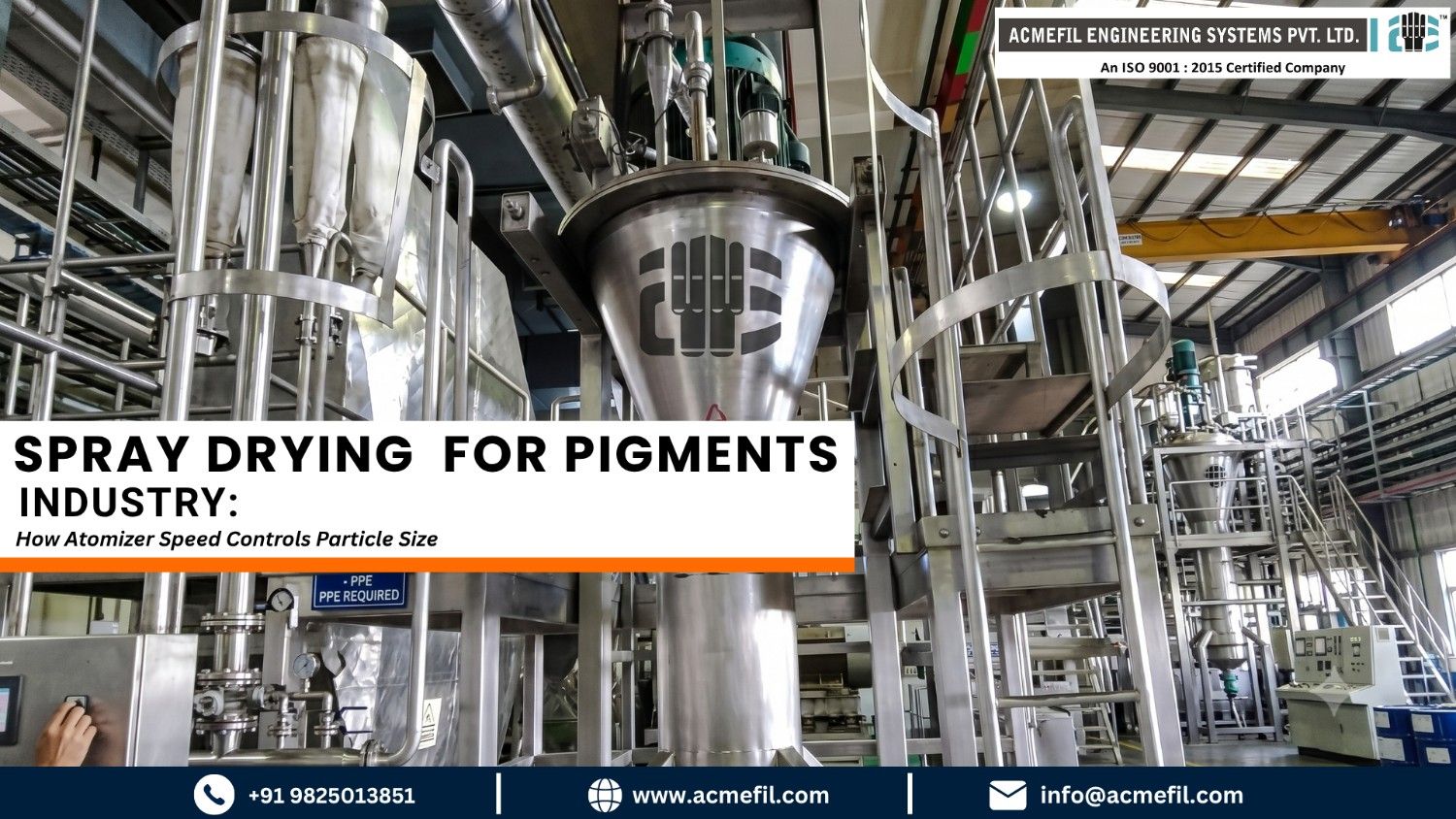
A spray dryer for pigments works best when the pigment feed is a pumpable slurry, suspension, or solution that must be converted into a free-flowing powder with controlled moisture and particle size. The most important control point is atomization. In simple terms, smaller droplets usually produce finer powder, while larger droplets usually produce coarser powder. Atomizer speed, feed solids, viscosity, drying temperature, air flow, and powder recovery all decide the final result.
For pigment manufacturers, this is not only a drying decision. It affects shade consistency, dispersibility, dusting, bulk density, packaging, and downstream mixing behavior.
Why pigment drying is different from ordinary powder drying
Pigments are not simple moisture-removal products. A pigment powder must usually meet functional expectations after drying. It may need to disperse properly in paints, inks, coatings, plastics, ceramics, or chemical formulations. If the drying system creates too many fines, the powder becomes dusty and difficult to handle. If the particles are too coarse or uneven, dispersion and color behavior may suffer.
The first question I ask is not, “What capacity do you need?”
The first question is, “What is the feed condition?”
For pigments, the feed may be:
- A water-based pigment slurry
- A suspension with fine solids
- A filtered pigment intermediate that can be re-slurried
- A heat-sensitive pigment system
- An abrasive slurry
- A feed with settling tendency
- A feed where final shade and dispersibility matter
A spray dryer is suitable when the feed can be atomized consistently. If the material is already a wet cake, paste, or gelatinous mass that cannot be pumped and atomized properly, a spray dryer may not be the first choice. In that case, a flash dryer or spin flash dryer may need to be evaluated.
How a spray dryer for pigments works
In pigment spray drying, the feed is pumped to an atomizer and broken into droplets inside a hot drying chamber. These droplets meet hot air. Moisture evaporates quickly, and the dried pigment particles are separated from the air stream through a cyclone, bag filter, or combined powder recovery system.
The process has four practical stages:
| Stage | What happens | Why it matters for pigments |
|---|---|---|
| Feed preparation | Pigment slurry is adjusted for solids, viscosity, and stability | Poor feed preparation causes inconsistent atomization |
| Atomization | Feed is converted into droplets | Droplet size strongly influences final particle size |
| Drying | Droplets contact hot air and moisture evaporates | Wrong temperature profile can affect powder moisture and wall deposition |
| Powder recovery | Dried powder is separated from exhaust air | Fines recovery is important for yield, dust control, and plant cleanliness |
For a deeper understanding of the equipment layout, read this guide on spray dryer design and components.
How atomizer speed and particle size are connected
Atomizer speed and particle size are connected through droplet formation. In a rotary atomizer, the liquid feed spreads across a high-speed rotating disc. Centrifugal force throws the liquid outward and breaks it into droplets.
As a practical rule:
| Atomizer condition | Expected effect on droplet and powder behavior |
|---|---|
| Higher atomizer speed | Finer droplets, finer powder tendency, more fines, higher dust load risk |
| Lower atomizer speed | Larger droplets, coarser powder tendency, possible higher moisture if drying is insufficient |
| Higher feed viscosity | Larger droplets tendency, more atomization load |
| Higher feed solids | Larger dry particles may form from the same droplet size |
| Poor slurry stability | Broad particle size distribution and inconsistent powder |
| Excessive fines | Higher load on cyclone and bag filter |
This does not mean atomizer speed alone controls particle size. It is a major lever, but not the only lever.
I have seen buyers focus only on RPM and ignore feed solids. That is a mistake. If two pigment feeds run at the same atomizer speed but have different solids content and viscosity, the final powder can behave differently.
For more detail on this topic, refer to our guide on spray dryer atomization techniques.
Droplet size is not the same as final particle size
This is an important point.
In spray drying, the atomizer creates droplets. The dried powder particle is formed after moisture evaporates from those droplets. A droplet with high solids content can produce a larger dry particle than a droplet with low solids content. A droplet that dries too fast at the surface may form a shell. A droplet that remains too wet for too long may stick to the chamber wall or produce uneven powder.
For pigments, final particle quality depends on:
- Droplet size from the atomizer
- Feed solids concentration
- Pigment particle size in the slurry before drying
- Binder or dispersing agent behavior, if present
- Inlet and outlet temperature profile
- Residence time inside the drying chamber
- Cyclone and bag filter recovery efficiency
- Agglomeration or fines recycling, if used
That is why particle size control should be treated as a process design problem, not only as an atomizer speed setting.
Rotary atomizer vs nozzle atomizer for pigment spray drying
Both rotary and nozzle atomizers can be used in spray drying, but they do not behave the same way. For pigments, the right choice depends on feed viscosity, abrasiveness, solids loading, particle size target, and dryer chamber design.
| Selection point | Rotary atomizer | Pressure nozzle | Two-fluid nozzle |
|---|---|---|---|
| Best suited for | Slurries, suspensions, variable feed behavior | Pumpable liquid feeds under pressure | Fine atomization at smaller capacities or special cases |
| Particle size control | Controlled through disc speed and disc selection | Controlled through pressure, orifice, and feed properties | Controlled through compressed air and liquid flow |
| Feed tolerance | Generally better for slurries and suspended solids | Sensitive to nozzle blockage and wear | Can handle finer atomization but uses compressed air |
| Scale-up behavior | Good for industrial pigment production | Good when pressure atomization suits product morphology | Often used for trials, specialty products, or lower throughput |
| Maintenance concern | Disc wear, balance, bearing health | Orifice wear, blockage, pump pressure | Nozzle wear, air consumption, blockage |
| Pigment relevance | Strong option for many pigment slurries | Useful if particle shape and density requirements fit | Useful where very fine droplets are required |
If the buyer is comparing both systems, this guide on nozzle vs rotary atomizer spray dryers will help.
At Acmefil, rotary disc type spray dryers are used where high-speed centrifugal disc atomization is required. The rotary disc type is suitable for applications such as dyes, ceramics, food products, pharmaceuticals, detergents, pigments, and inorganic chemicals. For pigment slurries where droplet size control is critical, rotary atomization is often the first configuration to evaluate.
What particle size should pigment manufacturers target?
There is no universal particle size target for every pigment. The correct target depends on the final application.
A pigment for coating dispersion may need different behavior from a pigment used in ceramic processing. A pigment used in plastics may need different bulk density and flow properties from a pigment used in liquid color formulation.
Instead of asking for one fixed number, define the target with these questions:
| Buyer question | Why it matters |
|---|---|
| Is the powder used directly or redispersed later? | Redispersibility affects allowable agglomeration |
| Is shade consistency critical? | Overheating or uneven drying can create quality variation |
| Is low dusting required? | Too many fines can create handling and housekeeping issues |
| Is bulk density important for packing? | Particle structure affects bag filling and storage |
| Is the pigment abrasive? | Atomizer and nozzle material selection becomes important |
| Is the feed water-based or solvent-based? | Dryer configuration and safety review change |
| Is the feed stable during holding? | Settling affects atomization consistency |
Before you finalize equipment, collect both the target final moisture and the required particle size distribution. Do not rely only on visual powder appearance.
Key process parameters for pigment spray drying
The following parameters should be reviewed before selecting a spray dryer for pigments.
| Parameter | What to check | Effect on final powder |
|---|---|---|
| Feed solids | Percentage of solids in slurry | Affects evaporation load and particle formation |
| Feed viscosity | Pumpability and atomization behavior | Higher viscosity can create larger droplets |
| Pigment particle size in feed | Pre-drying dispersion quality | Affects final powder uniformity |
| Feed stability | Settling, foaming, or separation | Affects consistency during continuous operation |
| Inlet temperature | Hot air entering dryer | Affects drying rate and heat exposure |
| Outlet temperature | Air leaving dryer | Better indicator of final moisture condition |
| Atomizer speed | Rotary disc speed setting | Influences droplet size and fines generation |
| Feed rate | Liquid feed flow into dryer | Affects residence time and outlet moisture |
| Air flow | Drying and conveying medium | Affects drying capacity and powder carryover |
| Collection system | Cyclone, bag filter, or both | Affects recovery, dust load, and emission control |
You can also review this article on how to optimize spray drying parameters for a broader process view.
Common mistakes in pigment spray dryer selection
Mistake 1: Increasing atomizer speed without checking powder recovery
Higher atomizer speed can produce finer droplets. But finer droplets can also create more fines. If the cyclone and bag filter are not designed for that powder load, you may lose product, overload the filter, or create dust handling issues.
Particle size control must be matched with powder recovery design.
For pigment plants, the bag filter is not an accessory to think about later. It is part of the drying system.
Mistake 2: Treating all pigments as the same material
Pigments differ in chemistry, abrasiveness, density, heat behavior, and slurry stability. A setting that works for one pigment can fail for another.
Before sizing the dryer, share:
- Pigment type
- Feed solids
- Feed viscosity
- Final moisture target
- Particle size requirement
- Heat sensitivity
- Slurry pH
- Whether the feed settles during holding
- Required material of construction
- Current drying method, if any
This data helps the manufacturer decide whether a rotary atomizer type spray dryer or a nozzle atomizer type spray dryer is the better starting point.
Mistake 3: Selecting the dryer only by evaporation capacity
Evaporation capacity matters, but pigment quality matters more. A dryer may remove water, but still produce powder that is too dusty, too coarse, uneven, sticky, or difficult to disperse.
For pigments, the design should balance:
- Water evaporation load
- Particle size requirement
- Final moisture
- Product temperature sensitivity
- Wall deposition risk
- Powder recovery
- Cleaning access
- Material compatibility
If the buyer focuses only on “kg/hr water evaporation,” the plant may meet capacity but fail product quality.
Mistake 4: Ignoring pilot trials
Pilot trials are valuable because they show how the pigment behaves under actual drying conditions. Lab theory cannot always predict stickiness, wall buildup, fines load, or powder flow.
Acmefil has a pilot spray dryer facility with 3 kg/hr water evaporation capacity for product development and trials. For new pigment formulations or export-quality pigment powder, I prefer a trial before locking full-scale design.
You can review the pilot spray dryer for trial-based evaluation.
Recommended spray dryer configuration for pigments
For many pigment slurry applications, a rotary atomizer spray dryer is a strong starting point because it can handle suspended solids and allows particle size adjustment through disc selection and speed control. But final selection should not be automatic.
A typical pigment spray drying system may include:
- Feed tank with agitator
- Feed pump
- Feed filtration or strainer, where required
- Rotary atomizer or nozzle atomizer
- Hot air generator
- Drying chamber
- Cyclone separator
- Bag filter
- Air lock rotary valve
- Exhaust fan
- Control panel and instrumentation
- Powder collection arrangement
For pigment slurries with a settling tendency, the feed system design is as important as the drying chamber. If the feed tank is poorly agitated, the atomizer receives inconsistent solids. That causes particle size variation and powder quality problems even if the atomizer itself is correctly selected.
How to control particle size in pigment spray drying
To control particle size, start with the atomizer, but validate the full process.
| Control lever | Directional effect | Caution |
|---|---|---|
| Increase rotary atomizer speed | Finer droplets and finer powder tendency | Can increase fines and dust load |
| Reduce rotary atomizer speed | Coarser particle tendency | May increase wet particles if drying is insufficient |
| Increase feed solids | Larger dry particle formation from similar droplet size | May increase viscosity and atomization difficulty |
| Reduce feed rate | More drying time per unit feed | May reduce throughput |
| Adjust outlet temperature | Better final moisture control | Must protect heat-sensitive pigments |
| Improve feed dispersion | More uniform atomization | Requires proper agitation and pre-processing |
| Improve powder recovery | Better yield and dust control | Cyclone and bag filter must match fines load |
For buyers, the practical goal is not simply “small particle size.” The goal is the right particle size distribution for the end use.
When should you not use a spray dryer for pigments?
A spray dryer may not be the correct first choice when:
- The feed is a thick wet cake that cannot be re-slurried properly
- The material is a paste or gelatinous mass
- The product cannot tolerate the selected drying temperature
- The target powder requires a particle structure that spray drying cannot achieve
- The feed contains solids that settle too quickly without special handling
- Solvent handling requirements need a different safety-reviewed configuration
In such cases, evaluate other drying routes before committing. A choosing the right spray dryer guide can help with the first screening, but final equipment selection should be based on feed testing.
Buyer checklist before asking for a pigment spray dryer quote
Before sending an RFQ, prepare the following details:
| RFQ data | Example detail to provide |
|---|---|
| Product | Pigment name or pigment family |
| Feed form | Slurry, suspension, solution, wet cake, paste |
| Feed solids | Percentage by weight |
| Feed viscosity | At operating temperature |
| Feed rate | kg/hr or L/hr |
| Moisture target | Final powder moisture percentage |
| Particle size target | D10, D50, D90 if available |
| Heat sensitivity | Maximum acceptable product temperature |
| Current drying method | Tray dryer, spin flash, flash dryer, outsourced drying |
| Material of construction | Required contact parts |
| Utilities | Steam, gas, electricity, compressed air |
| Collection requirement | Cyclone, bag filter, or both |
| End use | Paint, ink, coating, plastic, ceramic, chemical formulation |
The more complete your process data, the more accurate the spray dryer recommendation will be.
Practical recommendation
For a spray dryer for pigments, do not select equipment only by capacity. Start with feed behavior, then atomizer type, then particle size target, then dryer and recovery system design.
If the pigment is a pumpable slurry and particle size control is important, evaluate a rotary atomizer spray dryer first. If the product needs a different particle morphology or if the process is better suited to pressure atomization, evaluate a nozzle system. If the feed is a wet cake or paste, do not force it into a spray dryer without testing.
A small pilot trial can save a large capital mistake.
FAQs
Is a spray dryer suitable for pigment powder production?
Yes, a spray dryer can be suitable for pigment powder production when the feed is a pumpable slurry, suspension, or solution. It is not always suitable for wet cakes, thick pastes, or gelatinous materials unless the feed can be prepared for consistent atomization.
How does atomizer speed affect pigment particle size?
In rotary atomization, higher atomizer speed generally creates finer droplets, which usually leads to finer powder. Lower speed generally creates larger droplets and a coarser powder tendency. Final particle size also depends on feed solids, viscosity, drying temperature, air flow, and powder recovery.
Which atomizer is better for pigments, rotary or nozzle?
Rotary atomizers are often preferred for pigment slurries and suspended solids where droplet control and industrial throughput matter. Nozzle atomizers can be suitable when feed behavior, chamber design, pressure, and particle morphology requirements support that choice. The correct answer should be confirmed through feed data or trials.
What data is required before selecting a pigment spray dryer?
You should provide feed solids, viscosity, feed rate, moisture target, particle size target, heat sensitivity, slurry stability, end use, and required material of construction. Without this data, dryer selection becomes guesswork.
Can pilot testing help control pigment particle size?
Yes. Pilot testing helps evaluate atomizer type, atomizer speed, outlet moisture, wall deposition, fines load, and powder recovery before full-scale plant selection. This is especially useful for new pigment formulations or powders with strict dispersion requirements.
For pigment spray drying projects, share your feed solids, viscosity, final moisture target, particle size requirement, and end-use application. Our team can help evaluate whether your material is better suited for rotary atomization, nozzle atomization, or another drying route.
Start with a technical discussion through the SprayDryer.com contact page or review Acmefil’s spray dryer manufacturer page for industrial spray drying equipment options.

Siddharth Nair is Technical Director at Acmefil Engineering Systems Pvt. Ltd. he leads solution design and applications engineering across the company’s full product range — spray dryers, multi-effect evaporators, agitated thin film dryers, spin flash dryers, fluid bed dryers, and complete ZLD systems.
His work spans process evaluation, equipment sizing, customer application consulting, and technical proposal development for industries including food and dairy, pharmaceuticals, chemicals, dyestuffs, ceramics, and industrial effluent treatment. He has hands-on commissioning experience across Acmefil’s 500+ installations in India and 15+ countries.
He holds a BTech in Mechanical Engineering from CHARUSAT University and also partners at A.S Engineers, working with blowers, sludge dryers, and industrial conveying systems.


