
A spray dryer for sodium silicate must be selected around one critical question: what powder quality do you need after drying? Sodium silicate is not a simple water solution. It is alkaline, can become sticky during drying, and can create glass-like deposits if the process window is wrong. In my experience, atomizer speed, feed concentration, inlet/outlet temperature, residence time, and powder separation must be treated as one system, not as separate settings.
For sodium silicate, the atomizer is usually the heart of the plant. It decides the initial droplet size. Droplet size then affects drying time, particle size, bulk density, flowability, dust load, and wall deposition risk. A published sodium silicate spray-drying patent also notes that spinning-disc atomizers are commonly used for sodium silicate solutions and warns that partially dried sodium silicate can “glass up” inside the dryer when process conditions are not controlled properly.
Why sodium silicate is difficult to spray dry
Sodium silicate, also called water glass, behaves differently from many food or organic chemical feeds.
The main challenge is that sodium silicate can pass through a sticky intermediate stage while moisture is being removed. If droplets reach the chamber wall before they are dry enough, deposits can build up. If the drying condition is too aggressive, the powder may become too light, dusty, or difficult to handle. If drying is too mild, moisture remains high and caking risk increases.
A good sodium silicate spray dryer design must balance:
- Feed solids and viscosity
- Silica-to-alkali ratio
- Atomizer type and atomizer speed
- Droplet size distribution
- Inlet and outlet air temperature
- Chamber size and residence time
- Product recovery through cyclone and bag filter
- Final moisture, bulk density, and solubility
This is why I do not recommend selecting a spray dryer only from a catalogue capacity. The same evaporation rate can produce very different powder behavior if the atomization and drying profile are wrong.
For a deeper foundation on spray drying fundamentals, read our guide on spray dryer operating principles and best practices.
How a spray dryer converts sodium silicate solution into powder
The sodium silicate spray drying process normally follows four stages.
| Stage | What Happens | Why It Matters |
|---|---|---|
| Feed preparation | Sodium silicate solution is filtered, mixed, and adjusted for solids and viscosity | Poor feed preparation causes nozzle blockage, unstable atomization, and uneven powder |
| Atomization | Feed is broken into droplets using a rotary atomizer or nozzle system | Droplet size controls drying speed and final powder particle size |
| Drying | Droplets meet hot drying air inside the chamber | Moisture evaporates rapidly while the particle structure forms |
| Separation | Powder is collected through cyclone, bag filter, and discharge system | Fine powder recovery and dust control affect yield and plant cleanliness |
The atomizer does not just “spray liquid.” It meters the feed, creates the desired liquid particle population, and distributes droplets inside the chamber. Atomizer selection depends on feedstock, required powder properties, dryer type, capacity, and atomizer capacity.
Which atomizer is better for sodium silicate?
For many sodium silicate applications, a rotary atomizer is the practical starting point because it can handle feed variability better than a small-orifice nozzle and allows droplet size adjustment through wheel or disc speed.
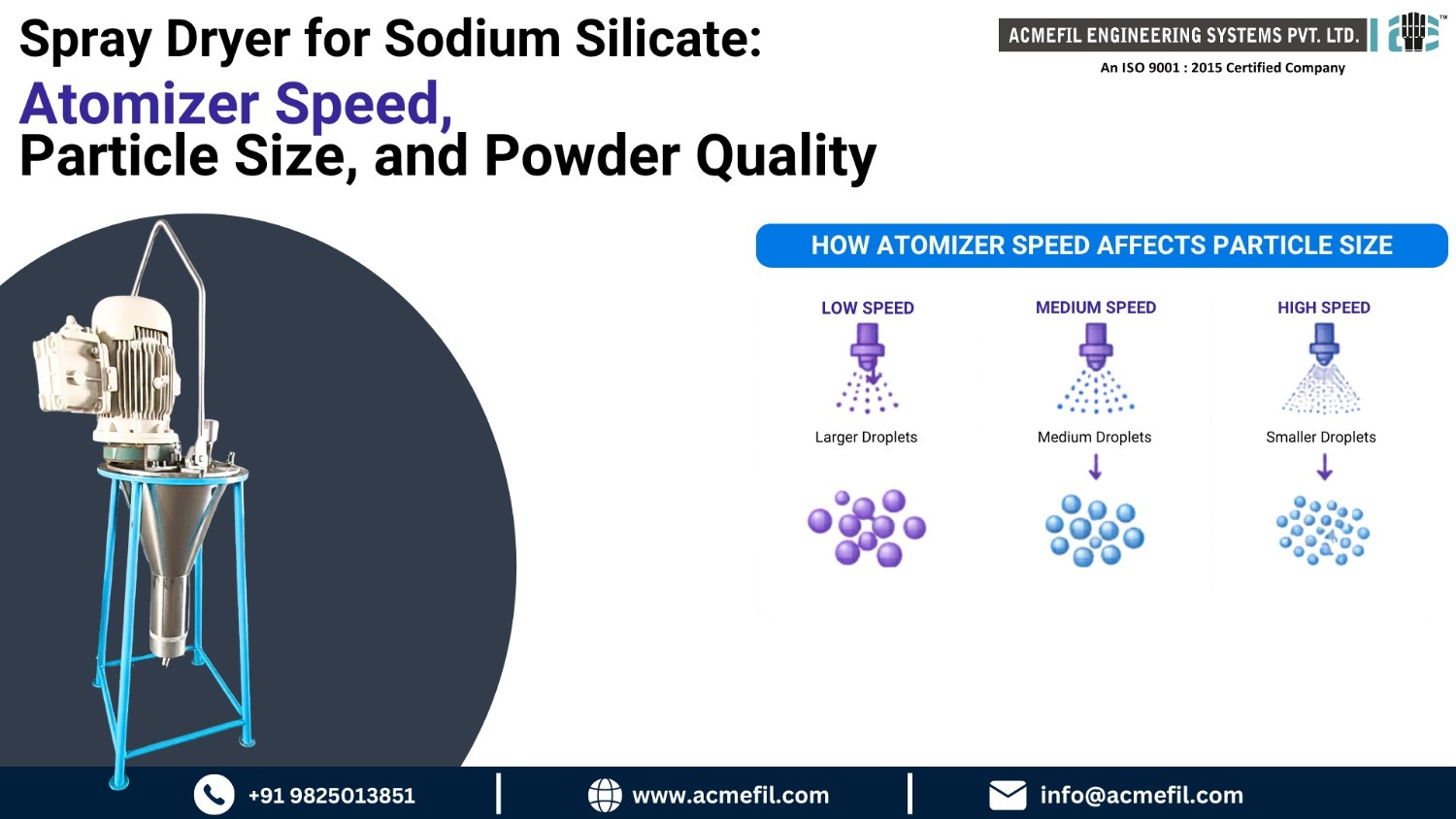
A rotary atomizer uses a high-speed rotating disc or wheel. The feed enters near the center, moves outward, and breaks into droplets at the edge. Higher peripheral speed usually creates smaller droplets. Lower speed usually creates larger droplets.
A pressure nozzle or two-fluid nozzle can also be used where the required particle morphology, capacity, chamber geometry, or powder density target makes nozzle atomization more suitable. The correct answer depends on the sodium silicate grade, feed solids, viscosity, target moisture, and final powder use.
For a detailed comparison, see our guide on nozzle vs rotary atomizer spray dryers.
Atomizer speed and particle size in sodium silicate spray drying
Atomizer speed directly affects droplet size. Droplet size affects powder particle size.
In simple terms:
| Atomizer Speed | Droplet Effect | Powder Effect | Risk |
|---|---|---|---|
| Too low | Larger droplets | Coarser particles, slower drying | Wet powder, wall deposits, incomplete drying |
| Correct range | Controlled droplets | Stable particle size and moisture | Best process window |
| Too high | Finer droplets | Finer powder, higher dust load | Lower bulk density, cyclone/bag filter load, powder loss risk |
The mistake I see in many spray dryer discussions is assuming that finer is always better. In sodium silicate, finer droplets dry faster, but they may also create lighter powder and more fines. That can affect packing, handling, dissolution behavior, and dust load.
Published sodium silicate drying data also shows an important trade-off: increasing inlet temperature can increase dryer capacity, but may reduce powder bulk density in some sodium silicate systems. The same source reports that sodium silicate spray drying often needs narrow process control to avoid glass-like deposits.
So the correct approach is not “run the atomizer as fast as possible.” The correct approach is to match atomizer speed with feed properties, chamber residence time, outlet moisture, and powder density target.
For more practical tuning logic, read how to optimize spray drying parameters.
Recommended design thinking for sodium silicate powder
For sodium silicate, I normally look at five questions before discussing dryer size.
What is the feed concentration?
Higher feed solids reduce water evaporation load, which is good for energy and capacity. But higher solids also increase viscosity. If viscosity increases beyond what the atomizer can handle cleanly, droplet formation becomes unstable.
A feed that looks acceptable in a tank can behave very differently at the atomizer. That is why feed filtration, agitation, temperature, and pump selection matter.
What particle size do you need?
Sodium silicate powder may be used in detergents, binders, construction chemicals, foundry applications, or other inorganic chemical processes. Each application may need a different particle size, bulk density, and dissolution profile.
If the buyer only says “dry powder,” the design is incomplete. The RFQ should define:
- Target particle size range
- Moisture limit
- Bulk density expectation
- Solubility or dissolution requirement
- Free-flowing requirement
- Final packing method
- Dust tolerance
- Downstream blending requirement
What bulk density is acceptable?
Bulk density matters for packing, transport, storage, and user handling. Very fine powder may look dry, but if it is too fluffy, the buyer may face high packing volume and dust handling problems.
For sodium silicate, powder quality must be judged by moisture and bulk density together, not moisture alone.
What is the wall deposition risk?
Wall sticking is one of the most serious operating problems in sodium silicate spray drying. It can reduce capacity, disturb airflow, contaminate product, increase cleaning time, and create shutdowns.
Wall deposition risk increases when:
- Droplets are too large
- Atomizer speed is too low for the feed condition
- Feed solids are too high without viscosity control
- Outlet temperature is not stable
- Chamber size is insufficient
- Airflow pattern is wrong
- Powder separation creates back-pressure instability
- Feed contains undissolved solids or gel-like material
A correct spray dryer design and components review should catch these risks before fabrication.
What powder collection system is needed?
Sodium silicate powder can generate fines. A cyclone alone may not be enough in many plants. A bag filter or suitable dust collection system is often required to improve powder recovery and control emissions.
This is not only an environmental question. It is also a yield question. If fine powder escapes the main collection system, the plant loses product and creates housekeeping problems.
Rotary atomizer vs nozzle atomizer for sodium silicate
| Selection Factor | Rotary Atomizer | Pressure Nozzle | Two-Fluid Nozzle |
|---|---|---|---|
| Feed tolerance | Better for variable feed and some slurry conditions | Needs cleaner feed and stable pressure | Useful for fine atomization at smaller capacity |
| Particle control | Controlled mainly by disc/wheel speed and design | Controlled by pressure, orifice, and feed properties | Controlled by air-to-liquid ratio and nozzle design |
| Clogging risk | Generally lower than small-orifice nozzles | Higher if feed has undissolved solids | Can be sensitive to air and feed stability |
| Dryer chamber | Often used with wider chambers | Often used with tower-type designs | Common in small-scale or special applications |
| Sodium silicate fit | Strong option for many solutions | Useful where specific powder morphology is needed | Useful for finer droplets, trials, and smaller capacities |
This table is a selection guide, not a universal rule. Sodium silicate grade, solids, viscosity, and target powder properties must decide the final atomizer choice.
For a deeper atomization guide, see spray dryer atomization techniques.
Process parameters that affect sodium silicate powder quality
Atomizer speed is important, but it does not work alone.
Feed solids
Higher solids can improve dryer capacity because less water must be evaporated per kg of product. But higher solids also increase viscosity and can make atomization harder. If droplet formation becomes unstable, particle size distribution widens.
Feed temperature
Feed temperature affects viscosity. A controlled feed temperature can improve pumpability and atomization consistency. But overheating the feed is not a shortcut. Sodium silicate chemistry and process safety must be respected.
Inlet air temperature
Inlet air temperature affects drying rate and capacity. Higher inlet temperature can increase evaporation, but it can also influence bulk density and wall deposition behavior. Sodium silicate should not be treated like a generic heat-stable liquid.
Outlet air temperature
Outlet temperature is often used as a practical indicator of final powder moisture. If outlet temperature fluctuates, final moisture usually fluctuates too. For sodium silicate, that can mean caking, stickiness, or unstable packing behavior.
Residence time
Large droplets need more drying time. Fine droplets dry faster. If chamber size and airflow are not matched to droplet size, the powder may hit the wall too wet or exit with uneven moisture.
Separation efficiency
Cyclone and bag filter performance decide how much product is recovered and how clean the exhaust stream remains. For fine sodium silicate powder, this part of the plant should not be treated as an accessory.
Common buyer mistakes when selecting a sodium silicate spray dryer
Mistake 1: Asking only for evaporation capacity
Evaporation capacity is necessary, but it is not enough. A 500 kg/hr evaporation plant that produces low-density, dusty, sticky, or inconsistent powder is not a successful plant.
The RFQ must include powder quality targets.
Mistake 2: Ignoring atomizer speed range
The atomizer should have enough operating flexibility to tune particle size during commissioning. If the atomizer cannot be adjusted properly, the plant may run, but the product may not meet specification.
Mistake 3: Copying temperature ranges from another plant
Sodium silicate grade, feed solids, and required powder properties vary. Copying another plant’s inlet/outlet temperature can create wall deposits or poor bulk density.
Mistake 4: Under-sizing the powder recovery system
Fine sodium silicate powder needs careful separation. Cyclone efficiency, bag filter area, air-to-cloth ratio, and discharge sealing must be reviewed together.
Mistake 5: Skipping pilot trials
Pilot trials are not a delay. They are a risk reduction step. In sodium silicate, a trial can show whether the feed atomizes cleanly, whether the powder sticks, and whether the particle size target is realistic.
At Acmefil, spray dryer pilot trials are available at 3 kg/hr water evaporation capacity for process development and scale-up evaluation. For capital equipment decisions, this is often more useful than theoretical discussion alone. Learn more about the pilot spray dryer facility.
Safety and handling points for sodium silicate spray drying
Sodium silicate and related silicate solutions are alkaline. Safety data for sodium metasilicate identifies skin irritation and serious eye damage hazards, with inhalation exposure capable of causing upper respiratory tract irritation.
In practical plant design, this means:
- Use proper enclosure around powder discharge points
- Provide suitable dust collection
- Avoid unnecessary manual powder handling
- Use PPE during cleaning and maintenance
- Design access points for safe inspection
- Review local safety and environmental requirements before commissioning
This article is not a substitute for a product-specific safety data sheet. The final safety design must follow the actual sodium silicate grade, concentration, site standards, and local regulations.
What data should you share before asking for a sodium silicate spray dryer quote?
A serious RFQ should include more than “we need a sodium silicate spray dryer.”
Share these details:
| RFQ Data | Why It Matters |
|---|---|
| Sodium silicate grade and SiO₂/Na₂O ratio | Affects viscosity, drying behavior, and final powder performance |
| Feed solids percentage | Decides evaporation load and atomization difficulty |
| Feed viscosity at operating temperature | Critical for atomizer and pump selection |
| Feed temperature | Affects viscosity and stability |
| Required powder moisture | Sets outlet temperature and drying duty |
| Target particle size | Decides atomizer selection and speed range |
| Bulk density expectation | Important for packing, storage, and handling |
| Production capacity | Determines chamber size, air volume, heating load, and separation system |
| Fuel or heat source | Affects hot air generator selection |
| Available plant height and layout | Important for chamber geometry and maintenance access |
| Dust control requirement | Decides cyclone, bag filter, and exhaust treatment |
| Trial requirement | Helps validate powder quality before full-scale design |
Recommended spray dryer configuration for sodium silicate
A typical sodium silicate spray dryer system may include:
- Feed preparation tank with agitator
- Feed pump suitable for alkaline solution
- Feed filtration or straining arrangement
- Rotary atomizer or nozzle atomizer depending on trial result
- Hot air generator
- Insulated drying chamber
- Cyclone separator
- Bag filter or pulse jet bag filter
- Rotary air lock valve
- Powder conveying or discharge system
- Control panel with temperature and feed control
- Cleaning and inspection access
For related equipment, Acmefil offers rotary atomizer type spray dryers, nozzle atomizer type spray dryers, and spray nozzles for different atomization requirements.
Final engineering view
A spray dryer for sodium silicate should not be selected only by evaporation rate. The real selection is based on the relationship between atomizer speed and particle size, feed viscosity, drying temperature, wall deposition risk, bulk density, and powder recovery.
If the goal is a stable industrial plant, the best route is to test the feed, define the powder target, select the atomizer based on actual behavior, and size the chamber and collection system around the drying curve.
That is how you avoid the two most common failures in sodium silicate spray drying: powder that does not meet specification and a dryer that needs frequent cleaning because of deposits.
FAQs
What is the best atomizer for sodium silicate spray drying?
A rotary atomizer is often a strong starting point for sodium silicate because it gives practical control over droplet size through disc or wheel speed and can handle feed variability better than many nozzle systems. However, pressure nozzle or two-fluid nozzle atomization may be suitable when a specific powder morphology, tower dryer layout, or fine particle target is required.
How does atomizer speed affect sodium silicate particle size?
Higher atomizer speed generally creates finer droplets, which usually results in finer powder particles. Lower speed creates larger droplets and coarser particles. In sodium silicate drying, very fine powder can increase dust load and reduce bulk density, while overly large droplets may create wet particles and wall deposits.
Why does sodium silicate stick inside a spray dryer?
Sodium silicate can pass through a sticky or glass-forming stage during drying. If droplets reach the chamber wall before they are dry enough, deposits can build up. Causes include large droplet size, wrong atomizer speed, high feed viscosity, unstable outlet temperature, poor airflow, or insufficient chamber residence time.
Can a sodium silicate spray dryer produce free-flowing powder?
Yes, but free-flowing powder depends on correct feed preparation, atomization, drying temperature, particle size control, final moisture, and powder collection. The dryer must be designed for the target bulk density and handling behavior, not just for water evaporation capacity.
Should sodium silicate be tested before full-scale spray dryer design?
Yes. Pilot testing is strongly recommended because sodium silicate drying behavior depends on feed solids, viscosity, chemistry, and powder targets. A pilot trial helps confirm atomizer selection, drying window, particle size, moisture, wall deposition tendency, and powder recovery before full-scale investment.
Planning a sodium silicate powder project? Share your feed concentration, viscosity, target moisture, particle size requirement, and production capacity. Our team can review the application and recommend the right atomizer type, drying chamber design, and powder recovery system.
Start with our spray dryer selection guide or contact the team through the SprayDryer.com contact page.

Siddharth Nair is Technical Director at Acmefil Engineering Systems Pvt. Ltd. he leads solution design and applications engineering across the company’s full product range — spray dryers, multi-effect evaporators, agitated thin film dryers, spin flash dryers, fluid bed dryers, and complete ZLD systems.
His work spans process evaluation, equipment sizing, customer application consulting, and technical proposal development for industries including food and dairy, pharmaceuticals, chemicals, dyestuffs, ceramics, and industrial effluent treatment. He has hands-on commissioning experience across Acmefil’s 500+ installations in India and 15+ countries.
He holds a BTech in Mechanical Engineering from CHARUSAT University and also partners at A.S Engineers, working with blowers, sludge dryers, and industrial conveying systems.


