
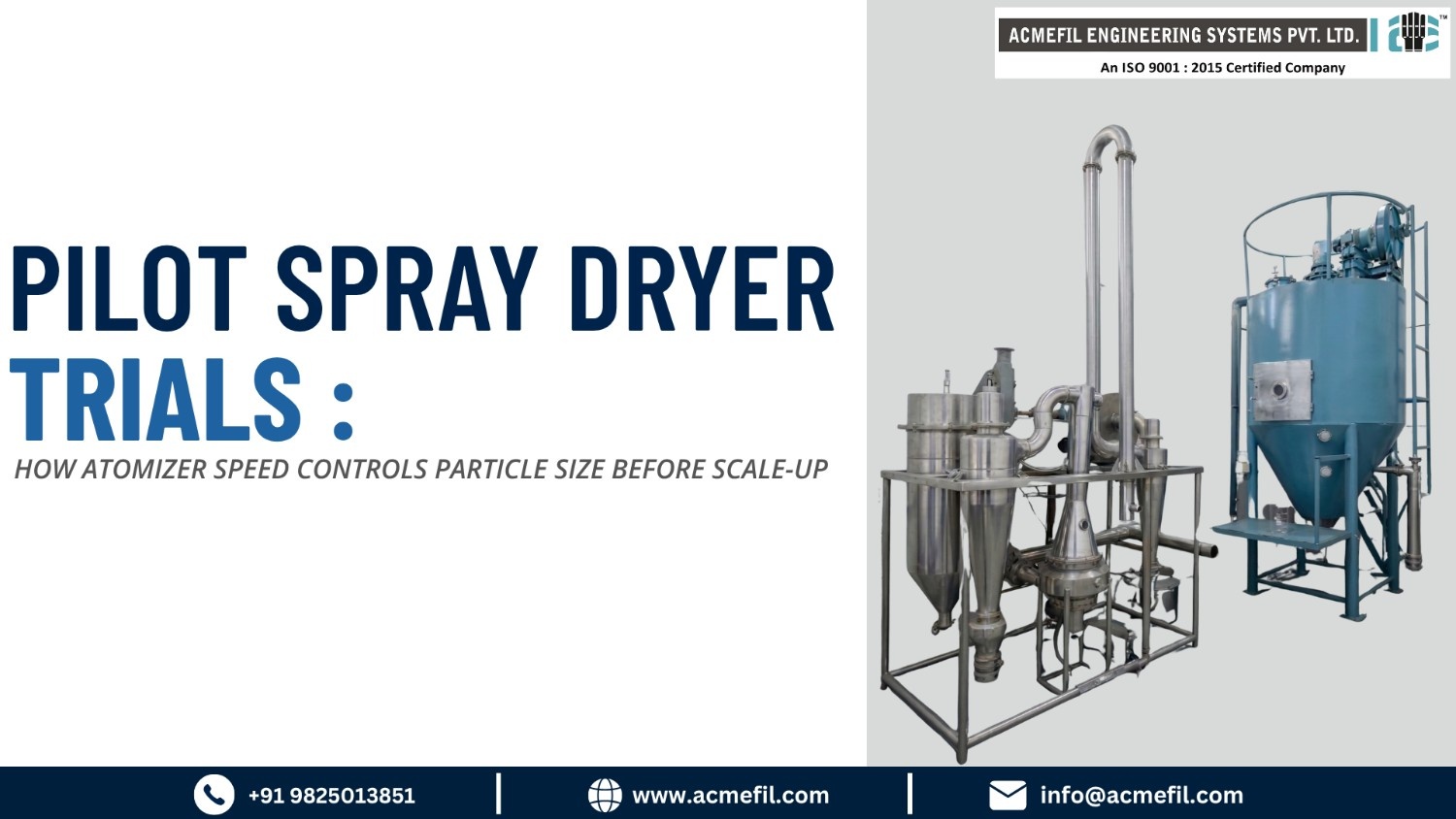
A pilot scale spray dryer trial is not just a small production run. It is the practical test that shows whether your feed can produce the required powder moisture, particle size, bulk density, flow behaviour and yield before you invest in a full-scale spray dryer. In most trials, atomizer speed is one of the first variables I watch because it directly affects droplet size, and droplet size strongly influences final particle size.
If you are planning a spray dryer project for chemicals, food ingredients, dyestuff, pigments, ceramics, enzymes or pharmaceuticals, do not finalize the plant only from theoretical calculation. Run the pilot trial first.
Why Pilot Spray Dryer Trials Matter Before Full-Scale Design
A spray dryer works by converting liquid feed into fine droplets, contacting those droplets with hot drying air, drying the droplets into particles, and separating the powder from the air stream.
On paper, this sounds simple. In plant operation, it is not.
Two feeds with the same solids percentage can behave differently because of:
- Viscosity
- Suspended solids
- Solubility
- Stickiness
- Surface tension
- Heat sensitivity
- Crystallization behaviour
- Final moisture target
- Required powder flowability
This is why pilot spray dryer trials are useful. They show how the real material behaves inside a drying chamber, not how it behaves in a spreadsheet.
At Acmefil, the pilot spray dryer facility is designed for 3 kg/hr water evaporation trials. For buyers, this is valuable because a small but properly recorded trial can prevent a wrong atomizer selection, wrong chamber sizing, poor powder recovery, nozzle choking, wall deposition or particle size mismatch at production scale.
For background reading on basic spray drying behaviour, you can also review this guide on spray dryer operating principles and best practices.
How Atomizer Speed Changes Particle Size in Pilot Spray Dryer Trials
In a rotary atomizer spray dryer, feed reaches a high-speed rotating disc. Centrifugal force spreads the liquid across the disc and breaks it into droplets. When atomizer speed increases, the energy available for atomization usually increases. This generally produces smaller droplets.
Smaller droplets usually dry faster and form finer particles. Larger droplets usually take longer to dry and form larger particles.
But this is where many buyers make a mistake. They assume atomizer speed alone controls particle size. It does not.
Final particle size is affected by the complete trial condition:
| Trial variable | Effect on particle size and powder quality |
|---|---|
| Atomizer speed | Higher speed generally reduces droplet size in rotary atomization |
| Feed solids | Higher solids can increase final particle size even if droplet size is similar |
| Feed viscosity | Higher viscosity can resist breakup and produce larger droplets |
| Feed rate | Higher feed rate can increase droplet loading and affect drying completion |
| Inlet temperature | Affects drying rate and surface formation |
| Outlet temperature | Strong indicator of final moisture condition |
| Disc design or nozzle type | Changes atomization pattern and droplet distribution |
| Chamber airflow | Affects residence time, wall deposition and particle trajectory |
| Fines recycle or fluidized stage | Can increase particle size through agglomeration |
This is why a serious pilot spray dryer trial should not only record final powder size. It should record the operating condition that created that size.
Atomizer Speed and Particle Size: The Practical Relationship
The practical relationship is simple to understand:
Higher rotary atomizer speed generally creates smaller droplets.
Smaller droplets usually create finer powder.
But feed solids, viscosity, drying temperature and agglomeration decide the final particle.
For example, a low-viscosity solution and a high-viscosity slurry may not behave the same at the same atomizer speed. A feed with suspended solids may need a rotary atomizer because nozzle choking becomes a real risk. A heat-sensitive feed may need a different balance of droplet size and outlet temperature because over-drying can damage product quality.
The right question is not, “What atomizer speed should I use?”
The right question is, “At what atomizer speed does my actual feed produce the target particle size, moisture, yield and powder handling behaviour?”
That question can only be answered properly through a controlled trial.
What Should Be Tested During a Pilot Spray Dryer Trial?
A useful pilot spray dryer trial should test both process performance and powder quality. If the trial only produces a sample but does not capture enough operating data, scale-up becomes weak.
For most trials, I would record these points:
| Trial area | What to record |
|---|---|
| Feed preparation | Solids percentage, viscosity, pH if relevant, feed temperature, filtration requirement |
| Atomization | Rotary speed, disc type, nozzle type, nozzle pressure if applicable |
| Drying conditions | Inlet temperature, outlet temperature, airflow, feed rate |
| Product result | Moisture, particle size, bulk density, colour, flowability, solubility or dispersibility |
| Operation behaviour | Wall deposition, cyclone recovery, bag filter load, nozzle choking, feed pump stability |
| Scale-up notes | Residence time requirement, likely chamber size, heat load and collection system requirement |
The best pilot trial report is not just a “sample passed” report. It should become the technical basis for full-scale design.
Rotary Atomizer or Nozzle Atomizer for Pilot Trials?
Atomizer selection depends on feed behaviour and powder target.
A rotary atomizer spray dryer is generally preferred when the feed contains suspended solids, slurry behaviour, variable feed properties, or when broad process flexibility is needed. Rotary disc atomization is also useful when droplet size control through disc selection and speed is important.
A nozzle atomizer spray dryer is useful when the feed is suitable for pumping through an orifice and when the process needs specific particle morphology, density or droplet pattern. Pressure nozzles and two-fluid nozzles behave differently, so the trial should match the intended production concept as closely as possible.
| Selection point | Rotary atomizer | Nozzle atomizer |
|---|---|---|
| Feed with suspended solids | Usually more forgiving | Can choke if filtration is poor |
| Particle size control | Controlled through disc design and speed | Controlled through pressure, orifice, air-to-liquid ratio and nozzle design |
| Feed rate flexibility | Good flexibility | More dependent on nozzle and pressure range |
| Fine particle generation | Possible, depending on speed and feed | Two-fluid nozzle can be useful for finer particles |
| Scale-up check | Match disc speed, peripheral velocity concept and chamber design | Match nozzle pressure, droplet size and spray angle |
| Common buyer mistake | Choosing only by capacity | Ignoring filtration and nozzle blockage risk |
For a deeper comparison, read nozzle vs rotary atomizer spray dryers and this guide on spray dryer atomization techniques.
Why Pilot Particle Size May Not Match Production Particle Size Automatically
One mistake I see in spray dryer scale-up is assuming that a pilot trial powder will automatically match the production powder if the same atomizer type is used.
It may not.
Scale changes airflow pattern, chamber geometry, residence time, droplet trajectory and wall interaction. Even if droplet size is similar, final particle size can change because the particle experiences a different drying environment.
That is why pilot trials should be used to understand the relationship between variables, not just to create one successful batch.
A good scale-up approach should answer:
- What atomizer speed range gives acceptable powder?
- How sensitive is particle size to feed rate?
- Does the powder stick at lower outlet temperature?
- Does a finer powder overload the bag filter?
- Does a larger droplet leave wet powder or wall deposits?
- Is the required particle size realistic with the chosen atomizer?
- Does the full-scale chamber need a rotary atomizer, pressure nozzle, two-fluid nozzle or fluidized spray dryer concept?
The pilot trial reduces uncertainty. It does not remove the need for engineering judgment.
How Feed Concentration Affects Particle Size
Feed concentration is one of the most underestimated variables in pilot trials.
If solids concentration increases, the same droplet can produce a larger dry particle because there is more solid material inside the droplet. If solids concentration is too low, you may get very fine powder, low yield and higher evaporation load. If solids concentration is too high, viscosity may increase and atomization may become difficult.
For many materials, the best trial sequence is:
- Start with a safe feed solids range.
- Establish stable drying at moderate atomizer speed.
- Adjust atomizer speed to study particle size movement.
- Increase or decrease feed concentration if the powder size or drying economy is not acceptable.
- Confirm final moisture and powder recovery.
Do not optimize atomizer speed while ignoring solids concentration. Both variables interact.
What Happens If Atomizer Speed Is Too Low?
If rotary atomizer speed is too low for the feed, droplet size becomes larger. Larger droplets need more time to dry. If the chamber size, airflow and temperature are not sufficient, the result can be:
- Wet powder
- Wall deposition
- Poor cyclone recovery
- Higher outlet moisture
- Larger particle size than target
- Sticky deposits near the chamber wall
- Inconsistent powder flow
For materials like dyestuff, pigments, inorganic chemicals or ceramic slurry, this can create a powder that looks acceptable in a small sample but fails during handling, packing or downstream processing.
What Happens If Atomizer Speed Is Too High?
Too much atomizer speed can also create problems.
Very fine droplets dry quickly, but they can produce excessive fines. Fine powder may increase dust load, reduce cyclone recovery, increase bag filter loading, affect bulk density and create handling difficulty.
In food ingredients or pharmaceutical powders, very fine particles may also affect dispersibility, flowability and dosing behaviour. In dyestuff or pigment applications, too much fines content can affect packing density and user handling.
The aim is not maximum atomizer speed. The aim is stable particle size distribution at acceptable moisture, yield and powder handling behaviour.
How to Structure a Proper Pilot Spray Dryer Trial
A proper trial should not randomly change many parameters at once. If everything changes together, you cannot identify what actually improved or damaged the powder.
A practical trial sequence can look like this:
| Trial step | Purpose |
|---|---|
| Baseline run | Establish stable drying and collect first powder sample |
| Atomizer speed variation | Observe droplet and particle size response |
| Feed rate variation | Check drying load and outlet temperature stability |
| Inlet/outlet temperature adjustment | Balance final moisture and heat sensitivity |
| Feed solids adjustment | Improve yield, evaporation load and particle size |
| Collection system observation | Check cyclone recovery, bag filter load and fines behaviour |
| Confirmation run | Repeat best condition to confirm consistency |
For more detail on process variables, read how to optimize spray drying parameters.
Pilot Scale Spray Dryer Trial Data Buyers Should Share Before Testing
The trial becomes stronger when the dryer manufacturer receives complete feed and powder data before the test.
Before a pilot spray dryer trial, prepare:
- Feed material name and application
- Feed type, solution, slurry, emulsion or suspension
- Solids percentage
- Viscosity
- Temperature sensitivity
- Solvent or water-based system
- Target final moisture
- Target particle size range
- Required bulk density
- Required solubility or dispersibility
- Any colour, odour or degradation concern
- Required production capacity for scale-up
- Existing drying method, if any
- Current problem, such as high moisture, poor flow, wall sticking or low yield
This helps the trial team decide whether to begin with rotary atomization, pressure nozzle, two-fluid nozzle or another spray dryer configuration.
Pilot Trials for Different Industries
A pilot scale spray dryer is useful across many industries, but each industry has a different trial objective.
| Industry | Typical pilot trial focus |
|---|---|
| Dyestuff and pigments | Particle size, colour, moisture, wall deposition, recovery |
| Ceramic slurry | Particle size distribution, flowability, spray granule behaviour |
| Inorganic chemicals | Moisture, solubility, powder handling, corrosion considerations |
| Food ingredients | Solubility, dispersibility, flavour retention, heat sensitivity |
| Enzymes and biochemical feeds | Lower thermal damage, moisture control, yield |
| Pharmaceuticals | Particle morphology, moisture, sterility concept where applicable |
| Detergent powder | Larger particle formation, density, agglomeration behaviour |
| Polymers and resins | Stickiness, drying profile, powder flow and collection |
For small-batch and development work, you may also find this article on spray dryers for small-scale production useful.
How Pilot Trial Results Support Full-Scale Spray Dryer Design
Pilot data supports full-scale design in five practical ways.
First, it confirms whether the material can be spray dried at all. Some feeds look suitable in discussion but create wall deposition, choking or poor recovery during trial.
Second, it helps select atomizer type. A rotary atomizer, pressure nozzle and two-fluid nozzle do not produce the same spray pattern or particle behaviour.
Third, it gives a realistic moisture and outlet temperature relationship. This matters because final moisture is one of the most common reasons spray dryer performance is questioned after installation.
Fourth, it gives powder samples for buyer approval. The plant team, R&D team, procurement team and end user can review actual powder before committing to full-scale procurement.
Fifth, it reduces scale-up risk. The final plant still needs engineering design, but trial data is far better than assumptions.
What I Look for in a Trial Before Recommending Scale-Up
When I review a pilot spray dryer trial, I do not look only at the best-looking powder sample. I look for process stability.
My main checks are:
- Did the feed pump run smoothly?
- Was the atomizer stable?
- Did particle size change predictably with atomizer speed?
- Was outlet temperature stable?
- Was final moisture within target?
- Did powder collect cleanly?
- Was wall deposition acceptable?
- Did fines load increase too much?
- Did the powder flow after cooling?
- Can the same condition be repeated?
If the trial condition cannot be repeated, it is not a reliable basis for full-scale design.
Common Mistakes During Pilot Spray Dryer Trials
The biggest mistake is treating the pilot dryer as a sample-making machine only.
Other common mistakes include:
- Running only one trial condition
- Not recording atomizer speed
- Ignoring feed viscosity
- Changing feed solids and atomizer speed together without tracking
- Judging only moisture, not particle size
- Judging only particle size, not yield
- Not checking wall deposits
- Not checking cyclone and bag filter behaviour
- Using a pilot atomizer that does not represent the full-scale concept
- Scaling up from a “good sample” instead of a stable operating window
A good pilot trial should create confidence. A weak pilot trial creates false confidence.
When a Pilot Spray Dryer Trial Is Strongly Recommended
I strongly recommend pilot testing when:
- The product is new or not previously spray dried
- The feed is sticky, viscous, abrasive or heat-sensitive
- Target particle size is narrow
- Powder flowability matters
- Solubility or dispersibility matters
- Production plant investment is significant
- The buyer is comparing rotary atomizer and nozzle atomizer options
- The process is moving from lab development to industrial production
- Existing spray drying performance is poor
- The material has high raw material cost and trial waste must be controlled
For these cases, pilot testing is not an extra step. It is risk control.
Final Takeaway
A pilot scale spray dryer trial should answer one central question: can this feed be converted into the required powder under stable, repeatable and scalable conditions?
Atomizer speed is a key part of that answer because it influences droplet size and final particle size. But it must be studied with feed solids, viscosity, feed rate, drying temperature, airflow and powder recovery. A trial that records all these variables gives the full-scale spray dryer designer something useful to work with.
If your spray dryer project depends on particle size, moisture, yield or scale-up confidence, do the pilot trial before finalizing the equipment.
FAQs
What is a pilot scale spray dryer?
A pilot scale spray dryer is a small-capacity spray drying system used for product development, process trials and scale-up validation before full-size plant investment. It helps test feed behaviour, atomizer selection, drying temperature, powder moisture, particle size, yield and collection performance using real material under controlled conditions.
How does atomizer speed affect particle size in a spray dryer?
In rotary atomization, higher atomizer speed generally creates smaller droplets. Smaller droplets usually produce finer powder. However, final particle size also depends on feed solids, viscosity, drying temperature, feed rate, chamber airflow, agglomeration and powder collection behaviour. Atomizer speed should therefore be optimized during trial, not selected alone.
Why should I run pilot spray dryer trials before buying a full-scale dryer?
Pilot spray dryer trials reduce scale-up risk. They show whether the material can be dried, what atomizer type works, what operating window gives target moisture and particle size, and whether the powder can be collected properly. They also provide physical samples for internal approval before full-scale investment.
Which atomizer is better for pilot spray dryer trials, rotary or nozzle?
There is no universal answer. Rotary atomizers are often suitable for slurries, suspended solids and flexible particle size control. Nozzle atomizers are useful where pressure, orifice size, spray angle or fine powder formation are important. The right choice depends on feed behaviour, filtration, viscosity, target particle size and scale-up requirement.
What data is needed for a pilot spray dryer trial?
Useful data includes feed solids, viscosity, feed temperature, heat sensitivity, target final moisture, target particle size, required bulk density, solubility or dispersibility requirement, production capacity, and existing drying challenges. Better input data leads to a more reliable trial plan and stronger scale-up recommendation.
Planning a spray dryer project where particle size, moisture, powder recovery or scale-up reliability matters? Share your feed details, target powder specification and required production capacity through the SprayDryer.com contact page. Our team can help evaluate whether a pilot spray dryer trial is the right next step before full-scale design.

Siddharth Nair is Technical Director at Acmefil Engineering Systems Pvt. Ltd. he leads solution design and applications engineering across the company’s full product range — spray dryers, multi-effect evaporators, agitated thin film dryers, spin flash dryers, fluid bed dryers, and complete ZLD systems.
His work spans process evaluation, equipment sizing, customer application consulting, and technical proposal development for industries including food and dairy, pharmaceuticals, chemicals, dyestuffs, ceramics, and industrial effluent treatment. He has hands-on commissioning experience across Acmefil’s 500+ installations in India and 15+ countries.
He holds a BTech in Mechanical Engineering from CHARUSAT University and also partners at A.S Engineers, working with blowers, sludge dryers, and industrial conveying systems.


