
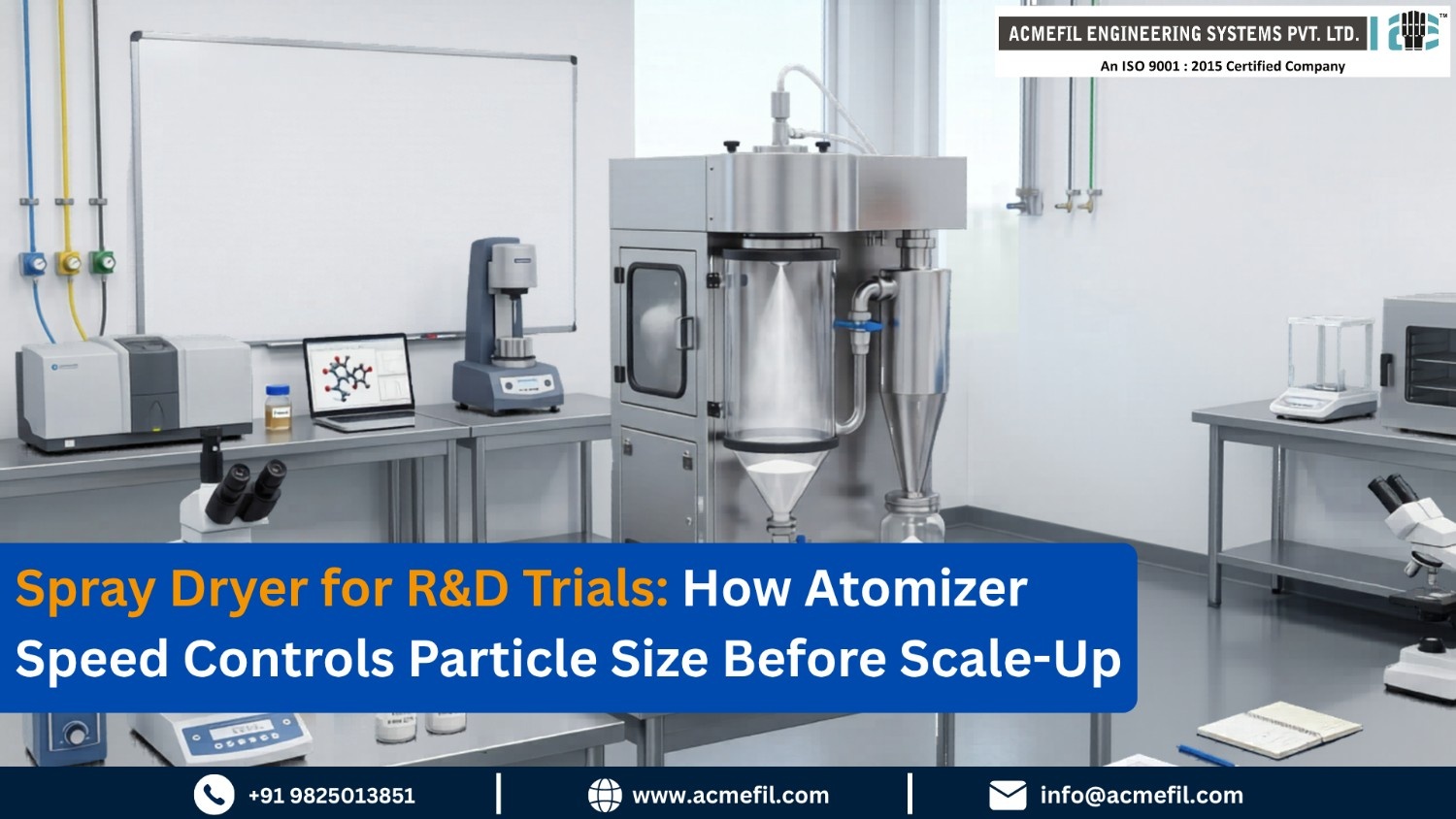
A spray dryer for R&D trials is used to test whether a liquid feed, slurry, emulsion, or extract can be converted into stable powder before investing in a full-scale spray dryer. In my view, the most useful trial does not only produce a sample. It tells you how the feed behaves during atomization, how atomizer speed affects particle size, what outlet moisture is realistic, and whether the selected dryer configuration is suitable for scale-up.
For R&D teams, this is where spray drying becomes practical engineering instead of brochure selection.
What Is a Spray Dryer for R&D Trials?
A spray dryer for R&D trials is a small-scale or pilot-scale system used for product development, formulation validation, process optimization, and scale-up study.
It helps answer questions such as:
- Can this feed be spray dried into powder?
- What inlet and outlet temperature range is practical?
- Which atomization method gives the desired particle size?
- Does the powder stick to the chamber or cyclone?
- What moisture level can be achieved without product damage?
- Is the product suitable for open-cycle drying, closed-loop drying, or sterile handling?
- What process data is needed before full-scale dryer design?
A pilot trial is especially useful for herbal extracts, food ingredients, pharmaceutical intermediates, dyestuffs, pigments, ceramics, detergents, enzymes, and specialty chemicals. These products often behave differently in real drying conditions than they appear in a laboratory beaker.
For a basic process foundation, first read the spray dryer working principle and then use this article to understand how R&D trials connect to particle size and scale-up.
Why R&D Trials Matter Before Buying a Production Spray Dryer
The wrong spray dryer selection usually starts before equipment purchase. It starts when the buyer assumes that a product is easy to dry without testing atomization, viscosity, stickiness, heat sensitivity, and powder recovery.
I have seen this mistake often in drying projects. A feed may look pumpable at room temperature but become unstable at higher solids. A powder may dry at the surface but retain moisture inside the particle. A product may atomize well through a nozzle but create wall deposits because the droplet size is too large for the chamber residence time.
A controlled R&D trial reduces that risk.
The trial should not be treated as a formality. It should be designed to collect usable process data.
| Trial Question | Why It Matters for Scale-Up |
|---|---|
| Can the feed be atomized consistently? | Poor atomization causes uneven drying and broad particle size distribution. |
| What droplet size range is formed? | Droplet size influences drying time, particle size, and moisture. |
| What outlet temperature protects product quality? | Heat-sensitive products may degrade if the outlet condition is wrong. |
| Does powder stick to the chamber wall? | Wall deposition affects recovery, cleaning frequency, and plant uptime. |
| What is the powder bulk density and flowability? | These affect packing, conveying, blending, and final application. |
| Which atomizer type is suitable? | Rotary atomizer, pressure nozzle, and two-fluid nozzle behave differently. |
| Is full-scale design feasible? | Some feeds need concentration, closed-loop drying, or another dryer type. |
For more process tuning details, see the guide on how to optimize spray drying parameters.
Atomizer Speed and Particle Size in Spray Dryer R&D Trials
Atomizer speed and particle size are closely connected, especially in rotary atomizer spray drying.
In a rotary atomizer, the liquid feed reaches a fast-rotating disc or wheel. Centrifugal force spreads the liquid outward and breaks it into droplets. In general, higher atomizer speed produces finer droplets. Finer droplets usually dry faster and tend to produce finer particles, assuming feed solids, viscosity, surface tension, and drying conditions remain stable.
But this relationship is not a simple speed-only formula.
Particle size is affected by:
- Atomizer speed
- Feed flow rate
- Feed viscosity
- Feed solids percentage
- Surface tension
- Atomizer disc design
- Chamber airflow pattern
- Inlet and outlet temperature
- Drying residence time
- Powder agglomeration or fines recycling
This is why R&D trials should record the full operating window, not only the final powder result.
What Happens When Atomizer Speed Is Increased?
When atomizer speed increases, droplet size usually decreases. Smaller droplets expose more surface area to hot air, so evaporation happens faster.
This can help when the product requires finer powder or lower final moisture. But it can also create problems.
Very fine particles may:
- Increase cyclone losses
- Increase bag filter load
- Create dusting issues
- Reduce flowability
- Lower bulk density
- Increase wall deposition in sticky products
- Create handling problems during packing or conveying
So the question is not, “What is the highest atomizer speed?”
The better question is, “What atomizer speed gives the required particle size, moisture, recovery, and powder handling behavior together?”
That is the purpose of an R&D spray drying trial.
Atomizer Speed vs Particle Size: Practical Trial Interpretation
| Trial Observation | Possible Cause | Engineering Action |
|---|---|---|
| Powder is too coarse | Droplets are too large, feed flow is high, atomizer speed is low, or feed viscosity is high | Increase atomizer speed, reduce feed flow, reduce viscosity, or adjust solids |
| Powder is too fine | Atomizer speed is too high or feed solids are too low | Reduce atomizer speed, increase solids if possible, or review atomizer type |
| Powder has broad particle size distribution | Inconsistent feed, unstable atomization, poor pump control, or fluctuating solids | Stabilize feed preparation and repeat trial with controlled parameters |
| Powder is wet inside | Droplets are too large or residence time is insufficient | Reduce droplet size, adjust outlet temperature, or review chamber sizing |
| Powder sticks to chamber wall | Product is sticky, outlet temperature is unsuitable, or droplet trajectory is wrong | Adjust temperature profile, feed concentration, atomization, or dryer configuration |
| Recovery is low | Too many fines or poor separation efficiency | Review cyclone, bag filter, particle size, and powder discharge arrangement |
For a deeper atomization comparison, read the guide on spray dryer atomization techniques.
Rotary Atomizer, Pressure Nozzle, or Two-Fluid Nozzle for R&D Trials?
The atomizer selected for trial should match the likely full-scale drying route. Otherwise, the trial can mislead the scale-up decision.
| Atomizer Type | Best Used When | Particle Size Control Logic | Watch-Out |
|---|---|---|---|
| Rotary atomizer | Slurries, suspensions, larger production plants, products needing controlled droplet formation | Particle size is adjusted mainly by disc speed, feed rate, and disc design | Very fine powder may increase dusting or recovery load |
| Pressure nozzle | Products needing narrow spray pattern or coarser particle control | Particle size depends on pressure, orifice, feed properties, and flow | Nozzle blockage risk if feed has suspended solids |
| Two-fluid nozzle | Small batches, fine atomization, low feed rate R&D work | Compressed air assists droplet breakup | Scale-up can be less direct if production will use a different atomizer |
If the commercial plant is likely to use a rotary atomizer, the R&D trial should not depend only on a two-fluid nozzle result. A two-fluid nozzle can produce a powder sample, but the powder behavior may not fully represent a rotary atomizer plant.
This is why the rotary atomizer versus nozzle atomizer comparison is important before trial planning.
What Should Be Measured During a Spray Dryer R&D Trial?
A good spray dryer R&D trial should measure more than inlet temperature and powder moisture. It should capture the process conditions that explain the result.
Feed Data
Before the trial, record:
- Feed composition
- Total solids
- Dissolved solids and suspended solids
- Viscosity at trial temperature
- pH
- Solvent type, if any
- Heat sensitivity
- Stickiness or glass transition behavior where relevant
- Filtration requirement
- Batch quantity available for testing
Operating Data
During the trial, record:
- Feed rate
- Inlet temperature
- Outlet temperature
- Atomizer type
- Atomizer speed or nozzle pressure
- Atomizing air pressure, if using two-fluid nozzle
- Airflow
- Chamber pressure
- Trial duration
- Cleaning observation after trial
Powder Data
After the trial, record:
- Final moisture
- Particle size distribution
- Bulk density
- Flowability
- Solubility or dispersibility, if relevant
- Color or thermal degradation
- Product recovery percentage
- Wall deposition
- Cyclone and bag filter recovery behavior
- Storage behavior after drying
For troubleshooting during trials, refer to the spray dryer troubleshooting guide.
Why Feed Solids and Viscosity Change Particle Size
Many R&D teams focus on atomizer speed first. That is understandable, but feed properties often control the result just as strongly.
A low-solids feed may form small droplets but require more evaporation load. A high-solids feed may improve dryer capacity but become viscous, difficult to pump, and harder to atomize. A slurry with suspended solids may need rotary atomization instead of a small nozzle. A sticky extract may need a different outlet temperature or carrier solid.
This is why the same atomizer speed can produce different powder behavior for two different products.
For example:
- A herbal extract may form sticky particles at the cyclone if outlet temperature is too low.
- A ceramic slurry may need controlled solids and stable agitation before atomization.
- A pigment slurry may require attention to particle dispersion before drying.
- A food ingredient may need protection from thermal degradation.
- A pharmaceutical intermediate may require hygiene, filtration, and contamination-control review.
The R&D trial should identify these product-specific limits before the buyer commits to a full-scale dryer.
R&D Trial Plan for Atomizer Speed and Particle Size
A useful R&D trial should change one major variable at a time. If atomizer speed, feed rate, inlet temperature, and feed solids all change together, the result becomes difficult to interpret.
A practical trial plan can look like this:
| Trial Step | Parameter Changed | What to Observe |
|---|---|---|
| Trial 1 | Baseline feed solids and baseline atomizer speed | Powder formation, moisture, recovery, wall deposition |
| Trial 2 | Higher atomizer speed | Particle size reduction, fines, cyclone recovery |
| Trial 3 | Lower atomizer speed | Coarser powder, moisture, chamber deposition |
| Trial 4 | Adjusted feed rate | Drying load, outlet temperature stability |
| Trial 5 | Adjusted feed solids | Capacity, viscosity, particle shape, stickiness |
| Trial 6 | Optimized condition repeat | Repeatability and scale-up confidence |
The repeat trial is important. A single successful run does not prove that a process is stable. Repeatability gives more confidence for commercial design.
Lab Scale Spray Dryer vs Pilot Spray Dryer for R&D Trials
A lab scale spray dryer is useful when the formulation is still changing and only a small quantity of feed is available. A pilot spray dryer is more useful when the R&D team needs process conditions that can support scale-up decisions.
| Requirement | Better Fit | Reason |
|---|---|---|
| Early product screening | Lab scale spray dryer | Small sample quantity, faster formulation check |
| Powder sample generation | Lab or pilot spray dryer | Useful for application testing |
| Particle size study | Pilot spray dryer | More meaningful atomization and recovery behavior |
| Scale-up preparation | Pilot spray dryer | Better process data for production design |
| Solvent-based product | Closed-loop review | Normal open-air drying may not be suitable |
| Sterile or pharma-sensitive product | Sterile/GMP-oriented review | Hygiene and contamination risks must be evaluated |
ACMEFIL’s verified pilot spray dryer facility supports trials with 3 kg/hr water evaporation capacity. This makes it useful for product development, process validation, and early scale-up evaluation before selecting a production spray dryer.
For equipment-level reference, see ACMEFIL’s lab scale spray dryer for R&D trials and pilot spray dryer pages.
When a Spray Dryer Trial May Not Be the Right First Step
Not every product should go directly to spray drying.
A spray dryer trial may not be the right first step when:
- The feed is too viscous to pump or atomize.
- The material contains large particles that can block the nozzle.
- The product is extremely sticky at the required outlet temperature.
- The solvent system requires closed-loop nitrogen operation.
- The feed is a wet cake or paste better suited for spin flash drying.
- The liquid is too dilute and should be concentrated in an evaporator first.
- The powder needs large agglomerated particles rather than fine powder.
This is where engineering judgment matters. Sometimes the right answer is not a bigger spray dryer. It may be feed concentration, a different atomizer, a fluidized spray dryer, or a different drying technology.
The guide on choosing the right spray dryer can help frame this decision.
How R&D Trial Data Supports Full-Scale Spray Dryer Design
Full-scale spray dryer design depends on more than lab success. The trial data must be translated into design inputs.
Important scale-up inputs include:
- Water evaporation load
- Required feed throughput
- Solids concentration
- Heat sensitivity
- Target outlet moisture
- Particle size requirement
- Bulk density requirement
- Atomizer type
- Atomizer speed range or nozzle pressure range
- Powder recovery arrangement
- Chamber deposition tendency
- Cleaning requirement
- Open-cycle or closed-loop requirement
- Utility availability
- Automation and control requirement
The trial should help the engineering team decide the dryer configuration, not just confirm that powder can be made.
For buyers evaluating smaller output requirements, the article on spray dryer for small-scale production is also useful.
Common Buyer Mistakes During Spray Dryer R&D Trials
Mistake 1: Treating Feed Rate as Evaporation Capacity
Feed rate and evaporation capacity are not the same.
A feed with 10 percent solids carries much more water than a feed with 40 percent solids. Two products may have the same feed rate but require very different drying loads.
Mistake 2: Asking Only for a Powder Sample
A powder sample is useful, but the process data behind that sample is more valuable. Without process conditions, the result cannot guide full-scale design properly.
Mistake 3: Ignoring Atomizer Selection
A two-fluid nozzle result may not directly scale to a rotary atomizer plant. The trial atomizer should reflect the likely production route.
Mistake 4: Increasing Atomizer Speed Without Checking Recovery
Fine powder is not always better. If the powder becomes too fine, recovery losses, dusting, and handling problems may increase.
Mistake 5: Not Testing the Real Commercial Feed
R&D feed and plant feed may differ in solids, viscosity, temperature, impurities, or storage behavior. The closer the trial feed is to the real production feed, the more useful the result.
What Information Should You Share Before a Spray Dryer Trial?
Before requesting a spray dryer for R&D trials, prepare this information:
- Product name and application
- Liquid, slurry, emulsion, or extract type
- Feed solids percentage
- Viscosity at expected operating temperature
- pH and corrosive nature
- Solvent details, if not water-based
- Heat sensitivity
- Target final moisture
- Required particle size
- Required bulk density
- Available trial quantity
- Hygiene or GMP requirement
- Expected production capacity
- End use of the powder
- Any previous drying problems
This information helps the technical team select atomization method, trial conditions, temperature profile, and powder recovery arrangement.
Final Takeaway
A spray dryer for R&D trials should be used as a decision tool, not only as a sample-making machine. The most important output is not just dry powder. It is the connection between feed behavior, atomizer speed, particle size, outlet moisture, recovery, and scale-up risk.
When atomizer speed is studied properly, the R&D team can understand whether the product needs finer droplets, coarser particles, a different atomizer, adjusted feed solids, or a different drying route altogether.
Before selecting a full-scale spray dryer, run a structured trial. Record the data. Repeat the optimized condition. Then design the production system around verified drying behavior.
For trial planning or technical evaluation, contact the SprayDryer.com team through the contact page or review ACMEFIL’s technical evaluation request page.
FAQs
What is a spray dryer for R&D trials?
A spray dryer for R&D trials is a lab-scale or pilot-scale dryer used to test whether a liquid feed, slurry, emulsion, or extract can be converted into powder before full-scale production. It helps evaluate atomization, particle size, outlet moisture, powder recovery, wall deposition, and scale-up risk.
How does atomizer speed affect particle size in spray drying?
In rotary atomization, higher atomizer speed generally creates finer droplets, which usually leads to finer powder particles. Lower speed generally creates larger droplets and coarser powder. However, feed viscosity, solids percentage, feed rate, surface tension, drying temperature, and chamber airflow also affect final particle size.
Why is particle size important in R&D spray drying trials?
Particle size affects drying time, final moisture, bulk density, solubility, flowability, dusting, recovery, packing, and end-use performance. A successful R&D trial should define the particle size range that gives the best balance between product quality and dryer operation.
Is a lab scale spray dryer enough for scale-up?
A lab scale spray dryer is useful for early product screening and small powder samples. For scale-up, a pilot spray dryer is usually more useful because it gives better data on atomization, drying behavior, product recovery, and operating stability before full-scale dryer design.
What should be tested before buying a production spray dryer?
Before buying a production spray dryer, test feed solids, viscosity, heat sensitivity, atomizer type, atomizer speed or nozzle pressure, inlet and outlet temperature, final moisture, particle size, bulk density, recovery, wall deposition, and cleaning behavior.
Planning a spray dryer R&D trial? Share your feed composition, solids percentage, viscosity, target moisture, expected particle size, and powder application. The right trial can help you avoid wrong dryer selection, poor recovery, and scale-up problems before capital investment.
Use the SprayDryer.com contact page to start the technical discussion.

Siddharth Nair is Technical Director at Acmefil Engineering Systems Pvt. Ltd. he leads solution design and applications engineering across the company’s full product range — spray dryers, multi-effect evaporators, agitated thin film dryers, spin flash dryers, fluid bed dryers, and complete ZLD systems.
His work spans process evaluation, equipment sizing, customer application consulting, and technical proposal development for industries including food and dairy, pharmaceuticals, chemicals, dyestuffs, ceramics, and industrial effluent treatment. He has hands-on commissioning experience across Acmefil’s 500+ installations in India and 15+ countries.
He holds a BTech in Mechanical Engineering from CHARUSAT University and also partners at A.S Engineers, working with blowers, sludge dryers, and industrial conveying systems.


