
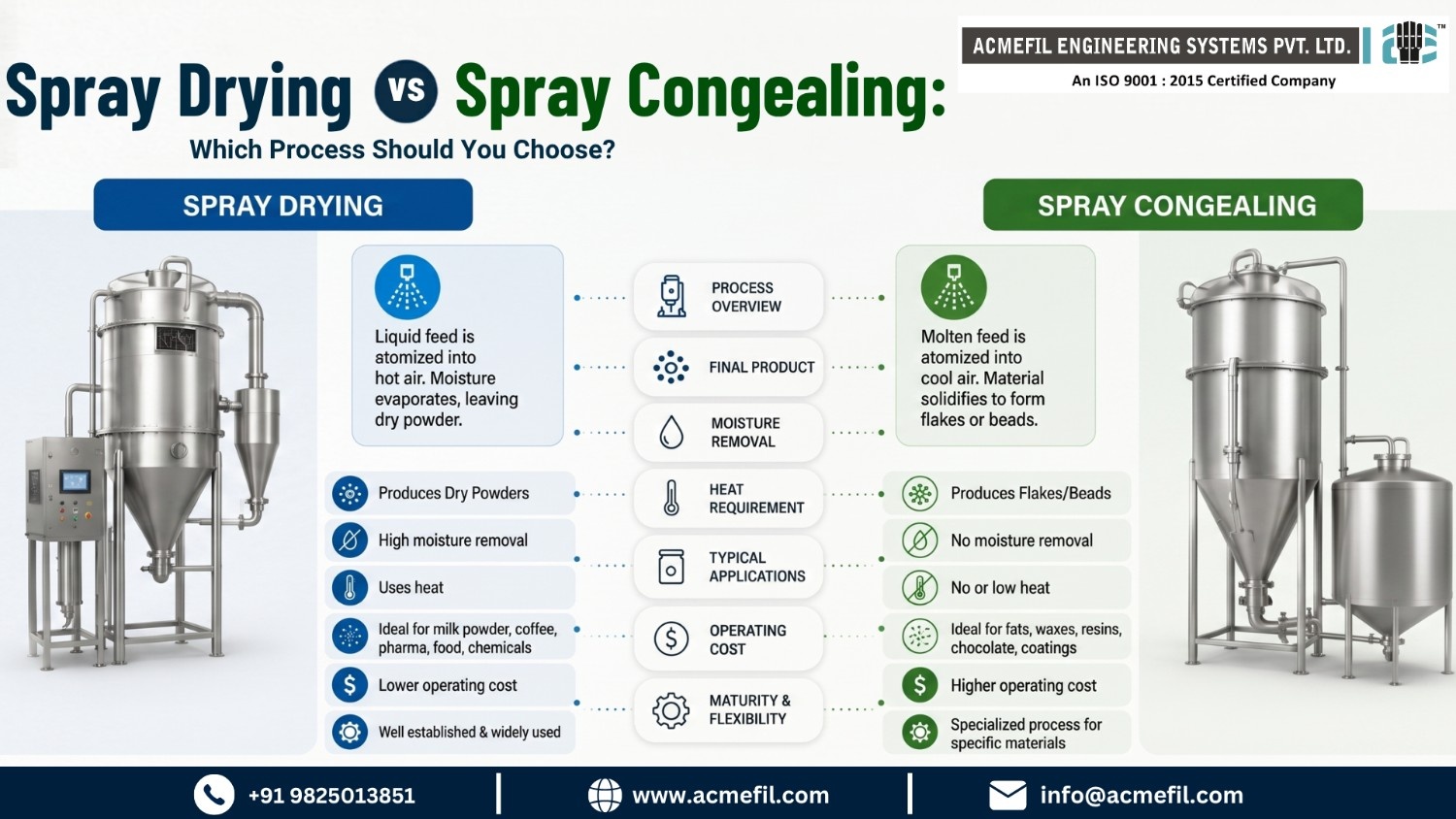
Spray Drying vs Spray Congealing: The Practical Difference
Spray drying vs spray congealing comes down to one basic question: are you removing liquid, or are you solidifying a melt?
Spray drying converts a liquid feed, slurry, solution, or emulsion into dry powder by atomizing it into hot air. Spray congealing, also called spray cooling or spray chilling in many applications, converts a molten feed into solid particles by atomizing it into cold air.
If your product contains water or solvent that must be evaporated, you are usually looking at spray drying. If your product is already a molten material and must be cooled into particles, spray congealing is the more relevant process.
This is not just a terminology issue. The wrong choice changes the entire plant design, heat load, particle structure, product stability, and downstream handling.
For a wider comparison with other drying technologies, you can also review our guide on comparing spray drying with other technologies.
What Is Spray Drying?
Spray drying is a continuous powder production process where a pumpable liquid feed is atomized into small droplets and contacted with hot drying air. Moisture or solvent evaporates quickly from the droplet surface, and the remaining solids form a powder.
A typical spray drying process has four main stages:
- Atomization of the liquid feed into droplets
- Contact between droplets and hot drying air
- Evaporation of moisture or solvent from the droplets
- Separation of dry powder from air using a cyclone, bag filter, or collection system
In practical plant design, the feed properties decide most of the spray dryer configuration. A low-viscosity solution, abrasive slurry, heat-sensitive extract, detergent formulation, ceramic slurry, and pharmaceutical feed will not behave the same inside the drying chamber.
That is why atomizer selection matters. Rotary atomizers, pressure nozzles, and two-fluid nozzles all create droplets, but they do not create the same droplet size distribution or particle behavior. For a deeper explanation, read our guide on spray dryer atomization techniques.
What Is Spray Congealing?
Spray congealing is a particle formation process where a molten feed is atomized into a cooling chamber. Instead of evaporating water or solvent, the process removes heat from each droplet until it solidifies.
The process is also called spray cooling or spray chilling depending on the industry and product. In simple terms, the material enters the system as a melt and exits as solidified particles.
A typical spray congealing process includes:
- Heating the feed above its melting point
- Pumping the molten feed to an atomizer or nozzle
- Breaking the melt into droplets
- Contacting those droplets with cool air
- Solidifying droplets into defined particles
- Separating and collecting the particles
This is why spray congealing is used only when the feed can exist as a stable molten phase. If the material cannot be melted safely, cannot be pumped at melt temperature, or degrades before atomization, spray congealing becomes risky.
For equipment-level context, Acmefil’s spray cooling system is designed around this same basic principle of converting molten mass into droplets and solidifying them through cold air exposure.
Spray Drying vs Spray Congealing: Key Differences
| Factor | Spray Drying | Spray Congealing |
|---|---|---|
| Main objective | Remove moisture or solvent | Solidify molten material |
| Feed form | Solution, suspension, slurry, emulsion, pumpable liquid | Melt, molten suspension, molten carrier system |
| Heat direction | Heat is added through hot drying air | Heat is removed through cool air |
| Main transformation | Liquid to dry powder by evaporation | Melt to solid particle by cooling |
| Driving mechanism | Heat and mass transfer | Heat removal and phase change |
| Chamber condition | Hot gas stream | Cooled air stream |
| Product risk | Stickiness, wall deposition, incomplete drying, thermal degradation | Poor solidification, agglomeration, melt degradation, nozzle blockage |
| Main control parameters | Inlet temperature, outlet temperature, feed rate, atomization, air flow, solids concentration | Melt temperature, cooling air temperature, atomization, viscosity, crystallization behavior, residence time |
| Typical product form | Dry powder, hollow/porous particles, agglomerates depending on design | Dense or solidified particles, often spherical or prilled |
| Best suited for | Milk powder, coffee extract, herbal extract, dyestuff, pigments, ceramics, detergents, inorganic chemicals | Waxes, fats, lipids, meltable carriers, melt-solidified encapsulated particles |
| Wrong selection symptom | Powder remains wet, sticky, degraded, or too fine | Particles remain soft, fused, misshaped, or blocked at discharge |
The Main Selection Rule
Use spray drying when the feed contains liquid that must be evaporated.
Use spray congealing when the feed is a melt that must be cooled into solid particles.
This sounds simple, but many project discussions go wrong because buyers start with the final form they want, not the feed condition they actually have.
A buyer may say, “We need free-flowing granules.” That does not automatically mean spray drying or spray congealing. The correct question is: what is the feed today?
If the feed is an aqueous slurry of ceramic material, spray drying may be the correct route. If the feed is a molten wax blend or lipid carrier, spray congealing may be more logical. If the feed is a wet cake or paste, neither may be ideal without further evaluation, and another dryer type may be required.
If you are still at the early equipment selection stage, our guide on choosing the right spray dryer will help you frame the decision better.
How Particle Formation Differs
In spray drying, the droplet starts as a liquid containing dissolved or suspended solids. As hot air contacts the droplet, moisture evaporates from the surface. A particle shell may begin to form. Depending on drying rate, solids migration, viscosity, and temperature, the final particle may become dense, hollow, porous, wrinkled, or agglomerated.
This is why outlet temperature, feed concentration, atomizer speed, and drying chamber design are not separate decisions. They work together.
In spray congealing, the droplet starts as a molten material. The particle forms as heat is removed and the material crosses its solidification point. There is no moisture removal as the primary mechanism. The structure depends on melt composition, cooling rate, crystallization behavior, droplet size, and air temperature.
A spray drying problem is often a drying kinetics problem.
A spray congealing problem is often a cooling and solidification problem.
That distinction matters during scale-up. You cannot solve a spray congealing issue by thinking like a dryer designer only. You need to understand melt handling, cooling, crystallization, and solid particle discharge.
Feed Type Decides the Technology
Before discussing chamber size or atomizer type, I would first classify the feed.
| Feed condition | More likely process | Why |
|---|---|---|
| Water-based solution | Spray drying | Water must evaporate |
| Solvent-based liquid | Spray drying, often closed-loop if solvent recovery or inert atmosphere is needed | Solvent must be removed safely |
| Slurry with suspended solids | Spray drying | Atomized droplets dry into powder |
| Emulsion | Spray drying or spray congealing depending on carrier and objective | The phase system decides the route |
| Molten wax, fat, lipid, or carrier | Spray congealing | Melt must solidify |
| Heat-sensitive aqueous extract | Spray drying with careful temperature and residence-time control | Moisture removal is still the goal |
| Wet cake or paste | Usually not spray drying or spray congealing directly | Feed may need spin flash, flash, fluid bed, or other dryer evaluation |
| Product that cannot tolerate melt temperature | Usually not spray congealing | Material may degrade before atomization |
For spray dryer projects, feed characterization should include solids percentage, viscosity, density, temperature sensitivity, stickiness tendency, target moisture, and desired particle size. For spray congealing, I would add melting point, melt viscosity, crystallization behavior, cooling curve, and solidification temperature window.
Temperature Logic Is Completely Different
Spray drying uses hot air, but that does not mean the product always reaches the inlet air temperature. In many spray drying operations, rapid evaporation keeps the droplet surface temperature lower during the early drying stage. Still, poor outlet temperature control can damage heat-sensitive products or leave powder with high residual moisture.
This is why spray dryer temperature selection must consider both inlet and outlet conditions, not only the maximum air temperature. To understand this better, see our guide on spray dryer operating principles and best practices.
Spray congealing uses cooling air. The risk is not moisture removal failure. The risk is incomplete solidification, sticky particles, wall deposition, or fused product because the droplets did not lose heat fast enough before collection.
In spray drying, you ask: did the droplet have enough heat and residence time to dry?
In spray congealing, you ask: did the molten droplet lose enough heat and residence time to solidify?
Equipment Differences
A spray dryer and spray congealing system may look similar from a distance because both use atomization and a chamber. But the process duty is different.
A spray dryer usually includes:
- Feed tank and feed pump
- Atomizer or nozzle
- Hot air generator or air heater
- Drying chamber
- Cyclone separator
- Bag filter or powder recovery system
- Exhaust air handling system
- Controls for inlet/outlet temperature, feed rate, and air flow
A spray congealing system usually includes:
- Heated feed preparation tank
- Heated lines or jacketed transfer system
- Atomizer or nozzle suitable for molten feed
- Cooling chamber
- Cooling air system
- Particle collection system
- Temperature control for melt and cooling air
- Anti-blockage and discharge handling provisions
The difference is not only hot air versus cold air. Spray congealing often needs stronger attention to heated feed handling before atomization. If the melt cools inside the line, pump, or nozzle, the system can block. Spray drying has its own blockage risks, but the mechanism is different.
For spray dryer equipment layout, our article on spray dryer design and components gives a useful base.
Which Process Gives Better Particle Control?
Both processes can control particle size, but they do it through different levers.
In spray drying, particle size is influenced by:
- Atomizer type
- Atomizer speed or nozzle pressure
- Feed viscosity
- Feed solids concentration
- Droplet size
- Drying rate
- Fines recycling or agglomeration system
- Chamber air flow pattern
In spray congealing, particle size is influenced by:
- Atomizer type
- Melt viscosity
- Melt temperature
- Droplet formation behavior
- Cooling air temperature
- Solidification rate
- Residence time
- Particle collision and collection design
A common mistake is to treat atomization as the only particle-size control point. It is important, but not enough.
In spray drying, a perfect droplet can still produce a poor powder if drying rate, outlet moisture, or wall deposition is not controlled. In spray congealing, a good droplet can still fuse or deform if the cooling zone is not designed correctly.
When Should You Choose Spray Drying?
Choose spray drying when your main objective is to convert a liquid feed into a dry powder.
This is common in:
- Milk powder and dairy powders
- Coffee extract
- Egg powder
- Soup mixes
- Food colours
- Herbal extracts
- Enzymes and biochemical products
- Dyestuff and pigments
- Detergents
- Ceramic slurries
- Inorganic chemicals
- Polymer and resin dispersions
Spray drying is useful when the process needs continuous powder production, controlled particle size, fast drying, and direct conversion from liquid to powder.
But it is not automatically suitable for every liquid. You still need to check feed pumpability, heat sensitivity, stickiness, product hygroscopicity, final moisture target, powder recovery requirement, and cleanability.
For operating improvements, review our guide on optimizing spray drying parameters.
When Should You Choose Spray Congealing?
Choose spray congealing when the feed is a molten material and the process objective is to form particles by cooling.
This is relevant when:
- The product can be melted without degradation
- The melt can be pumped and atomized
- The final product should be solidified particles rather than dried powder
- No moisture or solvent evaporation is required as the main duty
- The product benefits from spherical or prilled particle form
- The process needs melt-based encapsulation or solidification
Spray congealing is often discussed in pharmaceutical, food, wax, fat, lipid, and specialty chemical contexts. However, every melt behaves differently. Melting point alone is not enough. The process designer also needs melt viscosity, solidification behavior, particle target, cooling demand, and discharge behavior.
If the product remains tacky near room temperature, spray congealing may need careful cooling, collection, and post-cooling design.
Spray Drying vs Spray Congealing for Heat-Sensitive Products
Many buyers assume spray congealing is always better for heat-sensitive products because it uses cooling air. That is not always true.
Spray congealing may expose the material to elevated melt temperature before atomization. If the active ingredient, flavour, enzyme, or formulation cannot tolerate that melt temperature, spray congealing can damage the product before cooling even begins.
Spray drying uses hot air, but residence time can be very short. For some heat-sensitive liquid feeds, controlled spray drying may still be practical because evaporation cools the droplet during part of the process.
The correct question is not “hot air or cold air?”
The correct question is: which thermal exposure harms the product more, drying air exposure or melt temperature exposure?
That answer comes from product data, not assumption.
Common Buyer Mistakes
Mistake 1: Choosing by final product form only
Both processes can make particles. That does not mean they are interchangeable. Start from feed condition and process objective.
Mistake 2: Ignoring viscosity
A feed that is pumpable at room temperature may not behave well during atomization. A melt that is pumpable at 90°C may become too viscous if it cools in the line. Viscosity has to be evaluated at actual process temperature.
Mistake 3: Treating spray congealing as “cold spray drying”
Spray congealing is not spray drying with cold air. The mechanism is different. It is solidification, not evaporation.
Mistake 4: Not defining the target particle
Before equipment selection, define particle size range, flowability, bulk density, moisture requirement, friability, solubility, dispersibility, and packaging behavior. A vague “free-flowing powder” target is not enough.
Mistake 5: Skipping trial logic
If the feed is new, sensitive, sticky, high-value, or commercially important, a trial or at least a technical feasibility review is safer than relying only on catalogue assumptions.
What Data Should You Share Before Asking for a Recommendation?
For spray drying, prepare:
- Feed composition
- Solids percentage
- Viscosity at feed temperature
- Feed rate or required water evaporation rate
- Inlet moisture and target outlet moisture
- Heat sensitivity
- Stickiness or hygroscopic behavior
- Target particle size
- Required powder recovery level
- Cleaning or hygiene requirement
- Solvent presence, if any
For spray congealing, prepare:
- Melting point or melting range
- Melt viscosity at operating temperature
- Degradation temperature
- Solidification point
- Cooling curve, if available
- Target particle size
- Desired particle hardness
- Stickiness or tackiness after solidification
- Feed temperature window
- Required production rate
- Dust or fines tolerance
- Packaging and storage condition
This data prevents wrong equipment selection. It also helps the manufacturer decide whether rotary atomization, pressure nozzle, two-fluid nozzle, or another atomization method is suitable. For related equipment options, see Acmefil’s pages on rotary atomizers and spray nozzles.
Quick Decision Table
| Your situation | Better starting point |
|---|---|
| Feed is water-based liquid or slurry | Spray drying |
| Feed is solvent-based liquid | Spray drying, possibly closed-loop |
| Feed is molten wax, fat, lipid, or meltable carrier | Spray congealing |
| Need to evaporate moisture | Spray drying |
| Need to solidify melt | Spray congealing |
| Product cannot tolerate melt temperature | Spray drying or another low-temperature route may be safer |
| Product is sticky during drying | Spray drying needs careful outlet temperature and formulation review |
| Product stays soft after cooling | Spray congealing needs cooling and solidification review |
| Feed is wet cake or paste | Evaluate flash dryer, spin flash dryer, fluid bed dryer, or other dryer type |
| Buyer does not know feed behavior | Run technical feasibility review before equipment selection |
Final Recommendation
Spray drying and spray congealing both use atomization, but they solve different process problems.
Spray drying is a drying process. It removes moisture or solvent from liquid droplets and creates powder through evaporation.
Spray congealing is a cooling and solidification process. It converts molten droplets into solid particles by removing heat.
If you remember only one point, remember this: spray drying starts with a liquid feed that must lose moisture, while spray congealing starts with a melt that must lose heat.
For industrial projects, do not select the technology from a keyword alone. Select it from feed condition, thermal behavior, particle target, and downstream handling requirement.
FAQs
What is the main difference between spray drying and spray congealing?
Spray drying removes moisture or solvent from an atomized liquid feed using hot air. Spray congealing solidifies atomized molten droplets using cold air. Spray drying is a drying process, while spray congealing is a cooling and solidification process.
Is spray congealing the same as spray cooling?
In many industrial and pharmaceutical contexts, spray congealing, spray cooling, and spray chilling refer to the same process family. The feed is kept molten, atomized into droplets, and cooled until it solidifies into particles.
Which process is better for heat-sensitive products?
Neither process is automatically better. Spray drying uses hot air, but the residence time can be short and evaporative cooling may protect the droplet during part of drying. Spray congealing uses cooling air, but the product must first tolerate melt temperature. The correct choice depends on thermal stability data.
Can the same equipment be used for spray drying and spray congealing?
Some mechanical concepts are similar, especially atomization and chamber-based particle formation, but the process design is different. Spray drying needs hot air and moisture removal. Spray congealing needs heated feed handling and cooling air. A system should not be treated as interchangeable without engineering review.
Which process gives better powder flowability?
Both can produce free-flowing particles if designed correctly. Spray drying flowability depends on particle size, moisture, surface structure, agglomeration, and fines control. Spray congealing flowability depends on melt composition, cooling rate, particle hardness, and tackiness after solidification.
Need help deciding between spray drying and spray congealing for your product?
Start with the feed condition, target particle size, moisture or solidification requirement, and temperature sensitivity. If you already have this data, share it with the technical team through the SprayDryer.com contact page for a process-level discussion.

Siddharth Nair is Technical Director at Acmefil Engineering Systems Pvt. Ltd. he leads solution design and applications engineering across the company’s full product range — spray dryers, multi-effect evaporators, agitated thin film dryers, spin flash dryers, fluid bed dryers, and complete ZLD systems.
His work spans process evaluation, equipment sizing, customer application consulting, and technical proposal development for industries including food and dairy, pharmaceuticals, chemicals, dyestuffs, ceramics, and industrial effluent treatment. He has hands-on commissioning experience across Acmefil’s 500+ installations in India and 15+ countries.
He holds a BTech in Mechanical Engineering from CHARUSAT University and also partners at A.S Engineers, working with blowers, sludge dryers, and industrial conveying systems.


