
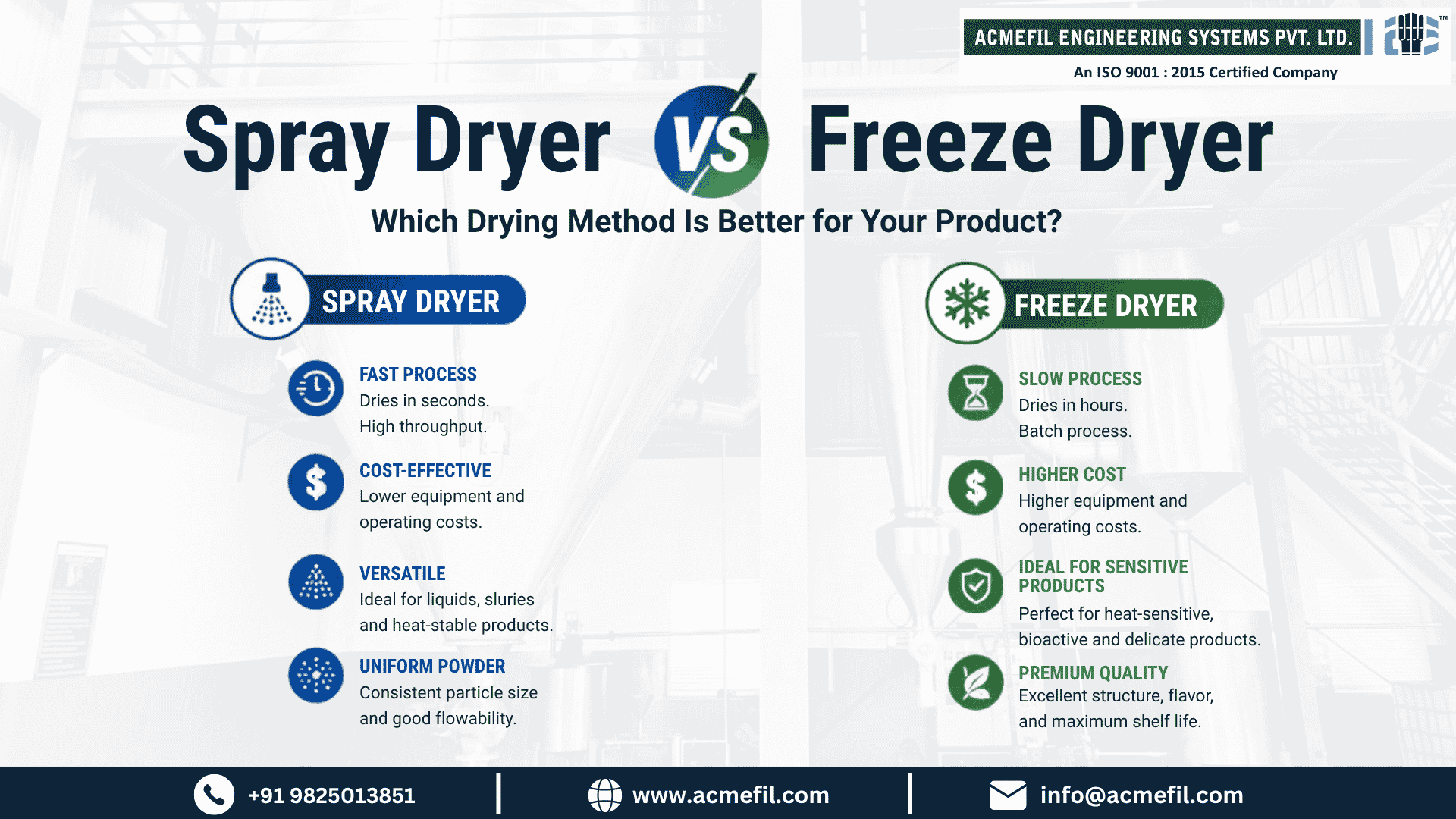
A spray dryer is usually better for continuous, large-scale powder production where speed, cost per kg, and controlled particle formation matter. A freeze dryer is better when the product is extremely heat-sensitive and you must preserve biological activity, original structure, aroma, or premium sensory quality even at a higher cost and longer cycle time.
At Acmefil, I do not start this comparison by asking which machine is “better.” I start with the product. If the feed is a liquid, slurry, emulsion, or solution that must become a free-flowing powder at industrial scale, spray drying is often the practical route. If the product cannot tolerate heat or must retain its original structure, freeze drying deserves serious evaluation.
What Is the Basic Difference Between a Spray Dryer and a Freeze Dryer?
A spray dryer converts a pumpable liquid feed into dry powder by atomizing it into fine droplets and contacting those droplets with hot drying air. The droplet dries very quickly, then the powder is separated from the exhaust air through a cyclone, bag filter, or a similar separation system.
A freeze dryer, also called a lyophilizer, first freezes the product. Then it applies vacuum so that ice changes directly into vapour through sublimation. This happens at low temperature, but the process is slow and normally works batch by batch.
That is the core trade-off.
Spray drying is a fast thermal process for powder production. Freeze drying is a low-temperature vacuum process for preservation.
Spray Dryer vs Freeze Dryer: Quick Comparison
| Selection Factor | Spray Dryer | Freeze Dryer |
|---|---|---|
| Working principle | Atomization into hot air, rapid drying, powder separation | Freezing, vacuum, sublimation, secondary drying |
| Process type | Usually continuous | Usually batch |
| Typical product form | Fine powder, agglomerated powder, granules depending design | Porous, light, fragile dried cake or structure-retained product |
| Speed | Very fast drying after atomization | Slow cycle, often hours to days depending product and batch |
| Heat exposure | Higher inlet air temperature, but short residence time | Low temperature during primary drying |
| Scale advantage | Strong for bulk industrial production | Strong for high-value, sensitive, lower-volume products |
| Powder control | Good control over particle size, bulk density, solubility, and flow with correct atomization | Excellent structure preservation, but powder handling may need milling or post-processing |
| Cost profile | Generally lower operating cost for bulk powder production | Higher capital and operating complexity due refrigeration, vacuum, condenser, and batch cycle |
| Best-fit products | Milk powder, coffee, flavours, detergents, dyes, pigments, ceramics, food ingredients, many chemical powders | Probiotics, vaccines, sensitive enzymes, biologicals, premium fruit pieces, high-value nutraceuticals |
| Main limitation | Not suitable for every heat-sensitive or shear-sensitive product without trials | Slow, expensive, and less practical for high-volume commodity powder production |
Independent technical references describe the same broad trade-off: freeze drying protects sensitive materials through low-temperature vacuum sublimation, while spray drying converts liquid to powder in a faster single-step process.
When Is a Spray Dryer the Better Choice?
A spray dryer is normally the better choice when the buyer needs industrial powder production, not just moisture removal.
In a spray dryer, the feed is broken into droplets through a rotary atomizer, pressure nozzle, or two-fluid nozzle. The droplet size, feed solids, viscosity, inlet temperature, outlet temperature, chamber residence time, and separation system all influence the final powder.
This matters because buyers are not only asking, “Can the product be dried?” They are asking:
- Will the powder flow properly?
- Will it dissolve or disperse as required?
- Will the moisture remain within specification?
- Will the product stick to the chamber wall?
- Will the plant handle the required capacity?
- Will the powder meet downstream packing and handling requirements?
For many food, dairy, dye, pigment, detergent, ceramic, and chemical applications, these are spray dryer questions.
If you are still at the technology-selection stage, start with choosing the right spray dryer before deciding only on price.
Where Freeze Drying Is Technically Better
Freeze drying is better when product preservation is more important than speed and cost.
Examples include sensitive biologicals, some probiotics, injectable formulations, high-value nutraceuticals, premium fruits, and products where the original structure, rehydration behaviour, colour, aroma, or bioactivity must be protected as much as possible.
The mistake is assuming that freeze drying is always “higher quality” for every product. That is not technically correct.
It may produce a better result for a very delicate product. But for an industrial powder where bulk density, packing, flowability, solubility, and production cost matter, freeze drying may create unnecessary cost and handling problems.
In practical equipment selection, a premium method is not automatically the right method. The right method is the one that meets the product specification at a commercially acceptable cost.
Spray Drying vs Freeze Drying for Food Products
In food processing, the choice depends on the product form and market positioning.
Spray drying is widely used when the required output is a powder. Typical examples include milk powder, coffee powder, fruit and vegetable extracts, soup mixes, food colours, flavours, enzymes, maltodextrin, and other food ingredients.
A well-designed spray dryer can support:
- Continuous production
- Controlled moisture reduction
- Powder particle-size control
- Improved packing and handling
- Scalable production economics
- Integration with cyclone, bag filter, fluid bed, and conveying systems
For dairy applications, you can also review our guide on spray dryer for milk powder.
Freeze drying is more suitable for premium products where structure retention is important. For example, freeze-dried fruit pieces are valued because they can retain shape and rehydrate differently compared with spray-dried powders.
So the question is not simply food vs food. The question is powder ingredient vs structure-preserved product.
Spray Drying vs Freeze Drying for Pharma and Nutraceutical Products
This is where the decision becomes more sensitive.
Some pharmaceutical and nutraceutical products are not suitable for normal spray drying because they may degrade under heat, shear, oxidation, or exposure to drying gas. In these cases, freeze drying may be the safer process route.
But it is also wrong to reject spray drying too early.
Spray drying can still be relevant for selected pharma, herbal extract, nutraceutical, and excipient applications when the formulation, solvent system, atomization method, inlet and outlet temperature, and residence time are designed properly. Closed loop spray drying and sterile spray drying may also be considered for suitable solvent-based, oxidation-sensitive, or controlled-environment applications.
For pharma-related projects, I prefer trial-based decision-making. Do not decide from a generic blog table. Decide from actual product behaviour.
Check:
- Assay or active retention after drying
- Moisture content
- Solubility and reconstitution
- Particle size distribution
- Bulk density
- Hygroscopicity
- Product recovery
- Wall deposition
- Colour, odour, and degradation markers
- Stability after storage
For a broader application view, read spray dryer applications in pharmaceuticals.
Cost Difference: Why Spray Drying Usually Wins at Scale
A spray dryer normally has a strong cost advantage for bulk powder production because it is fast and continuous. Once the feed is prepared and the drying parameters are stable, the plant can run continuously with controlled feed rate, hot air flow, outlet temperature, and powder separation.
A freeze dryer has more process stages. It needs freezing, vacuum, controlled shelf heating, condenser capacity, and a cycle that must be completed batch by batch. That adds time, equipment complexity, and operating cost.
This does not mean spray drying is always cheaper in a useful way. A cheaper process is useless if it damages the product. But when the product can tolerate spray drying and the target is industrial powder production, spray drying usually gives a better production economics.
If cost is a major selection factor, compare the complete project, not only the machine price:
| Cost Factor | Why It Matters |
|---|---|
| Water to be removed per day | This decides equipment scale and operating load |
| Feed solids percentage | Higher solids often reduces evaporation load |
| Required outlet moisture | Lower moisture target may increase residence time or energy demand |
| Product recovery | Wall sticking and fines loss can hurt economics |
| Utilities | Fuel, steam, electricity, compressed air, chilled water, vacuum, refrigeration |
| Cleaning requirement | Food and pharma products may need hygienic design or CIP planning |
| Labour and batch handling | Freeze drying may require more batch planning and handling |
| Post-processing | Milling, agglomeration, blending, sieving, or packing may change total cost |
For capital equipment evaluation, also read cost-benefit analysis of investing in a spray dryer.
Powder Quality: Which Method Gives a Better Final Product?
“Better powder” depends on what the powder must do.
Spray drying is strong when you need controlled powder properties. With the right atomizer and chamber design, you can influence particle size, bulk density, solubility, moisture, and flow behaviour. This is why spray drying is common in food ingredients, detergent powders, dyes, pigments, ceramics, and many chemical powders.
Freeze drying is strong when you need structural preservation. The dried product is often porous and light. It may rehydrate well, but it may not always behave like a dense, free-flowing industrial powder without further processing.
Here is the practical difference:
| Product Goal | Better Starting Point |
|---|---|
| Free-flowing industrial powder | Spray dryer |
| Large-volume production | Spray dryer |
| Controlled particle size through atomization | Spray dryer |
| Premium structure-retained dried pieces | Freeze dryer |
| Maximum protection of very heat-sensitive biologicals | Freeze dryer |
| Lower cost per kg for powder production | Spray dryer |
| Preservation before downstream reconstitution | Depends on product trial |
| Delicate aroma and colour retention | Often freeze dryer, but validate by trial |
For spray dryer powder behaviour, see spray dryer atomization techniques and nozzle vs rotary atomizer comparison.
The Most Common Buyer Mistake
The most common mistake is choosing the drying method from a general rule.
Some buyers say, “My product is heat-sensitive, so I need freeze drying.” That may be true, but not always.
Some products see high inlet air temperature in a spray dryer, but the droplet residence time is very short. The actual product temperature is often closer to the outlet air condition than the inlet air temperature. That is why a product trial is important before rejecting spray drying.
The opposite mistake also happens. Some buyers force spray drying onto a product that is too sensitive, too sticky, too low in solids, or too unstable. Then the plant struggles with wall deposition, low yield, poor powder quality, or product degradation.
Neither mistake is solved by a catalogue. It is solved by testing the feed.
What Data Should You Share Before Selecting Spray Drying or Freeze Drying?
Before we recommend a spray dryer configuration, I would ask for the following data:
| Required Data | Why It Matters |
|---|---|
| Feed composition | Tells us whether the material behaves like solution, slurry, emulsion, extract, or suspension |
| Total solids percentage | Directly affects evaporation load and plant size |
| Viscosity at feed temperature | Affects pumping, atomization, and droplet formation |
| Heat sensitivity | Determines safe outlet temperature and process risk |
| Required final moisture | Defines drying target and residence time |
| Target particle size | Influences rotary atomizer vs nozzle selection |
| Bulk density requirement | Important for packing, dosing, and transport |
| Solubility or dispersibility | Important for food, pharma, and chemical powders |
| Stickiness or glass transition behaviour | Helps predict wall deposition risk |
| Solvent or water-based feed | Decides open-cycle vs closed-loop drying consideration |
| Required capacity | Separates lab, pilot, and production-scale decisions |
| Hygiene or GMP requirement | Affects material of construction, filtration, and cleaning design |
For spray drying projects, this data is more useful than asking for the “standard model.” A standard dryer may not be the correct dryer for your feed.
Why Pilot Testing Matters Before Full-Scale Spray Dryer Selection
At Acmefil, we manufacture industrial drying and evaporation systems, and our in-house R&D pilot facility includes a lab scale pilot spray dryer with 3 kg/hr water evaporation capacity. This is useful when the buyer is uncertain about drying behaviour, wall sticking, product recovery, or final powder quality.
A pilot trial should answer practical questions:
- Can the feed be atomized properly?
- Does the product stick to the chamber?
- What outlet temperature gives acceptable moisture?
- Is the powder free-flowing or hygroscopic?
- Does the product need a carrier or formulation change?
- Which atomizer type is more suitable?
- What separation system is required?
- Is the product quality acceptable after drying?
This is why I prefer trial-backed selection for serious projects. A spray dryer is not a small purchase. If your product is new, sensitive, sticky, or high value, the pilot stage reduces the risk of wrong full-scale design.
You can review Acmefil’s pilot spray dryer facility for process development and trial discussions.
Which Drying Method Should You Choose?
Choose a spray dryer if your goal is continuous powder production, controlled particle formation, scalable capacity, and lower operating cost for suitable feeds.
Choose a freeze dryer if your product is extremely heat-sensitive, high-value, biologically active, or sold on the basis of preserved structure, premium sensory quality, or maximum retention of delicate properties.
Choose pilot testing if the product sits between the two.
This is especially common in herbal extracts, nutraceuticals, enzymes, flavours, coffee extracts, fruit concentrates, and pharma intermediates. On paper, both methods may look possible. In practice, the product trial usually makes the answer clearer.
Final Recommendation
For most industrial buyers comparing spray dryer vs freeze dryer, I would use this rule:
If you need a free-flowing powder at commercial scale, evaluate spray drying first. If the product fails because of heat sensitivity, biological instability, aroma loss, or quality degradation, then evaluate freeze drying.
Do not buy either system only because the technology sounds advanced. Buy it because it meets your feed behaviour, quality target, capacity requirement, and cost structure.
At Acmefil, we can support the spray drying side of that decision with application review, atomizer selection, pilot trials, and full-scale spray dryer design. For the right product, spray drying is not just faster. It is the more practical industrial route.
FAQs
Is spray drying better than freeze drying?
Spray drying is better for continuous, large-scale powder production where speed, cost, particle control, and throughput matter. Freeze drying is better for highly heat-sensitive and high-value products where preserving structure, biological activity, aroma, or delicate quality is more important than production speed.
Which is cheaper, spray drying or freeze drying?
Spray drying is generally more economical for bulk powder production because it is fast and continuous. Freeze drying usually requires refrigeration, vacuum, condensers, and long batch cycles, which increases equipment complexity and operating cost. The final decision should still depend on product quality after drying.
Can heat-sensitive products be spray dried?
Some heat-sensitive products can be spray dried because droplet residence time is very short, but not all can. The correct answer depends on formulation, feed solids, outlet temperature, atomization method, and acceptable quality loss. For sensitive products, a pilot spray drying trial is strongly recommended.
Does freeze drying preserve nutrients better than spray drying?
For many delicate biological, premium food, and nutraceutical products, freeze drying can preserve sensitive properties better because it operates at low temperature under vacuum. But the advantage depends on the product. For many industrial powders, spray drying provides the required quality at much better scale and cost.
Should I test my product before choosing a spray dryer?
Yes. If your feed is sticky, heat-sensitive, high-value, or new to production, pilot testing is the safest route. A pilot trial can check moisture, recovery, wall deposition, particle size, solubility, bulk density, and powder handling before you commit to full-scale equipment.
Need to Decide Between Spray Drying and Another Drying Method?
Share your feed details, solids percentage, target moisture, expected capacity, heat sensitivity, and final powder requirement with Acmefil’s technical team.
We can review whether spray drying is suitable, recommend the right atomization route, and guide you on pilot testing before full-scale plant selection.
Start with a technical discussion through the Acmefil contact page or read more about industrial spray dryer systems.

Siddharth Nair is Technical Director at Acmefil Engineering Systems Pvt. Ltd. he leads solution design and applications engineering across the company’s full product range — spray dryers, multi-effect evaporators, agitated thin film dryers, spin flash dryers, fluid bed dryers, and complete ZLD systems.
His work spans process evaluation, equipment sizing, customer application consulting, and technical proposal development for industries including food and dairy, pharmaceuticals, chemicals, dyestuffs, ceramics, and industrial effluent treatment. He has hands-on commissioning experience across Acmefil’s 500+ installations in India and 15+ countries.
He holds a BTech in Mechanical Engineering from CHARUSAT University and also partners at A.S Engineers, working with blowers, sludge dryers, and industrial conveying systems.


