
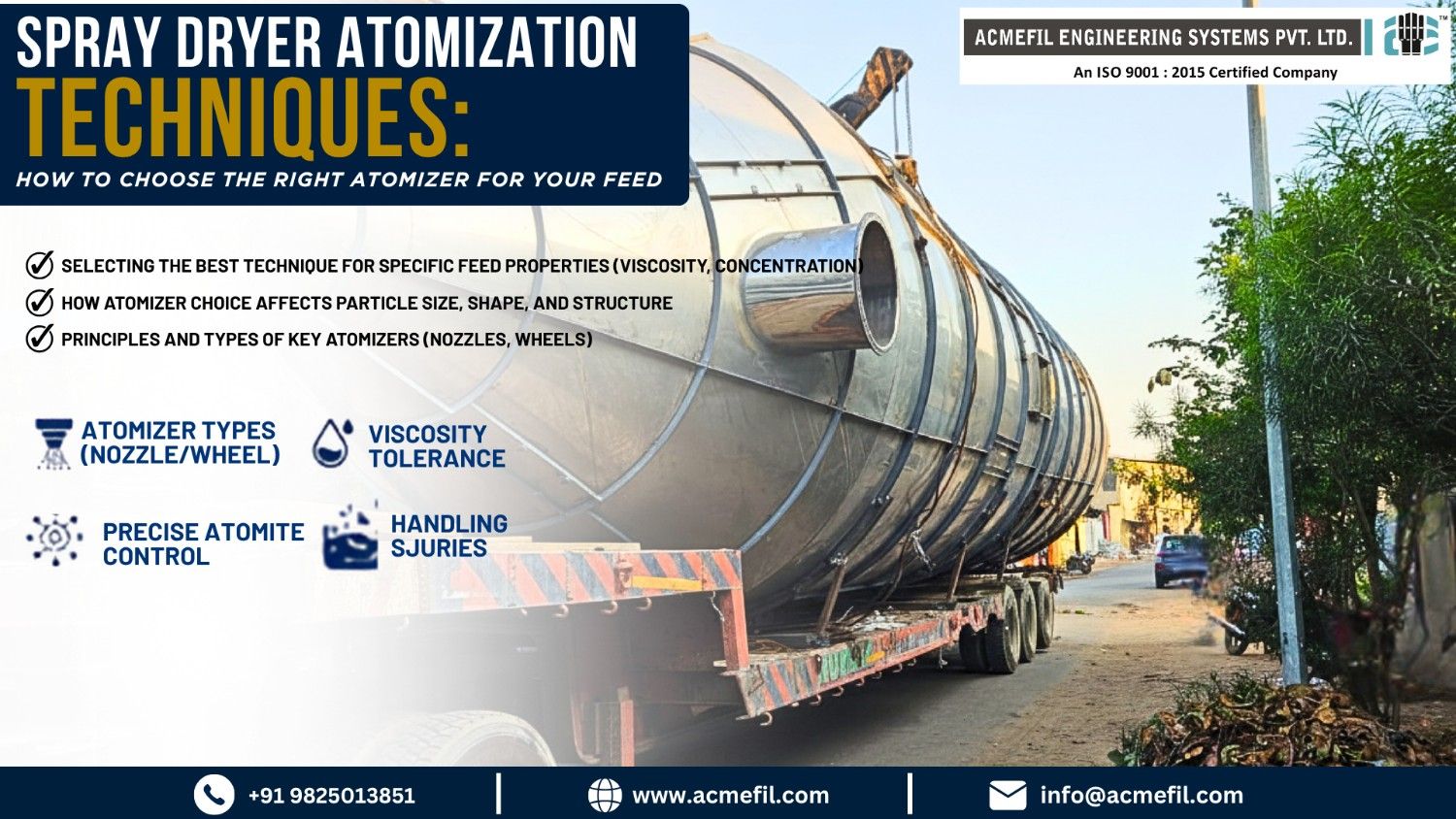
Atomization is the point where spray drying succeeds or fails. Among all spray dryer atomization techniques, the correct choice depends on feed viscosity, solids content, target particle size, bulk density, heat sensitivity, and production capacity. A rotary atomizer is usually stronger for slurries, variable feeds, and larger production rates. A pressure nozzle is better when particle size and bulk density need tighter control. A two-fluid nozzle is useful for fine droplets, pilot trials, and low-flow applications.
In my experience, many spray dryer problems blamed on “drying temperature” actually start at atomization. If the feed is not broken into the right droplet size, the drying chamber has to fight a problem it was never designed to solve.
Before selecting the chamber, blower, cyclone, bag filter, or hot air generator, I first want to understand the atomizer.
What Is Atomization in a Spray Dryer?
Atomization is the process of converting liquid feed, slurry, paste-like feed, or solution into fine droplets before it contacts hot drying air.
In a spray dryer, the process normally moves through four stages:
- Atomization of feed into droplets
- Contact between droplets and hot air
- Moisture evaporation from each droplet
- Separation of dried powder from air
The atomizer controls the starting droplet size. That droplet size strongly affects drying time, powder particle size, powder density, wall deposition, thermal exposure, and final product consistency.
A small droplet dries quickly but may create more fine powder and dust. A larger droplet may improve bulk density, but it needs more residence time. If the droplet is too large for the chamber, it can reach the wall before drying completely. That is when operators start seeing sticking, caking, wet powder, or low recovery.
For a wider process overview, you can also read our guide on spray dryer operating principles and best practices.
Main Spray Dryer Atomization Techniques
The main spray dryer atomization techniques used in industrial systems are:
| Atomization technique | How it works | Best suited for | Main caution |
|---|---|---|---|
| Rotary atomizer | Feed is thrown from a high-speed rotating disc by centrifugal force | Slurries, abrasive feeds, variable solids, high-capacity production | Higher mechanical complexity and atomizer maintenance |
| Pressure nozzle | Feed is pumped through a small orifice under pressure | Fine to coarse powder with better particle control | Nozzle clogging and wear if feed is not filtered or characterized |
| Two-fluid nozzle | Liquid feed is atomized using compressed air, gas, or steam | Fine droplets, pilot trials, small batches, difficult low-flow feeds | Compressed air demand and heat balance impact |
| Fluidized spray drying | Spray drying combined with fluid bed drying and fines recycling | Agglomerated powders and larger particles | More complex plant design and process control |
| Closed-loop or sterile spray drying | Atomization occurs inside a controlled nitrogen or sterile system | Solvent-based, oxidation-sensitive, and pharma applications | Requires stricter safety, filtration, and process control |
At Acmefil, we manufacture rotary disc type spray dryers, nozzle type spray dryers, fluidized spray dryers, closed-loop systems, sterile spray dryers, and lab-scale pilot spray dryers. The atomizer is not selected as a catalogue item. It is selected after understanding the feed and the powder target.
Rotary Atomizer Spray Dryer
A rotary atomizer uses a high-speed rotating disc to convert feed into fine droplets through centrifugal force. The feed enters the centre of the disc and spreads outward. As it reaches the edge, the liquid breaks into droplets and enters the hot air stream.
Acmefil’s rotary disc type spray dryers are designed for droplet control through disc selection and speed. In our verified product data, rotary disc atomization forms fine droplets in the 20 to 75 micron range, depending on feed and operating condition.
This technique is widely used for:
- Dyes and dyestuff intermediates
- Ceramic slurry
- Pigments
- Detergents
- Inorganic chemicals
- Food powders such as milk, egg, and soup mixes
- Pharmaceutical and chemical products where feed handling is critical
A rotary atomizer is often the better direction when the feed contains suspended solids or when the process needs flexibility across changing feed characteristics.
When Should You Choose a Rotary Atomizer?
Choose a rotary atomizer when the feed is difficult to push reliably through a small nozzle orifice.
I normally look at rotary atomization when the feed has one or more of these conditions:
- Higher solids content
- Abrasive or ceramic-type slurry
- Variable feed viscosity
- Suspended particles
- Higher production capacity
- Need for flexible droplet control through disc speed and disc design
- Risk of nozzle blockage with pressure atomization
The important point is this: rotary atomizers are forgiving with difficult feed, but they still need correct feed preparation. If the slurry is not screened, if the feed tank agitator is poor, or if viscosity changes during operation, even a good atomizer cannot fully compensate.
For buyers comparing atomizer type at a practical level, our separate guide on nozzle vs rotary atomizer spray dryers gives a focused comparison.
Pressure Nozzle Spray Dryer
A pressure nozzle atomizer uses pump pressure to force feed through an orifice. The pressure energy converts into velocity, and the liquid breaks into droplets as it exits the nozzle.
This method is useful when the buyer wants better control over particle size, powder density, and spray pattern. In many applications, pressure nozzles can produce fine to coarse particles depending on nozzle size, pressure, feed solids, and viscosity.
Pressure nozzle atomization is commonly selected for:
- Food processing
- Pharmaceutical powders
- Heat-sensitive products
- Flavours
- Enzymes
- Fine chemical products
- Applications where powder density matters
The pressure nozzle is simple in concept, but not simple in design. The nozzle orifice, feed pressure, spray angle, chamber height, pump selection, and filtration arrangement must work together.
If you only choose the nozzle based on capacity, you may get the right evaporation rate but the wrong powder.
When Should You Choose a Pressure Nozzle?
Choose a pressure nozzle when you need a more defined spray pattern and better particle-size targeting.
It is generally suitable when:
- The feed is pumpable and reasonably clean
- The product requires a controlled powder size
- Bulk density matters
- The dryer has a tall-form chamber design
- Feed filtration can protect the nozzle
- The process can tolerate nozzle inspection and cleaning routines
The biggest mistake I see with pressure nozzle systems is poor feed preparation. If the feed has undissolved solids, oversized particles, or crystallization tendency, the nozzle becomes the first failure point. Once the nozzle starts wearing or partially choking, spray pattern changes. Then wall deposition, moisture variation, and product inconsistency follow.
A spray dryer troubleshooting issue may look like a drying problem, but the root cause may be nozzle wear. That is why atomization must be included in any serious spray dryer troubleshooting review.
Two-Fluid Nozzle Spray Dryer
A two-fluid nozzle uses compressed air, gas, or steam to atomize the feed. Instead of relying mainly on liquid pressure, it uses the relative velocity between the liquid and atomizing medium to break the liquid into fine droplets.
This technique is useful for:
- Fine powder development
- Pilot plant trials
- Small batch production
- Low feed rates
- Difficult-to-atomize liquids
- R&D applications
- Heat-sensitive and specialty products
In Acmefil’s nozzle type spray dryer range, two-fluid nozzle atomization is used when finer particles are required and compressed air atomization is the right fit for the application.
The advantage is flexibility. The limitation is utility demand. Compressed air is not free. It also affects the heat balance inside the drying chamber. For a full-scale production plant, this must be calculated properly before finalizing the atomizer.
When Should You Choose a Two-Fluid Nozzle?
Choose a two-fluid nozzle when the process needs fine droplets at low flow or when the product is still under development.
This is especially useful when:
- The product is being tested at pilot scale
- The feed rate is low
- The powder target is very fine
- The feed does not atomize well under liquid pressure alone
- The application needs flexible atomization adjustment during trials
- The final commercial process is not yet fully known
At Acmefil, our lab-scale pilot spray dryer has 3 kg/hr water evaporation capacity. For many products, pilot trials are the safest way to compare atomization behaviour before committing to a full-scale spray dryer. You can also review our guide on spray dryer for small-scale production if your application is still at development or trial stage.
Rotary Atomizer vs Pressure Nozzle vs Two-Fluid Nozzle
Here is the practical way I compare these options during early selection.
| Selection factor | Rotary atomizer | Pressure nozzle | Two-fluid nozzle |
|---|---|---|---|
| Feed with suspended solids | Strong fit | Risk of clogging if not filtered | Possible, but depends on nozzle design |
| High-viscosity feed | Often better | Limited by pump and nozzle | Useful for some difficult feeds |
| Fine powder target | Possible | Good control | Strong for very fine droplets |
| Higher bulk density | Moderate | Often better | Depends on operating condition |
| Large production capacity | Strong fit | Good with correct multi-nozzle design | Less preferred for high utility efficiency |
| Pilot plant flexibility | Good, if pilot unit supports it | Good | Very strong |
| Maintenance focus | Mechanical atomizer care | Nozzle wear, choking, pump pressure | Air system, nozzle cleaning, air-liquid balance |
| Main risk | Incorrect speed/disc selection | Nozzle blockage or wear | Utility cost and heat balance impact |
| Best buyer question | “Will this handle my slurry reliably?” | “Can this deliver my target powder size and density?” | “Can we develop or fine-tune this product at low flow?” |
No atomizer is best for every product. The right atomizer is the one that produces the required droplet size reliably with your actual feed.
How Atomization Affects Droplet Size and Powder Quality
Droplet size is not only a number in microns. It decides how the product behaves inside the chamber.
Smaller droplets:
- Dry faster
- Need less residence time
- Can produce finer powder
- May increase dust load
- May reduce bulk density in some products
- Can be more sensitive to overheating
Larger droplets:
- Need more drying time
- May produce larger particles
- Can improve handling in some powders
- Increase wall deposition risk if chamber size is insufficient
- May need fluid bed integration for final drying or agglomeration
Acmefil’s fluidized spray dryer design is used when large particles, typically 50 to 150 microns in the verified product range, are required. In this arrangement, moist powder is further dried in an integrated fluid bed at the bottom of the chamber, fines are recycled back, and tertiary drying can be used where larger particle formation is needed.
This is relevant for detergent powders, food ingredients, and agglomerated powders where free-flowing behaviour matters as much as moisture removal.
Feed Characteristics You Must Check Before Atomizer Selection
Before selecting any atomizer, I want these feed details on the table.
| Feed data required | Why it matters |
|---|---|
| Total solids percentage | Affects viscosity, evaporation load, and droplet formation |
| Viscosity at operating temperature | Decides whether the feed can pass through a nozzle or needs rotary/two-fluid handling |
| Specific gravity | Impacts flow, pump sizing, and atomization behaviour |
| Suspended solids | Determines nozzle blockage risk and rotary atomizer suitability |
| Particle hardness or abrasiveness | Affects nozzle wear, disc wear, and material selection |
| Heat sensitivity | Impacts inlet and outlet temperature strategy |
| Stickiness or hygroscopic nature | Affects wall deposition risk and powder recovery |
| Target moisture | Defines drying requirement and outlet condition |
| Target particle size | Directly controls atomizer choice |
| Required bulk density | Influences nozzle, chamber, and drying pattern selection |
If a supplier selects a spray dryer atomizer without this data, the proposal is incomplete. You may still receive a quotation, but the risk is being transferred to the plant operator.
For full system-level selection, read our guide on choosing the right spray dryer.
Common Atomization Mistakes in Spray Dryer Projects
Mistake 1: Selecting the atomizer only by evaporation capacity
Evaporation capacity tells you how much water must be removed. It does not tell you whether the powder will meet particle size, bulk density, solubility, or flowability targets.
A 100 kg/hr evaporation requirement can still need different atomization strategies depending on whether the product is a ceramic slurry, milk powder, herbal extract, pigment, enzyme, or detergent base.
Mistake 2: Ignoring viscosity changes during operation
Some feeds look easy at room temperature but thicken during holding. Some feeds crystallize. Some settle if the agitation is weak. If viscosity changes between the feed tank and atomizer, the spray pattern changes.
This is why feed preparation, agitation, filtration, and temperature conditioning are part of atomization design.
Mistake 3: Using a pressure nozzle for slurry without checking blockage risk
Pressure nozzles can produce excellent powder, but they do not forgive oversized particles or poor filtration. If solids block the orifice, the spray pattern becomes uneven. Once spray pattern shifts, wall deposition and wet powder can begin quickly.
Mistake 4: Treating compressed air as a minor detail
In a two-fluid nozzle, compressed air quality, pressure, and volume matter. If air supply fluctuates, droplet size changes. If the air is not considered in the heat balance, the dryer may not perform as expected.
Mistake 5: Skipping pilot trials for new products
For new formulations, especially in food, pharma, herbal extracts, dyestuff, and specialty chemicals, pilot testing is often cheaper than correcting a wrong full-scale design later.
Acmefil’s pilot spray dryer facility allows product trials at 3 kg/hr water evaporation capacity. This helps evaluate whether the product atomizes properly before moving to commercial design.
How Acmefil Approaches Spray Dryer Atomizer Selection
At Acmefil, we do not treat atomizer selection as a shortcut. We start with the product.
For a serious spray dryer inquiry, the useful input is not “send price for spray dryer.” The useful input is:
- What is the feed material?
- What is the feed solids percentage?
- What is the viscosity?
- Is it a solution, emulsion, suspension, slurry, or paste-like feed?
- What is the current moisture and target final moisture?
- What particle size or powder behaviour is required?
- Is the product heat-sensitive?
- Is the product sticky, hygroscopic, abrasive, or solvent-based?
- What is the expected evaporation load?
- Is this a new product or an existing process scale-up?
Only after this data is reviewed can the atomizer, drying chamber, air flow, cyclone, bag filter, and hot air system be selected properly.
If you are still at the stage of understanding the full equipment layout, our article on spray dryer design and components will help you connect atomization with the complete drying system.
Which Spray Dryer Atomization Technique Should You Choose?
Use this simple starting rule.
Choose a rotary atomizer if your feed is a slurry, has variable properties, contains suspended solids, or needs flexible high-capacity processing.
Choose a pressure nozzle if your feed is clean and pumpable, and your priority is controlled powder size, density, and spray pattern.
Choose a two-fluid nozzle if your flow rate is low, your product is in development, or you need fine droplets with flexible adjustment during pilot trials.
Choose a fluidized spray dryer if your product needs larger, agglomerated, or free-flowing particles.
Choose a closed-loop or sterile configuration if the product is solvent-based, oxygen-sensitive, or requires pharmaceutical-grade controlled drying conditions.
The final answer should come from feed testing, not from assumptions. A well-selected atomizer makes the spray dryer easier to operate. A poorly selected atomizer makes the whole plant difficult, even if the chamber and utilities are correctly sized.
Final Takeaway
Spray dryer atomization techniques should be selected from the powder target backward, not from the machine catalogue forward. Start with the feed. Define the particle size, moisture, density, and application requirement. Then select the atomizer.
For standard products, engineering experience may be enough to shortlist the right option. For new products, pilot trials are the safer route.
If you are planning a spray drying project, share your feed properties, required evaporation load, target moisture, and particle size requirement. Acmefil can evaluate whether rotary atomizer, pressure nozzle, two-fluid nozzle, or another spray drying configuration is the right direction for your process.
FAQs
What are the main spray dryer atomization techniques?
The main spray dryer atomization techniques are rotary atomization, pressure nozzle atomization, two-fluid nozzle atomization, fluidized spray drying, and closed-loop or sterile spray drying. Rotary atomizers use centrifugal force. Pressure nozzles use liquid pressure. Two-fluid nozzles use compressed air, gas, or steam to break the feed into droplets.
Which atomizer is best for slurry feed in a spray dryer?
A rotary atomizer is often preferred for slurry feed because it handles suspended solids and variable feed properties better than small-orifice nozzle systems. The final choice still depends on solids percentage, viscosity, abrasiveness, target particle size, and required production capacity.
When should I use a pressure nozzle spray dryer?
Use a pressure nozzle spray dryer when the feed is clean, pumpable, and suitable for orifice-based atomization. It is useful when powder particle size, bulk density, spray pattern, and chamber residence time need tighter control. Proper feed filtration is important to reduce choking and nozzle wear.
Is a two-fluid nozzle suitable for production spray drying?
A two-fluid nozzle can be used for production spray drying, but it is more commonly useful for fine droplets, low-flow applications, product development, and pilot trials. For large production systems, compressed air demand and heat balance must be evaluated carefully before final selection.
Why is pilot testing important before selecting a spray dryer atomizer?
Pilot testing shows how the actual feed behaves during atomization and drying. It helps confirm droplet formation, powder recovery, wall deposition risk, moisture control, and particle size before committing to a full-scale plant. This is especially important for new formulations, heat-sensitive products, slurries, and specialty chemicals.
Need help selecting the right spray dryer atomizer for your product?
Share your feed type, solids percentage, viscosity, expected evaporation load, target moisture, and particle size requirement. Acmefil Engineering Systems can review your process data and recommend whether rotary atomization, pressure nozzle atomization, two-fluid nozzle atomization, or pilot testing is the right next step.

Siddharth Nair is Technical Director at Acmefil Engineering Systems Pvt. Ltd. he leads solution design and applications engineering across the company’s full product range — spray dryers, multi-effect evaporators, agitated thin film dryers, spin flash dryers, fluid bed dryers, and complete ZLD systems.
His work spans process evaluation, equipment sizing, customer application consulting, and technical proposal development for industries including food and dairy, pharmaceuticals, chemicals, dyestuffs, ceramics, and industrial effluent treatment. He has hands-on commissioning experience across Acmefil’s 500+ installations in India and 15+ countries.
He holds a BTech in Mechanical Engineering from CHARUSAT University and also partners at A.S Engineers, working with blowers, sludge dryers, and industrial conveying systems.


