
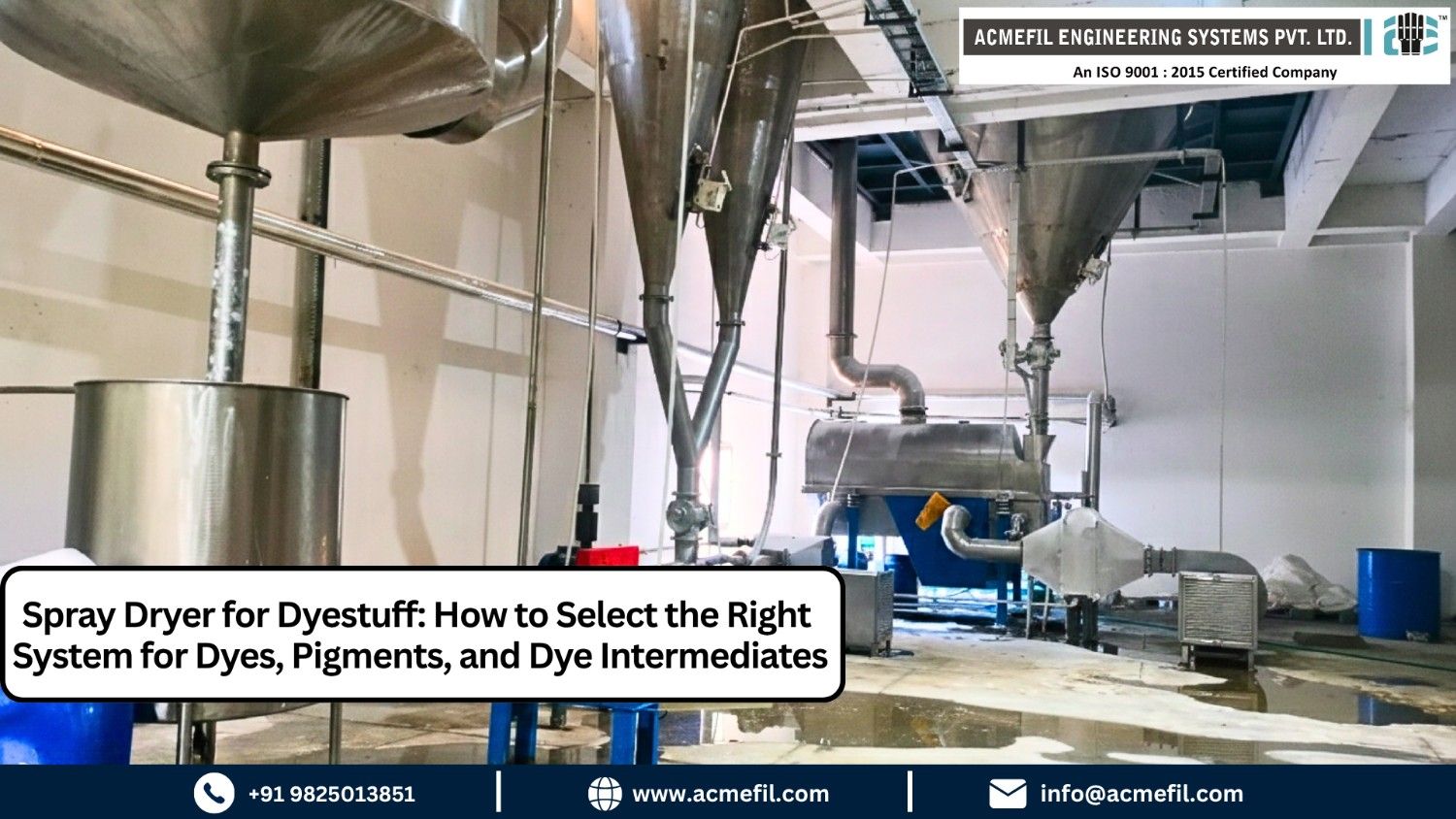
A spray dryer for dyestuff is used to convert liquid dye slurry, dye solution, pigment suspension, or dye intermediate feed into dry powder by atomizing the feed into hot drying air. For dyestuff plants, the real selection question is not only capacity. It is whether the dryer can handle feed solids, viscosity, colour stability, particle size, wall deposition risk, and powder recovery without disturbing the final shade or moisture specification.
In my experience, many dyestuff drying problems start before the dryer is ordered. The feed is not characterized properly, the atomizer is selected only by price, and the separation system is treated as an accessory. That is risky in dyes and pigments because small changes in particle size, residual moisture, or thermal exposure can affect powder handling and batch consistency.
If you are comparing spray drying options, start with the fundamentals of spray dryer design and components before finalizing a system.
What Is a Spray Dryer for Dyestuff?
A spray dryer for dyestuff is an industrial drying system designed to dry dye solutions, dye slurries, pigments, food colours, and dye intermediates into powder form. The feed is pumped to an atomizer, converted into fine droplets, contacted with hot air inside a drying chamber, and then separated from exhaust air using cyclone separators, bag filters, or a suitable powder recovery system.
For dyestuff and pigment applications, spray drying is commonly considered when the feed is pumpable and the desired output is a fine or controlled powder. ACMEFIL’s verified application data includes reactive dyes, disperse dyes, acid dyes, direct dyes, vat dyes, dye intermediates, and pigments.
The process becomes more complex when the feed contains suspended solids, salts, abrasive pigment particles, or heat-sensitive dye chemistry. This is why dyestuff spray dryer selection should be done from feed behaviour, not from a standard catalogue size.
Why Dyestuff Drying Is Technically Demanding
Dyestuff and pigment feeds are different from simple aqueous feeds. They may contain dissolved dye, insoluble pigment particles, inorganic salts, dispersing agents, binders, or residues from upstream processing. These factors affect atomization, drying time, powder recovery, and cleaning frequency.
The main challenges are:
- Maintaining consistent final moisture without overheating the product
- Avoiding sticky deposits on chamber walls and ducts
- Controlling particle size for flowability and packing
- Preventing excessive fines loss in exhaust air
- Handling abrasive or suspended solids in the feed
- Selecting proper material of construction for product contact areas
- Managing colour cross-contamination during product changeover
- Matching the atomizer type to feed viscosity and solids loading
A generic spray dryer may dry the feed, but a properly selected spray dryer for dyestuff must dry it in a way that protects powder quality and plant reliability.
How the Spray Drying Process Works for Dyestuff
A dyestuff spray drying system typically follows four operating stages.
First, the feed is prepared and filtered where required. The feed tank, agitator, and feed pump must keep the dye slurry or solution uniform. If solids settle before atomization, the dryer will not receive a consistent feed.
Second, the feed is atomized into droplets. This can be done using a rotary atomizer, pressure nozzle, or two-fluid nozzle depending on the feed and target powder.
Third, the droplets contact hot drying air inside the chamber. Moisture evaporates rapidly while the particle travels through the chamber.
Fourth, the dried powder is separated from the exhaust air. Cyclones, bag filters, or combined recovery systems are selected based on powder fineness, recovery expectations, and air pollution control needs.
For a deeper working-principle explanation, use this supporting guide on how a spray dryer works.
Rotary Atomizer vs Nozzle Type Spray Dryer for Dyestuff
Atomizer selection is one of the most important decisions in dyestuff drying. A wrong atomizer can create wall sticking, wide particle variation, unstable moisture, or poor powder recovery.
| Selection Factor | Rotary Atomizer Spray Dryer | Nozzle Type Spray Dryer |
|---|---|---|
| Best suited feed behaviour | Slurries, suspended solids, pigment feeds, variable feed rates | Pumpable solutions or feeds requiring specific particle morphology |
| Particle control method | Disc selection and atomizer speed | Nozzle orifice, pressure, and spray pattern |
| Typical advantage in dyestuff | Better flexibility for slurry-type feeds and pigment suspensions | Useful where fine or defined particles are required |
| Watch-out point | Chamber diameter and wall deposition must be designed correctly | Nozzle choking and feed filtration must be managed |
| Buyer mistake | Choosing only by motor rating or price | Ignoring feed pressure, filtration, and nozzle wear |
For dyestuff and pigment feeds with suspended solids, I usually start the discussion with rotary atomizer suitability. ACMEFIL’s rotary disc type spray dryer uses high-speed centrifugal atomization and is listed for dyes, ceramics, food, pharmaceuticals, detergents, pigments, and inorganic chemicals.
For feeds where pressure atomization or two-fluid atomization gives better particle control, a nozzle type dryer may be evaluated. The safer route is to compare both using actual feed behaviour, not assumptions. This article on nozzle vs rotary atomizer spray dryers can support that decision.
Which Dyestuff Products Can Be Spray Dried?
A spray dryer can be evaluated for many dyestuff and pigment categories when the feed is suitable for atomization. Common examples include:
- Reactive dyes
- Disperse dyes
- Acid dyes
- Direct dyes
- Vat dyes
- Dye intermediates
- Pigments
- Food colours
- Inorganic colour materials
- Ceramic colour slurry where applicable
The exact dryer configuration depends on whether the feed behaves like a solution, slurry, suspension, paste, or wet cake. This distinction matters.
If your feed is a liquid or pumpable slurry, spray drying may be suitable. If your feed is a filter cake, paste, or gelatinous mass, a spray dryer may not be the best first choice. In that case, a spin flash dryer or flash dryer may be more practical.
When a Spin Flash Dryer Is Better Than a Spray Dryer
This is an important buyer decision in dye plants.
A spray dryer needs atomizable feed. A spin flash dryer is designed for wet cake, paste, slimy material, or gelatinous feed. ACMEFIL’s verified application data lists dye intermediates, reactive dyes, J-Acid, N-Methyl J-Acid, Acetanilide, Sulfotobias Acid, pastes, high-viscosity sludge, pigments, and agro chemicals for spin flash dryer applications.
So the decision should not be “spray dryer or no spray dryer.” The correct question is:
Can the feed be atomized consistently?
If the answer is yes, evaluate a spray dryer. If the feed comes from a filter press as cake or paste, evaluate a spin flash dryer or flash dryer before forcing the application into a spray dryer design.
This single decision can prevent choking, poor drying, over-sized chambers, and unnecessary power consumption.
Feed Data Required Before Selecting a Dyestuff Spray Dryer
Before we recommend a spray dryer for dyestuff, these feed details should be collected:
| Feed / Product Data | Why It Matters |
|---|---|
| Feed type: solution, slurry, suspension, emulsion, or paste | Decides whether spray drying is practical |
| Total solids percentage | Controls evaporation load and dryer size |
| Viscosity at operating temperature | Affects pump selection and atomization |
| Particle size of suspended solids | Affects nozzle choking, atomizer wear, and powder recovery |
| pH and corrosive nature | Affects material of construction |
| Heat sensitivity | Affects inlet and outlet temperature selection |
| Target final moisture | Defines drying duty and residence time |
| Desired particle size and bulk density | Influences atomizer and chamber configuration |
| Solvent presence, if any | May require closed loop drying and safety review |
| Required product changeover frequency | Affects cleaning and layout design |
This is where many low-cost dryer quotes become misleading. A vendor can quote a dryer from capacity alone, but dyestuff drying needs feed characterization first.
Key Design Areas in a Spray Dryer for Dyestuff
Feed Preparation and Agitation
Dyestuff feeds can settle if they contain suspended solids or pigments. The feed tank should keep the slurry uniform before it reaches the atomizer. Poor agitation causes inconsistent droplet formation and unstable powder moisture.
Atomization System
The atomizer decides droplet size. Droplet size affects drying time, powder fineness, wall deposition, and product recovery. In dyestuff applications, atomizer selection should be linked to feed solids, viscosity, abrasiveness, and required powder properties.
You can use this guide on spray dryer atomization techniques as a supporting internal reference.
Drying Chamber
The chamber must give droplets enough residence time to dry before reaching the wall or outlet. For dyestuff and pigments, this is especially important because sticky semi-dried material can build up on the chamber wall and create cleaning problems.
Hot Air System
The hot air generator must match the product requirement. Direct-fired and indirect-fired heating options should be evaluated based on contamination sensitivity, fuel availability, and process requirements.
Powder Recovery
Fine dyestuff powder loss is not only a yield issue. It can also become a housekeeping and emission-control issue. Cyclone separators, bag filters, air locks, and duct design should be treated as part of the drying system, not as afterthoughts.
For troubleshooting symptoms such as wall sticking, high outlet moisture, or powder loss, refer to spray dryer troubleshooting common issues.
Common Mistakes When Buying a Spray Dryer for Dyestuff
The first mistake is buying by evaporation capacity only. Capacity matters, but it does not define product quality.
The second mistake is ignoring feed solids variation. A feed that runs well at one solids percentage may behave differently when concentration changes.
The third mistake is selecting the atomizer without pilot testing. In dyestuff drying, small changes in atomization can change powder behaviour.
The fourth mistake is under-sizing powder recovery. If the system generates very fine particles, cyclone-only recovery may not be enough for the plant’s cleanliness and product recovery expectations.
The fifth mistake is treating spray dryer and spin flash dryer as interchangeable. They are not. Spray dryers need atomizable feed. Spin flash dryers are better for wet cake and paste-type feeds.
Why Pilot Testing Matters for Dyestuff Spray Drying
Pilot testing is valuable because dyestuff drying is not fully predictable from a datasheet. The trial helps answer practical questions:
- Can the feed be atomized without choking or instability?
- Does the powder meet target moisture?
- Is the particle size acceptable?
- Is there wall deposition?
- Does the colour remain acceptable after drying?
- Is the powder recovery system suitable?
- Is spray drying better than spin flash drying for this feed?
ACMEFIL has an in-house pilot spray dryer with 3 kg/hr water evaporation capacity for product development and trial runs. For dyestuff manufacturers, this is useful before committing to full-scale equipment.
You can also review ACMEFIL’s pilot spray dryer page for the support system behind trials.
How to Optimize Spray Drying Parameters for Dyestuff
The main parameters to optimize are inlet temperature, outlet temperature, feed rate, atomizer speed or nozzle pressure, feed solids, airflow, and powder recovery.
Do not optimize only one parameter. For example, increasing inlet temperature may improve drying, but it can also increase thermal stress or wall deposition risk depending on product behaviour. Reducing feed rate may improve moisture control, but it can reduce plant throughput.
A better approach is to define the target powder first, then tune the dryer around it. For more detail, use the internal guide on how to optimize spray drying parameters.
Buyer Checklist Before Requesting a Dyestuff Spray Dryer Quote
Before sending an RFQ, prepare these details:
- Product name and dye category
- Feed form: solution, slurry, suspension, paste, or filter cake
- Feed solids percentage
- Feed viscosity
- Feed pH and corrosive nature
- Solvent presence, if any
- Inlet moisture and target final moisture
- Required powder particle size
- Required bulk density, if applicable
- Heat sensitivity or colour-change concern
- Required material of construction
- Existing upstream process details
- Available utilities and fuel
- Required automation level
- Trial quantity available for pilot testing
A clear RFQ reduces wrong selection. It also helps the manufacturer decide whether the right answer is a rotary atomizer spray dryer, nozzle type spray dryer, spin flash dryer, flash dryer, or another drying route.
Final Recommendation
For dyestuff and pigment manufacturers, a spray dryer should be selected from feed behaviour and final powder requirement. Rotary atomizer systems are often worth evaluating for slurry-type dyestuff and pigment feeds. Nozzle systems may be suitable where defined particle characteristics are needed. But if the feed is a wet cake or paste, do not force it into spray drying without comparing spin flash drying.
The best practical step is to test the actual feed. A pilot trial can confirm atomization behaviour, drying temperature window, powder recovery, and final moisture before full-scale investment.
FAQs
What is a spray dryer for dyestuff?
A spray dryer for dyestuff is an industrial drying system that converts dye solution, dye slurry, pigment suspension, or dye intermediate feed into dry powder. It works by atomizing the feed into droplets, drying those droplets in hot air, and separating the powder from exhaust air using suitable recovery equipment.
Which atomizer is better for dyestuff spray drying?
There is no universal answer. Rotary atomizers are often evaluated for slurry-type feeds, pigment suspensions, and variable feed behaviour. Nozzle atomizers may be suitable for pumpable feeds where specific particle characteristics are required. The right choice depends on solids content, viscosity, particle size, and final powder target.
Can pigments be dried in a spray dryer?
Yes, pigment feeds can be evaluated for spray drying when they are pumpable and atomizable. The design must consider suspended solids, abrasiveness, powder recovery, wall deposition, and required particle size. Pilot testing is recommended before full-scale selection.
Is a spray dryer suitable for dye filter cake?
Usually, a standard spray dryer is not the first choice for filter cake because the feed must be atomized. If the material is wet cake, paste, slimy, or gelatinous, a spin flash dryer may be more suitable. The decision should be based on actual feed behaviour.
Why is pilot testing important for dyestuff spray drying?
Pilot testing shows whether the feed can be atomized, dried, and recovered properly. It also helps confirm final moisture, particle size, wall deposition tendency, colour stability, and whether spray drying is better than spin flash drying for the specific dyestuff feed.
If you are planning a spray dryer for dyestuff, do not start with only capacity. Share your feed properties, target moisture, particle size requirement, and current upstream process. ACMEFIL can evaluate whether your application fits a rotary atomizer spray dryer, nozzle type spray dryer, pilot spray dryer trial, or an alternate drying system such as spin flash drying.
For technical evaluation, send your process details through the SprayDryer.com contact page or review ACMEFIL’s spray dryer manufacturer page for equipment options.

Siddharth Nair is Technical Director at Acmefil Engineering Systems Pvt. Ltd. he leads solution design and applications engineering across the company’s full product range — spray dryers, multi-effect evaporators, agitated thin film dryers, spin flash dryers, fluid bed dryers, and complete ZLD systems.
His work spans process evaluation, equipment sizing, customer application consulting, and technical proposal development for industries including food and dairy, pharmaceuticals, chemicals, dyestuffs, ceramics, and industrial effluent treatment. He has hands-on commissioning experience across Acmefil’s 500+ installations in India and 15+ countries.
He holds a BTech in Mechanical Engineering from CHARUSAT University and also partners at A.S Engineers, working with blowers, sludge dryers, and industrial conveying systems.


