
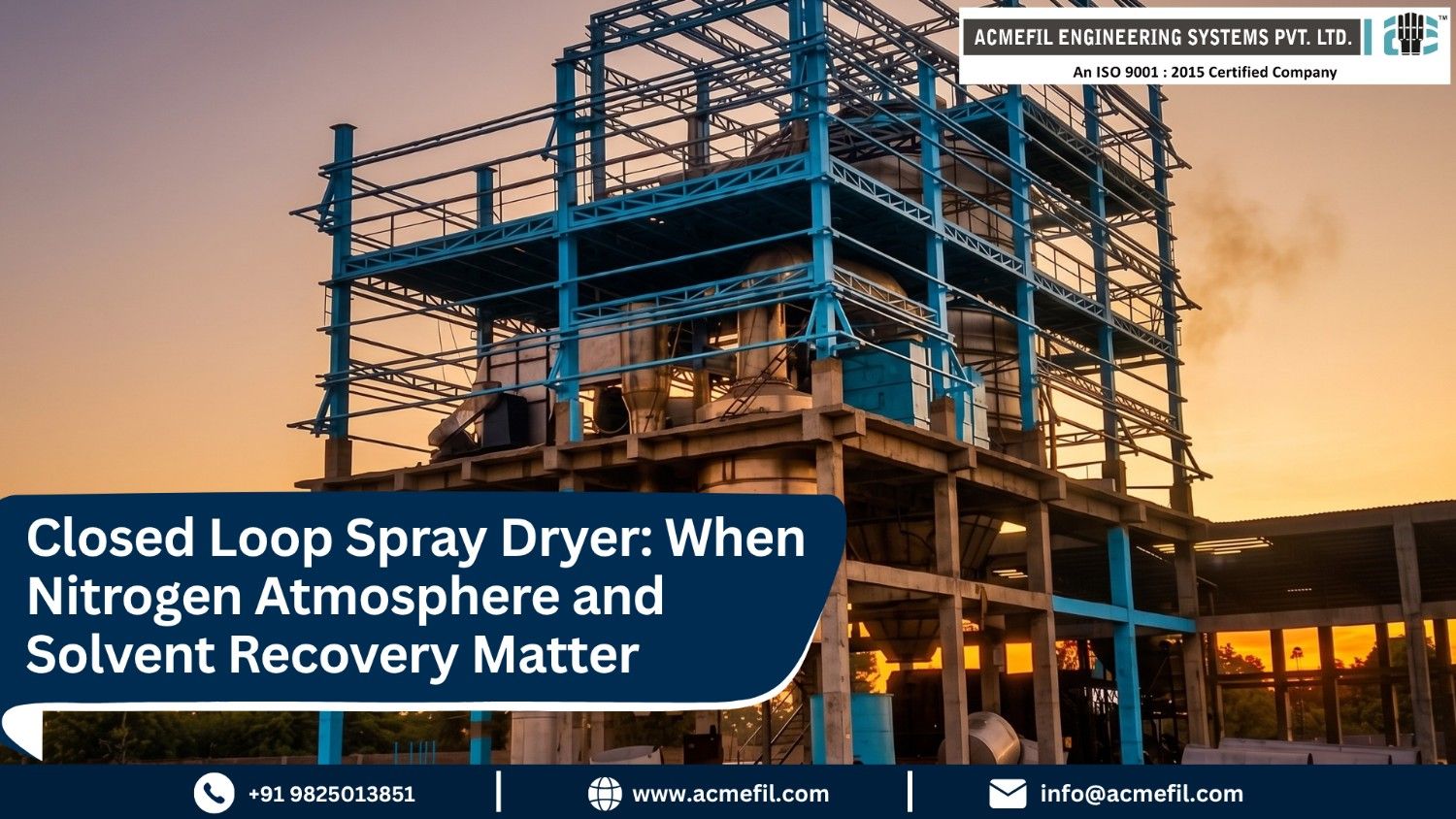
A closed loop spray dryer is used when the feed contains solvent, reacts with oxygen, or needs a controlled drying atmosphere. Instead of using open air as the drying medium, the system operates in a closed nitrogen loop. The solvent is recovered, the product is separated as powder, and the process stays isolated from normal atmospheric air.
In my view, this is not just another spray dryer variant. It is a different process decision. If the material is flammable, oxidation-sensitive, or pharmaceutical-grade, choosing an open spray drying system can create product, safety, and compliance problems from the first trial itself.
For a broader understanding of the basic spray drying sequence, start with how a spray dryer works and then use this guide to understand where closed loop spray drying fits.
What is a closed loop spray dryer?
A closed loop spray dryer is an industrial spray drying system where the drying gas, usually nitrogen, is recirculated instead of being exhausted directly into the atmosphere. The feed is atomized inside the drying chamber, the solvent evaporates, powder is separated, and the solvent vapour is condensed and recovered before the gas returns to the system.
The basic logic is simple:
| Process stage | What happens in a closed loop spray dryer |
|---|---|
| Feed atomization | Liquid feed is sprayed into fine droplets through a suitable atomizer |
| Nitrogen drying | Hot nitrogen contacts the droplets and evaporates solvent or moisture |
| Powder separation | Dried particles are separated through cyclone, bag filter, or collection system |
| Solvent recovery | Vapour is condensed and recovered instead of being released |
| Gas recirculation | Nitrogen is reheated and sent back into the dryer loop |
| Safety control | Oxygen level, temperature, pressure, and fire/explosion protection are controlled |
In an open system, air enters, contacts the product, and exits after drying. In a closed loop system, the same drying medium circulates in a controlled loop. That difference matters when air itself is the problem.
Why closed loop spray drying is used
A closed loop spray dryer is selected when one or more of these conditions are present:
- The feed contains organic solvent.
- The solvent vapour should be recovered.
- The product is sensitive to oxygen.
- The material may degrade in uncontrolled air exposure.
- The process needs pharmaceutical or sterile-grade containment.
- The product or solvent requires a controlled safety design.
- The plant wants to reduce solvent loss and uncontrolled vapour discharge.
This is common in pharmaceutical, specialty chemical, dye, flavour, extract, and advanced material applications. A buyer should not select this system only because it sounds more advanced. It should be selected because the feed chemistry and risk profile demand it.
Closed loop spray dryer working principle
The working principle of a closed loop spray dryer is similar to standard spray drying, but the drying medium is managed differently.
In a normal spray dryer, filtered air is heated and used once. In a closed loop spray dryer, nitrogen or another inert gas is heated, circulated through the drying chamber, passed through separation and condensation stages, and returned to the dryer.
The process usually follows this sequence:
- The liquid feed is pumped to the atomization system.
- The atomizer creates fine droplets inside the drying chamber.
- Heated nitrogen contacts the droplets and evaporates the solvent.
- Powder separates from the gas stream.
- Solvent vapour is condensed and collected.
- The nitrogen stream is cleaned, reheated, and recirculated.
- Oxygen level and operating conditions are monitored throughout the process.
For process engineers, the key point is this: the closed loop is not only about drying. It is about atmosphere control, solvent recovery, and product protection.
Closed loop spray dryer vs open loop spray dryer
Many selection mistakes happen because buyers compare closed loop and open loop spray dryers only on machine cost. That is the wrong comparison.
The better question is: what happens to your product and solvent if you dry it in air?
| Selection factor | Open loop spray dryer | Closed loop spray dryer |
|---|---|---|
| Drying medium | Air | Nitrogen or inert gas |
| Best suited for | Water-based, non-hazardous feeds | Solvent-based or oxygen-sensitive feeds |
| Solvent recovery | Not the main purpose | Core design requirement |
| Oxygen exposure | Present | Controlled and reduced |
| Vapour handling | Exhausted through air handling system | Condensed and recovered |
| System complexity | Lower | Higher |
| Typical buyer concern | Drying efficiency, moisture, powder quality | Solvent safety, product stability, recovery, containment |
| Capital cost | Usually lower | Usually higher |
| Wrong selection risk | Product quality issue | Safety, solvent loss, compliance, or product degradation risk |
A closed loop spray dryer is not the default answer for every feed. For water-based food products, standard spray drying may be enough. For solvent-based pharmaceutical intermediates or oxygen-sensitive materials, closed loop design becomes much more important.
You can compare this with other dryer choices in choosing the right spray dryer and spray dryer design and components.
Where nitrogen atmosphere makes the difference
Nitrogen is used because it reduces oxygen exposure inside the drying loop. That matters when the material or solvent can react with oxygen, degrade, or create unsafe vapour conditions.
I usually ask buyers three questions before discussing closed loop spray drying seriously:
- Does the feed contain organic solvent?
- Is the product sensitive to oxidation?
- Is solvent recovery important for process economics or environmental control?
If the answer is yes to any of these, a normal open dryer may not be the right starting point.
Nitrogen atmosphere helps in three practical ways:
| Requirement | Why nitrogen loop helps |
|---|---|
| Solvent-based drying | Supports inert atmosphere operation for solvent vapour handling |
| Oxidation-sensitive product | Reduces exposure to oxygen during drying |
| Pharmaceutical or sterile process | Supports controlled drying environment when combined with proper filtration and sterile design |
| Solvent recovery | Allows vapour to be condensed and recovered inside the system |
| Process isolation | Reduces direct interaction between product, solvent vapour, and outside air |
The final design still depends on feed composition, solvent type, boiling point, powder specification, and safety review. This is not a machine you should buy from a brochure photo.
Closed loop spray dryer for solvent recovery
Solvent recovery is one of the biggest reasons to consider a closed loop spray dryer.
In solvent-based spray drying, the solvent evaporates from the droplet. In an open system, handling that vapour becomes difficult and risky. In a closed loop system, the vapour-laden nitrogen passes through a condenser or recovery section. The solvent is collected, and the drying gas continues in the loop.
This helps the plant in three areas:
- It reduces solvent wastage.
- It reduces uncontrolled solvent vapour discharge.
- It improves the economic logic of drying solvent-based feeds.
But recovery is not automatic just because the system is called “closed loop.” The recovery section must be sized for the solvent load, vapour concentration, cooling duty, flow rate, and operating temperature profile.
A weak condenser design can make the loop unstable. A poorly characterized solvent system can create powder quality issues or safety concerns. That is why feed data matters before plant sizing.
When should you choose a closed loop spray dryer?
You should evaluate a closed loop spray dryer when the process has one or more of these conditions:
| Feed or process condition | Why closed loop should be evaluated |
|---|---|
| Organic solvent in feed | Solvent vapour needs controlled handling and recovery |
| Flammable solvent system | Inert atmosphere may be required as part of safety design |
| Oxygen-sensitive material | Air exposure can affect product quality |
| Heat-sensitive material | Process conditions must be controlled carefully |
| Pharmaceutical application | Clean, controlled, and sometimes sterile drying may be required |
| High-value active ingredient | Product loss and contamination risk become expensive |
| Strong solvent odour or VOC concern | Closed vapour handling may be necessary |
| Aseptic or sterile requirement | Sterile spray dryer design with filtration may be needed |
The wrong move is to start with capacity alone. Capacity is only one part of the design. For closed loop systems, the feed chemistry comes first.
Closed loop spray dryer for pharmaceutical products
Pharmaceutical spray drying often deals with APIs, excipients, herbal extracts, solvent systems, and controlled powder properties. When the product is sensitive or solvent-based, closed loop or sterile spray drying may be considered.
A sterile spray dryer is not just a closed loop dryer with polished steel. It may require HEPA filters, sterile micro filters, hygienic contact parts, cleanability planning, containment logic, and validation support depending on the application.
For pharmaceutical buyers, the key questions are:
- Is the product solvent-based or water-based?
- Is the powder intended for a regulated application?
- What is the target particle size and residual solvent limit?
- Is sterile or aseptic operation required?
- What material of construction is required for contact parts?
- How will cleaning and batch changeover be handled?
- Is a trial needed before full-scale design?
You can also review spray dryer applications in pharmaceuticals for a wider view of pharma spray drying applications.
Closed loop spray dryer for oxidation-sensitive materials
Some products do not fail because of drying temperature alone. They fail because they are exposed to oxygen during drying.
This can matter in flavours, extracts, pharmaceutical intermediates, specialty chemicals, and certain high-value powders. If the material changes colour, loses activity, forms unwanted by-products, or fails stability after drying, oxygen exposure should be investigated.
A closed loop spray dryer can help by reducing oxygen contact during the evaporation and drying stage. But it cannot fix a feed that is chemically unstable under all thermal conditions. That is why product trials and feed characterization remain important.
Atomizer selection in closed loop spray drying
Closed loop design does not remove the need for correct atomization. The atomizer still controls droplet formation, which affects drying rate, particle size, bulk density, wall deposition, and powder recovery.
In closed loop spray drying, the atomizer must be selected based on:
- Feed viscosity
- Solid content
- Solvent system
- Desired particle size
- Required powder morphology
- Heat sensitivity
- Chamber geometry
- Cleaning and maintenance needs
For some feeds, a nozzle atomizer may be suitable. For others, a rotary atomizer may provide better droplet control. The wrong atomizer can create wall sticking, wet powder, poor recovery, and inconsistent particle size even if the nitrogen loop is well designed.
For more detail, read spray dryer atomization techniques and comparing spray dryers: nozzle vs rotary atomizer.
Process data needed before sizing a closed loop spray dryer
A serious closed loop spray dryer enquiry should not start with “send price.” It should start with process data.
Here is the minimum data I would want before recommending a direction:
| Data required | Why it matters |
|---|---|
| Feed composition | Determines solvent load, drying behaviour, and material compatibility |
| Solvent type | Drives safety, recovery, condensation, and material selection |
| Feed solid content | Affects evaporation load and powder yield |
| Feed viscosity | Influences pump, nozzle, atomizer, and droplet formation |
| Target powder moisture | Defines drying duty and outlet condition |
| Residual solvent target | Critical for pharma and specialty chemical products |
| Product heat sensitivity | Determines allowable thermal exposure |
| Particle size requirement | Influences atomizer and chamber design |
| Bulk density target | Important for packaging and downstream handling |
| Expected capacity | Needed for chamber, heating, separation, and condenser sizing |
| Cleaning requirement | Affects CIP, access, contact parts, and batch operation |
| Area classification and safety requirement | Must be reviewed by qualified safety and process teams |
Without this data, any quote is only a rough commercial number. It may not survive engineering review.
Common buyer mistakes in closed loop spray dryer projects
Mistake 1: Treating closed loop as only an add-on
A closed loop spray dryer is not a standard dryer with a nitrogen pipe added. The loop affects drying gas flow, condenser duty, control philosophy, instrumentation, safety design, and recovery efficiency.
Mistake 2: Ignoring solvent properties
Different solvents behave differently. Boiling point, vapour pressure, flammability, condensability, and interaction with product solids all influence design.
Mistake 3: Not defining residual solvent target
If the final powder has a strict residual solvent requirement, that must be discussed at the design stage. It affects temperature profile, residence time, and sometimes post-drying strategy.
Mistake 4: Choosing capacity before confirming powder behaviour
A feed may atomize well at lab scale but stick at pilot or plant scale. Wall deposition, powder recovery, and particle morphology must be evaluated before scaling.
Mistake 5: Skipping pilot trials for difficult products
For high-value solvent-based or sensitive products, a pilot trial can save months of correction later. It helps answer whether the material can be dried, what powder quality is possible, and which operating window looks practical.
Role of pilot trials before full-scale plant design
For closed loop spray drying, trials are not a formality. They are a risk reduction step.
At Acmefil, pilot spray dryer trials are available for process development, with a lab scale spray dryer capacity of 3 kg/hr water evaporation. For new products, solvent-based feeds, heat-sensitive materials, or uncertain powder specifications, trial data helps narrow the design assumptions before committing to a full-scale plant.
A pilot trial can help evaluate:
- Whether the feed atomizes properly
- Whether powder sticks to the chamber wall
- What inlet and outlet temperature range is practical
- Whether the powder meets moisture target
- Whether particle size is close to expectation
- How much recovery loss may occur
- Whether the feed needs pre-concentration or formulation changes
For smaller development work, also read spray dryer for small-scale production.
Closed loop spray dryer design checklist
Before you finalize a closed loop spray dryer supplier, use this checklist:
| Checklist point | Why it matters |
|---|---|
| Nitrogen loop design reviewed | Confirms atmosphere control and circulation logic |
| Solvent recovery section defined | Avoids weak condensation and solvent loss |
| Oxygen monitoring considered | Supports safer closed loop operation |
| Fire detection and protection reviewed | Important for solvent-based process risk |
| Atomizer selected from feed data | Prevents droplet and particle-size problems |
| Powder separation system matched | Improves recovery and reduces carryover |
| Contact material selected | Important for pharma, chemical compatibility, and cleaning |
| HEPA or sterile filtration considered | Required for certain pharmaceutical applications |
| Cleaning philosophy defined | Avoids batch changeover and contamination problems |
| Pilot trial discussed | Reduces uncertainty before scale-up |
| Utility load estimated | Nitrogen, heating, cooling, and power must be evaluated |
| Safety review planned | Required for solvent, flammable, or hazardous material processes |
This is where experienced engineering matters. The dryer is only one part of the system. The condenser, nitrogen recirculation, controls, filters, isolation, and powder collection system decide whether the plant works smoothly.
Closed loop spray dryer applications
Closed loop spray drying is relevant across industries where solvent, oxygen sensitivity, or controlled atmosphere drying is important.
| Industry | Possible use cases |
|---|---|
| Pharmaceuticals | APIs, herbal extracts, sterile powder applications, solvent-based intermediates |
| Specialty chemicals | Solvent-containing products, sensitive additives, fine chemical powders |
| Flavours and extracts | Oxygen-sensitive or volatile product systems |
| Dyestuff and pigments | Selected solvent-based or sensitive chemical feeds |
| Advanced materials | Powders requiring controlled drying environment |
| Food ingredients | Selected sensitive ingredients where oxidation or volatile loss must be studied |
Not every product in these categories needs closed loop drying. The feed composition decides the equipment. That is why I prefer to review the product data sheet before recommending a dryer type.
How closed loop spray drying connects to powder quality
Powder quality is not controlled by the nitrogen loop alone. It is controlled by the full drying system.
Key variables include:
- Droplet size
- Feed concentration
- Inlet temperature
- Outlet temperature
- Residence time
- Atomizer type
- Chamber shape
- Solvent evaporation rate
- Powder separation design
- Final collection temperature
- Moisture and residual solvent target
Closed loop drying protects the atmosphere and enables recovery, but the powder still depends on drying kinetics. If the droplet dries too fast, you may get hollow or fragile particles. If it dries too slowly, wall sticking and high residual solvent may appear. If the atomization is poor, the loop cannot correct particle-size distribution.
For operating guidance, review spray dryer operating principles and best practices and how to optimize spray drying parameters.
When a closed loop spray dryer may not be the right choice
A closed loop spray dryer is not always justified. It may not be required when:
- The feed is water-based and stable in air.
- Solvent recovery is not needed.
- The product is not oxygen-sensitive.
- The application has low-value, non-critical powder requirements.
- The plant cannot support the required safety and utility infrastructure.
- The product is better suited to another dryer type.
For example, some free-flowing powders may be better handled in a standard spray dryer. Some wet cakes may require a spin flash dryer or another drying route. Some high-moisture effluent streams may need evaporation before drying.
The right dryer is not the most expensive one. The right dryer is the one that matches the feed, product target, safety requirement, and operating economics.
Final recommendation
A closed loop spray dryer should be evaluated when solvent recovery, nitrogen atmosphere, oxidation protection, or pharmaceutical-grade controlled drying is central to the process. It is especially relevant for solvent-based, heat-sensitive, oxygen-sensitive, and sterile spray drying applications.
Before selecting the system, define your solvent, feed solids, target moisture, residual solvent expectation, particle size, cleaning requirement, and safety constraints. Then run trials where the product is new or uncertain.
At Acmefil, we treat closed loop spray dryer selection as a process engineering decision, not just an equipment sale. The better the feed data, the better the dryer design.
FAQs
What is a closed loop spray dryer?
A closed loop spray dryer is a spray drying system that recirculates the drying gas, usually nitrogen, inside a sealed loop. It is used for solvent-based, oxygen-sensitive, or controlled-atmosphere drying applications where solvent recovery and process isolation are important.
Why is nitrogen used in closed loop spray drying?
Nitrogen is used because it provides an inert drying atmosphere and reduces oxygen exposure during drying. This is important for solvent-based products, oxidation-sensitive materials, and certain pharmaceutical or specialty chemical applications.
Can a closed loop spray dryer recover solvent?
Yes. A closed loop spray dryer is designed to evaporate solvent during drying, then condense and recover solvent vapour before the drying gas is recirculated. Recovery performance depends on solvent properties, condenser design, operating temperature, and system sizing.
Is a closed loop spray dryer suitable for pharmaceutical products?
It can be suitable for pharmaceutical applications, especially solvent-based or sensitive powders. For sterile pharmaceutical use, the system may require HEPA filters, sterile micro filters, hygienic design, proper cleaning strategy, and validation support based on the product and regulatory requirement.
Is closed loop spray drying safer than open loop drying?
For solvent-based or oxygen-sensitive materials, a closed loop nitrogen system can reduce certain risks compared with open air drying. However, safety depends on correct engineering, oxygen monitoring, fire detection, explosion protection, controls, solvent data, and qualified safety review.
If your product contains solvent, reacts with oxygen, or needs controlled drying conditions, do not finalize a dryer based only on brochure specifications. Share your feed composition, solvent system, target powder moisture, capacity, and application details with Acmefil’s technical team. A pilot trial or engineering review can help confirm whether a closed loop spray dryer is the right route before you invest in a full-scale plant.

Siddharth Nair is Technical Director at Acmefil Engineering Systems Pvt. Ltd. he leads solution design and applications engineering across the company’s full product range — spray dryers, multi-effect evaporators, agitated thin film dryers, spin flash dryers, fluid bed dryers, and complete ZLD systems.
His work spans process evaluation, equipment sizing, customer application consulting, and technical proposal development for industries including food and dairy, pharmaceuticals, chemicals, dyestuffs, ceramics, and industrial effluent treatment. He has hands-on commissioning experience across Acmefil’s 500+ installations in India and 15+ countries.
He holds a BTech in Mechanical Engineering from CHARUSAT University and also partners at A.S Engineers, working with blowers, sludge dryers, and industrial conveying systems.


