
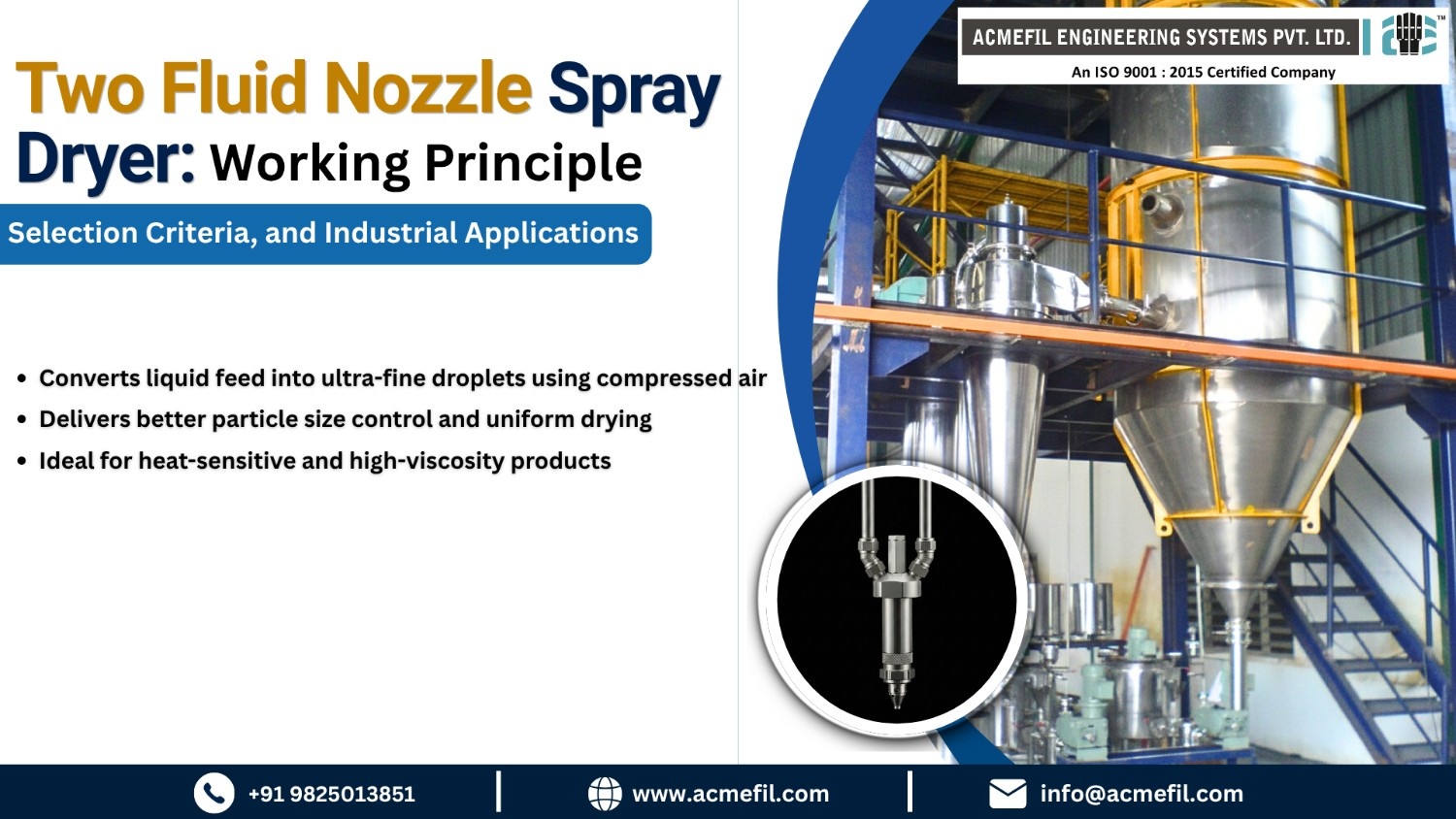
A two fluid nozzle spray dryer uses compressed air or gas along with liquid feed to create fine droplets before the feed enters the hot drying chamber. I usually recommend evaluating this atomizer when the buyer needs fine particle formation, controlled powder morphology, and flexibility during pilot trials or small-to-medium production runs. It is especially useful for selected heat-sensitive products such as enzymes, flavours, pharmaceutical ingredients, and food products where atomization control has a direct effect on final powder quality.
The important point is this: a two fluid nozzle is not automatically better than a pressure nozzle or rotary atomizer. It is better only when the feed properties, powder target, capacity, and operating cost justify the compressed air requirement.
What Is a Two Fluid Nozzle Spray Dryer?
A two fluid nozzle spray dryer is a nozzle type spray drying system where two streams meet at the atomization point:
- Liquid feed
- Compressed air or atomizing gas
The compressed air breaks the liquid into fine droplets. These droplets then contact hot drying air inside the chamber. Moisture evaporates rapidly, and the dried particles are separated from the exhaust air through a cyclone, bag filter, or a combination of separation equipment.
In a standard spray drying process, the four core stages remain the same:
- Atomization of feed into droplets
- Contact between spray and hot air
- Drying of droplets into powder
- Separation of dried powder from air
The atomizer decides the first stage. If atomization is poor, the rest of the dryer has to compensate, and usually it cannot compensate fully. You may see wall deposition, wet powder, wide particle size variation, or low recovery.
For a deeper process overview, read our guide on how a spray dryer works and the basics of spray dryer design and components.
How Does a Two Fluid Nozzle Work?
In a two fluid nozzle, the liquid feed is introduced through one passage and compressed air is introduced through another. Depending on the nozzle design, mixing may happen inside the nozzle or near the nozzle exit.
The compressed air creates high shear around the liquid stream. That shear tears the liquid into ligaments and then into droplets. Smaller droplets expose more surface area to hot air, so moisture removal becomes faster.
This is why two fluid nozzles are often used when fine atomization is required.
But there is a trade-off. The atomization energy comes from compressed air. Compressed air is not free. It adds operating cost, utility load, and control complexity. For this reason, I do not select a two fluid nozzle only because it can create fine droplets. I first check whether the final powder specification actually needs that level of atomization.
Where Two Fluid Nozzle Spray Dryers Fit Best
A two fluid nozzle spray dryer is usually considered when the product needs fine droplets, controlled particle formation, or trial flexibility.
Common application areas include:
| Industry | Typical Products | Why Two Fluid Nozzle May Help |
|---|---|---|
| Food processing | Flavours, food additives, herbal extracts, selected proteins | Fine atomization can support fast drying and controlled powder form |
| Pharmaceutical | Selected powders, extracts, heat-sensitive intermediates | Useful where smaller droplet formation and process control are important |
| Biochemical | Enzymes, fermentation-derived products | Fine droplets can reduce drying time exposure when parameters are correctly selected |
| Flavours and extracts | Aroma-sensitive or value-added liquid feeds | Helpful when morphology and recovery matter |
| R&D and pilot trials | New formulations and process development feeds | Easier to test atomization behavior before committing to full-scale design |
At ACMEFIL, nozzle type spray dryers are evaluated for heat-sensitive products such as enzymes, blood, flavours, pharmaceutical products, and food processing applications. The final decision depends on feed filtration, viscosity, solids content, target moisture, and required powder behavior.
For broader application planning, see our article on applications of spray dryers.
Two Fluid Nozzle vs Pressure Nozzle vs Rotary Atomizer
Many buyers come to us after deciding the atomizer type too early. That is a mistake. Atomizer selection should come after feed testing and powder target definition, not before.
| Selection Point | Two Fluid Nozzle | Pressure Nozzle | Rotary Atomizer |
|---|---|---|---|
| Atomization energy | Compressed air or gas | Feed pressure through nozzle orifice | High-speed rotating disc |
| Best fit | Fine atomization, pilot trials, selected heat-sensitive feeds | Defined particle profile and higher pressure atomization | Slurries, higher capacities, suspended solids, broader feed flexibility |
| Utility concern | Compressed air consumption | High-pressure pump requirement | Atomizer drive and mechanical maintenance |
| Main risk | Higher operating cost and nozzle sensitivity | Nozzle wear or blockage if feed is unsuitable | More complex atomizer assembly and speed control |
| Feed cleanliness requirement | High | High | More tolerant than nozzle systems in many slurry applications |
| Typical buyer question | “Can I get finer droplets?” | “Can I get a specific particle structure?” | “Can I handle this slurry reliably at scale?” |
A two fluid nozzle is usually the right discussion when the product needs fine atomization at lower feed flow rates or during development work. A rotary atomizer becomes more attractive when capacity, slurry handling, and feed variability are stronger concerns.
Read the full comparison here: nozzle vs rotary atomizer spray dryer.
When Should You Choose a Two Fluid Nozzle Spray Dryer?
You should evaluate a two fluid nozzle spray dryer when at least three of these conditions are true:
- The target powder needs fine particle formation.
- The feed is clean enough for nozzle operation.
- The product is heat-sensitive and needs controlled residence exposure.
- The batch size or production capacity is not too high for compressed air economics.
- The product is still in R&D or pilot stage.
- The powder specification depends strongly on atomization quality.
- The feed has low-to-moderate viscosity and can be filtered properly.
- The buyer wants to compare atomization options before final plant design.
The last point is important. In many real projects, the question is not “Which atomizer is best?” The question is “Which atomizer gives the required powder at acceptable operating cost?”
That answer usually comes from a pilot trial, not from a brochure.
When Is a Two Fluid Nozzle Not the Best Choice?
A two fluid nozzle spray dryer may not be suitable when:
- The feed contains coarse suspended solids that can block the nozzle.
- The feed is abrasive and may wear nozzle parts quickly.
- The production capacity is high and compressed air cost becomes significant.
- The target powder does not need fine atomization.
- The plant does not have stable compressed air availability.
- The feed viscosity is too high for reliable atomization.
- The process requires very large throughput with robust slurry handling.
One common buyer mistake is assuming that finer droplets always mean better powder. That is not true.
Fine droplets dry faster, but they can also create very fine powder, low bulk density, dusting issues, or product loss if the separation system is not designed correctly. The chamber, cyclone, bag filter, airflow, and powder collection arrangement must match the atomization behavior.
For process optimization, read how to optimize spray drying parameters.
Key Process Data Needed Before Designing a Two Fluid Nozzle Spray Dryer
Before recommending a two fluid nozzle spray dryer, I would ask for these details:
| Required Data | Why It Matters |
|---|---|
| Feed composition | Determines drying behavior, stickiness, and thermal sensitivity |
| Total solids percentage | Affects evaporation load and powder yield |
| Viscosity at feed temperature | Impacts atomization quality and pumpability |
| Suspended solids or insoluble particles | Determines filtration need and nozzle blockage risk |
| Target inlet and outlet moisture | Controls drying profile and final powder specification |
| Required particle size or bulk density | Decides whether fine atomization is useful or harmful |
| Heat sensitivity | Guides inlet temperature, outlet temperature, and residence time |
| Feed rate or evaporation load | Determines chamber size, utility load, and system economics |
| Compressed air availability | Critical for two fluid nozzle operation |
| Product recovery requirement | Impacts cyclone, bag filter, and collection system design |
Without this data, atomizer selection becomes guesswork. In spray drying, guesswork becomes expensive because chamber size, air handling, heating load, powder separation, and utility consumption all depend on the first design decision.
Why Pilot Testing Matters for Two Fluid Nozzle Spray Drying
Two products with similar names can behave differently inside a spray dryer. A herbal extract from one supplier may dry cleanly. Another may stick to the chamber wall. One flavour formulation may produce acceptable powder. Another may need carrier adjustment or different outlet temperature.
This is where pilot testing becomes useful.
ACMEFIL has an in-house R&D pilot plant facility with a spray dryer pilot capacity of 3 kg/hr water evaporation. Pilot trials help check:
- Whether the feed atomizes properly
- Whether the powder sticks to the chamber wall
- Whether the outlet moisture target is realistic
- Whether the cyclone and bag filter can recover the powder efficiently
- Whether a two fluid nozzle, pressure nozzle, or rotary atomizer is the better route
- Whether the product can be scaled up safely and economically
For small-scale and product development decisions, also read spray dryer for small-scale production.
How Particle Size and Powder Quality Are Affected
The atomizer does not only create droplets. It influences the final powder.
In a two fluid nozzle spray dryer, droplet size is affected by:
- Liquid feed rate
- Atomizing air flow
- Air-to-liquid ratio
- Feed viscosity
- Feed surface tension
- Nozzle geometry
- Solids content
- Feed temperature
- Spray angle
- Chamber airflow pattern
Smaller droplets generally dry faster because they have more exposed surface area. But the plant must be designed for the powder that results from that droplet formation.
For example, if the product becomes too fine, the buyer may face dusting, lower bulk density, or higher load on the bag filter. If droplets are too large, the powder may remain wet, deposit on the chamber wall, or fail final moisture specification.
That is why atomization cannot be treated separately from drying chamber design.
Design Points That Matter in a Two Fluid Nozzle Spray Dryer
A practical two fluid nozzle spray dryer design should consider the complete system, not only the nozzle.
Nozzle Placement
The nozzle position affects droplet travel path, wall contact risk, and residence time. Poor placement can cause wet droplets to hit the chamber wall before drying.
Airflow Pattern
Co-current airflow is common in many heat-sensitive spray drying applications because the hottest air contacts the wettest droplets first. This can reduce thermal damage when outlet temperature and residence time are controlled properly.
Chamber Size
Fine droplets may dry quickly, but chamber sizing still matters. Sticky products, high moisture loads, and low outlet temperature targets may require more residence time.
Feed Filtration
Nozzle systems need cleaner feeds than many rotary atomizer applications. Even small particles can disturb spray pattern or cause blockage.
Powder Separation
Fine particles need efficient recovery. Cyclone design, bag filter selection, air velocity, and powder discharge arrangement must be checked together.
Utility Planning
Compressed air demand must be included in operating cost. A low-cost dryer can become expensive to run if atomizing air consumption is ignored.
Common Problems in Two Fluid Nozzle Spray Drying
| Problem | Likely Cause | What to Check First |
|---|---|---|
| Wet powder | Large droplets, low outlet temperature, high feed rate | Atomizing air, feed rate, outlet temperature |
| Chamber wall deposition | Sticky feed, poor spray pattern, wrong temperature profile | Feed solids, carrier system, nozzle angle, chamber air pattern |
| Nozzle blockage | Poor filtration or suspended solids | Feed strainer, particle size in feed, nozzle orifice |
| Excessive fine powder | Too much atomizing air or unsuitable nozzle setup | Air-to-liquid ratio, nozzle selection, cyclone/bag filter |
| Low powder recovery | Fine particles escaping separation system | Cyclone design, bag filter condition, air velocity |
| Inconsistent moisture | Feed variation or unstable atomization | Feed pump stability, air pressure, feed solids consistency |
A good troubleshooting process starts with the feed and atomization, not only with temperature. Many moisture problems are actually droplet formation problems.
For more fault analysis, see spray dryer troubleshooting common issues.
Two Fluid Nozzle Spray Dryer for Heat-Sensitive Products
A two fluid nozzle spray dryer can be useful for selected heat-sensitive products because fine droplets dry quickly. But heat sensitivity is not solved by atomization alone.
You still need to control:
- Inlet air temperature
- Outlet air temperature
- Feed concentration
- Residence time
- Droplet size
- Powder discharge temperature
- Product exposure to oxygen, where relevant
- Final moisture specification
For pharmaceutical and food applications, the dryer may also need hygienic material selection, cleanable construction, controlled air filtration, and careful product contact design.
Read more on spray dryer applications in pharmaceuticals and spray dryers in food processing.
How I Would Decide the Atomizer Route
For a buyer comparing atomizer options, I would not start with equipment price. I would start with five questions:
- What particle size and bulk density do you need?
- What is the feed viscosity and solids content?
- Does the feed contain suspended or abrasive solids?
- What is the evaporation load per hour?
- What is the acceptable operating cost, including compressed air?
If the feed is clean, the capacity is moderate, and fine atomization is important, a two fluid nozzle spray dryer deserves serious evaluation.
If the feed is a slurry, has suspended solids, or requires higher continuous throughput, I would compare it carefully against a rotary atomizer spray dryer.
If the powder specification depends on particle structure and bulk density, pressure nozzle atomization may also be relevant.
This is why atomizer selection should be treated as an engineering decision, not a catalogue selection.
Buyer Checklist Before Requesting a Quote
Before you request a quote for a two fluid nozzle spray dryer, prepare this information:
- Product name and application
- Liquid feed composition
- Feed solids percentage
- Feed viscosity and temperature
- Required powder moisture
- Required particle size or bulk density
- Heat sensitivity details
- Feed rate or water evaporation requirement
- Available utilities, including compressed air
- Preferred material of construction, if already known
- Any hygiene, pharma, or food-grade requirement
- Existing process issue, if this is a replacement or upgrade
This data helps the equipment manufacturer evaluate whether a two fluid nozzle is actually the right atomization system.
Final Recommendation
A two fluid nozzle spray dryer is a strong option when fine atomization, pilot flexibility, and controlled powder formation matter more than maximum throughput. It is useful for selected heat-sensitive food, pharmaceutical, flavour, enzyme, and specialty chemical applications.
But it should not be selected only because it sounds technically advanced. The real selection depends on feed behavior, compressed air cost, powder specification, chamber design, and recovery system performance.
At ACMEFIL, we prefer to evaluate the feed first, then decide the atomizer. For new or uncertain products, a pilot spray drying trial is often the most practical way to avoid a wrong full-scale investment.
FAQs
What is a two fluid nozzle spray dryer?
A two fluid nozzle spray dryer is a spray drying system where liquid feed and compressed air or gas meet at the nozzle to create fine droplets. These droplets enter a hot air stream, dry rapidly, and are collected as powder through a cyclone, bag filter, or combined separation system.
Is a two fluid nozzle better than a pressure nozzle?
Not always. A two fluid nozzle is useful when fine atomization and flexible droplet control are required. A pressure nozzle may be better when the process needs pressure-driven atomization, defined particle structure, and suitable feed conditions. The right choice depends on feed properties and powder specification.
Which products are suitable for a two fluid nozzle spray dryer?
Two fluid nozzle spray dryers are commonly evaluated for selected heat-sensitive products such as enzymes, flavours, pharmaceutical products, food ingredients, extracts, and R&D formulations. Feed cleanliness, viscosity, solids content, and product recovery requirement must be checked before selection.
What is the main disadvantage of a two fluid nozzle spray dryer?
The main disadvantage is compressed air consumption. The atomization energy comes from compressed air or gas, which increases operating cost. The nozzle can also be sensitive to feed particles, poor filtration, and unstable feed quality.
Should I do a pilot trial before buying a two fluid nozzle spray dryer?
Yes, especially when the product is new, sticky, heat-sensitive, expensive, or not yet standardized. A pilot trial helps check atomization behavior, wall deposition, powder moisture, product recovery, and whether two fluid nozzle atomization is better than pressure nozzle or rotary atomizer selection.
Planning a spray dryer for a heat-sensitive or fine-particle product? Share your feed details, target moisture, capacity, and powder specification with ACMEFIL’s engineering team. We can evaluate whether a two fluid nozzle spray dryer, pressure nozzle dryer, or rotary atomizer spray dryer is the safer route for your application.
Use the SprayDryer.com contact page to request technical discussion or trial evaluation.

Siddharth Nair is Technical Director at Acmefil Engineering Systems Pvt. Ltd. he leads solution design and applications engineering across the company’s full product range — spray dryers, multi-effect evaporators, agitated thin film dryers, spin flash dryers, fluid bed dryers, and complete ZLD systems.
His work spans process evaluation, equipment sizing, customer application consulting, and technical proposal development for industries including food and dairy, pharmaceuticals, chemicals, dyestuffs, ceramics, and industrial effluent treatment. He has hands-on commissioning experience across Acmefil’s 500+ installations in India and 15+ countries.
He holds a BTech in Mechanical Engineering from CHARUSAT University and also partners at A.S Engineers, working with blowers, sludge dryers, and industrial conveying systems.


