
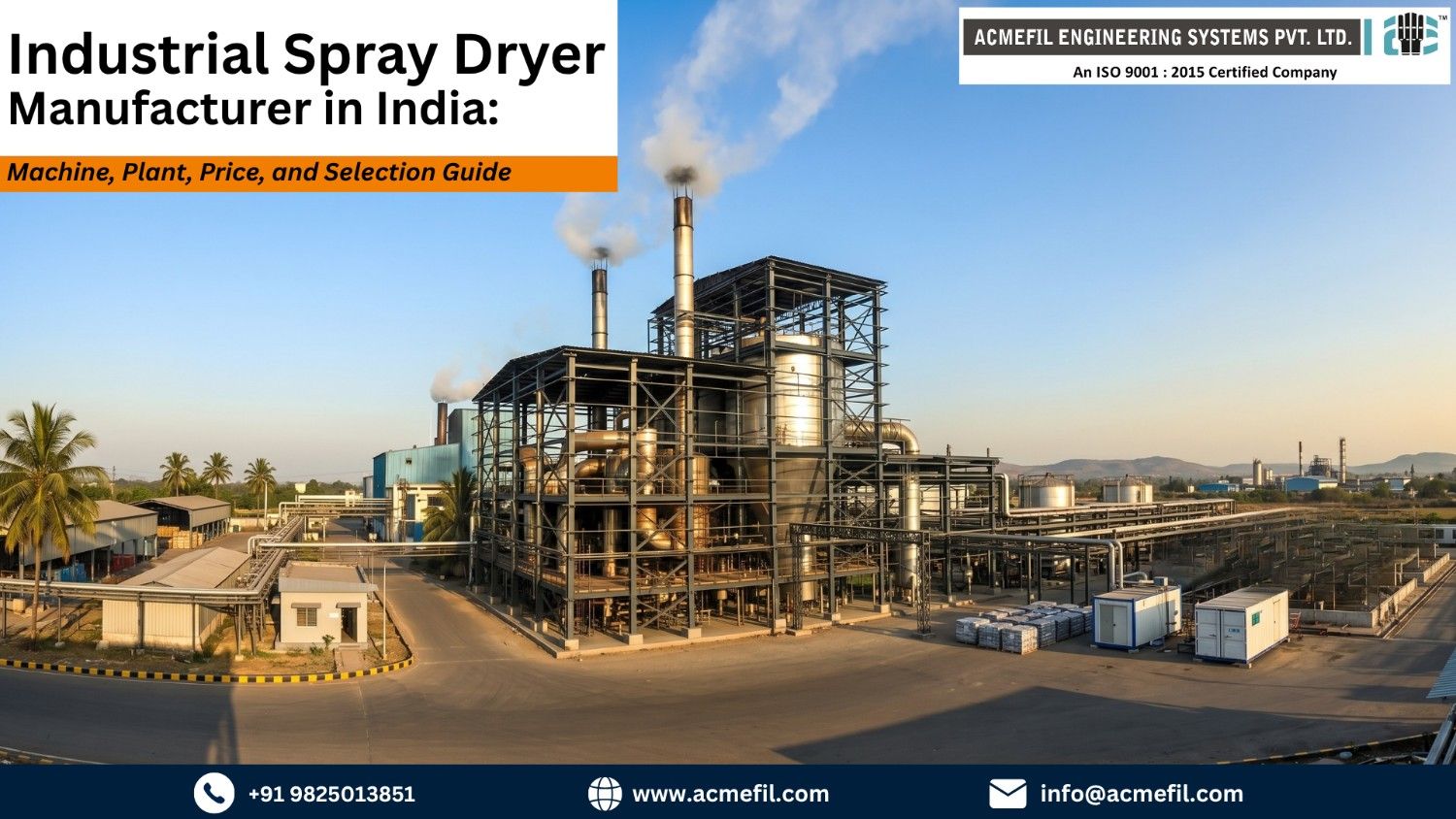
An industrial spray dryer is not a catalogue machine. It is a process system designed around your feed properties, evaporation load, atomizer selection, outlet moisture target, heat source, and powder recovery requirement. If you are searching for an industrial spray dryer manufacturer, spray dryer machine manufacturer, or spray dryer plant manufacturer in India, the first question should not be only “What is the price?” The better question is: “What process data does the manufacturer need before sizing the plant?”
I have seen spray dryer inquiries fail at the very first stage because the buyer asks for a quote before defining the feed.
A spray dryer may look simple from outside: feed goes in, powder comes out. In reality, the plant has to control atomization, air flow, drying temperature, residence time, chamber geometry, powder separation, fines recovery, and product moisture at the same time.
For a deeper foundation on the process, you can also read this guide on how a spray dryer works and the detailed overview of spray dryer design and components.
What does an industrial spray dryer manufacturer actually supply?
A serious industrial spray dryer manufacturer does more than fabricate a drying chamber. A complete spray dryer plant normally includes:
- Feed preparation and feed pumping system
- Atomizer system, such as rotary disc, pressure nozzle, or two-fluid nozzle
- Hot air generation system
- Air distributor
- Drying chamber
- Cyclone separator
- Bag filter or final powder recovery system
- Exhaust air handling
- Powder discharge system
- Rotary air lock valve
- Instrumentation and control panel
- Safety and utility integration based on the product
At ACMEFIL, spray drying is treated as a full process design problem, not only a fabrication job. The feed, powder target, industry, utilities, material of construction, and operating conditions all affect the final plant configuration.
If you are comparing suppliers, check whether they are only quoting a machine or whether they are evaluating the complete process. That difference matters when the plant starts running.
How does a spray dryer machine convert liquid feed into powder?
Spray drying transforms a liquid feed into a dried particulate product by spraying the feed into a hot drying medium. The process has four main steps:
| Stage | What happens | Why it matters |
|---|---|---|
| Atomization | Liquid feed is converted into fine droplets | Droplet size affects drying time, particle size, and powder quality |
| Spray-air contact | Hot air contacts the droplets inside the chamber | Air distribution affects uniform drying |
| Moisture evaporation | Water or solvent evaporates from the droplets | Temperature profile affects moisture and heat sensitivity |
| Powder separation | Dried powder is separated from air | Cyclone, bag filter, and fines handling affect yield |
The most common mistake is to treat atomization as a small component decision. It is not. Atomizer selection changes the drying chamber design, particle size profile, pump pressure, maintenance pattern, and sometimes the complete economics of the plant.
You can compare atomizer logic in more detail in this guide on spray dryer atomization techniques and this comparison of nozzle vs rotary atomizer spray dryers.
Which spray dryer machine type should you choose?
There is no single spray dryer machine that fits every application. The correct design depends on feed behavior and required powder properties.
| Spray dryer type | Best suited for | Practical selection note |
|---|---|---|
| Rotary disc type spray dryer | Slurries, dyes, ceramics, detergents, pigments, food powders, inorganic chemicals | Useful where centrifugal atomization and droplet size control through disc selection and speed are important |
| Pressure nozzle spray dryer | Feeds requiring controlled coarse or fine granular particles | Needs proper feed pressure, nozzle design, and filtration |
| Two-fluid nozzle spray dryer | Finer particles, lower feed rates, heat-sensitive materials, R&D and specialty applications | Uses compressed air for atomization, suitable when very fine droplet formation is required |
| Fluidized spray dryer | Agglomerated powders, detergents, food ingredients, larger particle size requirements | Integrated fluid bed helps build larger particle size and further drying |
| Closed loop spray dryer | Solvent-based and oxidation-sensitive products | Uses nitrogen atmosphere and solvent recovery system |
| Sterile spray dryer | Pharmaceutical and aseptic powder applications | Requires sterile filtration and controlled hygienic design |
| Lab scale pilot spray dryer | R&D, product development, feasibility testing | Useful before committing to a full-scale industrial plant |
For a buyer, the real question is not “Which spray dryer is best?” It is “Which spray dryer is correct for my feed and powder target?”
That answer usually depends on these inputs:
- Feed solid percentage
- Feed viscosity
- Feed temperature
- Particle size target
- Moisture target
- Bulk density requirement
- Heat sensitivity
- Solvent or water-based feed
- Stickiness or hygroscopic behavior
- Required capacity
- Available fuel or utility
- Product recovery and dust control requirement
A supplier who gives a confident answer without asking these details is not doing proper spray dryer selection.
Industrial spray dryer manufacturer in India for process industries
India has strong demand for spray drying plants because many industries need liquid-to-powder conversion at commercial scale. Spray dryers are widely used in:
- Dyestuff and pigments
- Food and dairy
- Pharmaceuticals and herbal extracts
- Detergents
- Ceramics
- Inorganic chemicals
- Polymers and resins
- Biochemicals
- Effluent and ZLD applications
ACMEFIL manufactures spray dryers and related drying and concentrating systems from Ahmedabad, Gujarat. The company’s equipment range covers rotary disc type spray dryers, nozzle type spray dryers, fluidized spray dryers, closed loop and sterile spray dryers, lab scale pilot spray dryers, spin flash dryers, flash dryers, fluid bed dryers, multi-effect evaporators, membrane systems, and ZLD systems.
For a broader technical view, see applications of spray dryers and the application-specific guide on spray dryers in pharmaceutical applications.
What affects spray dryer price in India?
Spray dryer price in India cannot be estimated responsibly from one keyword or one machine name. A pilot spray dryer, food-grade spray dryer, chemical spray dryer, closed loop spray dryer, and full industrial spray dryer plant can have very different scope and cost.
The main price drivers are:
| Price factor | Why it changes cost |
|---|---|
| Water evaporation capacity | Higher evaporation load requires larger chamber, higher air flow, larger heat duty, and bigger separation system |
| Feed type | Sticky, viscous, abrasive, or heat-sensitive feeds need different design precautions |
| Atomizer type | Rotary atomizer, pressure nozzle, and two-fluid nozzle have different design and maintenance implications |
| Material of construction | MS, SS 304, SS 316, and product-contact finishing change cost significantly |
| Heat source | Direct fired, indirect fired, steam, gas, electric, or thermic fluid systems affect both capex and operating cost |
| Powder recovery system | Cyclone-only, cyclone plus bag filter, or advanced recovery changes system cost |
| Closed loop or open cycle | Solvent recovery and nitrogen operation increase system complexity |
| Automation level | Manual, semi-automatic, PLC-based, and instrumented systems differ in cost |
| Utility and site scope | Ducting, insulation, erection, commissioning, and integration change final project value |
| Compliance and hygiene needs | Pharma, sterile, food-grade, or solvent systems need stronger design controls |
For this reason, a buyer asking only “spray dryer price in India” will usually get a misleading answer.
A better RFQ should say:
“We need a spray dryer plant for this feed, this solid percentage, this capacity, this moisture target, this particle size target, this heat source, and this material of construction.”
That type of inquiry allows the manufacturer to size the spray dryer machine technically.
If you are still at the planning stage, this article on cost-benefit analysis before investing in a spray dryer will help you think beyond purchase price.
Why pilot trials matter before buying a spray dryer plant
A spray dryer plant is often a capital decision. If your feed is new, difficult, sticky, heat-sensitive, or commercially untested, pilot trials can prevent expensive mistakes.
At ACMEFIL, the in-house R&D pilot facility includes a spray dryer pilot setup with 3 kg/hr water evaporation capacity. This is useful for product development, drying trials, and process validation before scaling to a full industrial spray dryer plant.
Pilot trials help answer practical questions such as:
- Will the feed atomize properly?
- Does the powder stick to the chamber wall?
- What inlet and outlet temperature range gives acceptable moisture?
- Does the powder flow freely after drying?
- Is rotary atomization or nozzle atomization more suitable?
- What separation system is required?
- Does the material degrade under the drying conditions?
- What changes are needed before scaling?
A trial does not remove every scale-up challenge, but it gives much better process confidence than designing from assumptions.
You can also review spray dryer operating principles and best practices before planning your trial.
How to compare spray dryer machine manufacturers
When buyers compare spray dryer machine manufacturers, they often compare only price, capacity, and delivery time. Those are important, but they are not enough.
Use this checklist before finalizing a supplier:
| Evaluation point | What to ask |
|---|---|
| Process understanding | Did the supplier ask for feed properties, solids, viscosity, moisture target, and particle size target? |
| Atomizer selection | Did they explain why rotary, pressure nozzle, or two-fluid nozzle is suitable? |
| Application experience | Have they handled similar products or industry conditions? |
| Pilot testing | Can they run a trial before full-scale design? |
| Complete plant scope | Are hot air generation, cyclone, bag filter, ducts, controls, and powder discharge included? |
| Material selection | Is MOC selected based on product, temperature, corrosion, hygiene, and cleaning needs? |
| Utility planning | Are fuel, power, compressed air, steam, and exhaust requirements clearly defined? |
| Maintenance access | Are atomizer, chamber, cyclone, bag filter, and rotary valve accessible for cleaning and maintenance? |
| Documentation | Will they provide layout, utility details, and operating guidance? |
| After-sales support | Is commissioning and troubleshooting support part of the scope? |
The lowest quotation may become expensive if the plant does not meet the moisture target, blocks frequently, consumes more utility than expected, or produces powder outside specification.
For troubleshooting context, read common spray dryer troubleshooting issues.
What data should you send for a spray dryer plant quotation?
A serious spray dryer plant manufacturer needs proper process data. Before asking for a quote, prepare the following:
| RFQ input | Example of what to provide |
|---|---|
| Feed name | Milk concentrate, dye slurry, herbal extract, ceramic slurry, pigment dispersion |
| Feed basis | Water-based or solvent-based |
| Feed solids | Percentage of solids in feed |
| Feed viscosity | At operating temperature, if available |
| Feed rate | kg/hr or L/hr |
| Required evaporation | kg/hr water or solvent evaporation |
| Final moisture | Target powder moisture percentage |
| Particle size target | Fine powder, granule, agglomerated powder, or specific range |
| Heat sensitivity | Maximum safe product temperature, if known |
| Bulk density target | Required if product handling or packing depends on it |
| Heat source | Gas, steam, electric, thermic fluid, direct fired, indirect fired |
| Material of construction | MS, SS 304, SS 316, or other requirement |
| Site condition | Indoor, outdoor, space limits, height limits, utility availability |
| Industry requirement | Food, pharma, chemical, ceramic, detergent, ZLD, or other |
| Trial requirement | Whether pilot testing is required before final design |
This data helps the manufacturer select the spray dryer machine correctly and avoid under-designed or over-designed systems.
When should you choose rotary atomizer, nozzle atomizer, or closed loop spray dryer?
Choose a rotary atomizer spray dryer when
Rotary atomization is often selected for slurries and applications where droplet size control through disc speed and disc selection is useful. It is common in dyes, ceramics, detergents, pigments, food powders, pharmaceuticals, and inorganic chemicals.
A rotary atomizer can be a strong choice when the feed has suspended solids or when the plant needs flexibility in operation.
Choose a pressure nozzle spray dryer when
Pressure nozzle systems are used when feed can be pumped under pressure through an orifice to produce the required droplet pattern. They can be suitable for certain food, chemical, and pharmaceutical products where the dryer geometry and particle morphology requirement fit nozzle atomization.
The key limitation is that nozzle design, feed filtration, pressure stability, and wear must be handled properly.
Choose a two-fluid nozzle spray dryer when
Two-fluid nozzles use compressed air for atomization and are suitable for finer particles, smaller capacity ranges, specialty products, and heat-sensitive applications. They are commonly useful in pilot scale, R&D, and certain pharma or food applications.
Compressed air consumption and scale-up logic must be considered.
Choose a closed loop spray dryer when
Closed loop spray drying is used for solvent-based or oxidation-sensitive products. The system operates in a nitrogen atmosphere and recovers solvent. This is a different level of plant design compared with an open-cycle air dryer.
Closed loop design should not be treated as a simple option. It affects safety systems, solvent recovery, instrumentation, and operating procedure.
You can review the product-side details on rotary atomizer type spray dryers, nozzle atomizer type spray dryers, fluidized spray dryers, and closed loop spray dryers.
Why ACMEFIL for industrial spray dryer machines and plants?
ACMEFIL Engineering Systems Pvt. Ltd. is an ISO 9001:2015 certified manufacturer, supplier, and exporter of drying and concentrating equipment based in Ahmedabad, Gujarat. The company was incorporated in 2000 and has 500+ installations across India and international markets.
For spray drying projects, the key advantage is not just equipment manufacturing. It is the ability to evaluate the complete drying problem.
ACMEFIL’s spray dryer capabilities include:
- Rotary disc type spray dryers
- Nozzle type spray dryers
- Fluidized spray dryers
- Closed loop spray dryers
- Sterile spray dryers
- Lab scale pilot spray dryers
- Hot air generation systems
- Cyclone and bag filter systems
- Pilot plant trials
- Installation, commissioning, and after-sales support
The company also manufactures related systems such as multi-effect evaporators, agitated thin film dryers, spin flash dryers, flash dryers, fluid bed dryers, membrane systems, and zero liquid discharge systems. This matters when the spray dryer is part of a bigger process line, such as concentration before drying, effluent treatment, or powder handling.
For a direct product inquiry, visit ACMEFIL’s spray dryer manufacturer page or the pilot spray dryer page.
Buyer mistake I see often: asking for capacity before defining evaporation load
Many buyers ask for a “500 kg/hr spray dryer” or “1000 kg/hr spray dryer” without clarifying whether that number means feed rate, water evaporation, or powder output.
These are not the same.
For example:
- Feed rate means how much liquid enters the dryer.
- Evaporation load means how much moisture must be removed.
- Powder output means dried product collected after evaporation.
If your feed has 40% solids, the sizing logic is different from a feed with 10% solids. If the final powder moisture target is tighter, the outlet temperature and residence time may change. If the product is sticky, the chamber diameter and wall deposition behavior become important.
So before comparing spray dryer price in India, define the basis of capacity. Otherwise, two suppliers may quote two different machines for two different assumptions.
Final recommendation before choosing a spray dryer plant manufacturer
Choose a spray dryer plant manufacturer who asks difficult questions before giving a price.
That may feel slower in the beginning, but it is safer for the project. The correct manufacturer should evaluate feed behavior, atomizer selection, thermal sensitivity, moisture target, material of construction, powder recovery, utility availability, and commissioning scope.
A spray dryer is not purchased only for drying. It is purchased for a powder outcome.
If the powder does not meet the required moisture, particle size, solubility, bulk density, color, flowability, or recovery level, the plant is not successful even if the machine runs.
FAQs
What is an industrial spray dryer?
An industrial spray dryer is a drying system that converts liquid feed, slurry, solution, emulsion, or suspension into dry powder by atomizing the feed into hot air. It is used in food, dairy, pharmaceutical, chemical, ceramic, detergent, pigment, dyestuff, and effluent treatment applications.
Who is the right spray dryer manufacturer in India for my project?
The right spray dryer manufacturer is the one that evaluates your feed properties, evaporation load, atomizer type, powder target, utility conditions, material of construction, and plant scope before quoting. Do not select only by price. Select by process fit, trial capability, design clarity, and commissioning support.
What is the difference between a spray dryer machine and a spray dryer plant?
A spray dryer machine usually refers to the main drying equipment. A spray dryer plant refers to the full system, including feed handling, hot air generation, atomizer, drying chamber, cyclone, bag filter, ducting, controls, powder discharge, utilities, and commissioning scope.
What is the spray dryer price in India?
Spray dryer price in India depends on capacity, atomizer type, material of construction, heat source, automation level, powder recovery system, closed loop requirement, hygiene requirement, and scope of supply. For industrial plants, a responsible price normally requires feed data and process sizing.
Which is better, rotary atomizer or nozzle type spray dryer?
Rotary atomizers are often preferred for slurries, suspended solids, and flexible droplet size control. Pressure nozzles or two-fluid nozzles can be better for specific particle morphology, fine particles, or smaller specialty applications. The correct choice depends on feed properties and powder target.
For a technically correct spray dryer quotation, share your feed details, solids percentage, required evaporation load, final moisture target, particle size requirement, heat source, and material of construction. The ACMEFIL team can evaluate whether your application needs a rotary atomizer, nozzle type, fluidized, closed loop, sterile, or pilot spray dryer system.
Request a technical discussion through the ACMEFIL contact page or explore the main spray dryer manufacturer page.

Siddharth Nair is Technical Director at Acmefil Engineering Systems Pvt. Ltd. he leads solution design and applications engineering across the company’s full product range — spray dryers, multi-effect evaporators, agitated thin film dryers, spin flash dryers, fluid bed dryers, and complete ZLD systems.
His work spans process evaluation, equipment sizing, customer application consulting, and technical proposal development for industries including food and dairy, pharmaceuticals, chemicals, dyestuffs, ceramics, and industrial effluent treatment. He has hands-on commissioning experience across Acmefil’s 500+ installations in India and 15+ countries.
He holds a BTech in Mechanical Engineering from CHARUSAT University and also partners at A.S Engineers, working with blowers, sludge dryers, and industrial conveying systems.


